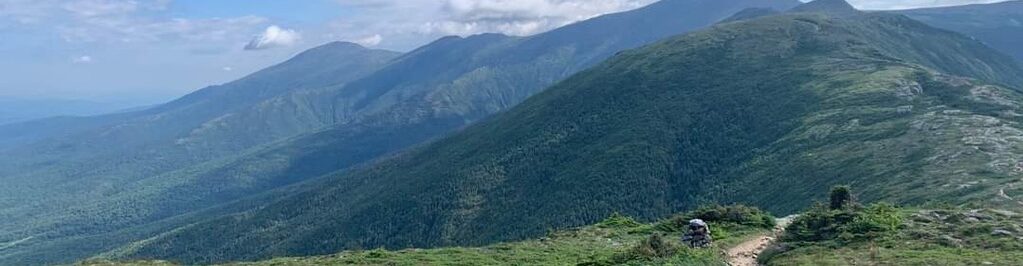
Week 10 Day 2
What materials have you gathered for your project? What resources have you discovered?
EXAMPLE
Poetry as a Way of Knowing Gratitude
As an overall human collective– we’re pretty entitled. At least, in the West we are. We’re overly concerned with appearances and material things, as well as fulfilling our own means. Because of this, it’s pretty easy to take the things we do have for granted. It’s a sin that I too am guilty of– and when I noticed this a few years back, it got me thinking about the concept of gratitude, and how scarcely many of us practice it in our day-to-day lives. I’d argue that a good portion of the population would find more satisfaction with themselves by simply acknowledging the things that are, instead of the things that could or should’ve been. It doesn’t have to be over-the-top, and you don’t have to scribe daily praise in a journal. However, expressing gratitude towards even the smallest things– like your morning coffee or hot water– can be just as rewarding as gratitude towards the important people and things in your life. Finding a daily routine with it can be one of the most fulfilling things you can do. And so, I’ve tried to compile ten poems below that express different forms and odes to thankfulness and gratitude. Some of it is surreal– some very physical. Some of it is towards small delights, some towards people and loved ones.
- > Gratitude > poem >
Gratitude List
Thank you for insulting me.
You helped me see how much I was worth.
Thank you for overlooking my humanity.
In that moment I gained power.
To be forgotten by the wider world
and the righteous religious
and the weaponized soldiers
is not the worst thing.
It gives you time to discover yourself.
*
Lemons.
Mint.
Almonds roasted and salted.
Almonds raw.
Pistachios roasted and salted.
Cheese.
––Naomi Shihab Nye, The Tiny Journalist (2019)
Thank You
If you find yourself half naked
and barefoot in the frosty grass, hearing,
again, the earth’s great, sonorous moan that says
you are the air of the now and gone, that says
all you love will turn to dust,
and will meet you there, do not
raise your fist. Do not raise
your small voice against it. And do not
take cover. Instead, curl your toes
into the grass, watch the cloud
ascending from your lips. Walk
through the garden’s dormant splendor.
Say only, thank you.
Thank you.
––Ross Gay, Against Which (2006)
- Poet: Ross Gay (poetry as a way of knowing gratitude) > Catalog of Unabashed Gratitude
Catalog of Unabashed Gratitude is a sustained meditation on that which goes away—loved ones, the seasons, the earth as we know it—that tries to find solace in the processes of the garden and the orchard. That is, this is a book that studies the wisdom of the garden and orchard, those places where all—death, sorrow, loss—is converted into what might, with patience, nourish us.
- > Articles > Wild Love, an Interview with Ross Gay
- On Being > Ross Gay > Joy is Such a Human Madness (originally appeared in The Book of Delights and read in the On Being episode “Tending Joy and Practicing Delight.”
Google Scholar > Poetry and Gratitude
Mason Library
> A-Z Databases
> Books > Gratitude (first page of results, Sam Hammil, Gratitude)
But wait, what is gratitude anyway?
NIH article, Gratitude and Well Being
Contents:
The psychology of gratitude / Robert A. Emmons — Part I: Philosophical and theological foundations — Gratitude in the history of ideas / Edward Harpham — Gratitude in Judaism / Solomon Schimmel — The blessings of gratitude : a conceptual analysis / Robert C. Roberts — Part II: Social, personality and developmental approaches to gratitude — Gratitude in modern life : its manifestations and development / Dan P. McAdams and Jack Bauer — The gratitude of exchange and the gratitude of caring : a developmental interactionist perspective of moral emotions / Ross Buck — Parent of the virtues? the prosocial contours of gratitude / Michael E. McCullough and Jo-Ann Tsang — Part III: Perspectives from emotion theory — Gratitude (like other positive emotions) broadens and builds / Barbara L. Fredrickson — Gratitude and subjective well-being / Philip Watkins — Part IV: Perspectives from anthropology and biology — Gratitude and gift exchange / Aafke Komter — Primate social reciprocity and the origin of gratitude / Kristin Bonnie and Frans de Waal — Gratitude and the heart : the psychophysiology of appreciation / Rollin McCraty and Doc Childre — Part V: Discussion and conclusions — Gratitude : considerations from a moral perspective / Charles Shelton — Gratitude as thankfulness and as gratefulness / Brother David Steindl-Rast.
PennSound web-based open-access digital archive and audio resource based at the University of Pennsylvania
Week 10 Day 2: Project Proposal Workshop
- Ideas and Proposals
There are many ways to begin:
- With language: with a poem. Then moving from the poem to other poem, a poet or poets, to prose (by the poet, by the poet’s readers);
- With poetic form: Poetry and Form: exploring the “evolving, ongoing conversation that provides context on forms and their impact on poetic history and poetry today.” Let’s say you read Dylan Thomas’ Do Not Go Gentle into that Good Night or Elizabeth Bishop’s One Art. You come across a poetic form called a Villanelle (see villanelle), and you then find The Waking by Theodore Roethke;
- With cultural Issues: history, politics, myth, place and space, religion and spirituality, feminist practice, environment and place (and so on and so forth);
- With a poem or poems and/or a poetics concerned with self and identity, social groups or identity politics, and communities of readers and writers. Breaking boundaries between high and popular culture, old and new;
- With poetry and poetics concerned with language and writing and reading—an exploration of fresh forms of language, consciousness, social and biological relations. One example would be Objectivist Poets (also see objectivist poets), and objectivism and the various projects concerned with not so much free verse from freeing words and language (search “concrete,” “projective,” “open,” “organic,” “variable” as key terms). Experiments with typography and visual, nonreferential (language not as mirror or window) and nonsyntactical (abstract) poetry.
- With a poet (a list here of “objectivists”): Charles Olson, Louis Zukofsky (primary documents), Robert Creely, George Oppen;
- With poetry and poetics concerned with performance, performativity sound and music and voice: a return to poetry as performance, oral and embodiment;
- With poetry and poetics concerned with Cultural Continuity and Transmission. (Continuities and Discontinuities). For example, modern poets on tradition and the past, Gary Snyder and “Axe Handles,” counterpoetics as generative continuation of the modern impulse to “make it new”;
- With the Poet and the Culture: William Carlos Williams “Against the Weather: a Study of the Artist,” Robert Pinsky, “the Responsibilities of the Poet,” Dana Gioia’s “Can Poetry Matter”; Adrienne Rich, “When We Dead Awaken; poetry as resistance and the poet as resisting—to dominant culture, to commonplaces and normative values.
2. What is a proposal, anyway?
Below are three terms you will likely encounter in your classes in college: Proposal, Précis, and Abstract. Let’s remember that these forms of writing (like these three) will mean different things in different academic contexts (for example, in history or education or biology).
The definitions and then examples to follow are from academic projects in the humanities:
Proposal The proposal explains a research area (or topic or problem) and describe in detail a line of inquiry or research to be conducted. Proposals vary in length. For example, an undergraduate student might write a 1–2 page proposal for an essay or a graduate student might seek funding with a proposal that is 4–12 pages; dissertation and book proposals might run between 12 to 100 pages, depending on institution and publisher. As the architect Louis Sullivan once said, “Form ever follows function.”
Proposals most often include a claim (or “thesis statement”). A proposal positions a research project in a context/scholarly field, describe the research methodology (for instance, a “feminist” reading of a text), and explain the expected outcome or results of the research. Longer proposals (say a doctoral dissertation or book proposal) may include chapter summaries.
Précis A brief research proposal of approximately two to three double-spaced pages. A précis is speculative––and concise. It works from a hypothesis (most often in the form of a claim or thesis statement) that concisely states a central concern of the proposed research paper, discusses relevant scholarship, and explains the research methodology. A précis is often followed by a working bibliography.
Abstract In humanities disciplines, an abstract describes a conference paper proposal of approximately 250–500 words. Unlike précis, abstracts are not speculative. In most cases, too, the final essay or book chapter or product is written before the abstract. An abstract is written after research and hence includes the research problem, its context in scholarship, and its solution.
3. Examples of Proposals
Proposal for a Conference Presentation
Speculative American Fiction and the Future of Ecological Citizenship
In my paper I will discuss how speculative American literature has used ecological risk scenarios as starting points for their imagining of new forms of citizenship. I will first consider two dystopian satires— Norman Spinrad’s Greenhouse Summer (1999) and T.C. Boyle’s A Friend of the Earth (2000)—which both critically examine the future of citizenship in the context of complex global systems. As I will show, both texts throw an interesting light on Patrick Hayden’s concept of world environmental citizenship and Ulrich Beck’s hopes for a cosmopolitan vision that emerges from the global environ- mental threats creating the world risk society. My paper will then turn to Kim Stanley Robinson’s Pacific Edge (1988), one of the few (critical) utopian novels that dare to imagine a near-future in which global ecological risk has indeed, as Beck suggests it might, led to cosmopolitan forms of governance. Drawing on Andrew Dobson’s concept of “post-cosmopolitan” ecological citizenship, I will examine how in Robinson’s novel the ever-faster degradation of ecosystems has been stopped and even reversed because “two working generations” of citizens have insisted on their environmental rights and taken on their ecological responsibilities. The narrative strategies of these three novels, I will argue, offer readers an imaginative and affective engagement with their own future and invite them to reflect on the potential consequences of their current actions as consumers and citizens.
Paper Proposal
For my essay, I am writing about the pros and cons of hunting. This is a perfect topic that relates to nature and relates to something that I am passionate about and take pride in doing. Hunting is looked at in many ways and I want to explore the positives and negatives that it brings. Hunting relates to this class, because it involves humans going into an animal’s habitat looking to take an animal’s life for the food it brings in return. However, not all hunters look at hunting as a chance for food, as in trophy hunting. I am currently all done with my “pros” side of my essay, might look to add a book source as well but now switching over to the “cons” of hunting and am excited to write and learn about what other viewpoints might be about the same topic. I am looking to also add a book source, and retouch up my introduction as I did not know how to really start so made it very brief and started with writing about the cons.
Project Proposal
For my research project I want to focus on something I enjoy so that it’s easy to find motivation to write about. In class I came up with the idea of, “Why do humans love telling stories?” That idea wasn’t airtight however, and didn’t roll with the themes of the class as well as I’d hoped. So, I kept thinking and worked to figure out if I could put that idea through the lens of our class. When thinking about nature involving with stories, I came up with a restructured idea that focused less on why we love telling stories, but on how stories capture wildness. This topic seemed extremely broad, so I looked at it through a lens of my personal interests. This centered me in on movies and film. My idea I want to investigate is: How does film capture the essence ofnature and wildness?
I had to come up with the main topics I would discuss in the essay. I found five main discussion points that I can focus on in five body paragraphs, all of which are represented in film. The power of nature, survival in wilderness, primal instincts, growth in nature, and civilization versus nature. I have then found movies to use as prime examples to drive the discussion. The final body paragraph will be focusing on the movies Dune and Dune 2, as they display all five main topics so perfectly, I want to build throughout the essay to then be able to use it as a perfect example of nature and wildness being shown in film. Here is a list of the films I will be using for each of the topics, for reference:
- – Power of Nature: Interstellar (2014), The Wave (2015)
- – Survival in Wilderness: Interstellar (2014), The Martian (2015), The Edge (1997)
- – Primal Instincts: No Country for Old Men (2007), Revenge (2017), Logan (2017)
- – Growth in Nature: The Way (2010), The Last Samurai (2003)
- – Civilization vs. Nature: Avatar (2009), Jurassic Park (1993), Jurassic World (2015),
- Kingdom of the Planet of the Apes (2024)
- – Dune (2021), Dune 2 (2024)
Some questions I am looking to answer in this essay include, “Do these films give a different perspective on nature?”, “Is there a specific way nature should be portrayed?”, “How is human nature impacted by wildness?”, “Is human nature portrayed accurately?”, “How do these films make people think about nature?”. While these questions are not specifically going to be focused on, I will be building each paragraph with them in mind, and I hope to answer as many of them as I can through each topic.
My motivations for this inquiry are based on my love for movies. I love seeing the inner workings of how they are made, but also, I appreciate the cinematography, attention to detail, actors’ performances, and deeper meanings behind movies. I can use this love for all these aspects of film to my advantage because I can build a stronger essay. I also enjoy a lot of these movies, and any that I haven’t seen look very interesting, so I get to watch a lot of movies for research. This also allows me to look at movies I have previously seen with a new perspective, something I’ve learned a lot about already this semester. Finally, human nature is very interesting to me, so I’m excited to have primal instincts as a main topic so I can do more research into how humans act in the most primal situations.
Now how does this work with the class and what we’ve been learning? Film is such an interesting dimension because it is all based on how humans perceive the world. The way nature is displayed in film is how the people making the movie perceive it, which can mean it can differ greatly between movies. Is nature more respected or more feared, or is it both? The human nature topic is also interesting, because when it is shown in movies, that means humans recognize how terrifying those primal instincts can be, but also how powerful. Being able to look at how film captures the essence of nature and wildness will show how humans perceive nature, and if it is accurate or not. This is what I look forward to finding out.
Panel Abstract (for Keene State College Academic Excellence Conference)
Reading Gary Snyder: Poetry, Practice, and Bioregionalism
Presentation Type: Panel discussion
Sponsor: Mark Long, English and American Studies
Student Presenters
Dominic Berrini, Brooke Jacobs, Melissa Pomponio
Abstract
This panel will be devoted to Gary Snyder’s generous contributions to American culture as a prize-winning author, his role as an environmental philosopher and activist, and his distinctive place in the development of American poetry during the second half of the twentieth century. The three student presentations represent the work of an intensive six-week summer seminar on Snyder taught by professor Mark Long during the 2002 summer session at Keene State College. The first presentation, Dominic Berrini’s “Gary Snyder’s Bioregional Thinking: Re-organizing the Watershed Community,” focuses on Snyder’s return from his studies in Japan to California in 1968 and his attention—in his Pulitzer-prize winning collection Turtle Island and other prose—to a model for living in and around the larger and smaller watersheds and bioregions that make up America. The second presentation, Melissa Pomponio’s “Myth As A Territory For Practice In Snyder’s Myths & Texts” focuses on the way Snyder establishes “a new social mythology” through the many functions of myth in his poems “Logging,” “Hunting,” and “Burning” and the way his territory for practice places special demands on the reader. The third presentation, Brooke Jacobs’ hypertext of Gary Snyder poem, “Piute Creek,” provides a model for interactive textual criticism using a hypertext environment to incorporate background information, critical theory, illustrations, and explication, allowing the reader to choose his or her own adventure, enhancing the reading experience and exploring new mediums for textual criticism.
Essay Proposal and Abstract (for a book of essays)
Searching for Wildness: Reconstituting the Nature Essay in the Twenty-First Century
My dream is that people will find a way back home, into their bodies, to connect with the earth, to connect with each other, to connect with the poor, to connect with the broken, to connect with the needy, to connect with people calling out all around us, to connect with the beauty, poetry, the wildness.
––Eve Ensler
This article describes a special-topics seminar that traces the genre of the nature essay as it is reconstituted in a broader inquiry into the cultural significance and meaning of wildness. The genre of the nature essay, as Berry Lopez explains—“or environmental literature or the literature of place or landscape writing––is a categorical term. Its utility and its distinct boundaries are both evolving, and so subject to the passage of time.” The evolving category of writing about the more-than-human world is the subject of my course that begins with considering the twentieth-century nature essay in relationship to the rise of the social movement of environmentalism through nonfiction essays by, among other writers, Rachel Carson, Wendell Berry, and Scott Russel Sanders. I then describe examples of essays that establish a continuity between nature writing and what I have come to call the literature of wildness. I elaborate the idea of wildness—or the process of the natural world that encompasses most everything in the physical universe, including what we call “nature,” from the teeming microorganisms in our bodies to the unfolding realm of the cosmos. I then ask students to consider the concept of the wild, the relationship of wildness to the nature/culture concept, as well as the impulse to engage in more than what the poet Gary Snyder calls “environmentalist virtue, political keenness, or useful and necessary activism” (Practice ix). This search takes many forms, in essays written by different kinds of people—thoughtful amateurs, professional educators and academics, students, artists, farmers, and professional scientists from around the world. I then ask students to read selected essayists (and essays) who do not assume that nature is separate from the human under what I call the “search for wildness”—that is, the act of seeking an understanding of the expression of the wild both in nature and in culture. In brief, these essays incorporate the nature essay into a broader field of inquiry that includes natural history (of trees, moss, weeds, corn), human history (how and what we eat, population growth, agriculture, urban planning), cultural issues, including relationships linking culture, place, “race,” and identity, and issue from the sciences, (ecology, genetics and systematics, physics, evolutionary biology)—to list just a few examples. Some of the essays advocate for social or political change. Others invite us to change how we see the world by bringing to our attention the complexities of physical processes—from the biology of digestion to the evolutionary process of life. The essays are engaging, interesting, provocative, challenging—and include description, philosophical reflection, critical analysis, or humor. The article concludes with a brief case for a literature of wildness, using examples of the genre by writers to include Janisse Ray, Sandra Steingraber, Linda Hogan, Jamaica Kincaid, Robin Wall Kimmerer, Drew Lanham, and Camille T. Dungy, to unsettle the idea of nature that underwrites the North American nature essay.
Chapter Abstract
This chapter accounts for the origins and the development of the American nature essay through the twentieth century. My approach begins with an overview of the historical tributaries of the genre––including the scientific observation and philosophical ruminations of European naturalists, the travel journal, place-based diaries, and the regional essays of nineteenth-century nature writers. I then introduce essay writers who use the form to enact ways of thinking about nature––in historical, political, historical, sociological, economic, technological, and moral terms. The chapter seeks to enlarge the American nature essay tradition by inviting teachers and students to experience the genre as a search for wildness: a search to understand the material world, and our place in that world, from the teeming microorganisms in our bodies to the natural and cultural systems of which we are a part.
Project Proposals for Poetry as a Way of Knowing
An effective project proposal will likely include the following elements:
- A summary statement: (“executive summary”). Most often the first sentence, but you can use other strategies (see below).
- A definition of key terms, phrases, idea(s), concept(s)
- A description of the complexity of the definition or category of the thing (What is “nature,” what is “anxiety,” what is “poetry”?)
- Your motivation and purpose: for this project, explaining what motivates you to propose this anthology, and the purpose of the gathering of poems
- An awareness of purpose and audience: who are you writing to, and why?
- A list of poems that exemplify the scope of the project (poems from different time periods, authors, literary and cultural traditions)
Poetry as a Way of Knowing Gratitude
As an overall human collective– we’re pretty entitled. At least, in the West we are. We’re overly concerned with appearances and material things, as well as fulfilling our own means. Because of this, it’s pretty easy to take the things we do have for granted. It’s a sin that I too am guilty of– and when I noticed this a few years back, it got me thinking about the concept of gratitude, and how scarcely many of us practice it in our day-to-day lives. I’d argue that a good portion of the population would find more satisfaction with themselves by simply acknowledging the things that are, instead of the things that could or should’ve been. It doesn’t have to be over-the-top, and you don’t have to scribe daily praise in a journal. However, expressing gratitude towards even the smallest things– like your morning coffee or hot water– can be just as rewarding as gratitude towards the important people and things in your life. Finding a daily routine with it can be one of the most fulfilling things you can do. And so, I’ve tried to compile ten poems below that express different forms and odes to thankfulness and gratitude. Some of it is surreal– some very physical. Some of it is towards small delights, some towards people and loved ones.
- You Were You Are Elegy – Mary Jo Bang
- Sacramento O No – Liz Waldner
- Thank You – Ross Gay
- To Daffodils – Robert Herrick
- Brian Age Seven – Mark Doty
- We Eat Out Together – Bernadette Mayer
- Smile – Nome Emeka Patrick
- Ashberries: Letters – Philip Metres
- I Can’t Swim – Heather Christle
- Catalog of Unabashed Gratitude – Ross Gay
Poetry as a Way of Knowing What Awaits
Like tremulous Spirits the snow flutters down through the
hemlocks,
More gently than sound.
There she is sleeping alone in the grave as we left her,
Calm in the ground.
Out of lost silent aeons she rose to a moment of being,
Coming to birth.
Now she lies as we left her there, waiting the long journey
Homeward,
Back through the earth
When the spring comes to weather the blanket of funeral
snow-pedals,
She will wake from her dreams,
And move into silence, a little more slowly than snow-
flakes
Melt into the stream.
––Chard Powers Smith, A Grave in Winter
The life experiences I have never wondered about were the future and the past. I did not understand what such things were, believing that the present was what I should focus on. To this day, this is still true. The present is what gets things done and where you find memories of the day. When speaking of “what awaits,” the mind does not know, nor see what will come to be. What comes hereafter can only be predicted to a certain extent, for example the weather, or how someone feels in the moment and what will come of that feeling. The loss and gain of what will be after the present, does not have a name other than what awaits. The feeling one can get from the past or from the lack of experience, can be tainting to the mind and cause a buildup of emotions. This stress can indicate a difference in future for someone due to fear. Though the thought of awaiting is not like other feelings. Awaiting is an emotional presence of time during which, something of conscience yearns for. It is a positive feeling which consults the similar noun of “wait,” and adds the effect of emotional essence. Awaiting creates a period of haze. The time which someone is awaiting presents itself as many things, perhaps, longing, a yearning, or a less wanted feeling of doubt.
- On Stone Mountain By Malcolm Tariq
- From The Return by Charles Tomlinson
- Icos by Charles Tomlisnson
- Sailing to Byzantium by William Butler Yeats
- Almost awake: Early Morning Gratitude by Li-Young Lee
- In Little Rock by Jake Adam York
- Mourning by Caroline Forche
- A Grave in Winter by Chard Powers Smith
- A Bell is a Bearer of Time by Alison C. Rollins
- Welcome to Indian Country by Rena Priest
Poetry As A Way Of Knowing Anxiety
My project consists of anxiety. How anxiety can feel for a person or look to others can vary due to how someone is feeling in that moment. Anxiety is classified as a mental illness and is very common affecting people of all ages. I chose this topic because many people in my life have been diagnosed with anxiety. I have seen all of them cope in different ways or even shut down in stressful situations. I feel that anxiety is not represented enough and people don’t truly know what it means to be diagnosed with anxiety. Along with that, there can be situations where you are feeling anxious in the moment and that is oftentimes called social anxiety. The anxiousness of a test coming up, starting a new class, or even a job interview are all normal when feeling stress. Being diagnosed with anxiety will make you feel these stressful situations more intensely and excessively than the average person that can affect everyday life.
In the poems I have selected they’ll not only be about anxiety but feeling it, experiencing what people diagnosed with the mental illness have to go through on a daily basis. This will create background experience on what can happen in the mind when in stress. Some poems won’t directly showcase the feelings of anxiety, but will indirectly.
The poems I will be using for my anthology are:
- Anxiety about Dying BY ALICIA OSTRIKER
- Boil BY ALICIA OSTRIKER
- I Can’t Speak BY ALICIA OSTRIKER
- In this short Life that only lasts an hour (1292) BY EMILY DICKINSON
- Anxiety of Ten O’Clock BY MIRIAM GOODMAN
- Smile BY NOME EMEKA PATRICK
- Peniaphobia BY KELLE GROOM
- Thoughts on One’s Head BY WILLIAM MEREDITH
- Comfort Animal BY JOY LADIN
The poems I might use for my anthology
- Telephone BY MARCIA LEE MASTERS
- Inevitability BY VIEVEE FRANCIS
Week 10 Day 1
What is it I need to know?
. . .
What is it I don’t know that I need to know?
––Mary Oliver, from The Leaf and the Cloud
Before our break I asked you to think about poetry and ways of knowing as you consider a final project for the course. I recommended that you become familiar with the assignment. The work: Reading poems, becoming familiar with poets and groups of poets and movements” in poetry (objectivism, Modernism, landscape and pastoral or place-based); Brainstorming at the Poetry Foundation
Poetry Foundation > Poems & Poets
Poetry Foundation > Topics & Themes
A.R. Ammons > poems (and bio) of A.R.Ammons
(poetry and the environment)
Elizabeth Bishop (Geography)
One Week to November 10th: Project Proposal
Knowing
Adrienne Rich Diving into the Wreck (1973)
Certainty and uncertainty (belief and uncertainty)
Emily Dickinson, The World is Not Conclusion
Poetry Foundation > Topics and Themes > Poetry & Nature: Poetry about the environment and natural world, including poems about seasons, animals, and climate change, as well as traditions like pastoral poetry and ecopoetry.
Poetry and Place
Poetry Foundation > Nature
The Academy of American Poets [poets.org] > Poetry and Nature > Nature Poetry [From A Poet’s Glossary]
Denise Levertov, Sojourns in a Parallel World
Whenever we lose track of our own obsessions,
our self-concerns, because we drift for a minute,
an hour even, of pure (almost pure)
response to that insouciant life:
cloud, bird, fox, the flow of light, the dancing
pilgrimage of water, vast stillness
of spellbound ephemerae on a lit windowpane,
animal voices, mineral hum, wind
conversing with rain, ocean with rock, stuttering
of fire to coal—then something tethered
in us, hobbled like a donkey on its patch
of gnawed grass and thistles, breaks free.
How is it that we can become more present to ourselves, to others, to the world?
Poetry and Presence?
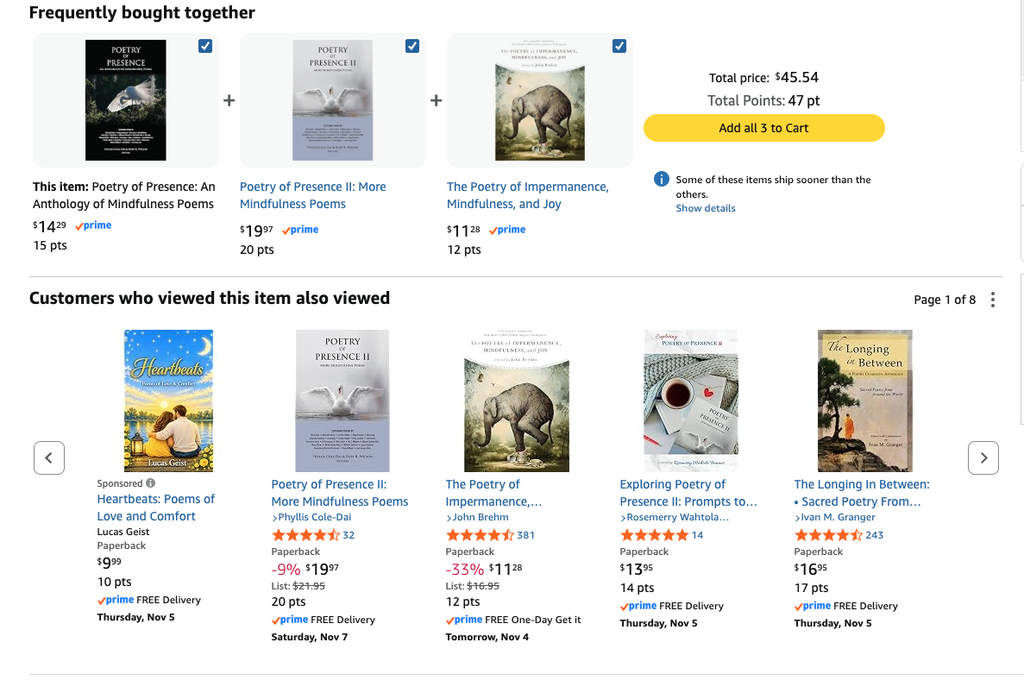
Google Search > Poetry and Presence > Poetry of Presence: An Anthology of Mindfulness Poems and Poetry of Presence II: More Mindfulness Poems (2023)
Mason Library > note well link to request through Interlibrary Loan

Metadata includes contents
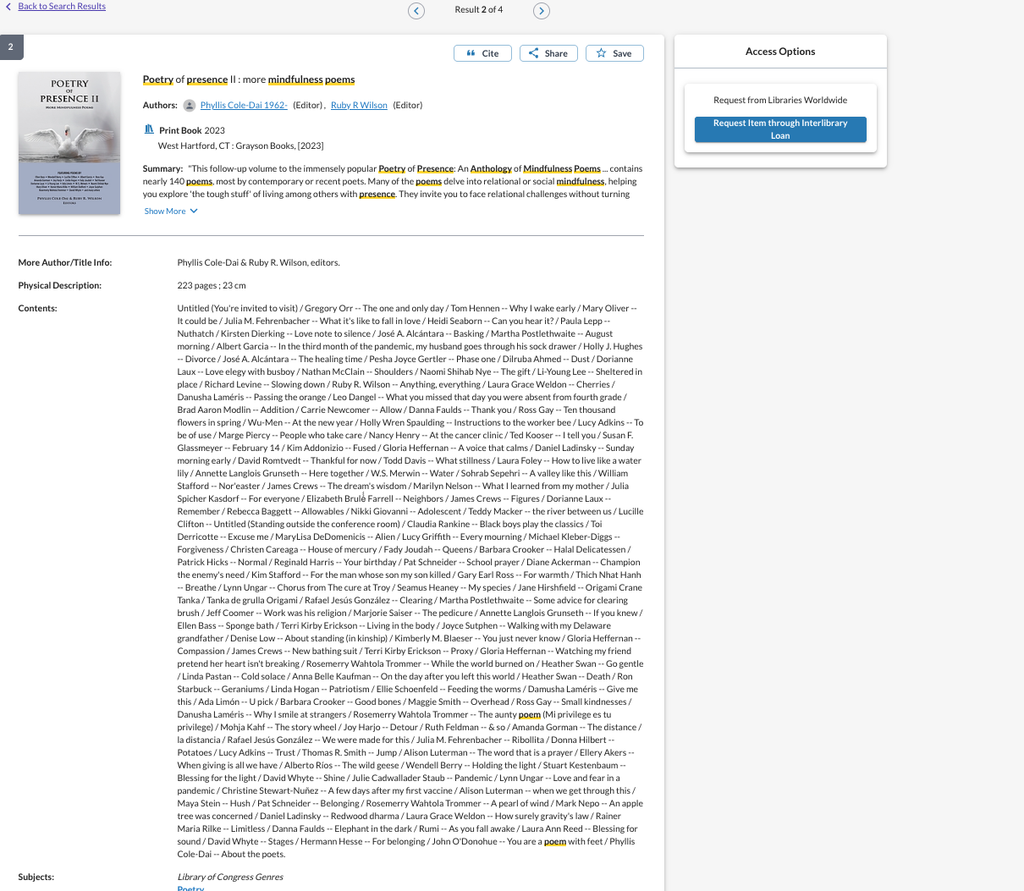
Search > Amazon:
Philip Booth, Presence, Poetry (October/November 1987): 18–19. Poetry Foundation
Chances of Survival: Philip Booth in Conversation, The American Poetry Review, Volume 18, no. 3 (May/June 1989)
Berghash: In a good number of your later poems you talk about the meaning of nothing. You say that it is “an acute presence of absence,” as against the “raw beauty of being.” When I read this I understood it as a way of being which is egoless, and therefore more integrated with oneself and the world.
Booth: It does seem to me that ego can become part of a kind of universal ego. Not that the self is submerging its ego to become part of that whole, but that the presence of the ego in the self can become part of a larger “raw beauty of being,” to pick up the line you just quoted. I am tempted to extend this and say that such integration strengthens the so-to-speak ego of the whole. That is a fair enough extension of let’s say psychoanalytic theory, although I don’t often think in terms of the theory. It is much more an intuitive sense that I have. I think it’s Masefield who says in a poem, maybe it’s in “Dauber,” “The days that make us happy make us wise.” That comes back to your sense of there being something beyond survival, something in the fruition of one’s feeling, the flowering that is itself a wisdom which is sustaining. And its name is joy.
Berghash: Is joy something you attain easily or with difficulty?
Booth: I don’t think that one can search for joy, or buy joy, or take out a map and draw a straight line toward joy. I think that there is a great deal of serendipity involved. It often happens when one least expects it. Not necessarily when one least expects it, but not necessarily when one is looking for it. A poem of mine called “How to See Deer” says that if you go out looking for deer you do not see deer. In his story “The Bear” Faulkner uses that point when he writes about the young boy going out into deep woods in the deep South trying to search for an almost mythical bear. But he doesn’t see the bear until he casts away his gun and puts away his compass. I saw a deer last night not half a mile from where we are sitting now in your house. It might have come down from the reservoir at the top of the peninsula and run over your lawn for all I know; but for me the deer was a joy to which one could make oneself available as one makes oneself available to the possibility of a poem. If you think about nothing but boats, or if you think about nothing but houses, or if you think about nothing but (in a man’s case) women, or (in a woman’s case) perhaps men, it’s pretty hard to arrive at the kind of joy that you imagine you are searching for.
Dana Cunningham, Poetry and the Art of Presence
Dana Cunningham is an instrumental pianist whose primary passion is performing her original compositions and reciting poetry in concert and retreat settings. She has a degree in communication from Vanderbilt University, where she also studied piano at Blair School of Music. Dana currently lives and composes in the mountains of New Hampshire. For more information, visit www.danacunningham.com.
The Martin Institute for Christianity and Culture was established in 2011 to assist Christian individuals and organizations to deeply understand, intelligently communicate, and effectively implement reliable and psychologically realistic pathways of becoming more like Jesus for the sake of the world. As part of that quest, we hope to honor the legacy of Dallas Willard while placing his work in the context of other thought and praxis leaders who have developed methods for authentic Christian formation that have stood the test of time.
Denise Levertov, “Presence,” an audio reading, The University of Arizona Poetry Center. From Evening Train. New York: New Direction, 1993.
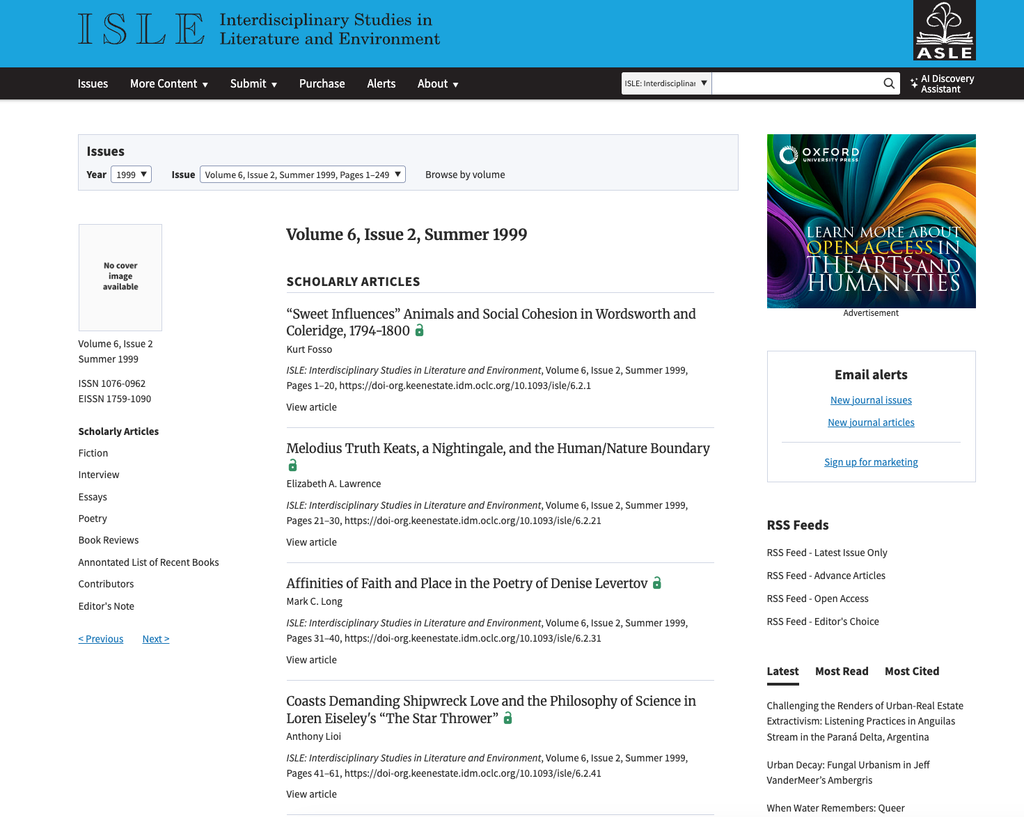
Affinities of Faith and Place in the Poetry of Denise Levertov
LONG, MARK C. “Affinities of Faith and Place in the Poetry of Denise Levertov.” Interdisciplinary Studies in Literature and Environment, vol. 6, no. 2, 1999, pp. 31–40. JSTOR, http://www.jstor.org/stable/44085650. Accessed 3 Nov. 2026.

George Steiner. . . .
Google Scholar > Poetry and Presence [3,060,000 results in 0.17 seconds] > George Stiener > Real Presences
Browse: the idea of presence, poetry and absence, the art of presence, presence and experience,
Resistance to poetry, authorial presence, poetry and performance, divine presence
The Poetry as a Way of Knowing Project
Learning to Use Blogger
Poetry as a Way of Knowing the Present
Theme > Choose > Customize
Layout > Customize > Add a “Gadget” for page
Add Pages
Add Posts
About: Description of Project
Add a License for your content
This work is licensed under a Creative Commons Attribution 4.0 International License

Week 8
Julianna Glass, quoting Whitman, 1855 Preface to Leaves of Grass:
“re-examine all you have been told at school, or church, or in any book, dismiss whatever insults your own soul.”
This is What Happens When Women Read foundation
Preparing for Poetry as a Way of Knowing Project during weeks 8 and 9
Keep thinking about poetry and ways of knowing as you consider a final project for the course. I recommend that you become familiar with the assignment. This will allow us to hit the ground running when we return to class during week ten
Reading poems, becoming familiar with poets and groups of poets and
movements” in poetry (objectivism, Modernism, landscape and pastoral or place-based)
Brainstorming at the Poetry Foundation
Poetry Foundation > Poems & Poets
Poetry Foundation > Topics & Themes
A.R. Ammons > poems (and bio) of A.R.Ammons
November 10th: Project Proposal
Week Seven Day 2
“Write something. Make it good. Make it better.”
Purpose: A succinct overview of the poem (or section or segment of a long poem) and a focused commentary of no more than 500 words.
1st paragraph textual information
history (manuscripts, versions, editions). This is factual “common knowledge” and needs no citation. (There are exceptions, with manuscript details that might be useful to link to.)
The first versions of Unnamed Lands can be found in some of Walt Whitman’s early manuscripts from 1855 to 1860. These manuscripts contain phrases and ideas that would become the poem “#82,” renamed to “Unnamed Lands” around 1857 to 1859, and officially published in Leaves of Grass in 1860. By 1871, it had been placed into a cluster titled “Leaves of Grass,” and then in 1881 it was moved into the cluster “Autumn Rivulets” where it remained through the final publication of Leaves of Grass in 1892. (Charlotte F.)
In the poem For You O Democracy, transcendentalist Walt Whitman addresses a personified vision of democracy in the United States. It opens with our speaker, Walt Whitman, revealing his audacious plans toward a personification of democracy. He speaks of making the land indestructible, populating it with a race of people united by a “life-long love of comrades.” He compares his supplementation of companionship as one would plant a tree, fostering its growth throughout America. He says the bond will extend to cities, which remain closely connected like a line of people standing side by side, joining their arms in unison. The first version of For You O Democracy had been written sometime between 1859 and 1860. It was originally printed in the 1860 edition of Whitman’s Leaves of Grass. This poem was one of 39 poems within the Calamus cluster. For You O Democracy wouldn’t take its final form until 1867 under the name “A Song,” but would take again its current title in 1881. For You O Democracy is representative of Whitman’s program of “adhesiveness.” Zapata-Whelan describes this as a “phrenological term denoting for Whitman a physical-spiritual union…” For You O Democracy echoes the eugenics – the selection of desired heritable characteristics – of this era. In the poem, Whitman claims to “make the most splendid race the sun ever shone upon.” This poem “incites an exuberant uprising of solidarity and love,” says Zapata-Whelan. (Haley, “For You O Democracy”)
2nd paragraph Descriptive account of form and content
Details of poem structure (free verse, octave/sestet, narrative book-length poem, etc.), relation of poem to other poems or texts or contexts; descriptive summary of theme of the poem and poetic features (language, imagery)
Henceforth, the poem is written in free-verse style with no fixed rhyme scheme or traditional stanza pattern, instead unfolding in long blocks of lines organized around shifting themes. Though rooted in real events of the Johnstown Flood, it blends narrative detail with lyric qualities, dwelling on emotional intensity and human fragility. Whitman’s decision to let Death speak directly connects the poem to earlier works like “Whispers of Heavenly Death,” where death also becomes the narrator and “This Compost,” which explores destruction, decay, and regeneration. The language is solemn and literary, marked by repetition and the personification of Death as an immense force. Whitman’s imagery moves between devastation – “towns drown’d,” and “thousands never found or gather’d.” and renewal, capturing a hopeful vision of “blossoms rapidly blooming.” Together, these elements transform a natural disaster into a vision of rebirth. (Abby, “A Voice From Death”)
3rd paragraph: Tradition of commentary and conversation about the poem. How was the poem received by contemporaries? How has the poem been read by readers since its publication? Are there critical debates or different ways of reading the poem?
As historian Routledge writes in his 2009 commentary of After the Sea-Ship that “Whitman explores the nature of people’s individuality when united within a new and ideal democracy, towards which it seemed America was progressing.” Routledge recognizes that though a simple, seemingly uplifting piece, as readers we must look at this poems placement alongside the others in its collection to truly grasp its contents. (Madeline)
Routledge, Craig. “Featured Poem: After the Sea-Ship.” Reader, 2009, www.thereader.org.uk/featured-poem-after-the-sea-ship-by-walt-whitman/. Accessed 10 Oct. 2026.
Title Search > “After the Sea-Ship”
In “We Two, How Long We Were Fool’d” Whitman changes his attitude towards sexual acceptance, instead looking inward and stressing the need for his unwilling female readers to accept his male body and his poem as given. Despite it being different from his readers’ desires. Some think it to be a modern Adam and Eve in search of a new spirit and to actually celebrate male-male attraction. With emphasis in which the pair in the poem was gulled by abstinence. He stresses elemental imagery with earth and water over air and fire, mixing images of nature. (Bethany, “We Two, How Long We Were Fool’d”)
Many readers compare this poem to the poems of the Calamus cluster due to the interpretations of the “two” that Whitman speaks about being two men. He includes ideas about escaping, suggesting that, “Now transmutted, we swiftly escape as Nature escapes,” showing the theme of freedom. “We Two, How Long We Were Fool’d” focuses on a pairing while using detailed imagery of nature and elements, repeating the term “We are two” when describing nature they are transforming into. The expansive and freeing tone allows this pairing to explore themselves and the world around them, which ultimately “voided all but freedom, and all but [their] own joy”.
Children of Adam was critiqued heavily by literary mentor Ralph’s Waldo Emerson, and he suggested that it be removed from Whitman’s Boston Edition because of the explicit sexual content. Whitman decided to keep it, and the cluster was received well by women of the time who often felt liberated and equal when reading his poems. Other women, like Elizabeth Cady Stanton, were “troubled by the skewed understanding of women’s sexuality” when it came to Whitman’s writing. When first writing “We Two, How Long We Were Fool’d”, Whitman wanted men and women to have acceptance of their own bodies but also for women to accept Whitman’s male body even if they might’ve rejected that idea. E.H. Miller’s interpretation of the poem was a male pairing searching for a new spirit. Gay Wilson Allen sees the duo being deceived into denying one another, and M. Jimmie Killingsworth “sees in this poem a significant shift in Whitman’s attitude on sexual acceptance”. The main debate between all of these interpretations is whether Whitman is talking about a man and woman, or two men. Some readers interpret the pairing to resemble Adam and Eve due to the nature of the poem and the title of the cluster. Others view the poem as revolving around two men because of Whitman’s known romantic relations with men and his other poems in the Calamus cluster. (Lily, “We Two, How Long We Were Fool’d”)
Despite its motivating literary movements, the interpreted reception of this poem is not always received positively. One contemporary, Steven P. Schneider, finds issues with the lack of representation in regards to the extolment of Native Americans from their land. He describes Whitman’s 1860 version of The Prairie-Grass Dividing as a “…romanticized description of those who lived in the prairies,” failing to notice that the praise of the settlers overshadows the hand which they might have played in the removement of Native Americans or the slaughter of the Buffalo, as they had a steady pathway to extinction. Schneider continues to describe this poem as a “key poem in Whitman’s canon”. To Schneider, the focus of the poem is the sentiment that the westward plains states correspond directly to the idea of a healthy manhood. That the interconnected description linking together the prairie and the people highlights the need for a close companionship between men as well as a strong will, “Those of earth-born passion, simple, never constrain’d, never obedient”. (Nancy, “The Prairie-Grass Dividing”)
4th paragraph: final comment about the significance and/or interest of the poem
A succinct overview of the poem and its interest and/or relevance
Whitman presents his unique perspective of what a miracle is via his poem “Miracles.” Whitman calls the reader to observe the simple joys of life found all around, primarily through nature. (Clover, “Miracles”)
“Pensive on Her Dead Gazing” is a poem about the mass loss of life after a war and mother nature mourning each and every person as she reclaims their body into the earth. Whitman once said that “nothing can happen more beautiful than death” in his poem “Starting from Paumanok”, a belief that can be seen echoed in “Pensive on Her Dead Gazing”. (Charlotte Cole, “Pensive on Her Dead Gazing”)
Bibliography and Further Reading
The exact format for this material is imperative. Form ever follows function. Purpose: direct readers to the work cited in entry or any additional extant commentary on the poem.
(For example, if writing about a poem that takes up nature, probably include
Killingsworth, M. Jimmie. Walt Whitman and the Earth: A Study in Ecopoetics (Iowa City: University of Iowa Press, 2004). HTML PDF
Or about Whitman and identity and sexuality
Erkkila, Betsy, ed. Walt Whitman’s Songs of Male Intimacy and Love: “Live Oak, with Moss” and “Calamus” (Iowa City: University of Iowa Press, 2011). PDF
Elements and Format
Bibliography and Further Readings Robert D. Richardson, Emerson: The Mind on Fire (1995); James Grout, Mithridatum, Encyclopaedia Romana (1997–2026)
Bibliography and Further Readings Elizabeth Nix, What Was the ‘Shot Heard Round the World’? History, 22 (2015); The Shot Heard Round the World, National Park Service (2015).
Bibliography and Further Reading “Emily Dickinson’s Love Life.” (Emily Dickinson Museum: The Homestead and the Evergreens. Web. 11 Nov. 2013); Thomas H Johnson, The Complete Poems of Emily Dickinson (1961).
Checklist
Single space the poem
Poem titles are enclosed in quotation marks and are not set in italics (unless it is a book-length poem). For example, “Crossing Brooklyn Ferry”
Use hyperlinks. In both the text and the Bibliography and Further Reading
Cite sources
There are many different ways of reading the poem. Some read it and read it as him just supporting females by saying what they want while others see it as him disrespecting women and ruining their vision by saying they rely on men. People debate on his perspective on women and I think this poem adds to it as seeing there are many different sides to this poem. (Farah, “A Woman Waits for Me”)
Use the Archive or “reliable sources” (Information Literacy)
Ward, Steven. “For You O Democracy by Walt Whitman – Poem Analysis.” Poem Analysis, Poem Analysis, 5 Aug. 2023, poemanalysis.com/walt-whitman/for-you-o-democracy/. Accessed 14 Oct. 2026.
Week Seven Day 1
Week Six Day 2
Home > Search > “poem title””
Home > Literary Manuscripts > Integrated Catalog of Walt Whitman’s Literary Manuscripts >
Commentary > Selected Criticism >
Home > Letters > Correspondence
Searchable bibliography of the Walt Whitman Quarterly Review (full text)
Key Word Search
Home > Walt Whitman: An Encyclopedia
Mason Library
Author name search Walt Whitman (or filter to Keene State College Mason Library)
Articles in Database (Academic Journals, Magazines)
Walt Whitman Quarterly Review
Search for Whitman at EBSCO Database
Web Search
Author names search: Walt Whitman
Author and title search
*Google Scholar*
Walt Whitman
Walt Whitman and “poem title”
Week 6 Day 1
Read “The Eighteenth Presidency! (3–32)
6 on”trustee of the people”
14–15 on the “gerontocracy” (cf 30–31)
20 old parties are “defunct,” no party has the right to “wield the American government,” and “”telling lies, trying to delude and frighten the people”
“Origins of Attempted Succession” (137–46)
138–39 and 140 On party members and office holders
Specimen Days (147–60)
“The real war will never get in the books”: “Future years will never know”
158 Upon Our Own Land, civilization and progress
I Hear It Was Charged Against Me
America Singing
I HEAR America singing, the varied carols I hear,
Those of mechanics, each one singing his as it should be blithe
and strong,
The carpenter singing his as he measures his plank or beam,The mason singing his as he makes ready for work, or leaves off
work,
The boatman singing what belongs to him in his boat, the deck-
hand singing on the steamboat deck,
The shoemaker singing as he sits on his bench, the hatter singing
as he stands,
The wood-cutter’s song, the ploughboy’s on his way in the morn-
ing, or at noon intermission or at sundown,
The delicious singing of the mother, or of the young wife at work,
or of the girl sewing or washing,
Each singing what belongs to him or her and to none else,
The day what belongs to the day—at night the party of young
fellows, robust, friendly,
Singing with open mouths their strong melodious songs.
––Walt Whitman, I Hear America Singing
Inscriptions
One’s-Self I Sing
For Him I Sing
Song of Myself
Children of Adam
I Sing the Body Electric
Calamus
These I Singing in Spring
Song of the Answerer
A Song of Joys
Song of the Broad-Axe
Song of the Exposition
Song of the Redwood-Tree
A Song for Occupations
A Song of the Rolling Earth
Birds of Passage
Song of the Universal
Sea-Drift
Song for All Seas, All Ships
Drum Taps
First O Songs for a Prelude
Song of the Banner at Daybreak
Dirge for Two Veterans
Autumn Rivulets
Song of Prudence
Warble for Lilac-Time
Italian Music in Dakota
Whispers of Heavenly Death
That Music Always Round Me
From Noon to Starry Night
A Riddle Song
Songs of Parting
Song at Sunset
These Carols
To Get the Final Lilt of Songs
Now Precedent Songs, Farewell
Old Chants
Sounds of the Winter
A Twilight Song
“Bumming my way around over forty-five of these here forty-eight States I heard plenty of folks singing.
Singing and working and fighting are so close together you can’t hardly tell where one quits and the other one begins. Where you find one you’ll find the other two, because folks that sing are always our best workers and hardest hitters.
Music has got to say what we’re all trying to say. . . .
it would be a whole lot better if we both always keep our eye peeled and our ear cocked to what all of us are trying to say – because all any kind of music is good for anyway is to make you and me know each other a little better. That’s the most modern thing in the world.”
––Woody Guthrie, America Singing (New York Times 4 April, 1943)
Yes. We need to know one another a little bit better. Free ourselves from our self-imposed cages of outrage and sadness and pessimism and sing to each other. I always believe that it’s our saving grace, when people sing together. The fact that we can harmonize. We can even do something I would classify as being beyond harmony. You hear it at giant sporting events. the sound of thousands and thousands of people reaching a common pitch, good singers and bad singers, all amassed as a monolithic choir — it’s one of the most miraculous sounds on Earth. It’s what I would advocate as a defense for humanity if we were ever being charged at an intergalactic court, having to fight or argue for our existence.
Art in itself, to me, communicates a belief in the idea of a better future or at least the idea that there is a future. When you share imaginative works of art, when you share your imagination, you create a world or an environment where imagination is valued. That’s dangerous to the powers that be, because they would rather you not have an imagination. They’d prefer you not think, or more specifically, they’d prefer to be able to guarantee that you’re going to think a certain way. Art, if it’s being done right, punches holes in the status quo.
Jeff Tweedy, Woody Guthrie Was Right About Us (New York Times 5 October 2026). Woody Guthrie was a folk singer and songwriter. Jeff Tweedy is the founder and leader of the Grammy Award-winning rock band Wilco, which collaborated with Billy Bragg on “Mermaid Avenue,” a slate of songs created with previously unheard lyrics by Guthrie.
Week 5 Day 2
Continued work in the document Week 5 Democratic Vistas Discussion
Primary and Secondary Sources and all that
Home > Commentary > Selected Criticism > encyclopedia_entry4
- Title: Democratic Vistas [1871]
- Creator(s): Wrobel, Arthur
- Print Source: The contents of this file are based on a pre-print electronic copy of Walt Whitman: An Encyclopedia, ed. Donald D. Cummings and J.R. LeMaster (New York: Garland Publishing, 1998).
- Cite this page: Wrobel, Arthur. “Democratic Vistas [1871].” The Walt Whitman Archive. Gen. ed. Matt Cohen, Ed Folsom, & Kenneth M. Price. Accessed 01 October 2026. <http://www.whitmanarchive.org>.
This lengthy prose work, published in an eighty-four-page pamphlet in 1871, is comprised of a trilogy of essays Walt Whitman originally intended for publication in the Galaxy magazine. Two appeared in the Galaxy : “Democracy” in December 1867 and “Personalism” in May 1868; he submitted the third, “Orbic Literature,” to the Galaxy, but it did not appear.
Galaxy, The >
Galaxy magazine (The Galaxy or Galaxy Magazine) at Wikipedia >
Note 13. “The Galaxy”. University of Pennsylvania. >
1866-1878: HathiTrust has all 25 volumes in page image form >
“Democracy” (December 1867) Full view V.4 1867 (Cornell University)
“Personalism” (May 1868) Full view v.6 1868 (University of Michigan)
2. Orbic Literature
(No extant manuscript?)
Though all the Breeds handwritten fragment
Search “Orbic Literature”
Item 3, Caterina Bernardini, Whitman and World Cultures
Whitman was an avid reader and an independent, improvised—and chaotically organized—scholar of all things that seemed to him to be somehow connected to, or illuminating of, world history and geography. To a certain degree, though, these documents also show us how it may be useful to transcend a strict disciplinary division of literature, history, and geography when thinking of Whitman’s intellectual and creative modus operandi. For Whitman, these disciplines, and his own interest in and dedication to them, were often conflated: ultimately, they all served, in various ways, the poet’s ambitious agenda, by which, “with the twirl of my tongue I encompass worlds and volumes of worlds,” as audaciously declared by the lyrical I in “Song of Myself.”
[See Commentary > Selected Criticism > Books Walt Whitman and the World (Command +F no use of “orbic” in text)
Search “Orbic”
Appears in multiple instances, in poems and prose
“orbic poems”
“orbic tendencies”
“orbic singer”
“orbic bards”
“orbic language”
“orbic flex” (“the orbic / flex of his mouth is pouring and filling”)
“she was harmonic, orbic”
“Yet there is a brave penetration about Sarrazin which beats anything heretofore—is better than Maurice Bucke’s, better than John Burroughs’, better than Wm. O’Connor’s—the largest, most liberal investigation so far, particularly in what he says of evil—of evil, not for itself but as an essential of the orbic system—the cosmos. Walt Whitman in Camden (vol.5). p.404 [emphasis added]
4. Orbic and Cosmos
Walt Whitman Archive > Kosmos
“one of the roughs, a kosmos;” (Cosmos is English spelling, Kosmos German spelling)
Kosmos
Humboldt, Alexander von (1769–1859) at the Whitman Archive
Alexander von Humboldt at the Stanford Dictionary of Philosophy
Cosmos at Wikipedia
5. “the question of such new sociology” (50) cf. 75, 92, 95
“democratic ethnography of the future” (87)
Walt Whitman Quarterly Review > Issues (open-access journal)
Search Democratic Vistas
Harold Aspiz, Another Early Review of Democratic Vistas (1985)
Robbins, T. D., (2018) “A “Reconstructed Sociology”: Democratic Vistas and the American Social Science Movement”, Walt Whitman Quarterly Review 36(1), 27-71. doi: https://doi.org/10.13008/0737-0679.2304
literary historians have often understood Whitman’s only book-length treatment on “political and literary as something of an art-movement manifesto advocating for the need and potential of a dissident, participatory literature. But in the pages that follow, I hope to revive Democratic Vistas as a case study of early American social science, as well. Situating the text’s composition—from manuscript notes, source material, and pilot essays to its publication as an 84-page pamphlet—within the intellectual tendencies of Reconstruction-era social science reveals Democratic Vistas as an equally important document for the nascent discipline. In his program to cultivate a population of self-reliant, creative readers, Whitman examines the national histories of literary institutions; he meditates on the social reproduction of “taste” and its connections to political and economic power; and he conceives of a democratic reception theory based on a new ethics of reading, entering debates about the “best books” with the country’s newly professionalized class of librarians. Finally, I argue that, in linking the transmission, reception, and circulation of “culture” to the nation’s social evolution, Whitman laid the groundwork for that concept’s adoption by future sociologists, anthropologists, and activists at the turn of the twentieth century—with the young Ruth Benedict as the case in point.
Mullins, M., (1993) “Leaves of Grass as a “Woman’s Book“”, Walt Whitman Quarterly Review 10(4), 195-208. doi: https://doi.org/10.13008/2153-3695.1380.
“LEAVES OF GRASS IS ESSENTIALLY A WOMAN’S BOOK: the women do not know it, but every now and then a woman shows that she knows it: it speaks out the necessities, its cry is the cry of the right and wrong of the woman sex-of the woman first of all, of the facts of creation first of all-of the feminine: speaks out loud: warns, encourages, persuades, points the way.”l Walt Whitman made this remark to Horace Traubel in the late summer of 1888, thirty-three years after· the first edition of Leaves of Grass was published. This seems a curious statement, especially since Leaves of Grass has, with very few exceptions, been read primarily as expressive of male sexuality and desire. An overview of critical studies of Whitman’s work reveals that the poems have been read for the most part with an emphasis upon masculine sexuality: phallic imagery, so evident throughout Leaves of Grass, homosexuality as expressed in the Calamus cluster and elsewhere, the lyric erotic passages in “Song of Myself.”
At first glance, this focus seems warranted, for these themes and issues are central in Whitman’s verse. Nor have the qualities of receptivity, expansiveness, and connection gone unnoticed in Leaves of Grass; however, in some instances they can be understood as stemming from the kind of writing which Helene Cixous and other French feminist writers describe.
In many places throughout Leaves of Grass, Whitman refers to an equable, democratic treatment of gender. He writes, for instance, “I am the poet of the woman the same as the man, / And I say it is as great to be a woman as to be a man. If this is so, if Whitman is the poet of the woman as well as of the man as he claims to be, then women’s sexuality and voice in Leaves certainly call for a more developed critical consideration. In general, Whitman’s portrayal of women and women’s sexuality in Leaves of Grass has generated several critical approaches; one approach is to acknowledge (and sometimes, lament) Whitman’s perceived reduction of women to types, and to examine these types as indicative of negative or positive societal values (for instance, the prostitute or the mother).4 Another approach is to point out the inconsistency of Whitman’s attitudes about women, his assertion of democratic equality versus the depiction of women in his verse. These critical approaches to women in Leaves of Grass (and, certainly, these categories are neither mutually exclusive nor exhaustive) are due, to some extent, to the larger problematic of the expression/repression of women’s sexuality in nineteenth-century America; Whitman can be taken to task for some of the restrictive stereotypes in his verse, but it should also be noted that these constrictive images are, to some degree, reflective of societal mores as well. Whitman’s rendering of women’s body and women’s desire, especially his treatment of women’s eroticism, has been relatively overlooked. Leaves can be read as a “woman’s book,” but this must be done from a different critical perspective than has thus far been taken in regard to the poems. The reading strategies Helene Cixous has developed, particularly her ideas about l’ecriture feminine (writing-the-body), allow for a more nuanced recognition of those places in the Leaves where a distinctly feminine eroticism is called forth. In her work, Cixous emphasizes multiplicity, diffuseness, and openness-experienced through the body and in particular through orgasmic utterance-as essential characteristics of feminine writing. The connection between the plurality of being and sexual desire, once articulated, contributes to a concept of the subject which is fluid, multiple, even contradictory. The kinds of writing Cixous describes can be found in many places in Leaves of Grass. In this essay, I discuss passages from three of Whitman’s poems as exemplary instances of l’ecriture feminine: “Crossing Brooklyn Ferry,” section eleven of “Song of Myself,” and the woman’s dream sequence from “The Sleepers.” See notes, 206–208
Week 4 Day 2
Starting with Texts
- Walt Whitman Democratic Vitsas (1871)
- Leaves of Grass (1891–92)
Thinking and Writing and Research
- Writing with Sources
- Primary and Secondary Sources
- Books, Journals, and Databases
- Peer Review
- Open Web
Information (and Media) Literacy - authority and reliability are constructed (for example, by experience and expertise)
- contextual (it really does matter who is writing or saying something and their purpose for writing or saying).
Reading and Thinking and Writing with Others
- Make connections: embed your discussion in other intellectual contexts and make use of intertextual thinking. Follow writers to their sources, read those sources, and use those sources to think with the writer
- Build Credibility/Authority (primary and secondary, quoted in vs. quoted from)
- Use appropriate/Relevant Evidence (evidence chosen that makes you more persuasive)
- Set up (lead in to suggest how to read) and follow up (discuss/analyze fully each quotation)
Digging in to Ideas
Democracy, Culture (democratic culture): What is democratic culture? How is it (or how might it be) different from other forms of culture? What opportunities, roles, responsibilities and/or obligations are associated with life in a democratically organized society? In what forms do we find expression of democratic ideals, values, and practice? How do individuals come to organize their lives around a belief in the ideals of democracy? How do we live with the ideal and the fact—the possibilities, for example, of the logic of equality and the persistent fact of inequality? And so on.
John Dewey, Creative Democracy: The Task Before Us (1939)
“Democracy is a way of life controlled by a working faith in the possibilities of human nature. Belief in the
Common Man is a familiar article in the democratic creed. That belief is without basis and significance
save as it means faith in the potentialities of human nature as that nature is exhibited in every human
being irrespective of race, color, sex, birth and family, of material or cultural wealth.”
“Democracy is a way of personal life controlled not merely by faith in human nature in general but by faith
in the capacity of human beings for intelligent judgment and action if proper conditions are furnished. I
have been accused more than once and from opposed quarters of an undue, a utopian, faith in the
possibilities of intelligence and in education as a correlate of intelligence.”
Democracy at The Poetry Foundation: poems and commentary
- Langston Hughes, Let America be America Again (1935)
- Alan Ginsberg, America (1956)
Week 4 Day 1
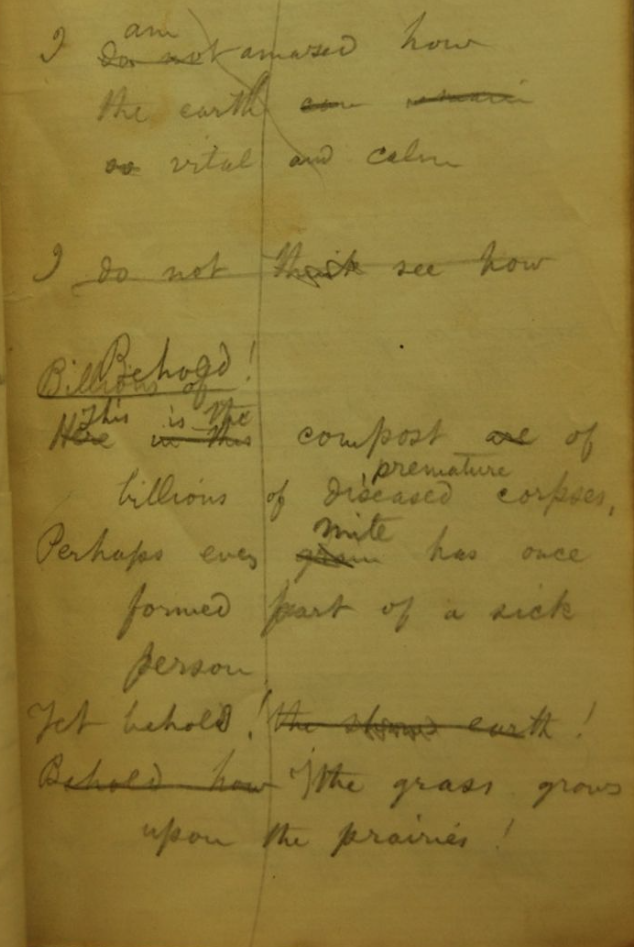
“This Compost” (59 results), mentioned in my Teacher Talk post Walt Whitman and Democratic Literacy
1856 See Harold Aspiz entry in Walt Whitman: An Encyclopedia , ed. Donald D. Cummings and J.R. LeMaster (New York: Garland Publishing, 1998), This Compost (1856)
Sort by date?
Talbot Wilson 1847– (notebook Notebook LC #80, https://whitmanarchive.org/item/loc.00141)
[the scope of government] notebook from between 1855-1856 (about 20 leaves, handwritten) see p. 30 (of 39) notebook entry
- Date: between 1855-1856
p. 30 (of 39) notebook entry
In-Class Workshop
- Choose a line (or lines) from one of the poems we have read today: I Celebrate Myself (13–56) and Come Closer to Me (57–64) in Leaves of Grass (1855)
- Copy and paste (or transcribe line(s) into a document
- Search for interesting/relevant information about the lines (form, production, reception) in the Walt Whitman Archive
- Document what you find, and include links to the page(s) you discover in a document
- Upload your working document to Google Folder Walt Whitman Archive Workshop #1 Fall 2026
Week 3 Day 2
Essay on Reading and Writing in School
- Can the essay be something worth doing?
- Given that academic essays are written under duress, can the essay (or the process of writing an essay) be motivated by a genuine line of inquiry—with a level of complexity that can unravel the very pretension of the thesis statement?
- Can the essay (and the response to the essay) lead the student into a line of thought that requires her to write beyond the assignment?
- Can the essay be conceived as a means for slowing thought down; as a technology for generating reflection; as a practice of entertaining other possibilities than the ones that seem easiest to defend and substantiate; as a way to explore issues of such seriousness and importance that one never reaches that point where ‘nothing more needs to be said’” (“On Asking” 142-59)
- Can the essay be used to help students learn to use language to think new thoughts?
- Can the essay be used to write beyond the commonplace forms of thought or foregone conclusions?
- Can the essay be used to demonstrate not mastery but the very opposite: the ability to write toward, at, and even beyond the limits of one’s understanding?
- Can the essay be a site for questioning one’s own pieties, challenging one’s beliefs, undermining one’s own cherished assumptions?
- Can the essay incorporate sources inside or outside one’s discipline that would call into question your working assumptions and show your narrow ways of thinking as you learn about subjects and critical questions that may not have ever occurred to you?
From our Workshop on Generative AI (GAI) to Class Guidelines for GAI
Thinking with Poems: Review the modes of response in An Anatomy of Reading
- Description and Annotation and Explication of poems from Emily Dickinson and Heather McHugh
- Complete the four modes of response in the anatomy of reading exercise on one of the sixty-two poems by Emily Dickinson on the web site of the Poetry Foundation.
Due by Monday at midnight in the Google Folder HNRS 210 Emily Dickinson: Marginalia Annotation Explication and Analysis
On Reading Walt Whitman: Page Images of 1855 Edition and Leaves of Grass (1855)
Week 2 Day 2
Follow-up discussion of Sylvia Plath’s Metaphors (see below)
During the semester we will be reading a wide selection of lyric poems. Though we will also be reading about poetry and poetics to understand and appreciate some of the ways poets work with the resources of language and form.
Poems often move from the particular to the general, a process the poet Williams Carlos Williams describes in the opening of his book-length poem Paterson, “To make a start, / out of particulars / and make them general, rolling / up the sum, by defective means . . . .”
In a Station of the Metro
The apparition of these faces in the crowd;
Petals on a wet, black bough.
––Ezra Pound, Selected Poems of Ezra Pound (1957)
Nomad Exquisite
As the immense dew of Florida
Brings forth
The big-finned palm
And green vine angering for life,
As the immense dew of Florida
Brings forth hymn and hymn
From the beholder,
Beholding all these green sides
And gold sides of green sides,
And blessed mornings,
Meet for the eye of the young alligator,
And lightning colors
So, in me, come flinging
Forms, flames, and the flakes of flames.
––Wallace Stevens, Harmonium (1923)
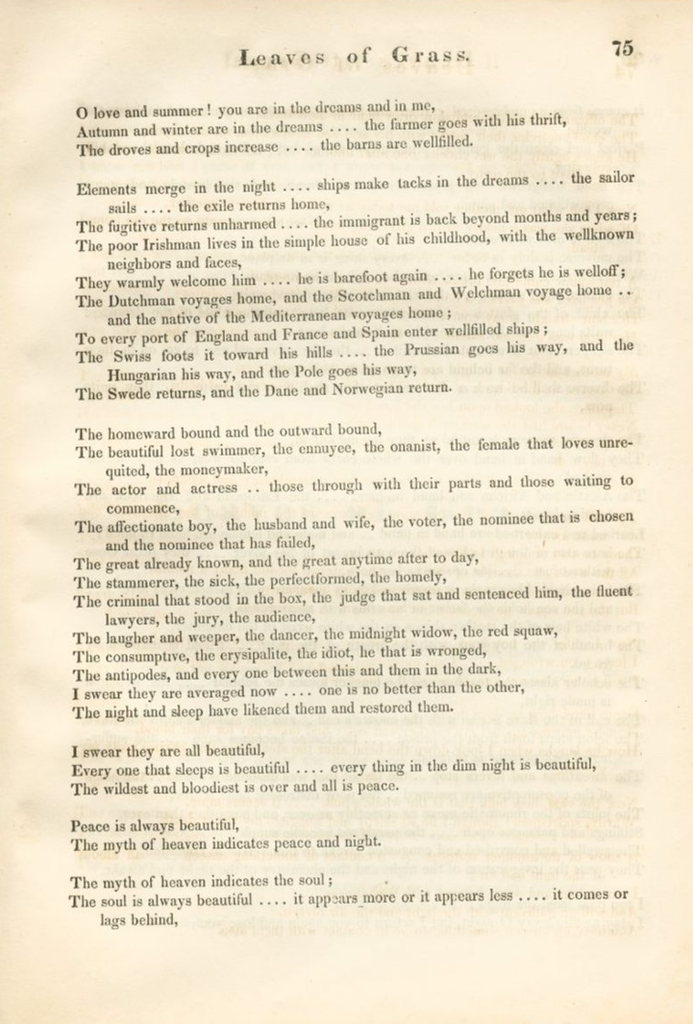
––from Walt Whitman, Leaves of Grass (1855 edition)
Readings: annotations and discussion. Workshop on Generative AI (GAI).
Week Three: Gary Soto, How Things Work
Week 2 Day 1
––Adrienne Rich, 1973
(Rigoberto González, “Diving into the Wreck”: An Appreciation)
Metaphors
I’m a riddle in nine syllables.
An elephant, a ponderous house,
A melon strolling on two tendrils.
O red fruit, ivory, fine timbers!
This loaf’s big with its yeasty rising.
Money’s new-minted in this fat purse.
I’m a means, a stage, a cow in calf.
I’ve eaten a bag of green apples,
Boarded the train there’s no getting off.
“To pay attention / this is our endless and proper work” writes Mary Oliver in the poem “Yes! No!” Here are some of the ways we might attend to a poem (although in numerical order, these questions are not meant to be asked in a necessary sequence):
1.Experience the poem. A poem is a particular kind of experience—like going to a ballgame or swimming in salt water. A poem invites you to respond fully, with both body and mind. Allow this to happen. A means to this end is to read aloud: embody the voice speaking.
2. Pay attention to the speaker of the poem. Who is speaking? What might you infer about the speaker? What tone do you hear? (Anger or awe?) What might be the motivations for speaking? Is there an audience, either named or implied? Does tone or emotion in the poem change how you respond? Can you describe that change?Describe or paraphrase the poem. Pay attention to theme and/or form.
3. Situation and setting. Where does the poem take place? What is the time of day or season? Is the poet speaking to a particular person or persons? In there an antecedent situation from which the poem emerges?
4.What is the poem’s theme? Is it a poem about love? Is it a poem about frogs? Is it a poem about frogs that happens at the same time to be about this wonderful and elusive thing we call love?
5. Word and word order. So much depends upon particular words and their placement and their effects. Pay attention to the poet’s word choice, word order in the poem.
7. Metaphor. Pay attention the ways that the poem uses imagery
8. Structure. Is the poem organized by a time sequence (narrative)? Is it organized by the musical sound of the human voice (lyric)? Is it organized by scene (dramatic)? Does it have the structure of an argument?
9. Does the poem express an attitude toward the subject? A judgment about some thing or issue?
10. Why is the poem a poem? How does the poem address its subject matter? Is the poem written in a particular way? What formal patterns do you see in the object before you? Pay attention to diction (word choice) variations and patterns of sound (rhythm), line length and syntax, or stanza divisions.
What Can I Tell My Bones?
1
Beginner,
Perpetual beginner,
The soul knows not what to believe,
In its small folds, stirring sluggishly,
In the least place of its life,
A pulse beyond nothingness,
A fearful ignorance.
Before the moon draws back,
Dare I blaze like a tree?
In a world always late afternoon,
In the circular smells of a slow wind,
I listen to the weeds’ vesperal whine,
Longing for absolutes that never come.
And shapes make me afraid:
The dance of natural objects in the mind,
The immediate sheen, the reality of straw,
The shadows, crawling down a sunny wall.
A bird sings out in solitariness
A thin harsh song. The day dies in a child.
How close we are to the sad animals!
I need a pool; I need a puddle’s calm.
O my bones,
Beware those perpetual beginnings,
Thinning the soul’s substance;
The swan’s dread of the darkening shore,
Of these insects pulsing near my skin,
The songs from a spiral tree.
Fury of wind, and no apparent wind,
A gust blowing the leaves suddenly upward,
A vine lashing in dry fury,
A man chasing a cat,
With a broken umbrella,
Crying softly.
2
It is difficult to say all things are well,
When the worst is about to arrive;
It is fatal to woo yourself,
However graceful the posture.
Loved heart, what can I say?
When I was a lark, I sang;
When I was a worm, I devoured.
The self says, I am;
The heart says, I am less;
The spirit says, I am nothing.
Mist alters the rocks. What can I tell my bones?
My desire’s a wind trapped in a cave.
The spirit declares itself to these rocks.
I’m a small stone, loose in the shale.
Love is my wound.
The wide streams go their way,
The pond lapses back into a glassy silence.
The cause of God in me – has it gone?
Do these bones live? Can I live with these bones?
Mother, mother of us all, tell me where I am!
O to be delivered from the rational into the realm of pure song,
My face on fire, close to the points of a star,
A learned nimble girl,
Not drearily bewitched,
But sweetly daft.
To try to become like God
Is far from becoming God.
O, but I seek and care!
I rock in my own dark,
Thinking, God has need of me.
The dead love the unborn.
3
Weeds turn toward the wind weed-skeletons.
How slowly all things alter.
Existence dares perpetuate a soul,
A wedge of heaven’s light, autumnal song.
I hear a beat of birds, the plangent wings
That disappear into a waning moon;
The barest speech of light among the stones.
To what more vast permission have I come?
When I walk past a vat, water joggles,
I no longer cry for green in the midst of cinders,
Or dream of the dead, and their holes.
Mercy has many arms.
Instead of a devil with horns, I prefer a serpent with scales;
In temptation, I rarely seek counsel;
A prisoner of smells, I would rather eat than pray.
I’m released from the dreary dance of opposites.
The wind rocks with my wish; the rain shields me;
I live in light’s extreme; I stretch in all directions;
Sometimes I think I’m several.
The sun! The sun! And all we can become!
And the time ripe for running to the moon!
In the long fields, I leave my father’s eye;
And shake the secrets from my deepest bones;
My spirit rises with the rising wind;
I’m thick with leaves and tender as a dove,
I take the liberties a short life permits–
I seek my own meekness;
I recover my tenderness by long looking.
By midnight I love everything alive.
Who took the darkness from the air?
I’m wet with another life.
Yea, I have gone and stayed.
What came to me vaguely is now clear,
As if released by a spirit,
Or agency outside me.
Unprayed-for,
And final.
––Theodore Roethke, Words for the Wind (1958). Rpt. in The Collected Poems of Theodore Roethke
(Annotation: Psalm 22:17: English Standard Version (ESV): “I can count all my bones—they stare and gloat over me”; New International Version (NIV): “All my bones are on display; people stare and gloat over me”; King James Version (KJV): “I may tell all my bones: they look and stare upon me.”)
Google AI Overview
“What Can I Tell My Bones?” is a famous 1958 metaphysical poem by Theodore Roethke. It explores aging, mortality, the limits of human reason, and the deep, silent connection between the physical body and the human soul.
If you are referring to the literary work, you can tell your bones to confront aging with honesty, or you can read the complete text through Ronnow Poetry. If you meant something else—such as physical health, nutrition, or a creative writing prompt—please clarify your intent.
If you’d like, let me know:
- Were you looking for an analysis or summary of Theodore Roethke’s poem?
- Did you mean to ask a question about bone health, calcium, or physical care?
I can help you explore the exact topic you have in mind.
(Grade Saver is one of the links in the “Overview.” There are other more personal thoughts that are engaged with lines of the poem.)
All Ignorance Toboggans into Know
all ignorance toboggans into know
and trudges up to ignorance again:
but winter’s not forever,even snow
melts;and if spring should spoil the game,what then?
all history’s a winter sport or three:
but were it five,i’d still insist that all
history is too small for even me;
for me and you,exceedingly too small.
Swoop(shrill collective myth)into thy grave
merely to toil the scale to shrillerness
per every madge and mabel dick and dave
–tomorrow is our permanent address
and there they’ll scarcely find us(if they do,
we’ll move away still further:into now
––E. E. Cummings, 1×1 (1944)
Fire on the Hills
The deer were bounding like blown leaves
Under the smoke in front of the roaring wave of the brush-fire;
I thought of the smaller lives that were caught.
Beauty is not always lovely; the fire was beautiful, the terror
Of the deer was beautiful; and when I returned
Down the back slopes after the fire had gone by, an eagle
Was perched on the jag of a burnt pine,
Insolent and gorged, cloaked in the folded storms of his shoulders.
He had come from far off for the good hunting
With fire for his beater to drive the game; the sky was merciless
Blue, and the hills merciless black,
The sombre-feathered great bird sleepily merciless between them.
I thought, painfully, but the whole mind,
The destruction that brings an eagle from heaven is better than mercy.
––Robinson Jeffers, Thurso’s Landing and Other Poems (1932)
The Peace of Wild Things
When despair for the world grows in me
and I wake in the night at the least sound
in fear of what my life and my children’s lives may be,
I go and lie down where the wood drake
rests in his beauty on the water, and the great heron feeds.
I come into the peace of wild things
who do not tax their lives with forethought
of grief. I come into the presence of still water.
And I feel above me the day-blind stars
waiting with their light. For a time
I rest in the grace of the world, and am free.
––Wendell Berry, Openings (1968)
Lie to yourself about this and you will
forever lie about everything.
Everybody already knows everything
so you can
lie to them. That’s what they want.
But lie to yourself, what you will
lose is yourself. Then you
turn into them.
*
For each gay kid whose adolescence
was America in the forties or fifties
the primary, the crucial
scenario
forever is coming out—
or not. Or not. Or not. Or not. Or not.
*
Involuted velleities of self-erasure.
*
Quickly after my parents
died, I came out. Foundational narrative
designed to confer existence.
If I had managed to come out to my
mother, she would have blamed not
me, but herself.
The door through which you were shoved out
into the light
was self-loathing and terror.
*
Thank you, terror!
You learned early that adults’ genteel
fantasies about human life
were not, for you, life. You think sex
is a knife
driven into you to teach you that.
––Frank Bidart, Metaphysical Dog (2013). Rpt. in Half-light: Collected Poems 1965–2016.
The Realm of Spirit
When I wrote my poems and kept them in a drawer
I believed I was William Blake in a closet.
The pathos of my unappreciated genius
bowed my shoulders but put spring in my step.
In that divided mood each line I composed
seemed to me a triumph against prodigious odds.
I communicated this sense of struggle to my friends
who treated me with the respect due a warrior.
And I exhaled contempt for the famous names
whose anodyne verses collected yearly prizes.
I lived like that for decades, impregnable
in the knowledge that my castle had no drawbridge.
Then one day in a trance of inadvertence
I sent my poems to an editor, who published them.
Now the drawer is empty and the closet is sealed
and I know that in the realm of spirit I am nothing.
––Michael Fried, The Next Bend in the Road (2004)
The Summer Day
Who made the world?
Who made the swan, and the black bear?
Who made the grasshopper?
This grasshopper, I mean—
the one who has flung herself out of the grass,
the one who is eating sugar out of my hand,
who is moving her jaws back and forth instead of up and down—
who is gazing around with her enormous and complicated eyes.
Now she lifts her pale forearms and thoroughly washes her face.
Now she snaps her wings open, and floats away.
I don’t know exactly what a prayer is.
I do know how to pay attention, how to fall down
into the grass, how to kneel down in the grass,
how to be idle and blessed, how to stroll through the fields,
which is what I have been doing all day.
Tell me, what else should I have done?
Doesn’t everything die at last, and too soon?
Tell me, what is it you plan to do
with your one wild and precious life?
––Mary Oliver, House of Light (1990)
Week 1 Day 1
Poetry as a Way of Knowing
- What is Poetry?
Answer is best found by looking at a poem, and then by looking at more poems:
“This World is not Conclusion.
A Species stands beyond––
Invisible, as Music––
But positive, as Sound––”
—Emily Dickinson, “This World is not Conclusion” (373)
“I don’t want to know
wreckage, dreck and waste, but these are the materials
and so are the slow lift of the moon’s belly
over wreckage, dreck and waste, wild treefrogs calling in
another season, light and music still pouring over
our fissured and cracked terrain” (4)
––Adrienne Rich, An Atlas of the Difficult World (1991)
Or you could look more discursively, following hyperlinks on the World Wide Web or using other information platforms on the Internet:
Wikipedia entry on Poetry (A reliable source? See Reliability of Wikipedia)
Claude (a large language model (LLM), a generative pre-trained transformer) is a powerful search tool that generated the following output in response to a basic “what is?” prompt:
A few things that tend to set it apart:
- Compression — poems often say a lot in very few words, leaning on suggestion and implication rather than spelling everything out.
- Sound and rhythm — meter, rhyme, alliteration, and the music of the words matter as much as their literal sense. Even free verse, which drops formal rhyme/meter, still cares deeply about the sound of a line.
- Imagery and metaphor — poetry often works by showing rather than telling, letting a concrete image carry an abstract feeling.
- Form — the way a poem is broken into lines and stanzas is itself meaningful; where a line ends changes how you read it, unlike in prose where sentences just run to the margin.
- Ambiguity as a feature — poems often hold multiple meanings at once rather than resolving to a single clear statement, which is part of why they reward rereading.
But it’s worth saying that poetry resists a single tidy definition — people have argued about where the line between poetry and prose actually sits for centuries. Some define it structurally (line breaks, meter), others functionally (it’s poetry if it does what poetry does — compresses, defamiliarizes, moves you), and some poets have deliberately blurred the boundary (prose poems, for instance, have no line breaks at all but still feel like poetry).
If you’re curious, I’m happy to go deeper into any angle — the history of different poetic forms, how meter actually works, or the difference between how various cultures or eras have thought about it.
Poetry is language arranged to do more than convey information — it uses rhythm, sound, imagery, and compression to create meaning and feeling that ordinary prose usually doesn’t reach.
. . .
(As readers and thinkers and writers we will talking about AI this semester. Because you will be doing academic research, you will need to be thinking about bias and misinformation. LLMs are primarily designed to produce fluent text rather than to verify factual accuracy; it is not surprising, then, that generative AI reproduces and amplifies patterns present in training data that can produce unreliable output, including errors of fact, social biases, and contextual inaccuracies.)
But I am curious, and I want to encourage you to be curious. So I am going to turn to a few twentieth-century poets (and critics)
. . .
“A Poem is a composition written for performance by the human voice.”
—the editors of the Norton anthology of Poetry
“Poetry is language at its most intense.”
—The editors of The Practical Imagination
“Poetry is the kind of thing poets write”
—Robert Frost
“A poem is a walk.”
—A.R. Ammons
“Poetry is anything said or put on paper in such a way as to invite a certain kind of attention.”
—William Stafford
“What the poet is called upon to clarify is not answers but the existence and nature of questions; and his likelihood of so clarifying them for others is made possible only by dialogue with himself.”
—Denise Levertov
“Poetry is the way we [the pronoun is gender specific here, “for women poetry is not a luxury. . .it is a vital necessity] help give names to the nameless so it can be thought.”
—Audre Lorde
“Poetry is the skilled and inspired use of language.”
—Gary Snyder
“Poetry is discovery and projection of the self.”
—Richard Wilbur
“It is myself that I remake.”
––W.B. Yeats
“Poetry is a kind of saying.”
—Robert Penn Warren and Cleanth Brooks
“Poetry is an action that mediates and sustains the self in the world.”
—Sherman Paul
“Any poem is an. . .inquiry into the resources of language it makes available to itself.”
—Richard Poirier
2. Ways of Knowing
- We can distinguish between ways of knowing
- We can recognize that some knowing is better than some other kinds of knowing
- We can say that some knowing is not so good as other kinds of knowing
If you were to apply this distinction to your own life and say that you “really do know something,” where would you point, what would you talk about?
(claiming to know the world around us? claiming to know our own minds? claiming to know the minds of others.)
3. Knowledge
In introductory classes to epistemology, we are taught to distinguish between three different kinds of knowledge. The first kind is acquaintance knowledge: we know our mothers, our friends, our pets, etc., by being acquainted with them. The second kind is knowledge of facts, propositional knowledge, or knowledge-that: this is the sort of knowledge we acquire when we learn that, say, Ithaca is in New York State or that Turin is located in Italy. It is customary to add to the list a third kind of knowledge that is supposed to be distinct both from acquaintance knowledge and from propositional knowledge. One possesses this knowledge when one can be truly described as knowing how to do something: play the piano, make a pie, walk, speak, create, build, and so on.
––from Knowledge How, the Stanford Dictionary of Philosophy
4. (Poems as) Ways of Knowing
Evening Star (Part 11)
11
The pickerel
swims up from the pond from its roses of slow decay, and
looks at me
astonished.
What is it I need to know?
The gypsy moths, still caterpillars,
wrench themselves from the milky shreds of birth
and set out on the long journey
in the shining tree.
What is it I don’t know that I need to know?
––Mary Oliver, from The Leaf and the Cloud
From the Book of Time (Part 6)
6
Count the roses, red and fluttering.
Count the roses, wrinkled and salt.
Each with its yellow lint at the center.
Each with its honey pooled and ready.
Do you have a question that can’t be answered?
Do the stars frighten you by their heaviness
and their endless number?
Does it bother you, that mercy is so difficult to
understand?
For some souls it’s easy; they lie down on the sand
and are soon asleep.
For others, the mind shivers in its glacial palace,
and won’t come.
Yes, the mind takes a long time, is otherwise occupied
than by happiness and deep breathing.
Now, in the distance, some bird is singing.
And now I have gathered six or seven deep red,
half-opened cups of petals between my hands,
and now I have put my face against them
and now I am moving my face back and forth, slowly,
against them.
The body is not much more than two feet and a tongue.
Come to me, says the blue sky, and say the word.
And finally even the mind comes running, like a wild thing,
and lies down in the sand.
Eternity is not later, or in any unfindable place.
Roses, roses, roses, roses.
––Mary Oliver, from The Leaf and the Cloud
Some Questions You Might Ask
Is the soul solid, like iron?
Or is it tender and breakable, like
the wings of a moth in the beak of the owl?
Who has it, and who doesn’t?
I keep looking around me.
The face of the moose is as sad
as the face of Jesus.
The swan opens her white wings slowly.
In the fall, the black bear carries leaves into the darkness.
One question leads to another.
Does it have a shape? Like an iceberg?
Like the eye of a hummingbird?
Does it have one lung, like the snake and the scallop?
Why should I have it, and not the anteater
who loves her children?
Why should I have it, and not the camel?
Come to think of it, what about the maple trees?
What about the blue iris?
What about all the little stones, sitting alone in the moonlight?
What about roses, and lemons, and their shining leaves?
What about the grass?
(Marginal comments: Questions you might ask; “I keep looking around me”; “one question leads to another.”)
––Mary Oliver, House of Light (1990)
How to Live. What to Do
Last evening the moon rose above this rock
Impure upon a world unpurged.
The man and his companion stopped
To rest before the heroic height.
Coldly the wind fell upon them
In many majesties of sound:
They that had left the flame-freaked sun
To seek a sun of fuller fire.
Instead there was this tufted rock
Massively rising high and bare
Beyond all trees, the ridges thrown
Like giant arms among the clouds.
There was neither voice nor crested image,
No chorister, nor priest. There was
Only the great height of the rock
And the two of them standing still to rest.
There was the cold wind and the sound
It made, away from the muck of the land
That they had left, heroic sound
Joyous and jubilant and sure.
––Wallace Stevens, Ideas of Order (1936). Rpt. in Collected Poems
Not Ideas about the Thing but the Thing Itself
At the earliest ending of winter,
In March, a scrawny cry from outside
Seemed like a sound in his mind.
He knew that he heard it,
A bird’s cry at daylight or before,
In the early March wind.
The sun was rising at six,
No longer a battered panache above snow . . .
It would have been outside.
It was not from the vast ventriloquism
Of sleep’s faded papier mâché . . .
The sun was coming from outside.
That scrawny cry—it was
A chorister whose c preceded the choir.
It was part of the colossal sun,
Surrounded by its choral rings,
Still far away. It was like
A new knowledge of reality.
––Wallace Stevens, Ideas of Order (1936). Rpt. inThe Collected Poems of Wallace Stevens
I have never seen “Volcanoes” (175)
I have never seen “Volcanoes” ––
But, when Travellers tell
How those old –– phlegmatic mountains
Usually so still ––
Bear within –– appalling Ordnance,
Fire, and smoke, and gun,
Taking Villages for breakfast,
And appalling Men ––
If the stillness is Volcanic
In the human face
When upon a pain Titanic
Features keep their place ––
If at length the smouldering anguish
Will not overcome ––
And the palpitating Vineyard
In the dust, be thrown?
If some loving Antiquary,
On Resumption Morn,
Will not cry with joy “Pompeii”!
To the Hills return!
––Emily Dickinson
(Marginal reflection: If you search for the poem using Google, the algorithm generates a link to the text of the poem at the Poetry Foundation. The second result is a site called Poem Analysis. The third result is “annotations” or notes on a site called Genius. Result five is a typescript of the poem in the Amherst College Library Digital Emily Dickinson Collection that contains all of Dickinson’s manuscripts, drafts, fragments, and letters held in Archives & Special Collections as well as Mabel Loomis Todd’s manuscript transcriptions and publication correspondence. There is also a Finding Aid, where you can look at the manuscript pages (the fasicles) that Dickinson made: for example, Tell All the Truth––)
Publication – is the Auction (788)
Publication –– is the Auction
Of the Mind of Man––
Poverty––be justifying
For so foul a thing
Possibly––but We––would rather
From Our Garret go
White––unto the White Creator––
Than invest––Our Snow––
Thought belong to Him who gave it––
Then––to Him Who bear
It’s Corporeal illustration––sell
The Royal Air––
In the Parcel––Be the Merchant
Of the Heavenly Grace––
But reduce no Human Spirit
To Disgrace of Price––
Fire on the Hills
The deer were bounding like blown leaves
Under the smoke in front of the roaring wave of the brush-fire;
I thought of the smaller lives that were caught.
Beauty is not always lovely; the fire was beautiful, the terror
Of the deer was beautiful; and when I returned
Down the back slopes after the fire had gone by, an eagle
Was perched on the jag of a burnt pine,
Insolent and gorged, cloaked in the folded storms of his shoulders.
He had come from far off for the good hunting
With fire for his beater to drive the game; the sky was merciless
Blue, and the hills merciless black,
The sombre-feathered great bird sleepily merciless between them.
I thought, painfully, but the whole mind,
The destruction that brings an eagle from heaven is better than mercy.
––Robinson Jeffers, Thurso’s Landing and Other Poems (1932)
A Dent in a Bucket
Hammering a dent out of a bucket
a woodpecker
answers from the woods
––Gary Snyder, Danger on Peaks (2004)
(Marginal comments. Searched on Google, over 8500 results. Wendell Berry (1934–2026). Died August 31, 2026 New York Times Obituary.