
Last evening the moon rose above this rock
Impure upon a world unpurged.
The man and his companion stopped
To rest before the heroic height.
Coldly the wind fell upon them
In many majesties of sound:
They that had left the flame-freaked sun
To seek a sun of fuller fire.
Instead there was this tufted rock
Massively rising high and bare
Beyond all trees, the ridges thrown
Like giant arms among the clouds.
There was neither voice nor crested image,
No chorister, nor priest. There was
Only the great height of the rock
And the two of them standing still to rest.
There was the cold wind and the sound
It made, away from the muck of the land
That they had left, heroic sound
Joyous and jubilant.
––Wallace Stevens, Ideas of Order (1936)
“Books are to be call’d for, and supplied, on the assumption that the process of reading is not a half-sleep, but, in highest sense, an exercise, a gymnast’s struggle; that the reader is to do something for himself, must be on the alert, must himself or herself construct indeed the poem, argument, history, metaphysical essay—the text furnishing the hints, the clue, the start or framework. Not the book needs so much to be the complete thing, but the reader of the book does. That were to make a nation of supple and athletic minds, well-train’d, intuitive, used to depend on themselves, and not a few coteries of writers.”
—Walt Whitman, “Democratic Vistas”
Introduction
Thank you for sharing your experiences using Generative AI (GenAI) in school. Your comments were remarkably consistent. As a few of you pointed out, every one of us is already using GenAI. It is embedded in many of the digital tools and programs we use every day, from the images we capture using the camera on our smart phones to the autocorrect suggestions in a text or email, to the algorithms that drive the content on social media feeds, not to mention the now ubiquitous and embedded tools in our digital experiences, including autocorrect, spell-checkers, chat bots of one kind or another, and search engine results.
For the purposes of a first-year college thinking and writing class our focus will be on the AI tools that generate text. These statistical large language models (LLMs) are programmed to recognize abstract patterns that generate what is most probable based on those patterns. These tools are therefore being used in routine transactional communication tasks in the workplace—generating meeting minutes, routine reports and memos, social media text, customer service transactions, translation, market research and analysis, and so on.
But in a college classroom, designed to develop particular content knowledge and skills, there are additional considerations. Because an LLM is run on a machine, it has no way of determining what is true or false. It has no expertise. It has no experience. It has no understanding, embodied knowledge, or semantic awareness. It cannot think or feel.
GenAI programs operate, for the most part, without an ethical or moral framework. A GenAI tool does not distinguish between accurate/inaccurate or biased/unbiased information, and it should not be surprising that it recombines accurate source information in ways that generate inaccurate statements. It makes things up. Rather than using a metaphor and calling these “hallucinations,” let’s just say that these inaccurate statements are part and parcel of what these programs do.
In addition to formulating our guidelines for the class, based on your previous classroom experiences, I recommend that you become familiar with the Modern Language Association (MLA) Student Guide to AI Literacy. In this document you will find the following statement on “AI Literacy”:
AI Literacy
Ethical and effective use of GenAI technologies is emerging as an essential skill that students must develop in order to live, learn, and work. Yet GenAI comes with potential pitfalls for students–from the risk of being accused of academic misconduct to missing out on foundational skills in reading, writing, research, and learning.
Developing literacy with a tool means becoming a more skilled and thoughtful user of that tool. For example, developing literacy in reading means being able to reread, tackle increasingly difficult texts, and do research in order to further build your capability as a reader. Literacy also assumes you have enough knowledge to question and evaluate what you are studying.
Similarly, developing AI literacy requires that you learn certain basics about how GenAI works, how to use it, and how to evaluate its output. You should also learn when not to use it. Developing GenAI literacy should be your starting point for using this technology. When you build skills and habits for using GenAI ethically and effectively you will establish yourself as a thoughtful creator and consumer of GenAI content as technologies change over time.
The responsible and effective use of emergent GenAI tools requires students to be thoughtful and deliberate.
How to Live, What to Do
Consider the following example. After selecting and placing the poem “How to Live, What to Do,” by Wallace Stevens, as one of two epigraphs for this post, I opened a search window on my Google Chrome browser to refresh my memory of the poem’s date of publication. (Rather than getting up from my desk to pull the volume off my bookcase.). Here is the search result on Google search:
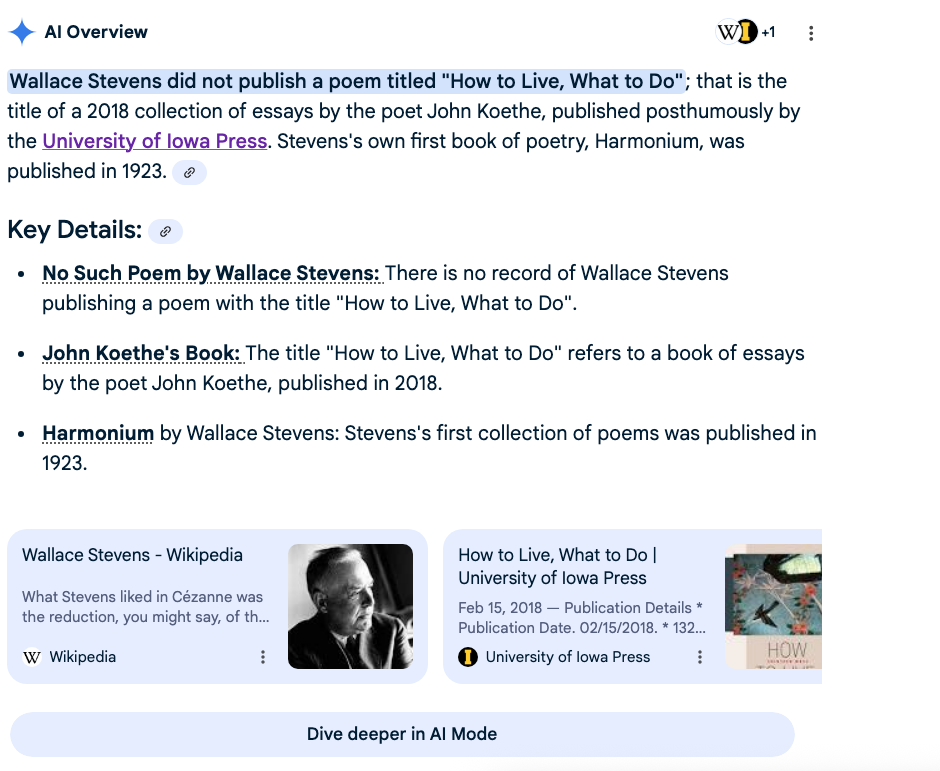
The GenAI Overview is incorrect. And mores the pity, as a large percentage of users would likely accept the results. (Note well the deceptive and seductive certainty of the output, “did not publish a poem” and “no such poem.”) As an avid reader of poems, with a doctorate in American literature and culture and decades of reading and teaching poetry, I was aware that this overview was wrong. (As it happens, I have also read the Koethke book, and know that he took his title from the poem.) But if you don’t have background or expertise, well, again, mores the pity.
There is such a poem. But remember, my question was about when the poem was published, and in which of Stevens’ volumes of poetry. Then curiosity got the best of me. And I clicked on “Dive Deeper in AI Mode.” Below is the prompt and the answer:
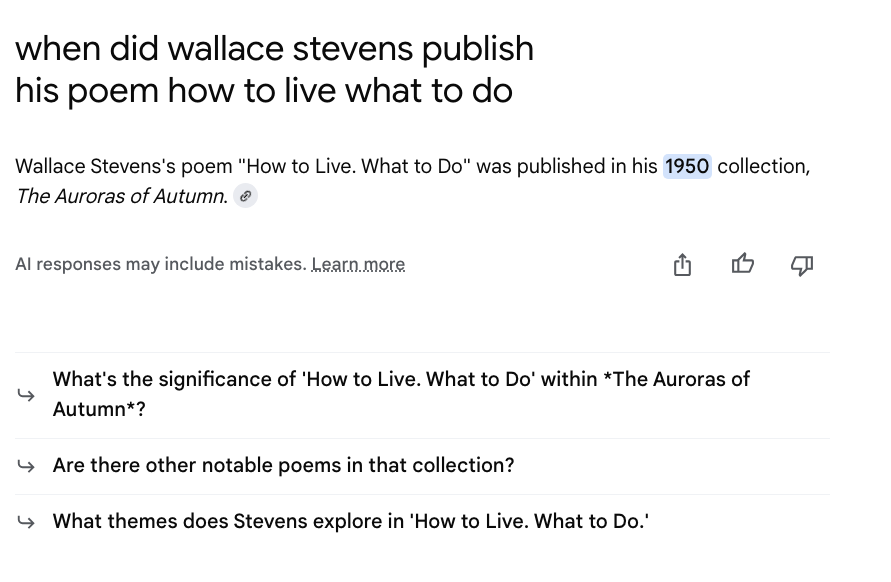
By “going deeper,” the mode of inquiry (GenAI) produced a new finding: Lo! Wallace Stevens did write and publish a poem entitled “How to Live, What to Do.” But. I studied Stevens in graduate school, and have taught his work for decades; and I knew that this was among his earlier poems. So I got up and pulled the Collected Poetry and Prose off the shelf and looked at the Table of Contents to refresh my memory. And there it was, nestled between “Lions in Sweden” and “Some Friends from Pascagoula” in the sequence of poems in Ideas of Order, a book published in 1936.
(As a follow up, I retyped my query into Google search and in this instance the GenAI “Overview” reported that the poem appears in the 1942 collection Parts of the World, though the table of contents of that book does not include the poem. (“AI responses may include mistakes”. . . .)
The Use of AI in Teaching and Learning
One of you wrote to me in an email that “we should avoid the use of AI as much as possible. I believe that everything GenAI does for us makes us lose a skill that we could greatly benefit from.”
I’m not sure I could say this better. The example above illustrates well the problem. I might begin to define the problem as the wide availability of a (seductive) technology that is unreliable. In order to check the accuracy of the information generated a user will in most cases spend far more time vetting the information than if the user simply used a more reliable methods of searching for information––methods, not incidentally, we will be practing next week.
But the more I think about the problem the more I suspect that the use of GenAI will diminish the opportunity for people (in the present case, you, as students) to experience the pleasure and rewards of curiosity––the formalized curiosity that the writer and sociologist Zora Neale Hurston once called “poking and prying with a purpose.” (She makes this widely-cited remark about research in her lovely memoir, Dust Tracks on a Road, first published in 1942.)
So maybe it is not so much “losing” a skill as making it less possible to access the opportunity to experience the creative mind at work. “There is then creative reading as well as creative writing,” the nineteenth-century American thinker Ralph Waldo Emerson writes in his singular 1836 oration The American Scholar. He continues, “When the mind is braced by labor and invention, the page of whatever book we read becomes luminous with manifold allusion. Every sentence is doubly significant, and the sense of our author is as broad as the world.” We might compare Emerson’s expanding circle of the self (“broadness”) to Whitman’s aspiration for the reader in the second epigraph to this class note. “Not the book needs so much to be the complete thing, but the reader of the book does.”
Emerson and Whitman are chasing a simple formulation, really: it is that reading, thinking, and writing are by definition creative activities that we learn and refine as we develop as human beings. In reading we learn to process language and information, to access ideas, and open ourselves to minds and worlds that differ from our own; in thinking we learn to recognize patterns, make inferences, and evaluate evidence, as well as to access concepts and principles, understand cause and effect, temporality, and to consider moral and ethical questions in complex situations we face in our lives; and in writing we discover and formulate and learn to share thoughts and ideas, communicate with different audiences, and learn to use language and discourse effectively in differing rhetorical contexts.
These creative activities––reading, thinking, research, writing––are what this class is all about.
What can you do with this poem? How does this poem help you think? How do you think with a poem? What can you do with what you know? These questions bring to mind another comment that one of you made, that “using AI completely defeats the purpose of any assignment because it does it for you.” What is the purpose of the reading, thinking, and writing assignments in this class? The purpose––and forgive me for reaching for more abstract language to capture the purpose––is to engage you in activities that constitute you, as a writer and as a thinking subject with agency in the world.
Finally, in your comments on AI there surfaced a prescient question about the very definition of writing itself. After all, what is writing? The question is helpful for us. For GenAI produces text, not thinking and not writing. Texts that are machine-generated output have no intent, provenance, or reliable accuracy. Writing as output is different from writing as constitutive. GenAI makes you dependent on Natural Language Processing (NLP) to generate language and in the process robs you of one of your greatest gifts as a human being: the ability to use language. I can’t help but think of the conclusion of Walker Percy in the essay we read and annotated during the first week of class, “The Loss of Creature.” As you will remember, he writes, that the loss of our autonomy (he uses the term “sovereignty”) is “a consequence of the seduction of the layman by science. The layman will be seduced. . .as long as he waives his sovereign rights as a person and accepts his role of consumer as the highest estate to which the layman can aspire” (63).
As you navigate the use of GenAI in forms of intellectual work, and develop a functional level of AI Literacy, I encourage you to consider the cautionary words of one of your classmates. “If you get all your help from AI,” they write, “it can damage your ability to ask for help from another human. AI doesn’t judge or think, it doesn’t have a face or a social standing.” This is a brilliant and haunting observation that should give all of us pause.
Acceptable and Unacceptable Uses
While some of your groups were more critical of these emergent technological tools, others were more willing to approach the use of GenAI with less skepticism. Using language from your experiences using GenAI, sent to me for writing specific guidelines for our class, please find below a list of acceptable and unacceptable uses. I also include below guidelines for citing GenAI using the Modern Language Association (MLA) style guide and the relevant excerpt from the Keene State Policy on Academic Honesty.
Acceptable uses
- Exploration of Ideas, including the use of AI to explore topics and generate initial ideas, developing sample statements of purpose (or thesis statements) through AI-assisted questioning, creating outlines or possible organizational sequences of ideas;
- Research Assistance, including clarifying complex concepts or terminology, defining search terms, generating a list of questions to focus a line of inquiry, or compiling a first draft of an annotated bibliography or list of works cited;
- Writing Process Support, including reviewing grammar and style, suggesting sentence revisions for clarity, or receiving feedback on the organization of a draft.
Unacceptable uses
- Generating Primary Content, including having GenAI write substantial portions of assignments, submitting AI-generated text as original work, using GenAI to complete an entire assignment;
- Doing Critical Analysis, including the use of GenAI-generated analysis or interpretations, or using GenAI conclusions rather than thinking and reasoning on one’s own;
- Failing to disclose AI, including misrepresenting GenAI-generated content as your own intellectual work, or using GenAI to complete writing tasks designed to evaluate specific skills (such as explication, analysis, or interpretation.
If you are using an GenAI tool to think or write for you, you are violating the trust of your teacher, who is dedicated to improving your intellectual capacities; you are betraying your classmates, and failing to contribute to the learning community in our classroom; and you are transgressing the ethical values that motivate genuine academic inquiry.
Guidelines for Citing AI
Honesty and transparency are core principles of academic inquiry. You are therefore responsible for your writing and for disclosing the use of any assistance you received in completing your academic work. Any and all use of GenAI must be appropriately documented using standard academic citation guidelines
The Modern Language Association (MLA) Style Center has guidelines for citing generative AI. In this class we will follow the MLA guidelines:
- cite a GenAI tool whenever you paraphrase, quote, or incorporate into your own work any content (whether text, image, data, or other) that was created by it;
- acknowledge all functional uses of the tool (like editing your prose or translating words) in a note, your text, or another suitable location;
- and be judicious in vetting each secondary source a GenAI cites.
Here is an example of how to cite an in text citation or paraphrase: (“Describe the symbolism”): - Works Cited Entry “Describe the symbolism of the green light in the book The Great Gatsby by F. Scott Fitzgerald” prompt. ChatGPT, 13 Feb. version, OpenAI, 8 Mar. 2023, chat.openai.com/chat.
- Works-Cited-List Entry “In 200 words, describe the symbolism of the green light in The Great Gatsby” follow-up prompt to list sources. ChatGPT, 13 Feb. version, OpenAI, 9 Mar. 2023, chat.openai.com/chat.
The Keene State College Academic Honesty Policy statement on generative AI
Generative artificial intelligence (AI) is an emerging tool in teaching, learning, and workplace environments. The College strongly encourages instructors to establish and to clearly articulate course policies governing students’ appropriate use of generative AI, if any. Generative AI tools may not be used in the completion of coursework unless the instructor specifically authorizes their use. If an instructor approves the use of generative AI for coursework, any use must be properly cited, as defined by this Academic Honesty Policy. The College encourages our entire academic community to consider the ethical implications of uploading copyrighted work to generative AI programs.