Category Archives: Reading as a Writer

Keener Sounds

“The ear does it. The ear is the only true writer and the only true reader.”

––Robert Frost to John Bartlett, 22 February 1914

Words of the fragrant portals, dimly-starred,
And of ourselves and of our origins,
In ghostlier demarcations, keener sounds.

––Wallace Stevens, The Idea of Order at Key West

We do not need to learn how to hear the sounds in a poem. This is because every speaker, “intuitively and accurately, courses gracefully through immensely subtle manipulations of sounds,” writes Robert Pinsky in The Sounds of Poetry: A Brief Guide. Since we were children, most of us enact this grace every day when we speak and listen to one another. And yet, “learning to hear language in a more conscious way,” Pinsky reminds us, “can enhance our pleasure in lines and poems.”

The idea that we can continue to learn what we already know how to do will resonate for anyone who has tried to get better at one thing or another. “Athletes by studying or coaching, can learn to walk or run more effectively.” With these words, Pinksy leans on a metaphor we entertained in the first few weeks of this course. You will remember Walt Whitman saying in Democratic Vistas “that the process of reading is not a half-sleep, but, in highest sense, an exercise, a gymnast’s struggle; that the reader is to do something for himself, must be on the alert. . . . Not the book needs so much to be the complete thing. . .but the reader of the book does.”

What Whitman means by “complete” is not self-evident. But Pinsky and Whitman would appear to agree that hearing-knowledge is always already in play when we read the lines of a poem. I’m guessing that they would also likely agree that learning to hear language in a more conscious way might offer a more pleasurable and perhaps lead the reader to a more “complete” experience of a poem. That is, the pleasures and satisfactions of reading poetry are experienced in reading poems.

This may seem obvious. Yet as Pinsky points out, art “proceeds according to principles discernible in works of art.” (7). And hence how to proceed becomes more clear as readers of a poem. “No instruction manual can teach as much as careful attention to the sounds of even one great poem.” And so we are gifted the opportunity to learn from a well-made poem a way to write, and a way to read. Whitman’s gymnast’s struggle, in this way, includes the embodied experiences of listening and hearing. I love how Pinsky explains that

there is a special intimacy to poetry because, in this idea of the art, the medium is not an expert’s body, as when one goes to the ballet: in poetry, the medium is the audience’s body. When I say to myself a poem by Emily Dickinson or George Herbert, the artist’s medium is my breath. The reader’s breath and hearing embody the poet’s words. This makes the art physical, intimate, vocal, and individual

I keep reading The Sounds of Poetry with students because Pinsky’s approach to poems (and prosody) is deliberately accessible, or to use his terms, “brief, plain, and accurate.” Students appreciate his reticence to lean too readily on technical vocabulary (useful, of course, but not necessary) and students find in his descriptive analysis a more satisfying (and instructive) alternative to the “vague impressions about the emotional effects of sounds (the supposedly exuberant or doleful w’s, the anxious or sensual t’s, etc.)” that too often circulate in online poetry commentaries. We need fewer vague impressions and more attention to the actual patterns of sounds we recognize and that we can learn to hear.

Patterns of sound are the keener sounds we encounter in well-made poems. As James Longenbach writes in The Art of the Poetic Line:

Poems are poems because we want to listen to them. Some poems have a prominent argument; some poems don’t. But all poems live or die on their capacity to lure us from their beginnings to their ends by a pattern of sounds. This is why a poem we don’t understand may seem wonderfully satisfying, and this is why a poem we understand all too well may also seem wonderfully satisfying. A poem may harness the power of meter, rhyme, syntax, and line to establish and disrupt a pattern of sounds, and a poem may with equal integrity reject the power of meter, rhyme, syntax, and line.

I encourage you to keep these ideas in mind as you read the “Introduction,” and the brief prospectus for the book ,”Theory,” in The Sounds of Poetry, and in the weeks ahead as you consider the ways the core chapters of Pinsky’s book will contribute to your projects.

Thinking and Writing in Context

It is difficult
to get the news from poems
                        yet men die miserably every day
                                                for lack
of what is found there.

––William Carlos Williams, from “Asphodel that Greeny Flower,” Journey to Love (1955)

Context I: Ideas and Intellectual Traditions

The context of our course is poetry and poetics; and in writing about poems and poets and the discourse of poetics you are part of an ongoing conversation that I have been pulling you into all semester. You have been reading (and writing about) poems and you have been reading prose statements by poets, critics, and theorists In an introductory college course, of course, you are not going to see all of the dimensions of this fascinating conversation.

But you can be aware of it; and you can use this awareness as you begin to write your way into a conversation about language, poetic form, and ideas. Read over the “Teacher Talks” I have written this semester; review the materials now archived on the “Workshops” page; and reread the poems we have read together: in reviewing the materials you will gain more confidence in what you have learned and you will likely see exciting connections across these primary and secondary materials.

It is also the case that materials we might gather under the category “poetry and poetics” is part of a more capacious field of human activity (literature and culture) that involves other kinds of experiences and thinking, whether psychological, social, political, moral, or philosophical. For instance, if I am writing a poem that engages with society I would eventually become aware of the intellectual context in which I am writing: for instance, I would find my way to the ideas of C. Wright Mills, Erving Goffman, and Pierre Bourdieu, three field-defining (and field-expanding) sociologists who shaped how we think about society, societal norms and institutions, and social change. If I am writing about the natural world, my writing would likely be informed by the intellectual context that shaped how we think in a more ecological way about the human and more-than-human world, a context that includes the ideas and empirical research of people such as Eugene Odum, James Lovelock, Rachel Carson, E. O. Wilson, Sylvia Earle, Vandana Shiva, and Robin Wall Kimmerer.

Context II: The Stories of our Lives

This course is organized around the premise that poems offer a vocabulary for knowing something about the world around us. This is the world that our experiences (and the humanities and science) teach us that we can never fully know. But to know (and to be) who we are is to know within the story we use to organize our lives.

Here is the neurologist and clinician Oliver Sacks explaining the constitutive place of story in our lives in a notable passage from his book The Man Who Mistook His Wife for a Hat (1985).

We have, each of us, a life-story, an inner narrative — whose continuity, whose sense, is our lives. It might be said that each of us constructs and lives, a “narrative,” and that this narrative is us, our identities. If we wish to know about a man, we ask “what is his story — his real, inmost story?” — for each of us is a biography, a story. Each of us is a singular narrative, which is constructed, continually, unconsciously, by, through, and in us — through our perceptions, our feelings, our thoughts, our actions; and, not least, our discourse, our spoken narrations. Biologically, physiologically, we are not so different from each other; historically, as narratives — we are each of us unique.

One can read this alongside a passage from George Saunders’ book A Swim in a Pond in the Rain: In Which Four Russians Give a Master Class on Writing, Reading, and Life (2021), in which he argues not only that our singular inner narratives are constructed but they are also determinative. Our stories are evidence of how when make our inner lives we become subject to “a delusional gulf. . .between things as we think they are and things as they actually are:

The instant we wake the story begins: “Here I am. In my bed. Hard worker, good dad, decent husband, a guy who always tries his best. Jeez, my back hurts. Probably from the stupid gym.” And just like that, with our thoughts, the world gets made.

Or, anyway, a world gets made.

This world-making via thinking is natural, sane, Darwinian: we do it to survive. Is there harm in it? Well, yes, because we think in the same way that we hear or see: within a narrow, survival-enhancing range. We don’t see or hear all that might be seen or heard but only that which is helpful for us to see and hear. Our thoughts are similarly restricted and have a similarly narrow purpose: to help the thinker thrive.

All of this limited thinking has an unfortunate by-product: ego. Who is trying to survive? “I” am. The mind takes a vast unitary wholeness (the universe), selects one tiny segment of it (me), and starts narrating from that point of view. Just like that, that entity (George!) becomes real, and he is (surprise, surprise) located at the exact center of the universe, and everything is happening in his movie, so to speak; it is all, somehow, both for and about him. In this way, moral judgment arises: what is good for George is… good. What is bad for him is bad. (The bear is neither good nor bad until, looking hungry, it starts walking toward George.)

So, in every instant, a delusional gulf gets created between things as we think they are and things as they actually are. Off we go, mistaking the world we’ve made with our thoughts for the real world. Evil and dysfunction (or at least obnoxiousness) occur in proportion to how solidly a person believes that his projections are correct and energetically acts upon them.

Here is the thing: Saunder’s distinction between “a world” and “the world” is unsettling. It places demands on us we might otherwise ignore. It confronts us with how little we actually know about ourselves and the world. At the same time, it suggests that we can imagine through learning and growing and changing the ways we think and act in the world.

Poetry and Knowing

This space between worlds is of great interest to poets. Consider this poem by Denise Levertov, “Sojourns in a Parallel World,” from her 1996 collection Sands from the Well:

We live our lives of human passions,
cruelties, dreams, concepts,
crimes and the exercise of virtue
in and beside a world devoid
of our preoccupations, free
from apprehension—though affected,
certainly, by our actions. A world
parallel to our own though overlapping.
We call it “Nature”; only reluctantly
admitting ourselves to be “Nature” too.
Whenever we lose track of our own obsessions,
our self-concerns, because we drift for a minute,
an hour even, of pure (almost pure)
response to that insouciant life:
cloud, bird, fox, the flow of light, the dancing
pilgrimage of water, vast stillness
of spellbound ephemerae on a lit windowpane,
animal voices, mineral hum, wind
conversing with rain, ocean with rock, stuttering
of fire to coal—then something tethered
in us, hobbled like a donkey on its patch
of gnawed grass and thistles, breaks free.
No one discovers
just where we’ve been, when we’re caught up again
into our own sphere (where we must
return, indeed, to evolve our destinies)
—but we have changed, a little.

There are things we know, and there are things we don’t know. There is a world and there is the world beyond the world we have made. This is the condition of our lives. The poet Theodore Roethke, in his unforgettable poem The Waking, offers another instance of this interest in thinking and knowing. “We think by feeling. What is there to know?” In this case, what is offered is an assertion and a question, an untethering or breaking free that might lead us from where we are (or where we think we are) to someplace new.

As early as the first week of our class we were talking about feeling and thinking and knowing. You may remember, for instance, that I shared lines from Mary Oliver’s book-length poem The Leaf and the Cloud:

The pickerel
swims up from the pond from its roses of slow decay, and
looks at me
astonished.

What is it I need to know?

The gypsy moths, still caterpillars,
wrench themselves from the milky threads of birth
and set out on the long journey
in the shining tree.

What is it I don’t know that I need to know?

In these lines the speaker, reflecting on a “face to face” encounter with a pickerel, asks “What is it I need to know?” The speaker then describes the unfolding process of Lymantria dispar (the Gypsy Moth), which evolves through four distinct developmental stages––egg, larva, papa and adult (the moth). Did you know that during the larval stage of the life cycle of Lymantria, the female passes through six caterpillar instars, the male six?

Here Oliver enacts a process that leads from paying attention to asking questions. In the poem, the observation and description lead the speaker to a question about knowing. “What is it I don’t know that I need to know?” The questions that arise when we engage with ourselves and the world, the poem suggests, are about knowing: Who am I? Where am I? What am I doing here? What is going on? These are personal questions, about ourselves; but they are also philosophical questions, that have to do with understanding and making meaning.

Here is a recent poem by Patrick Rosal, Prayer for When I’m Lost. Note well the following lines,

prayer: give me a language for grief, jubilation, the gamut
of danger in waves. Let me name it aloud: Give this trouble

a shape. 

In their way of knowing, or in Patrick Rosal’s words, “giving trouble a shape,” poems unsettle the stories we live by. Not unlike other forms of art, a poem can offer us a vocabulary for the things we experience, and name within ourselves (say, grief). You might say they explore the less accessible dimensions of our inner lives. Let us remember the journey in Adrienne Rich’s Diving into the Wreck, the encounter of the narrator with

the thing I came for:
the wreck and not the story of the wreck
the thing itself and not the myth

This kind of seeking requires us to move beyond ourselves and into the process of becoming. For the poet Mary Oliver, this movement becomes possible when we make use of the two gifts we are given in the universe: “the ability to love and the ability to ask questions” (48). To love and to ask questions, she reminds us, expand and extend us. “Let me be who I am, and then some” (10), is how she pleads her case in the first essay of her collection Winter Hours, for “life is no narrow business” (12).

Links and Streams

“I found when I had finished my new lecture that it was a very good house, only the architect had unfortunately omitted the stairs.”

––Ralph Waldo Emerson, Journals and Miscellaneous Notebooks

Among the thorny problems with using GenAI in your research is the broken link between the thinking and writing of others and your own. What happens is that information (facts, opinions, judgments) are decontextualized. In the academic writing you will be doing in the coming years you will be expected to include the stairs into the house of your thinking and writing so that a reader may join you in the collaboration at the center of meaningful intellectual work.

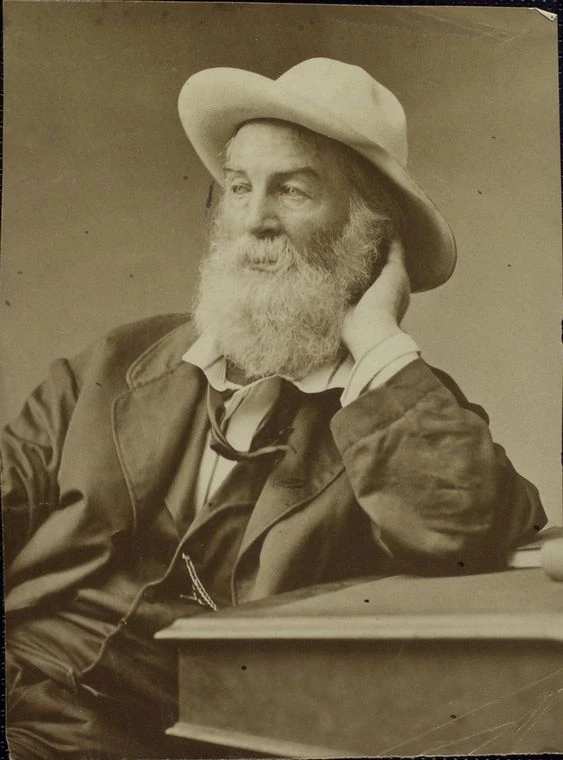
Walt Whitman. Photo credit: NYPL Digital Collections, Image ID: 437787

Web Literacy

In writing your literary commentaries you are using web pages and digital repositories (mostly the Walt Whitman Archive) as well as gathering information on the open web. We have talked about the skills of “surface” reading or skimming, as well as so-called “deep” reading. While the massive amount of information available on the web makes skimming a fundamental strategy––a strategy used by scholars, after all, in surveying the vast scholarly history of commentary on one subject or idea or question––deep (or critical) reading will often follow.  

As GenAI increasingly filters and organizes information we find on the open web it becomes increasingly clear that educated people need to think clearly and carefully about the information presented to them when they are seeking information or facts. In class we talked about peer review, and the role of experts in fields of expertise and knowledge.

My former colleague Mike Caulfield has some basic principles for searching for information on the web that he associates with “web literacy”: it includes 1) checking for previous fact-checking, 2) going upstream to the source, and 3) reading laterally. Here is how he elaborates his case in Web Literacy for Student Fact Checkers (2021):

What people need most when confronted with a claim that may not be 100% true is things they can do to get closer to the truth. They need something I have decided to call “moves.”

Check for previous work: Look around to see if someone else has already fact-checked the claim or provided a synthesis of research.

Go upstream to the source: Go “upstream” to the source of the claim. Most web content is not original. Get to the original source to understand the trustworthiness of the information.

Read laterally: Read laterally.[1] Once you get to the source of a claim, read what other people say about the source (publication, author, etc.). The truth is in the network.

Circle back: If you get lost, hit dead ends, or find yourself going down an increasingly confusing rabbit hole, back up and start over knowing what you know now. You’re likely to take a more informed path with different search terms and better decisions.

In general, you can try these moves in sequence. If you find success at any stage, your work might be done.

As information on the internet becomes increasingly organized for users by GenAI, these basic principles or habits will remain useful as you seek facts and information. They encompass some of what we have already talked about, including determining the provenance (origin, source) and the reliability (who and where) of the information, as well as the context (“truth is in the network”).

Links and Streams

When doing digital research it is useful to be aware of the distinction between how the information we access on the web is organized and distributed. What we find is determined by how we find it (or how it is found for us.)

Consider the link and the stream. As you continue your research, and poke around on the open web, you will be making use of hyperlinks or hypertext. In Education in the (Dis)Information Age, an essay I will use here to elaborate on using hyperlinks, the musicologist and digital media specialist Kris Schaffer writes that “if no one does this, or if they wait too long, the clickbait and conspiracy theories will win out.” One of the salient points Shaffer is making is that social media platforms

have worked hard to kill the hyperlink. Sure, there are plenty of links to click on, but they aren’t generated by users. Remember the difference between a link and a URL. I can paste a URL into a tweet or a Facebook post and it becomes clickable, but I cannot write in hypertext. I cannot annotate and link my writing with that of others. And including multiple URLs confuses the platforms! (It would be ironic that platforms whose financial well being is determined by clicks would have this problem — if we didn’t know better.) Social media are designed to share text, images, video, and articles, but not to write in hypertext — the language of the web. After all, if I actually click on all those links, I leave the platform… and take my ad-revenue-generating clicks with me.

The hyperlink is a simple and reliable method for digital citation that makes possible open access to distributed sites of information. It changes not only how we find things out, but at the same time how we read and think and write. The problem is that we have become increasingly habituated to proprietary platforms that only pretend to have our interests in mind. 

The problem is how we describe our digital lives. In simple terms, the metaphor of the web has been supplanted by the metaphor of the stream. In an essay in The Atlantic 2013: The Year “the Stream” Crested Alexi C. Madrigal writes, “The Stream has been the organizing metaphor for the web for the past several years.” Madrigal calls on Erick Schonfeld to explain how “Information is increasingly being distributed and presented in real-time streams instead of dedicated Web pages”:

Web companies large and small are embracing this stream. It is not just Twitter. It is Facebook and Friendfeed and AOL and Digg and Tweetdeck and Seesmic Desktop and Techmeme and Tweetmeme and Ustream and Qik and Kyte and blogs and Google Reader. The stream is winding its way throughout the Web and organizing it by nowness.

While these examples are dated (this was published in 2013) the enduring point is that the shift in the way we talk about and use the web matters. As the Iranian-Canadian blogger Hossein Derakshan writes in The Web We Have to Save, “The Stream now dominates the way people receive information on the web. Fewer users are directly checking dedicated webpages, instead getting fed by a never-ending flow of information that’s picked for them by complex –and secretive — algorithms.” Not unlike the meme “Kill Your TV,” a parallel instance for our age appears to be delete your Facebook account. The problem, as Derakshan explains, is the seductive efficiencies of digital technologies:

The Stream means you don’t need to open so many websites any more. You don’t need numerous tabs. You don’t even need a web browser. You open Twitter or Facebook on your smartphone and dive deep in. The mountain has come to you. Algorithms have picked everything for you. According to what you or your friends have read or seen before, they predict what you might like to see. It feels great not to waste time in finding interesting things on so many websites.

This situation is not unlike what Walker Percy described for us as “the loss of creature,” or the willingness to passively receive information and experience rather than actively struggling for it. After all, what exactly are we exchanging for efficiency? What we are missing? Percy would say agency and control. Indeed, the reach of what you are writing on a platform you control is not to be underestimated. Kris Schaffer proposes the following answer to the question:

Think about it this way. If I’m the first person to take a primary source, transcribe (or translate) it, and annotate it with hyperlinks, and my public, digital writing gains traction, it will fast become the go-to source at the top of the search results. My hyperlinks and commentary will become the portal to the resources that people engage to gain context, background, and nuance. It’s a tremendous responsibility, but also a tremendous opportunity, to connect my skills as an academic and a humanist to the issues of the day, in an attempt to bring nuance and truth to the public consciousness.

Shaffer concludes,

It’s time we brought back the hyperlink and learned how to really use it. It’s time we used information abundance to our advantage. And it’s time we disentangled our communications from platforms tuned for the spread of disinformation. The health of our democracies just might depend on it.

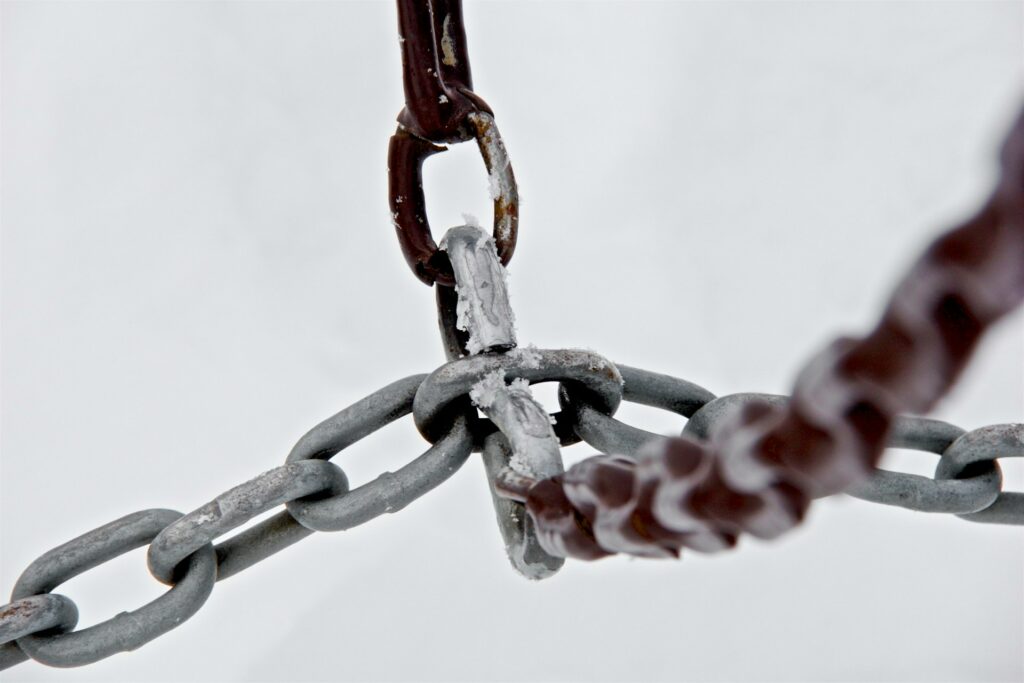
Photo credit: Photo credit: Bryson Hammer on Unsplash

In the context of academic writing, and with the advent of increasingly sophisticated GenAI platforms, the hyperlink makes visible a mind at work. As it happens, Ralph Waldo Emerson offers a nineteenth-century version of this visibility and the concept of networks–of words, thoughts, and texts––in his essay Quotation and Originality

All minds quote. Old and new make the warp and woof of every moment. There is no thread that is not a twist of these two strands. By necessity, by proclivity, and by delight, we all quote. We quote not only books and proverbs, but arts, sciences, religion, customs, and laws; nay, we quote temples and houses, tables and chairs by imitation.

Thinking and  Making. Architectonics. Houses and chairs. At the very least, we owe it to ourselves, and to our readers, to know where we are getting the information we use.

On Rediscovering the Network

What if we really did want to make durable and transparent connections across our experiences both in and outside the classroom? What if we really wanted to work together to build learning pathways, or a network, to integrate learning as well as to connect your college experiences to later stages of life or careers outside of school?

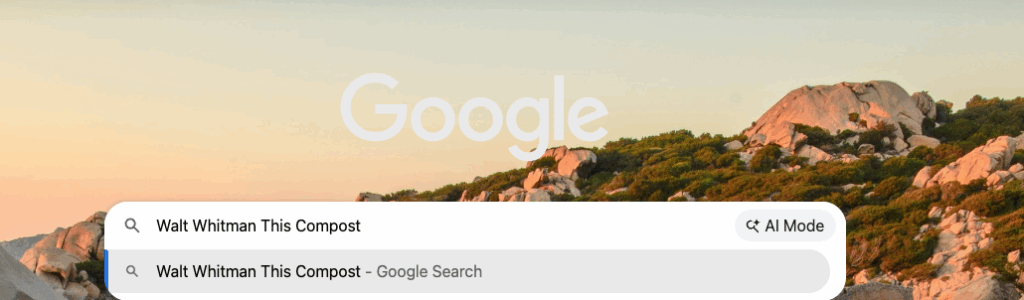
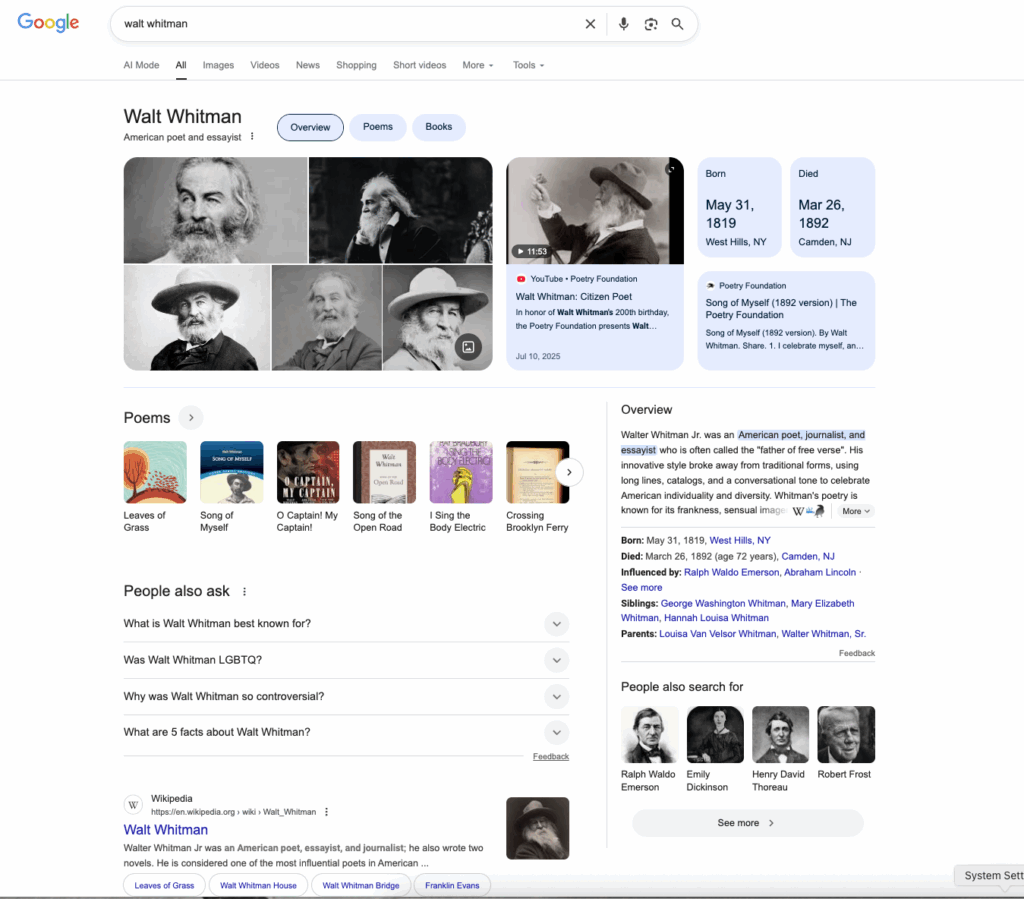
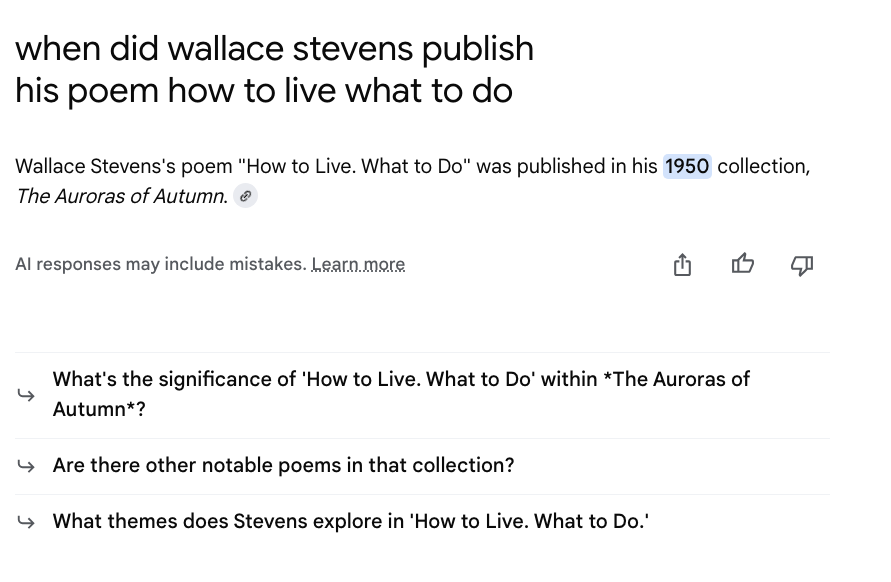
Consider the following examples using a search engine. First, a Google search, what some call “googling”:

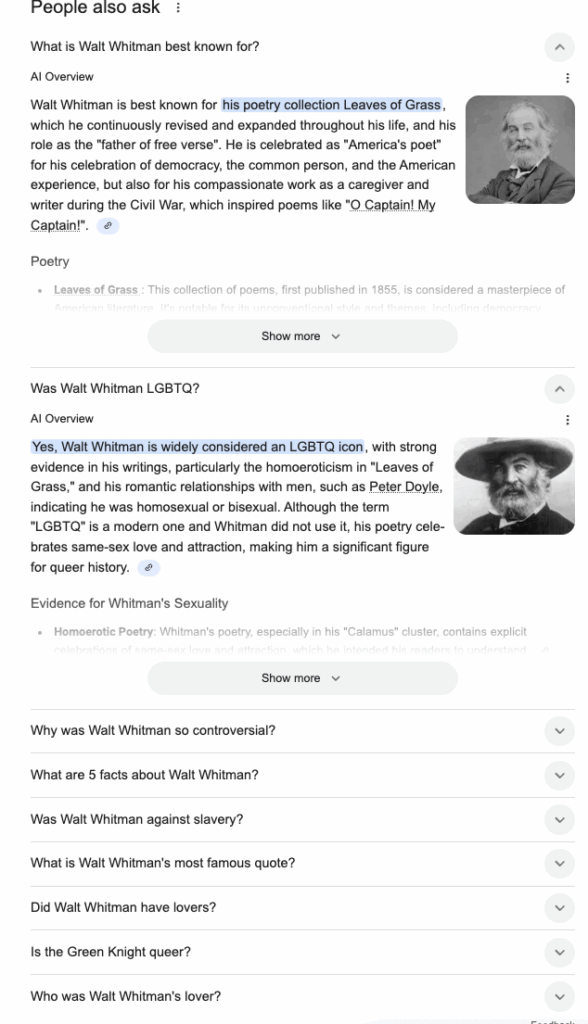
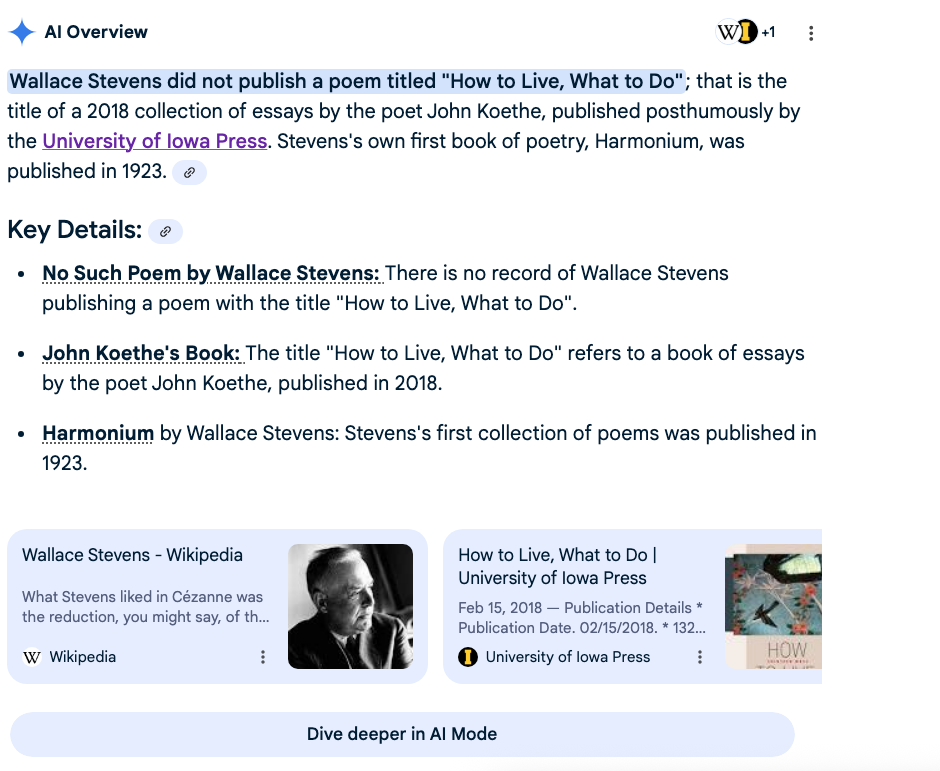
In this case (unless you turn it off) the web browser gives you at the top of your results a GenAI summary:

The rewards and the risks of the GenAI Overview are many

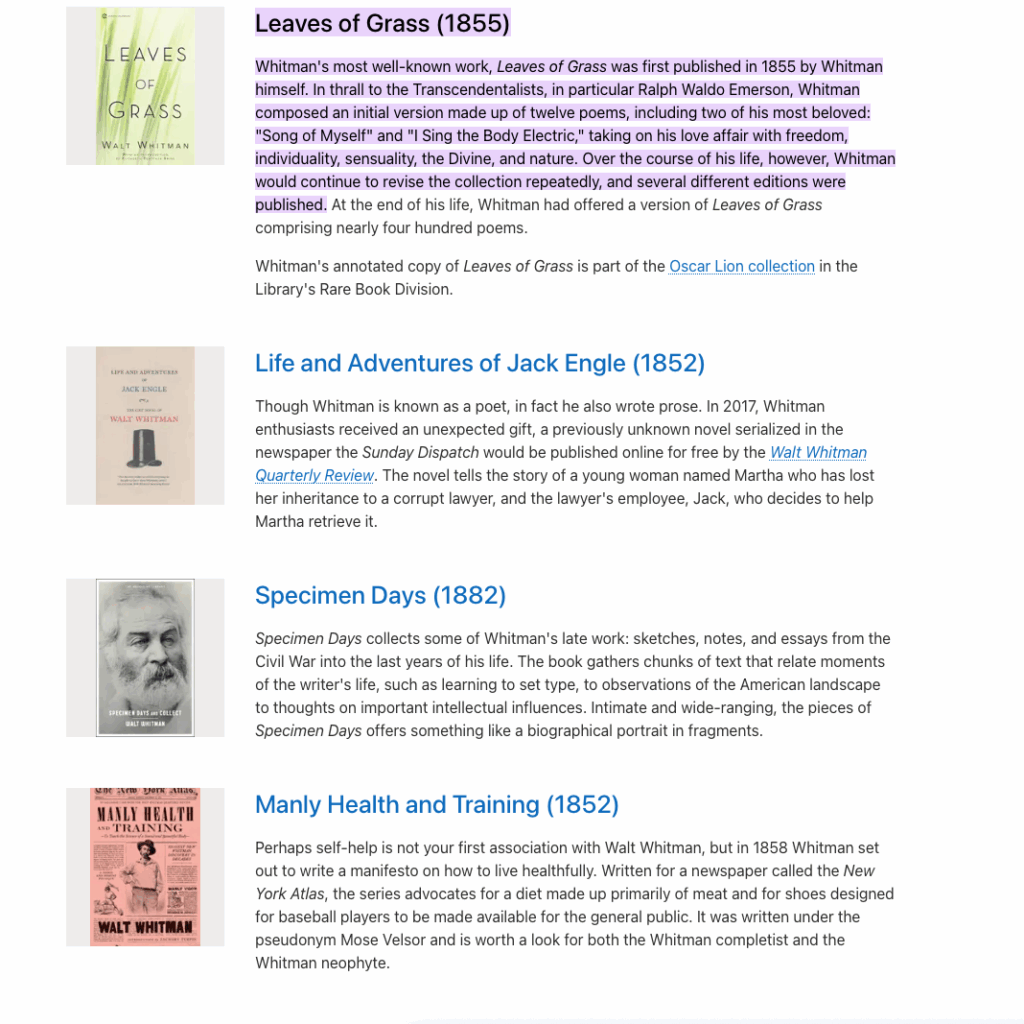
When a user clicks on the link icon they are rewarded with a drop-down list of sources. But who (or what) chose those sources. A predictive algorithm. How do we rank these sources in relation to others in terms of accuracy and reliability and comprehensiveness? If we step out of the GenAI stream (though of course our feet are still wet, as the machine is sifting and sorting and ranking web sites in the results!) we come to The New York Public Library > Where to Start with Whitman (link #13 of 14,400,000 results)

This is, by most measures, a bit more promising. For example, the “Manifesto” offers insights into Whitman’s fascination with the body and bodily health.

Of course networked learning, and the metaphor of the web as a network, has deep roots. The metaphor of Indra’s Jeweled Net, in the Atharva Veda and is used by the Buddhist Tu- Shun (557-640 B.C.E.) to envision a vast net that includes jewels at each meeting point that represent individual life forms (atoms, cells, units of consciousness) that are interconnected; so that a change in one is reflected in all the others. The metaphor has been used, more recently, to describe the complex interconnected networks formed by relationships between objects in a system, in computation, ecological thinking, and in accounts of social networks.

What I am wondering about here is whether this ancient surmise is one antidote to the modern pathology of thinking predicated on individual parts that fuels the individualistic and atomistic patterns of behavior that make it so very difficult to imagine ways to imagine, if not change, the conditions of our lives.

On Writing a Literary Commentary

“Not knowing where one is coming out is an essential part of the experience of thinking.”

—Reuben Brower

This post is in lieu of a demonstration in class. I am documenting how my interest in a poem by Walt Whitman leads me from one place to another. Read this post before class. We will dedicate all of our class time to your own process of gathering materials for your first commentary on a poem by Walt Whitman.

When I posted On Literary Form, Production and Reception a little over two weeks ago I started with a look ahead:

In our work ahead with the poems of Walt Whitman, you will be learning how to make use of primary and secondary materials. You will be learning to navigate a digital archive. And you will be learning to enlarge your attention to matters of literary form, production, and reception. These three coordinates are especially useful for readers in college and beyond: 1) paying attention to the way a text is put together, 2) exploring the conditions (social, historical, biographical, ideological) in which a text was produced by an author; and 3) considering the tradition of commentary, or reception, of a text.

Since then, you have read the 1855 edition of Leaves of Grass, read and considered a selection of Whitman’s prose writing, and considered a range of poets and artists and readers responding to Whitman. In Walt Whitman and Democratic Literacy, posted a few days earlier, on September 18, as we approached our extended study of Walt Whitman’s poetry and prose, I quoted my own words (from the course syllabus):

reading, thinking, and writing are by definition creative activities that we learn and refine as we develop as human beings. In reading we learn to process language and information, access ideas, and open ourselves to minds and worlds that differ from our own; in thinking we learn to recognize patterns, make inferences, and evaluate evidence, as well as to access concepts and principles, understand cause and effect, temporality, and to consider moral and ethical questions in the complex situations we face in our lives; and in writing we discover and formulate and learn to share thoughts and ideas, communicate with different audiences, and learn to use language and discourse effectively in differing rhetorical contexts.

In the more recent Caution: Under Construction I focused attention on starting with a text, in this case Whitman’s speculative essay Democratic Vistas. My other purpose was to sound a cautionary note on approaching a text through the stories of other readers who have read Democratic Vistas. Our class discussions of Democratic Vistas were delightfully productive. The work we did with the passages that you chose from the text invited you to begin moving from your reading experience to the kinds of questions that come up in reading: questions about literary form, production, and reception.

In describing this work I was encouraging you to build out from your reading through primary and secondary materials in the digital archive. In class, I did a basic search for the primary document: Complete Prose Works > Democratic Vistas (pp. 203–58). I demonstrated how to find versions of the manuscript: Index of Works > Democratic Vistas. This path offered access to all known versions of the essay, organized by the section in which they appear on the Archive (20 primary documents). I noted that the search results included 5 secondary commentaries. I followed another pathway, too: Literary Manuscripts > Integrated Catalog of Walt Whitman’s Literary Manuscripts > Democratic Vistas (20 items). I then said, “Pay careful attention to the intertextual pathways above. They are ways to navigate the archive that you will be using during the next few weeks as you begin writing descriptive commentaries on Whitman’s poems.”

Making Connections

In other words, for nearly a month we have been preparing for the work you are doing right now. And as I have been saying and demonstrating––and as you have been doing in our in-class search workshops––there are many entry points for you as a reader and writer studying a poem by Walt Whitman. These pathways to materials in the Archive include the following.

  • Home > Published Writings > Works
    Clicking on a title allows a user to produce a list of all writings, published or unpublished, that are known to be related to a given work.
  • Home > Integrated Catalog of Walt Whitman’s Literary Manuscripts
    The Integrated Catalog combines the catalogs of each repository, describing all of Whitman’s literary manuscripts, organized around the concept of Whitman’s “works.”
  • Home > Reviews (1855-1892)The reviews collected here include all of the items found in Walt Whitman: The Contemporary Reviews, ed. Kenneth M. Price (Cambridge University Press, 1996). This digital version of the print text includes more than 100 other reviews that were not included in that volume because of space considerations or because they had not been discovered.
  • Home > Selected Criticism
    This section of the Archive offers a sampling of copyrighted criticism, some out-of-copyright commentary, and selected full-length book studies by several scholars.
  • Home > Bibliography
    Includes articles, books, chapters of books, and poems about Whitman, published from 1838 to the present.

Of course knowing where to start will not take you where you are going. For as the teacher Reuben Brower reminds us in the epigraph to this essay, “Not knowing where one is coming out is an essential part of the experience of thinking.”

The “experience of thinking” is what college is (or should be) all about. The more thinking you do, the more competent your thinking will be. And good thinking, for the most part, leads to good (or effective) writing. People who teach talk about “critical” thinking and “creative thinking.” You will hear these terms a lot. But I prefer to start with the more basic term “thinking.” I start this way because creative thinking is most often critical and critical thinking is at its best creative.

One way to go about the process of writing about a poem by Walt Whitman is to follow the steps outlined in the assignment. Some students benefit from these kinds of outlines or rubrics. (This is why I write out the outline or rubric.) But genuine inquiry (or “research”) is a process that, for most of us, does not unfold in a step-by-step manner. Rather, the process involves the creative (and critical) work of making connections. It involves making abductive leaps (guesses) about particulars and relations that lead to finding out new information that unsettles the information you have already gathered.

Writing a literary commentary, then, is a process of thinking. I am especially fond of Annie Dillard’s concise description of the thinking and writing process in her book The Writing Life: “Make connections; let rip; dance where you can.” Making connections, letting your mind rip, and dancing where you can: this is precisely the creative work Emerson described for us as a mind “braced by labor and invention.” But remember what I said in class, it all begins with your interest. Your interest is where the process begins.

So that you will have the time and space to follow your interests during our time in class, in what follows, I am going to make some connections. I’m going to start with a poem I first mentioned in our reading of the first edition of Leaves of Grass, “The Sleepers.” Since I first read it, this poem has fascinated me. So let me see what I can find.

1. “The Sleepers”

A search in the Archive turns up “Sleepers, The (1855)” in Walt Whitman: An Encyclopedia that is available here. I learn that the poem had different titles, “Night Poem” (1856) and in the 1860 and 1867 editions the title is “Sleep-Chasing.” (Here I am documenting what I found out about the textual history.) There are a number of other fascinating details about the making of this poem in the entry by Burton Hatlen, including the context in which the poem was written and the reception of the poem among Whitman’s readers. (Let’s remember that these are the three elements of the literary commentary you will be writing.)

Another entry in the Encyclopedia is an account of the poem, “Thou Orb Aloft Full-Dazzling (1881).” From this overview by David B. Baldwin, I navigate from Literary Manuscripts > Integrated Catalog of Walt Whitman’s Literary Manuscripts > item: “Thou Orb Aloft” and I find myself looking at a two-page draft of a poem published first in 1881 as “A Summer Invocation.” This would be the poem that would be published later that year under the title “Thou Orb Aloft Full-Dazzling.”

2. “Miracles”

Another poem that interests me in Leaves of Grass is Miracles. What is a miracle, anyway? And what an amazing thing Whitman says in the second line of the poem, “I know nothing else but miracles.” And the last line! Wow.

These comments are what we called “marginal” comments (marginal thinking) But I find myself thinking beyond first thoughts to second thoughts. What is a “miracle” anyway? Perhaps more importantly for my purpose (as a reader of Whitman’s poem writing a commentary) what did this term miracle mean to people in the nineteenth century? Here I am trending to asking the kinds of questions we answer using what we called “annotation.” As I begin thinking, making connections, I recall that according to the New Testament, some guy named Jesus was known to be involved in a bunch of miracles. But wait, I am now thinking, what about Whitman and religion? Have other readers of Whitman asked this question?

The Walt Whitman Archive turns out to be an amazing resource for asking these kinds of questions. A term search in the Archive for religion dredges up 505 results. The results include “prophecy,” “The Revival Movement,” and “Metaphysics.” There are potentially useful lines from section 7 of Starting from Paumanock that turn up in the results as well:

I too, following many and follow’d by many, inaugurate a religion,  
 I descend into the arena,
(It may be I am destin’d to utter the loudest cries there, the win 
 ner’s pealing shouts,
Who knows? they may rise from me yet, and soar above every thing.)


Each is not for its own sake,
I say the whole earth and all the stars in the sky are for religion’s  
 sake.

I say no man has ever yet been half devout enough,
None has ever yet adored or worship’d half enough,
None has begun to think how divine he himself is, and how cer- 
 tain the future is.

I say that the real and permanent grandeur of these States must  
 be their religion,
Otherwise there is no real and permanent grandeur;
(Nor character nor life worthy the name without religion,
Nor land nor man or woman without religion.)

But where do I find myself with this gathering of information? Well, I have moved from where I was to where I am now: 1) I have found my way to another spectacular poem by the poet and 2) in asking about religious discourse (“miracles” etc.) I now have a search term: religion that leads me to an entry by David Kuebrich in the Walt Whitman: An Encyclopedia. The entry is useful for expanding my awareness of the social and cultural and religious discourse circulating in the nineteenth century, a discourse that may turn out to be of use for my understanding as I seek to get an overview of Whitman’s “religious vision” and what Whitman called in section 41 of “Song of Myself” (I am reminded by Kuerich) his “rough deific sketches.”

Now back to the poem and Leaves of Grass. I realize that I need to think about the poem in a book, and more specifically where Whitman placed the poem in the sequence. It turns out it is poem 21 in the 38-poem sequence “Autumn Rivulets.” It appears after Thought and before Sparkles from the Wheel. Then I notice something else. And it might (or might not) lead me somewhere (another connection, or not!).

There is a poem called To Him that was Crucified. Ok. So? Well, what I now know is that there is another poem in the Autumn Rivulets cluster of Leaves of Grass with a potentially related title To Him that was Crucified. I make an inference: the “Him” is the special guy in the Christian scriptures associated with miracles.

I am moving. It turns out, too, that there is in the results an encyclopedia entry on poem “Miracles” (1856). Reading this material leads me to another question: what are other instances of Whitman using the word “Miracles” in his poetry, prose, correspondence, or notebooks? A single-term search Whitman Archive > “Miracles” turns up 210 Results. Then I circle back to primary documents. I go to Home > Literary Manuscripts > Integrated Catalog of Walt Whitman’s Literary Manuscripts > Miracles and I am looking at 6 items: notebook entries [“Poem incarnating the mind”] and [9th av.] draft prose manuscript [“The Genuine Miracles of Christ”], manuscript page [“Such boundless and affluent souls”], and poem [“sea-cabbage”].

The title search includes a letter Marilla B. Minchen to Walt Whitman, 4 November 1891. It turns out that the admiring letter––her penmanship is spectacular––refers to the poem “Miracles” and includes other interesting information. (The pathway is Home > Letters > Correspondence.)

The search results also include a contemporary review of Leaves of Grass (Anonymous, 7 July 1860) that is, well, less admiring:

This is more decided language than we generally employ, and our readers may ask us for some justification of it. Let us remind them of Lord Macaulay’s description of Wycherley, which we can certainly apply to Walt Whitman. “His indecency is protected against the critics as a skunk is protected against the hunters. It is safe because it is too filthy to handle, and too noisome even to approach.” There are certain criminals whom even literary judges must try with closed doors, and our readers must deduce from our verdict that “the evidence is unfit for publication.” We say, then, deliberately, that of all the writers we have ever perused, Mr. Walt Whitman is the most silly, the most blasphemous, and the most disgusting; if we can think of any stronger epithets, we will print them in a second edition.

(Anonymous.) “Leaves of Grass.” The Walt Whitman Archive. Gen. ed. Matt Cohen, Ed Folsom, & Kenneth M. Price. Accessed 06 October 2026. <http://www.whitmanarchive.org> 

Let’s consider this as an exemplary moment in the history of literary reception. It is a good example of a reader who is apparently challenged by Whitman. He considers Whitman an interloper, and he defends a set of cultural commonplaces about literature and decency and so on. (I am now connecting this to the passages in Democratic Vistas that we read about the people who are defending the status-quo and Whitman’s call for what he calls, rather elusively, “orbic literature.”)

But does all of this get me further down the road or closer to what I might be looking for? (Most often in this kind of research, after all, most of what one finds will not be used in the final commentary on the poem.) Then I go back to Commentary > Selected Criticism to look for some more information to understand the social and historical moment. In one of the results I find a reference to the term “spiritual” and to “spiritualism.”

So I pull my anchor and head out of the safe archival harbor onto the open sea of the world wide web. First, I settle on a Wikipedia page Spiritualism (beliefs) and another page Spiritualism (movement). The former has key terms that help me in my inquiry into my poem “place”Miracles,” terms such as “metaphysical,” “matter” and “spirit.” There is also a brief note about the 18th-century spiritualist Emanuel Swedenborg. I look for Swedenborg in the Archive (24 results) and find an article likely written by Whitman, Who was Swedenborg? The latter entry is fascinating, but the movement and the discourse seems to be Whitman adjacent, though it is the discourse of Whitman’s age.

Then I remembered that Whitman talks about religion and literature and culture in Democratic Vistas,

The altitude of literature and poetry has always been religion—and always will be. The Indian Vedas, the Nackas of Zoroaster, the Talmud of the Jews, the Old Testament, the Gospel of Christ and his disciples, Plato’s works, the Koran of Mohammed, the Edda of Snorro, and so on toward our own day, to Swedenborg, and to the invaluable contributions of Leibnitz, Kant and Hegel—these, with such poems only in which, (while singing well of persons and events, of the passions of man, and the shows of the material universe,) the religious tone, the consciousness of mystery, the recognition of the future, of the unknown, of Deity over and under all, and of the divine purpose, are never absent, but indirectly give tone to all—exhibit literature’s real heights and elevations, towering up like the great mountains of the earth.

This is one of two mentions of Swedenborg in Democratic Vistas. I find this out by doing a term search in the digital copy of the text. A rabbit hole, we often say. But then I am hearing the words of Adrienne Rich: “but these are the materials.” And I am sensing that this material will help me with talking about the poem I have chosen in the paragraph of my commentary that provides the social/historical/cultural context.

What I want, though, is to get closer to this discourse. I need to provide some descriptive context for the poem. The list of references and further reading in the Spiritualism (movement) page on Wikipedia is super helpful. And my take way is a book Miracles and Modern Spiritualism (1896) by the evolutionary biologist Alfred Russel Wallace that is available to read at the Internet Archive. Maybe I will find in this work a useful way to situate Whitman (and his poem) in the religious discourse of the time–especially since he is using religious discourse and referring to religions throughout his corpus.

Finding Commentary

The other domain of interest I need to follow to write an effective descriptive commentary on my poem “Miracles” is how the poem has been read by others(informed readers and critics) in the twentieth- and twenty first century.

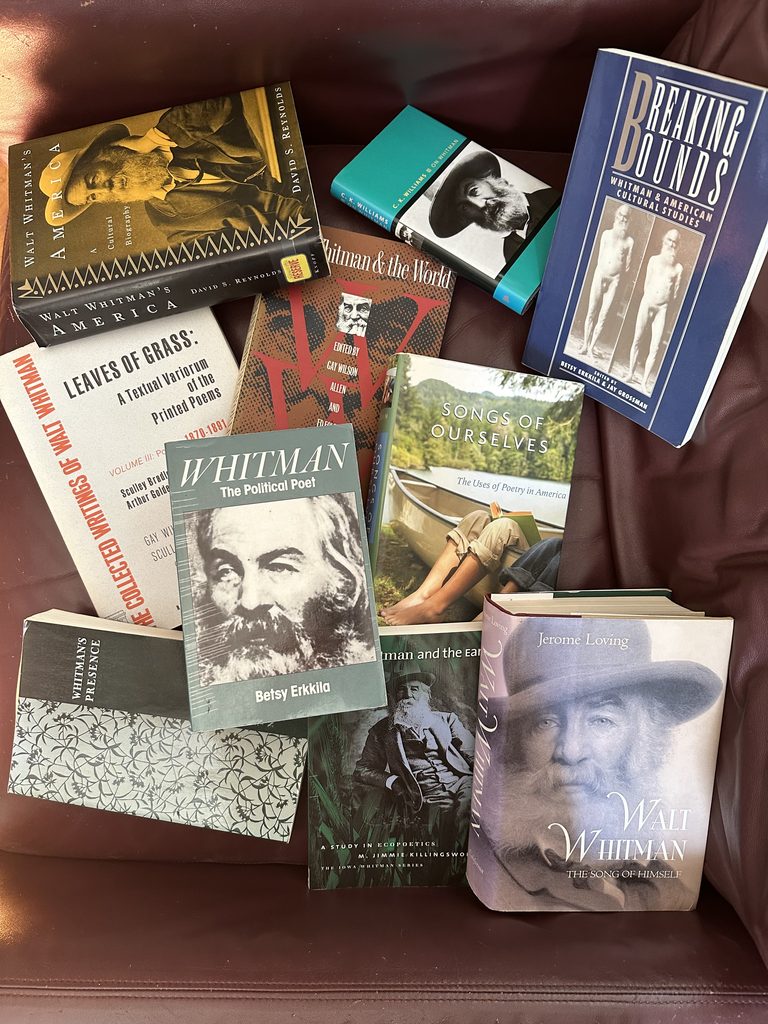
One place to travel is the Archive bibliography. Bibliography > Title Search. “Miracles” turns up 12 results with some excellent secondary sources. Another other pathway is Home > Selected Criticism where I find access to a sampling of copyrighted criticism and some out-of-copyright commentary, and full-length book studies:

Books

  • Killingsworth, M. Jimmie. Walt Whitman and the Earth: A Study in Ecopoetics (Iowa City: University of Iowa Press, 2004). HTML PDF (2 instances of word miracles)
  • Allen, Gay Wilson, and Ed Folsom, ed. Walt Whitman & the World (Iowa City: University of Iowa Press, 1995). PDF (9 instances, mention of poems in lists)

    Articles
  • “Just when all seems lost, he is redeemed by the miracle of a touch: “He ahold of my hand has completely satisfied me.” Only the experience of love can confirm reality. The speaker’s newfound wisdom is an intuitive knowledge, beyond reason and verbal expression” (np).
  • Walt Whitman: An Encyclopedia , ed. Donald D. Cummings and J.R. LeMaster (New York: Garland Publishing, 1998)
  • Mattausch, Dena. “”Of the Terrible Doubt of Appearances” (1860).” The Walt Whitman Archive. Gen. ed. Matt Cohen, Ed Folsom, & Kenneth M. Price. Accessed 06 October 2026. <http://www.whitmanarchive.org>.

    Beyond the Archive

For your commentaries, I encourage you to pack up some provisions and head out beyond the archive. The Mason Library is one of the places to go. The other destination is the wide open web.

Mason Library

Author name search Walt Whitman (About 49,600 results in Libraries Worldwide)
Filter to Keene State College Mason Library (About 250 results), print with call number and digital texts (ebooks)
Filter Books (92 entries)
Filter emusic

Articles in Database (Academic Journals, Magazines)
Walt Whitman Quarterly Review 
Search for Whitman at  EBSCO Database (373 results, filter for work to narrow)

Web Search (Google Chrome)
Author names search: Walt Whitman (About 14,600,000 results (0.27s) )
Author and title search Walt Whitman and “Miracles” (About 209,000 results (0.27s) )

*Google Scholar*
(Nb: Google Scholar is a useful research filter for students and scholars. Some of the items that you turn up will be full-text. digital and/or print, whereas other will need to be found in a database or, for more involved projects, using the Mason Library’s interlibrary loan services.)

Walt Whitman (articles: About 164,000 results (0.12 sec))
Walt Whitman and Miracles (sort by relevance 18,600 results (0.13 sec))

I look at the results, and turn up the following two (potentially useful) items:

  • Whitman, Walt. The Sea Is a Continual Miracle: Sea Poems and Other Writings by Walt Whitman. Brandeis University Press, 2017. (anthology)
  • Chesnick, Eugene. “Whitman and the Poetry of the Trillions.” Walt Whitman Quarterly Review 22.1 (1976): 14.

We could keep going. As there are places to go. But this is merely a preamble to your own work. On Thursday we will devote the entire class to your work. You can learn from another, I will circulate and answer questions and provide assistance.

Poetry as a Way of Knowing: Democracy

“This revolution is to be wrought by the gradual domestication of the idea of Culture. The main enterprise of the world for splendor, for extent, is the upbuilding of a man. Here are the materials strown along the ground.”

––Ralph Waldo Emerson, The American Scholar, 1837

I don’t want to know
wreckage, dreck, and waste, but these are the materials
and so are the slow lift of the moon’s belly.
over wreckage, dreck, and waste, wild treefrogs calling in
another season, light and music still pouring over
our fissured, cracked terrain. (4)

. . .

Flags are blossoming now where little else is blossoming
and I am bent on fathoming what it means to love my country.
The history of this earth and the bones within it?
Minerals, traces, rumors I am made from, morsel, minuscule
fibre, one woman
like and unlike so many, fooled as to her destiny, the scope of
her task?
One citizen like and unlike so many, touched and untouched in passing…
A patriot is not a weapon. A patriot us one who wrestles for the
soul of her country
as she wrestles for her own being, for the soul of his country…

Where are we moored?
What are the bindings?
What behooves us? (23)

. . .

FINAL NOTATIONS

it will not be simple, it will not be long
it will take little time, it will take all your thought
it will take all your heart, it will take all your breath
it will be short, it will not be simple

it will touch you through your ribs, it will take all your heart
it will not be long, it will occupy your thought
as a city is occupied, as a bed is occupied
it will take all your flesh, it will not be simple

you are coming into us who cannot withstand you
you are coming into us who never wanted to withstand you
you are taking parts of us into places never planned
you are going far away with pieces of our lives

it will be short, it will take all your breath
it will not be simple, it will become your will (57)

––from Adrienne Rich, An Atlas of the Difficult World: Poems 1988–1991 (1991)

**

“Democracy is a way of life controlled by a working faith in the possibilities of human nature. Belief in the Common Man is a familiar article in the democratic creed. That belief is without basis and significance save as it means faith in the potentialities of human nature as that nature is exhibited in every human being irrespective of race, color, sex, birth and family, of material or cultural wealth.”

“Democracy is a way of personal life controlled not merely by faith in human nature in general but by faith in the capacity of human beings for intelligent judgment and action if proper conditions are furnished. I have been accused more than once and from opposed quarters of an undue, a utopian, faith in the possibilities of intelligence and in education as a correlate of intelligence.”

John Dewey, Creative Democracy: The Task Before Us (1939)

**

Democracy at The Poetry Foundation: poems and commentary

  • Langston Hughes, Let America be America Again (1935)
  • Alan Ginsberg, America (1956) 

    (Democracy, Culture (democratic culture): What is democratic culture? How is it (or how might it be) different from other forms of culture? What opportunities, roles, responsibilities and/or obligations are associated with life in a democratically organized society? In what forms do we find expression of democratic ideals, values, and practice? How do individuals come to organize their lives around a belief in the ideals of democracy? How do we live with the ideal and the fact—the possibilities, for example, of the logic of equality and the persistent fact of inequality? And so on. . . .)

**

The pickerel
swims up from the pond from its roses of slow decay, and
looks at me
astonished.

What is it I need to know?

The gypsy moths, still caterpillars,
wrench themselves from the milky shreds of birth
and set out on the long journey
in the shining tree.

What is it I don’t know that I need to know?

––Mary Oliver, from “Evening Star “(Part 11), The Leaf and the Cloud, p.52

Caution: Under Construction

This post is focused on preparing for a class reading of Walt Whitman’s prose work Democratic Vistas (1871): enacting the time-honored and utterly audacious activity of reading a book together.

On Starting with the Text

On the one hand, I asked you to start with text so that you refrain from seeking an account of another person’s reading to stand in for your own. This method is the (democratic) method of Whitman’s call for “complete” readers. As he says near what he calls the “apex” of Democratic Vistas, as readers, each of us, and together, must “construct indeed the poem, argument, history, metaphysical essay—the text furnishing the hints, the clue, the start or frame-work.”

In this remarkable passage, Whitman challenges a commonplace assumption about books. “Not the book needs so much to be the complete thing,” he says, “but the reader of the book does.” And he goes further, calling for a collective of readers: “That were to make a nation of supple and athletic minds, well-train’d, intuitive, used to depend on themselves, and not on a few coteries of writers” (133–34; all page references will be to the printed edition we are using in your class). I have quoted from his text to call our attention to his argument about the collective of literate persons, again, with “supple and athletic minds, well-train’d, intuitive, used to depend on themselves.”

In an essay I published a few years ago,  Close Reading at the End of Time, I made a comparable argument for this idea of reading together. I write that we would do well to envision

the literary work of close reading as more than an event of the text and the reader but rather a more complex attending to the event of reading as situating the reader—in a community, that is, beyond the self. Or as Matthew Crawford argues in The World Beyond Your Head, as individuals, “we find ourselves situated in a world that is not of our making and this ‘situatedness’ is fundamental to what a human being is.” (26)

When we “start with the text,” on the other hand, of course, we are starting where we are: embedded in our history of experience with language, reading, and boundlessly prepared with a bundle of historical and social expectations that, when challenged, leave us entangled in the fact of the matter at hand: ourselves. But in “starting with the text” we are not starting with David Bromwich’s (excellent) introduction to the book On Democracy: Walt Whitman. Rather we will begin on page 33 in our editions, under the title in boldface text Democratic Vistas, with the first words of the essay: “AS THE GREATEST LESSONS OF NATURE through the universe are perhaps lessons of variety and freedom, the same present the greatest lessons also in New World politics and progress.”

On Starting with Words about Words 

When we choose not to start with a text (words) we most often begin with someone’s else’s reading of the text (words about words). Let’s say I open a web browser (say Chrome) on a search engine (say Google) and do a title search for what I am reading. I receive an index of web pages. An algorithm has organized what arrives in your search window based on data, including data about you and your habits––location, search history, and so on. (Caveat emptor, or “let the buyer beware”: your search engine is neither neutral nor disinterested portals to information you might be looking for; rather, they make money from advertising things.)

When I typed into my browser “Democratic Vistas” it took 0.74 seconds for me to receive about 1,230 results. The first link is an encyclopedia entry on the essay, “Democratic Vistas [1871],” by Arthur Wrobel, a pre-print electronic copy of Walt Whitman: An Encyclopedia, ed. Donald D. Cummings and J.R. LeMaster (New York: Garland Publishing, 1998), at the by now familiar!  Walt Whitman Archive. Wrobel was a member of the English department faculty, at the University of Kentucky, Lexington. (Below this first entry, I scan the 11 citations in the bibliography that follow. The list includes an essay by my dear friend James Perrin Warren, “Reconstructing Language in Democratic Vistas” in the book Walt Whitman: The Centennial Essays. Jim happens to be a retired professor who taught at Washington and Lee University.)

But before this first hyperlink there appears an “AI Overview.” This calls (or pulls?) my attention to other places. One of them is a short (4:19 ) YouTube “Summary and Analysis of ‘Democratic Vistas’” on a channel by Stanley St. Rose. Why wonder, I thought, so I looked for a brief bio so that I knew who was sharing the summary and analysis (Lessons 1, think about the author and their authority and the “container” of the information, in this case YouTube). I found it in the channel profile description. “Jesus Christ is Lord!!! From Christ and the Bible to everyday life, on this channel, I like to talk about all things. So, if you would like to join me please leave a like, comment, and subscribe.” Turns out the guy likes to post summary and analysis, and there is a timeline and a transcript.

The other source (“above the fold,” as people say about the lead stories on the top of a printed newspaper) is a book-length commentary on Whitman’s “Democratic Vistas” at the web site of the Cato Institute (container, check) an American Libertarian think tank, founded in 1977, based on Washington D.C. The commentary is edited with six brief introductions––inserted into Whitman’s text by Anthony Comegna (author, check), the Assistant Editor for Intellectual History at Libertarianism.org. Comegna received an M.A. (2012) and Ph.D. (2016) in history from the University of Pittsburgh, where he specialized in early American, intellectual, and Atlantic history. For the Cato Institute and Libertarianism.org, he produces regular historical content, columns, and scripts for the “Classics of Liberty” podcast.

In his penultimate headnote, “Mother of the True Revolutions,” Comegna concludes, “Whitman’s Democratic Vistas was both prophetic and naïve” (72). And in the final note, “The Whole Orb, Comegna’s framing is stated clearly and directly, as he pauses with his readers to “reflect on the great poet’s dual role as a restless, progressive, almost futurist libertarian and yet a harbinger of the sort of romantic democratic nationalism that has characterized American life—and American imperialism—ever since. Whitman’s life was absorbed with the twin pursuits of producing original American national art and decades of political activism for radical libertarian causes.” Then, at the end of the book, printed on one of the final leaves, is the following statement:

Libertarianism.org Liberty. It’s a simple idea and the linchpin of a complex system of values and practices: justice, prosperity, responsibility, toleration, cooperation, and peace. Many people believe that liberty is the core political value of modern civilization itself, the one that gives substance and form to all the other values of social life. They’re called libertarians. Libertarianism.org is the Cato Institute’s treasury of resources about the theory and history of liberty. The book you’re holding is a small part of what Libertarianism.org has to offer. In addition to hosting classic texts by historical libertarian figures and original articles from modern-day thinkers, Libertarianism.org publishes podcasts, videos, online introductory courses, and books on a variety of topics within the libertarian tradition.

If I were doing a workshop on “media and information literacy,” we would be talking about authority and reliability of information. We would talk about how information is constructed (for example, by experience and expertise) and contextual (It really does matter, for a number of reasons, who is writing or saying something, their purpose for writing or saying, and the “container” of the information, whether a YouTube channel or a Washington-based think tank).

On Working in the Walt Whitman Archive (1)

We have been starting to work in the Walt Whitman Archive. Last week, we did an in-class workshop, in which I asked you to

    1. Choose a line (or lines) from one of the poems we have read today:  I Celebrate Myself (13–56) and Come Closer to Me (57–64) in Leaves of Grass (1855)
    2. Copy and paste (or transcribe line(s) into a document
    3. Search for interesting/relevant information about the lines (form, production, reception) in the Walt Whitman Archive
    4. Document what you find, and include links to the page(s) you discover in a document
    5. Upload your working document to Google Folder Walt Whitman Archive Workshop #1 Fall 2026

One of the inquiries began with lines chosen from “Come Closer to Me” (that would be incorporated into the poem “The Sleepers”) :

“If you remember your foolish and outlawed deeds, do you think I cannot remember
my foolish and outlawed deeds?
If you carouse at the table I say I will carouse at the opposite side of the
table;
If you meet some stranger in the street and love him or her, do I not often meet
strangers in the street and love them?” (1855 58)

After circulating in class, and talking with most of you, I typed these lines from Whitman’s poem into my browser and was presented with the following information in the “AI Overview”:

I’m really not sure what is meant here by “famous.” And what I “learned” has no reliable provenance. Who says this? Where? If I were to inquire further, say, using the Whitman Archive, I would encounter a number of problems. While the lines (called “the quote”) are supposed to be in the 1885 edition, it turns out that the poem “The Sleepers” did not appear in the 1855 edition. Here is what a scholar (Burton Hatlen) says:

The poem that has become known as “The Sleepers” was first published as the fourth of the twelve untitled poems in the 1855 edition of Leaves of Grass. In the 1856 edition it became “Night Poem,” and in the 1860 and 1867 editions it is titled “Sleep-Chasings.” It acquired its final title in the 1871 edition. (The Table of Contents of the 1855 edition in an editorial apparatus added for help with navigating the content of the volume. For the Complete Edition has only “Leaves of Grass” diving the lines into discrete sections. There are no titles.)

The next step is to look for the lines. It turns out that a quick search will show that the lines actually appear in the second poem in the 1855 sequence, what in the editorial scheme of adding titles is “Come Closer to Me.” (A finding such as this is one of the reasons our exercise asked us to work in the Walt Whitman Archive.) If you trace the lines you will follow them into Poem of The Daily Work of The Workmen and Workwomen of These States (1856) that would later become part of the first numbered section of A Song for Occupations in the final edition of Leaves of Grass (1891–92).

Now back to our in-class workshop. What was of interest to the readers of these lines was Whitman’s use of “I” and “you.” It turns out that these terms (and their relations) are at the center of Whitman’s poetics; and they have been a preoccupation of Whitman’s readers and in the secondary commentary on his work. I suggested looking at another poem and we turned to a particular moment I suggested in the poem Crossing Brooklyn Ferry in the 1891–1892 edition of Leaves of Grass:

It avails not, neither time or place—distance avails

not,

I am with you, you men and women of a generation,

or ever so many generations hence,

I project myself—also I return—I am with you, and

know how it is.

Just as you feel when you look on the river and sky,

so I felt,

Just as any of you is one of a living crowd, I was one

of a crowd,

Just as you are refreshed by the gladness of the river,

and the bright flow, I was refreshed,

If you are interested in Whitman’s relationship with his reader, these lines are fascinating. If you are interested in finding out more about the “I” and the “you” and their relations, there are many place to go in the Archive.

In our Google document, though the lines from Whitman are followed by a link to a “web log” or blog. The link is to an April 2020 post on My French Quest: Adventures in Literature, French Culture and Language Acquisition. The post is a reflection on the poem “Whoever You Are Holding Me Now in Hand.” The personal mediation by a reader on the “I” and the “you” and their relations, with sentences that make statements about the matter at hand, such as “Whitman sees his readers as an active audience,” is evidence of an engaged and relatively informed reader sharing her interesting insights on the open web.

As you can see, we are back to another case study in the lesson that “authority and reliability are constructed (for example, by experience and expertise) and contextual (it really does matter who is writing or saying something and their purpose for writing or saying).” Farah and Olivia (our students in this story of poking and prying with a purpose) offer a concise summary of the author’s point:

  • In this article the author is explaining how Whitman sees his audience as an audience. Whitman is the speaker, we are the audience. He wants us to feel connected to him that the distance between him and his audience isn’t that far.

The author of the blog post (“Robyn”) is a widely-read writer sharing descriptive and interpretive adventures with authors and texts. It is self-published, by an author with linguistic expertise, that would be useful for readers and, perhaps, in certain kinds of academic and literary projects.

On Working in the Walt Whitman Archive (2)

But back to the search results and the 1,230 results. Below the fold—tucked under the featured AI-generated material, in the right window box, is a link to the brief Wikipedia entry (overview) article Democratic Vistas. It lists the publication year as 1871, and the author, Walt Whitman. So far so good. But then it lists the genre, “Poetry.” (Democratic Vistas is a work of prose.)

What follows is a link to an original facsimile edition, edited by the Whitman scholar Ed Folsom, published by the University of Iowa Press. Then a Pdf of the book at the Internet Archive, from the nineteenth century, with an inscription by the author, a lovely edition indeed.

Now back to where we started, and where I want us to play. The Walt Whitman Archive. A quick scan of the History of the Project will give you a sense of the integrity of the Archive and there is a fine description of its purpose:

Whitman scholarship is thriving: he remains one of the most discussed figures in American literary and cultural studies. Despite his prominence it has been difficult to study the evolving nature of his work because several of the important editions of Leaves of Grass have been inaccessible unless you happen to teach at a research library with a strong rare book room.

Curiously, scholarship has largely ignored Whitman’s poetry manuscripts in part because of related problems of access. The manuscripts are scattered widely at over sixty different libraries. Our work on the manuscripts, once completed, ought to significantly alter the conversation about the nature of Whitman’s creative process, his compositional practices, and the meaning of some of his key poems.

Students have also, as a result, been less informed about Whitman and his many contributions to literary and cultural histories around the world. But the Archive changes the game and makes it possible for any reader and student or scholar, with access to the internet, to engage with Whitman’s poetry in new and exciting ways.

As far as Democratic Vistas, well, there are places to go. For instance,

Complete Prose Works > Democratic Vistas (pp. 203–58) takes you to the primary text––which, of course, you can annotate. You can read the text on the scanned manuscript pages, if you wish. And you can search:

Index of Works > Democratic Vistas to find all known versions of the work, organized by the section in which they appear on the Archive (20 primary documents and 5 secondary commentaries).

Or

Literary Manuscripts > Integrated Catalog of Walt Whitman’s Literary Manuscripts> Democratic Vistas (20 items)

Pay careful attention to the intertextual pathways above. They are ways to navigate the archive that you will be using during the next few weeks as you begin writing descriptive commentaries on Whitman’s poems.

Conclusion

In class, most of you indicated that you have had prior workshops on media literacy and the related domain of information literacy. And as many of you also know, there are numerous open-access guides and tutorials on the web for further study. This post, and the work with Whitman in the weeks ahead, will respect the fact that you have this background by not repeating what you know in a learning module of some kind. The alternative is to dive into hands-on research in a robust, comprehensive, and well-constructed digital archive of literary materials. And this is what we will do!

Before class on Tuesday you are transcribing sentences from Whitman’s essay into our Google Doc. The textual history is in the Arhive, in Arthur Wrobel’s Democratic Vistas [1971], an electronic copy of the entry in Walt Whitman: An Encyclopedia, ed. Donald D. Cummings and J.R. LeMaster (New York: Garland Publishing, 1998) in The Walt Whitman Archive. Gen. ed. Matt Cohen, Ed Folsom, & Kenneth M. Price. I have copied the first part of the entry below so that we do not need to spend time on this during class:

This lengthy prose work, published in an eighty-four-page pamphlet in 1871, is comprised of a trilogy of essays Walt Whitman originally intended for publication in the Galaxy magazine. Two appeared in the Galaxy : “Democracy” in December 1867 and “Personalism” in May 1868; he submitted the third, “Orbic Literature,” to the Galaxy, but it did not appear.

The text of Democratic Vistas, which Whitman variously described as “memoranda” and “speculations,” some of which date to the middle 1850s, shows evidence of Whitman’s familiar propensity to tinker. Textual variations are evident in its several versions—from the “Rough Draft,” Galaxy, pamphlet, and Two Rivulets (1876) versions to the Specimen Days & Collect version. The various additions and deletions, however, are minor and do not alter Whitman’s purpose.



On Literary Form, Production, and Reception

“Books are the best of things, well used; abused, among the worst. What is the right use? What is the one end, which all means go to effect? They are for nothing but to inspire. I had better never see a book, than to be warped by its attraction clean out of my own orbit, and made a satellite instead of a system. The one thing in the world, of value, is the active soul.”

––Ralph Waldo Emerson, The American Scholar (1837)

In our work ahead with the poems of Walt Whitman, you will be learning how to make use of primary and secondary materials. You will be learning to navigate a digital archive. And you will be learning to enlarge your attention to matters of literary form, production, and reception. These are three coordinates especially useful for readers in college and beyond: 1) paying attention to the way a text is put together, 2) exploring the conditions (social, historical, biographical, ideological) in which a text was produced by an author; and 3) considering the tradition of commentary, or reception, of a text.

I am grateful for Clover’s first annotation on “I Celebrate Myself,” the poem from the 1855 edition that would evolve into perhaps Whitman’s most well-known poem, “Song of Myself.” Here is the annotation:

Walt Whitman is a transcendentalist. He believes that humans should be independent and society corrupts the human experience.

A reader and scholar of Whitman, Roger Asselineau, in his entry Transcendentalism in the Walt Whitman: An Encyclopedia, offers the next step to take:

Properly speaking, for geographical and social reasons, Walt Whitman was not a transcendentalist, since transcendentalism was a New England phenomenon affecting American scholars and clergymen’s relatives. Yet he can be considered the poet of transcendentalism whose coming Emerson had prophesied, but which he failed to be himself, because his poetry was more intellectual than inspired and was, besides, hampered by the straitjacket of traditional prosody. Emerson remained on the threshold of the Promised Land, but his works were the fountain-spring of Whitman’s poetry, if we are to believe what Whitman himself said on several occasions, notably to J.T. Trowbridge in 1860: “I was simmering, simmering, simmering; Emerson brought me to a boil” (qtd. in Trowbridge 166). 

This is a generative qualification of the general comment about what Whitman is, “a Transcendentalist”. It is not a correction but rather a qualification.

I am deliberately modeling how to move to secondary criticism (the reception of Whitman by readers). And I am demonstrating how we will be making use of the Walt Whitman Archive: in this case, connecting us to Whitman’s reception by an informed reader (a Whitman scholar), using secondary source material in our thinking and writing about a text by Whitman. My point here is that there are first thoughts. There are second thoughts. And there can be a series of thoughts to follow.

Let’s say, to continue, that you keep coming across that often cited “simmering” comment Whitman made to Trowbridge. One direction to take would be to Emerson and his writing, specifically his essay The Poet, where he says a number of things that might open up Whitman’s project for you.

(Note well, too, how I am using hyperlinks to “read laterally” to the primary source materials we are using here.)

Here is a list of excerpts from that essay that might contribute to Clover’s first statement about Whitman:

“The fate of the poor shepherd, who, blinded and lost in the snow-storm, perishes in a drift within a few feet of his cottage door, is an emblem of the state of man. On the brink of the waters of life and truth, we are miserably dying. The inaccessibleness of every thought but that we are in, is wonderful. What if you come near to it, — you are as remote, when you are nearest, as when you are farthest. Every thought is also a prison; every heaven is also a prison” (302).

“For it is not metres, but a metre-making argument, that makes a poem, — a thought so passionate and alive, that, like the spirit of a plant or an animal, it has an architecture of its own, and adorns nature with a new thing. The thought and the form are equal in the order of time, but in the order of genesis the thought is prior to the form. The poet has a new thought: he has a whole new experience to unfold; he will tell us how it was with him, and all men will be the richer in his fortune. For, the experience of each new age requires a new confession, and the world seems always waiting for its poet” (290-01).

“Man, never so often deceived, still watches for the arrival of a brother who can hold him steady to a truth, until he has made it his own. With what joy I begin to read a poem, which I confide in as an inspiration! And now my chains are to be broken; I shall mount above these clouds and opaque airs in which I live, — opaque, though they seem transparent, — and from the heaven of truth I shall see and comprehend my relations. That will reconcile me to life, and renovate nature, to see trifles animated by a tendency, and to know what I am doing. Life will no more be a noise; now I shall see men and women, and know the signs by which they may be discerned from fools and satans. This day shall be better than my birth-day: then I became an animal: now I am invited into the science of the real. Such is the hope, but the fruition is postponed. Oftener it falls, that this winged man, who will carry me into the heaven, whirls me into the clouds, then leaps and frisks about with me from cloud to cloud, still affirming that he is bound heavenward; and I, being myself a novice, am slow in perceiving that he does not know the way into the heavens, and is merely bent that I should admire his skill to rise, like a fowl or a flying fish, a little way from the ground or the water; but the all-piercing, all-feeding, and ocular air of heaven, that man shall never inhabit. I tumble down again soon into my old nooks, and lead the life of exaggerations as before, and have lost my faith in the possibility of any guide who can lead me thither where I would be” (291-92).

“This insight, which expresses itself by what is called Imagination, is a very high sort of seeing, which does not come by study, but by the intellect being where and what it sees, by sharing the path, or circuit of things through forms, and so making them translucid to others” (298).

“But the quality of the imagination is to flow, and not to freeze. The poet did not stop at the color, or the form, but read their meaning; neither may he rest in this meaning, but he makes the same objects exponents of his new thought. Here is the difference betwixt the poet and the mystic, that the last nails a symbol to one sense, which was a true sense for a moment, but soon becomes old and false. For all symbols are fluxional; all language is vehicular and transitive, and is good, as ferries and horses are, for conveyance, not as farms and houses are, for homestead” (302).

It is not difficult to identify in these passages a way of talking about poetry that might lead us to other primary and secondary sources in our continuing study of Whitman.

Walt Whitman and Democratic Literacy

Closer yet I approach you,
What thought you have of me now, I had as much of you—
I laid in my stores in advance,
I consider’d long and seriously of you before you were born.

Who was to know what should come home to me?
Who knows but I am enjoying this?
Who knows, for all the distance, but I am as good as looking
at you now, for all you cannot see me?

––Walt Whitman, Crossing Brooklyn Ferry

Reading and Literacy

We are transitioning into the second phase of our work together this semester: reading and thinking and writing with the poems (and prose) of Walt Whitman. You will be immersed in Whitman’s writing as you continue to develop as readers, thinkers, and writers; and you will be learning to make productive use of digital and print archives.

Our inquiry into Whitman’s corpus will be immersive—a method of reading we will be practicing together through the end of October. But the quality and reach of our immersive reading project will begin with you: with your motivation to immerse yourself in a textual corpus and to ride your curiosity from passage to passage, from text to text. This kind of intellectual immersion requires patience and persistence as your reading experience is challenged by singular texts that are, in both a literal and a figurative sense, beyond you.

In the MLA AI Literacy document I cited in my most recent “Teacher Talk” piece the authors write that “developing literacy in reading means being able to reread, tackle increasingly difficult texts, and do research in order to further build your capability as a reader. Literacy also assumes you have enough knowledge to question and evaluate what you are studying.” Following this, I included my own definition of what can happen when we experience the kind of reading I am describing here as part of what I have come to call “democratic literacy.” I write,

reading, thinking, and writing are by definition creative activities that we learn and refine as we develop as human beings. In reading we learn to process language and information, to access ideas, and open ourselves to minds and worlds that differ from our own; in thinking we learn to recognize patterns, make inferences, and evaluate evidence, as well as to access concepts and principles, understand cause and effect, temporality, and to consider moral and ethical questions in complex situations we face in our lives; and in writing we discover and formulate and learn to share thoughts and ideas, communicate with different audiences, and learn to use language and discourse effectively in differing rhetorical contexts.

I call this literacy “democratic” in part because of the inherent responsibilities we have as people living together in what Whitman and others have called a “culture of democracy.”

ten books with Walt Whitman in the title


The Walt Whitman Archive

In our class meeting this week I confessed my bias toward books. And I believe that reading Walt Whitman’s Leaves of Grass is an experience that everyone should have with a copy of the book in their hands. But I also want to save you the cost of purchasing another book; and, in using the Walt Whitman Archive, we will be reading in (and learning to navigate) a digital archive––one of the learning experiences that I believe is important for every student in college.

Over the next few weeks ,we will be reading and doing research on primary and secondary materials—all available in The Walt Whitman Archive. As you begin the first week in our study of Leaves of Grass, I recommend starting with the 1855 edition of Leaves of Grass, specifically the page that lists the poems. (This repository will be easier for you to navigate than the Complete Edition text.) However, in the spirit of immersion, I want you to allow your curiosity to lead you to the Background, and also “The Preface” to the 1855 edition available using the Complete Edition link. The background essay includes a fascinating account of the material process of publishing a book in the nineteenth century, and the complete edition of the book will give you access to the actual manuscript pages of the first edition.

The “Background” essay makes useful disclosures about the organization of the text as well. For instance, the author Ivan Marki writes that

it is also possible, as Ed Folsom has proposed, that the arrangement of the poems had less to do with thematics and more to do with the odd circumstances of the printing of the volume. Perhaps the final six poems contain no “Leaves of Grass” title because Whitman was trying to squeeze all of his poems into twelve signatures; thus, starting with the fourth poem, he stopped leaving blank space between poems, and, starting with the seventh poem, he omitted the repeated titles, moving the shorter poems to the end of the volume in case he would have to delete one in order to stay within the allotted number of pages (he was, after all, paying for the paper himself).

Our Week 3 Timeline on the course web site has a link to the page where you can read the two poems we will dig into on Tuesday next week, “I Celebrate Myself” and “Come Close to Me.”

Most of the work we will be doing in the weeks to come will be with the text of the complete (or “Deathbed Edition”) of Leaves of Grass (1891–92). The Individual Poems and Clusters is the page you will likely want to bookmark for the work ahead. 

One of the lessons for us is that the poems that appear in published works are written. In other words, as we have already talked about in class, composing is a process. And Whitman’s case is fascinating, as he worked on his poems for most of his adult life—revising, reordering them in sequences, and reflecting on the placement of the poems in the book Leaves of Grass. One of your jobs in the coming weeks will be to become interested in these intellectual and textual processes and to learn how to use research methods to trace them.

Navigating the Archive

In this section on navigating the Archive I’ll start with an example. Let’s say I read and become interested in the poem “This Compost.” And then I want to learn more about the poem. How do I navigate this digital archive? One pathway to follow, click by click on my desktop machine, leads me to what I might be looking for:

Published Writings > U.S. Editions of Leaves of Grass > Leaves of Grass (1891-92) > Autumn Rivulets > This Compost

One question we will be asking is when individual poems first appear in Leaves of Grass. This question will lead us to questions about the provenance of the lines of the poem, which would likely lead to a search in the archive for “This Compost.” As it happens, the search prompt turns up 59 results. One of the items is written by Harold Aspiz, “”This Compost” (1856),”includes a descriptive textual history of the poem:

Originally titled “Poem of Wonder at The Resurrection of The Wheat,” this exquisite lyric meditation on death was number 4 in the “Leaves of Grass” cluster in the 1860 edition, received its present intriguing title in 1867, and (having undergone several textual changes over the years) attained its present form in 1881, when it was placed in the “Autumn Rivulets” cluster of Leaves of Grass together with many other poems about death.

(Note well the descriptive mode of writing here. For you will be writing a textual history for each of the two poems that you will choose from Leaves of Grass for your descriptive commentaries.)

But there is more. The Archive includes letters and textual fragments and notebook entries that document the emergence and writing of the poem. There are other points of entry into the materials as well, pages such as the Integrated Catalog of Walt Whitman’s Literary Manuscripts that combines the catalogs of each repository––describing all of Whitman’s literary manuscripts, organized around the concept of Whitman’s “works.”

The other interest we will have, as a curious collective of critical readers, is how published literary works were read and received. The Archive has a repository, Commentary, a fascinating compilation of early commentary on Whitman’s writing, and Reviews (1855-1892), that includes all of the items found in Walt Whitman: The Contemporary Reviews, ed. Kenneth M. Price (Cambridge University Press, 1996) as well as more than 100 reviews not included in that volume because of space considerations or because they had not been discovered. The repository Selected Criticism includes some of the copyrighted criticism, some out-of-copyright commentary, and a few of the many full-length book studies by several scholars. And there is a Bibliography that includes articles, books, chapters of books, and poems about Whitman, published from 1838 to the present.

How to Live, What to Do

Last evening the moon rose above this rock
Impure upon a world unpurged.
The man and his companion stopped
To rest before the heroic height.

Coldly the wind fell upon them
In many majesties of sound:
They that had left the flame-freaked sun
To seek a sun of fuller fire.

Instead there was this tufted rock
Massively rising high and bare
Beyond all trees, the ridges thrown
Like giant arms among the clouds.

There was neither voice nor crested image,
No chorister, nor priest. There was
Only the great height of the rock
And the two of them standing still to rest.

There was the cold wind and the sound
It made, away from the muck of the land
That they had left, heroic sound
Joyous and jubilant.

––Wallace Stevens, Ideas of Order (1936)

“Books are to be call’d for, and supplied, on the assumption that the process of reading is not a half-sleep, but, in highest sense, an exercise, a gymnast’s struggle; that the reader is to do something for himself, must be on the alert, must himself or herself construct indeed the poem, argument, history, metaphysical essay—the text furnishing the hints, the clue, the start or framework. Not the book needs so much to be the complete thing, but the reader of the book does. That were to make a nation of supple and athletic minds, well-train’d, intuitive, used to depend on themselves, and not a few coteries of writers.”

—Walt Whitman, “Democratic Vistas”

Introduction

Thank you for sharing your experiences using Generative AI (GenAI) in school. Your comments were remarkably consistent. As a few of you pointed out, every one of us is already using GenAI. It is embedded in many of the digital tools and programs we use every day, from the images we capture using the camera on our smart phones to the autocorrect suggestions in a text or email, to the algorithms that drive the content on social media feeds, not to mention the now ubiquitous and embedded tools in our digital experiences, including autocorrect, spell-checkers, chat bots of one kind or another, and search engine results.

For the purposes of a first-year college thinking and writing class our focus will be on the AI tools that generate text. These statistical large language models (LLMs) are programmed to recognize abstract patterns that generate what is most probable based on those patterns. These tools are therefore being used in routine transactional communication tasks in the workplace—generating meeting minutes, routine reports and memos, social media text, customer service transactions, translation, market research and analysis, and so on.

But in a college classroom, designed to develop particular content knowledge and skills, there are additional considerations. Because an LLM is run on a machine, it has no way of determining what is true or false. It has no expertise. It has no experience. It has no understanding, embodied knowledge, or semantic awareness. It cannot think or feel.

GenAI programs operate, for the most part, without an ethical or moral framework. A GenAI tool does not distinguish between accurate/inaccurate or biased/unbiased information, and it should not be surprising that it recombines accurate source information in ways that generate inaccurate statements. It makes things up. Rather than using a metaphor and calling these “hallucinations,” let’s just say that these inaccurate statements are part and parcel of what these programs do.

In addition to formulating our guidelines for the class, based on your previous classroom experiences, I recommend that you become familiar with the Modern Language Association (MLA) Student Guide to AI Literacy. In this document you will find the following statement on “AI Literacy”:

AI Literacy

Ethical and effective use of GenAI technologies is emerging as an essential skill that students must develop in order to live, learn, and work. Yet GenAI comes with potential pitfalls for students–from the risk of being accused of academic misconduct to missing out on foundational skills in reading, writing, research, and learning.

Developing literacy with a tool means becoming a more skilled and thoughtful user of that tool. For example, developing literacy in reading means being able to reread, tackle increasingly difficult texts, and do research in order to further build your capability as a reader. Literacy also assumes you have enough knowledge to question and evaluate what you are studying.

Similarly, developing AI literacy requires that you learn certain basics about how GenAI works, how to use it, and how to evaluate its output. You should also learn when not to use it. Developing GenAI literacy should be your starting point for using this technology. When you build skills and habits for using GenAI ethically and effectively you will establish yourself as a thoughtful creator and consumer of GenAI content as technologies change over time.

The responsible and effective use of emergent GenAI tools requires students to be thoughtful and deliberate.

How to Live, What to Do

Consider the following example. After selecting and placing the poem “How to Live, What to Do,” by Wallace Stevens, as one of two epigraphs for this post, I opened a search window on my Google Chrome browser to refresh my memory of the poem’s date of publication. (Rather than getting up from my desk to pull the volume off my bookcase.). Here is the search result on Google search:

The GenAI Overview is incorrect. And mores the pity, as a large percentage of users would likely accept the results. (Note well the deceptive and seductive certainty of the output, “did not publish a poem” and “no such poem.”) As an avid reader of poems, with a doctorate in American literature and culture and decades of reading and teaching poetry, I was aware that this overview was wrong. (As it happens, I have also read the Koethke book, and know that he took his title from the poem.) But if you don’t have background or expertise, well, again, mores the pity.

There is such a poem. But remember, my question was about when the poem was published, and in which of Stevens’ volumes of poetry. Then curiosity got the best of me. And I clicked on “Dive Deeper in AI Mode.” Below is the prompt and the answer:

By “going deeper,” the mode of inquiry (GenAI) produced a new finding: Lo! Wallace Stevens did write and publish a poem entitled “How to Live, What to Do.” But. I studied Stevens in graduate school, and have taught his work for decades; and I knew that this was among his earlier poems. So I got up and pulled the Collected Poetry and Prose off the shelf and looked at the Table of Contents to refresh my memory. And there it was, nestled between “Lions in Sweden” and “Some Friends from Pascagoula” in the sequence of poems in Ideas of Order, a book published in 1936.

(As a follow up, I retyped my query into Google search and in this instance the GenAI “Overview” reported that the poem appears in the 1942 collection Parts of the World, though the table of contents of that book does not include the poem. (“AI responses may include mistakes”. . . .)

The Use of AI in Teaching and Learning

One of you wrote to me in an email that “we should avoid the use of AI as much as possible. I believe that everything GenAI does for us makes us lose a skill that we could greatly benefit from.”

I’m not sure I could say this better. The example above illustrates well the problem. I might begin to define the problem as the wide availability of a (seductive) technology that is unreliable. In order to check the accuracy of the information generated a user will in most cases spend far more time vetting the information than if the user simply used a more reliable methods of searching for information––methods, not incidentally, we will be practing next week.

But the more I think about the problem the more I suspect that the use of GenAI will diminish the opportunity for people (in the present case, you, as students) to experience the pleasure and rewards of curiosity––the formalized curiosity that the writer and sociologist Zora Neale Hurston once called “poking and prying with a purpose.” (She makes this widely-cited remark about research in her lovely memoir, Dust Tracks on a Road, first published in 1942.)

So maybe it is not so much “losing” a skill as making it less possible to access the opportunity to experience the creative mind at work. “There is then creative reading as well as creative writing,” the nineteenth-century American thinker Ralph Waldo Emerson writes in his singular 1836 oration The American Scholar. He continues, “When the mind is braced by labor and invention, the page of whatever book we read becomes luminous with manifold allusion. Every sentence is doubly significant, and the sense of our author is as broad as the world.” We might compare Emerson’s expanding circle of the self (“broadness”) to Whitman’s aspiration for the reader in the second epigraph to this class note. “Not the book needs so much to be the complete thing, but the reader of the book does.”

Emerson and Whitman are chasing a simple formulation, really: it is that reading, thinking, and writing are by definition creative activities that we learn and refine as we develop as human beings. In reading we learn to process language and information, to access ideas, and open ourselves to minds and worlds that differ from our own; in thinking we learn to recognize patterns, make inferences, and evaluate evidence, as well as to access concepts and principles, understand cause and effect, temporality, and to consider moral and ethical questions in complex situations we face in our lives; and in writing we discover and formulate and learn to share thoughts and ideas, communicate with different audiences, and learn to use language and discourse effectively in differing rhetorical contexts.

These creative activities––reading, thinking, research, writing––are what this class is all about.

What can you do with this poem? How does this poem help you think? How do you think with a poem? What can you do with what you know? These questions bring to mind another comment that one of you made, that “using AI completely defeats the purpose of any assignment because it does it for you.” What is the purpose of the reading, thinking, and writing assignments in this class? The purpose––and forgive me for reaching for more abstract language to capture the purpose––is to engage you in activities that constitute you, as a writer and as a thinking subject with agency in the world.

Finally, in your comments on AI there surfaced a prescient question about the very definition of writing itself. After all, what is writing? The question is helpful for us. For GenAI produces text, not thinking and not writing. Texts that are machine-generated output have no intent, provenance, or reliable accuracy. Writing as output is different from writing as constitutive. GenAI makes you dependent on Natural Language Processing (NLP) to generate language and in the process robs you of one of your greatest gifts as a human being: the ability to use language. I can’t help but think of the conclusion of Walker Percy in the essay we read and annotated during the first week of class, “The Loss of Creature.” As you will remember, he writes, that the loss of our autonomy (he uses the term “sovereignty”) is “a consequence of the seduction of the layman by science. The layman will be seduced. . .as long as he waives his sovereign rights as a person and accepts his role of consumer as the highest estate to which the layman can aspire” (63).

As you navigate the use of GenAI in forms of intellectual work, and develop a functional level of AI Literacy, I encourage you to consider the cautionary words of one of your classmates. “If you get all your help from AI,” they write, “it can damage your ability to ask for help from another human. AI doesn’t judge or think, it doesn’t have a face or a social standing.” This is a brilliant and haunting observation that should give all of us pause.

Acceptable and Unacceptable Uses

While some of your groups were more critical of these emergent technological tools, others were more willing to approach the use of GenAI with less skepticism. Using language from your experiences using GenAI, sent to me for writing specific guidelines for our class, please find below a list of acceptable and unacceptable uses. I also include below guidelines for citing GenAI using the Modern Language Association (MLA) style guide and the relevant excerpt from the Keene State Policy on Academic Honesty.

Acceptable uses

  • Exploration of Ideas, including the use of AI to explore topics and generate initial ideas, developing sample statements of purpose (or thesis statements) through AI-assisted questioning, creating outlines or possible organizational sequences of ideas;
  • Research Assistance, including clarifying complex concepts or terminology, defining search terms, generating a list of questions to focus a line of inquiry, or compiling a first draft of an annotated bibliography or list of works cited;
  • Writing Process Support, including reviewing grammar and style, suggesting sentence revisions for clarity, or receiving feedback on the organization of a draft.

Unacceptable uses

  • Generating Primary Content, including having GenAI write substantial portions of assignments, submitting AI-generated text as original work, using GenAI to complete an entire assignment;
  • Doing Critical Analysis, including the use of GenAI-generated analysis or interpretations, or using GenAI conclusions rather than thinking and reasoning on one’s own;
  • Failing to disclose AI, including misrepresenting GenAI-generated content as your own intellectual work, or using GenAI to complete writing tasks designed to evaluate specific skills (such as explication, analysis, or interpretation.

If you are using an GenAI tool to think or write for you, you are violating the trust of your teacher, who is dedicated to improving your intellectual capacities; you are betraying your classmates, and failing to contribute to the learning community in our classroom; and you are transgressing the ethical values that motivate genuine academic inquiry.

Guidelines for Citing AI

Honesty and transparency are core principles of academic inquiry. You are therefore responsible for your writing and for disclosing the use of any assistance you received in completing your academic work. Any and all use of GenAI must be appropriately documented using standard academic citation guidelines

The Modern Language Association (MLA) Style Center has guidelines for citing generative AI. In this class we will follow the MLA guidelines:

  • cite a GenAI tool whenever you paraphrase, quote, or incorporate into your own work any content (whether text, image, data, or other) that was created by it;
  • acknowledge all functional uses of the tool (like editing your prose or translating words) in a note, your text, or another suitable location;
     
  • and be judicious in vetting each secondary source a GenAI cites.

    Here is an example of how to cite an in text citation or paraphrase: (“Describe the symbolism”):
  • Works Cited Entry “Describe the symbolism of the green light in the book The Great Gatsby by F. Scott Fitzgerald” prompt. ChatGPT, 13 Feb. version, OpenAI, 8 Mar. 2023, chat.openai.com/chat.
  • Works-Cited-List Entry “In 200 words, describe the symbolism of the green light in The Great Gatsby” follow-up prompt to list sources. ChatGPT, 13 Feb. version, OpenAI, 9 Mar. 2023, chat.openai.com/chat.

The Keene State College Academic Honesty Policy statement on generative AI

Generative artificial intelligence (AI) is an emerging tool in teaching, learning, and workplace environments.  The College strongly encourages instructors to establish and to clearly articulate course policies governing students’ appropriate use of generative AI, if any. Generative AI tools may not be used in the completion of coursework unless the instructor specifically authorizes their use.  If an instructor approves the use of generative AI for coursework, any use must be properly cited, as defined by this Academic Honesty Policy. The College encourages our entire academic community to consider the ethical implications of uploading copyrighted work to generative AI programs.