“I found when I had finished my new lecture that it was a very good house, only the architect had unfortunately omitted the stairs.”
––Ralph Waldo Emerson, Journals and Miscellaneous Notebooks
Among the thorny problems with using GenAI in your research is the broken link between the thinking and writing of others and your own. What happens is that information (facts, opinions, judgments) are decontextualized. In the academic writing you will be doing in the coming years you will be expected to include the stairs into the house of your thinking and writing so that a reader may join you in the collaboration at the center of meaningful intellectual work.
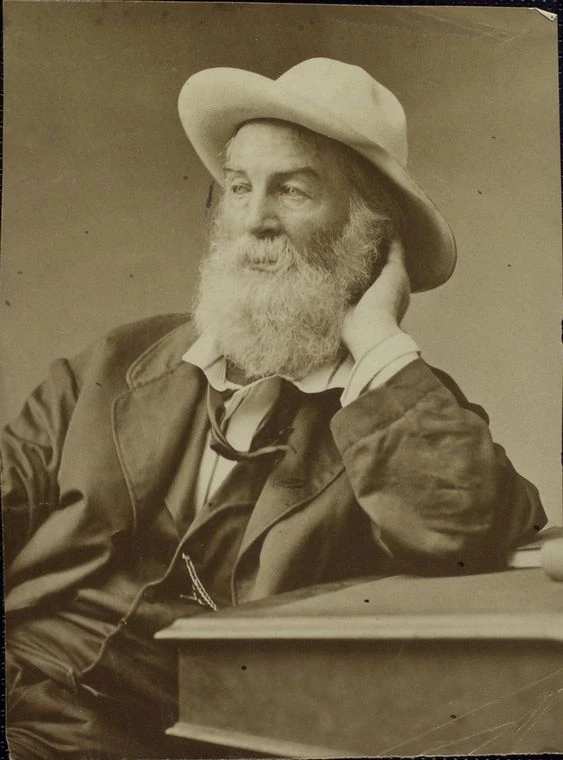
Walt Whitman. Photo credit: NYPL Digital Collections, Image ID: 437787
Web Literacy
In writing your literary commentaries you are using web pages and digital repositories (mostly the Walt Whitman Archive) as well as gathering information on the open web. We have talked about the skills of “surface” reading or skimming, as well as so-called “deep” reading. While the massive amount of information available on the web makes skimming a fundamental strategy––a strategy used by scholars, after all, in surveying the vast scholarly history of commentary on one subject or idea or question––deep (or critical) reading will often follow.
As GenAI increasingly filters and organizes information we find on the open web it becomes increasingly clear that educated people need to think clearly and carefully about the information presented to them when they are seeking information or facts. In class we talked about peer review, and the role of experts in fields of expertise and knowledge.
My former colleague Mike Caulfield has some basic principles for searching for information on the web that he associates with “web literacy”: it includes 1) checking for previous fact-checking, 2) going upstream to the source, and 3) reading laterally. Here is how he elaborates his case in Web Literacy for Student Fact Checkers (2021):
What people need most when confronted with a claim that may not be 100% true is things they can do to get closer to the truth. They need something I have decided to call “moves.”
Check for previous work: Look around to see if someone else has already fact-checked the claim or provided a synthesis of research.
Go upstream to the source: Go “upstream” to the source of the claim. Most web content is not original. Get to the original source to understand the trustworthiness of the information.
Read laterally: Read laterally.[1] Once you get to the source of a claim, read what other people say about the source (publication, author, etc.). The truth is in the network.
Circle back: If you get lost, hit dead ends, or find yourself going down an increasingly confusing rabbit hole, back up and start over knowing what you know now. You’re likely to take a more informed path with different search terms and better decisions.
In general, you can try these moves in sequence. If you find success at any stage, your work might be done.
As information on the internet becomes increasingly organized for users by GenAI, these basic principles or habits will remain useful as you seek facts and information. They encompass some of what we have already talked about, including determining the provenance (origin, source) and the reliability (who and where) of the information, as well as the context (“truth is in the network”).
Links and Streams
When doing digital research it is useful to be aware of the distinction between how the information we access on the web is organized and distributed. What we find is determined by how we find it (or how it is found for us.)
Consider the link and the stream. As you continue your research, and poke around on the open web, you will be making use of hyperlinks or hypertext. In Education in the (Dis)Information Age, an essay I will use here to elaborate on using hyperlinks, the musicologist and digital media specialist Kris Schaffer writes that “if no one does this, or if they wait too long, the clickbait and conspiracy theories will win out.” One of the salient points Shaffer is making is that social media platforms
have worked hard to kill the hyperlink. Sure, there are plenty of links to click on, but they aren’t generated by users. Remember the difference between a link and a URL. I can paste a URL into a tweet or a Facebook post and it becomes clickable, but I cannot write in hypertext. I cannot annotate and link my writing with that of others. And including multiple URLs confuses the platforms! (It would be ironic that platforms whose financial well being is determined by clicks would have this problem — if we didn’t know better.) Social media are designed to share text, images, video, and articles, but not to write in hypertext — the language of the web. After all, if I actually click on all those links, I leave the platform… and take my ad-revenue-generating clicks with me.
The hyperlink is a simple and reliable method for digital citation that makes possible open access to distributed sites of information. It changes not only how we find things out, but at the same time how we read and think and write. The problem is that we have become increasingly habituated to proprietary platforms that only pretend to have our interests in mind.
The problem is how we describe our digital lives. In simple terms, the metaphor of the web has been supplanted by the metaphor of the stream. In an essay in The Atlantic 2013: The Year “the Stream” Crested Alexi C. Madrigal writes, “The Stream has been the organizing metaphor for the web for the past several years.” Madrigal calls on Erick Schonfeld to explain how “Information is increasingly being distributed and presented in real-time streams instead of dedicated Web pages”:
Web companies large and small are embracing this stream. It is not just Twitter. It is Facebook and Friendfeed and AOL and Digg and Tweetdeck and Seesmic Desktop and Techmeme and Tweetmeme and Ustream and Qik and Kyte and blogs and Google Reader. The stream is winding its way throughout the Web and organizing it by nowness.
While these examples are dated (this was published in 2013) the enduring point is that the shift in the way we talk about and use the web matters. As the Iranian-Canadian blogger Hossein Derakshan writes in The Web We Have to Save, “The Stream now dominates the way people receive information on the web. Fewer users are directly checking dedicated webpages, instead getting fed by a never-ending flow of information that’s picked for them by complex –and secretive — algorithms.” Not unlike the meme “Kill Your TV,” a parallel instance for our age appears to be delete your Facebook account. The problem, as Derakshan explains, is the seductive efficiencies of digital technologies:
The Stream means you don’t need to open so many websites any more. You don’t need numerous tabs. You don’t even need a web browser. You open Twitter or Facebook on your smartphone and dive deep in. The mountain has come to you. Algorithms have picked everything for you. According to what you or your friends have read or seen before, they predict what you might like to see. It feels great not to waste time in finding interesting things on so many websites.
This situation is not unlike what Walker Percy described for us as “the loss of creature,” or the willingness to passively receive information and experience rather than actively struggling for it. After all, what exactly are we exchanging for efficiency? What we are missing? Percy would say agency and control. Indeed, the reach of what you are writing on a platform you control is not to be underestimated. Kris Schaffer proposes the following answer to the question:
Think about it this way. If I’m the first person to take a primary source, transcribe (or translate) it, and annotate it with hyperlinks, and my public, digital writing gains traction, it will fast become the go-to source at the top of the search results. My hyperlinks and commentary will become the portal to the resources that people engage to gain context, background, and nuance. It’s a tremendous responsibility, but also a tremendous opportunity, to connect my skills as an academic and a humanist to the issues of the day, in an attempt to bring nuance and truth to the public consciousness.
Shaffer concludes,
It’s time we brought back the hyperlink and learned how to really use it. It’s time we used information abundance to our advantage. And it’s time we disentangled our communications from platforms tuned for the spread of disinformation. The health of our democracies just might depend on it.
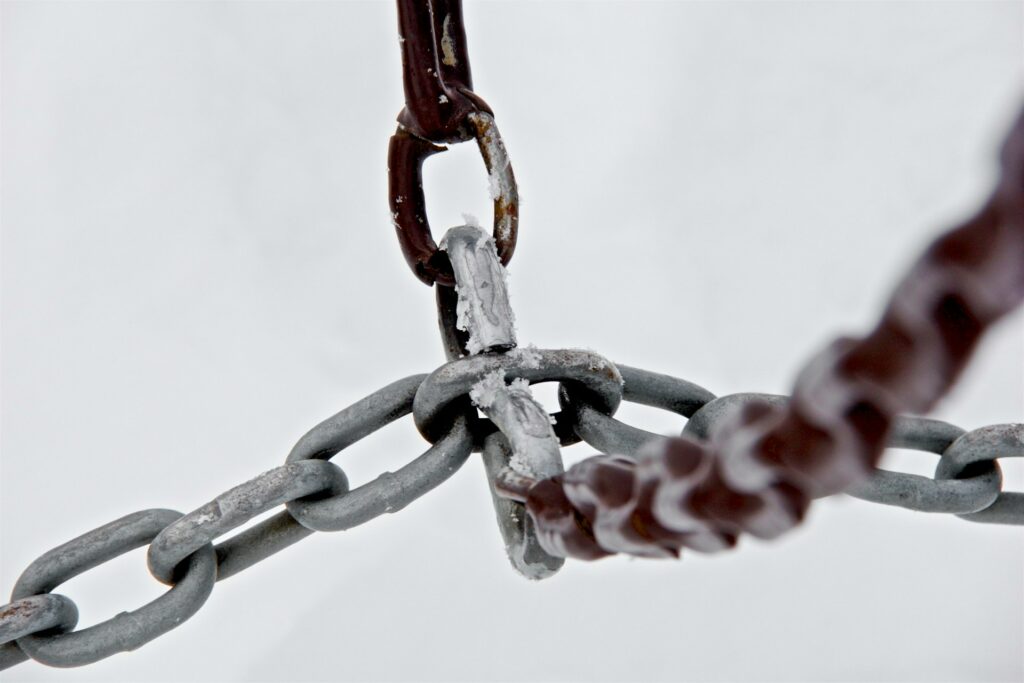
Photo credit: Photo credit: Bryson Hammer on Unsplash
In the context of academic writing, and with the advent of increasingly sophisticated GenAI platforms, the hyperlink makes visible a mind at work. As it happens, Ralph Waldo Emerson offers a nineteenth-century version of this visibility and the concept of networks–of words, thoughts, and texts––in his essay Quotation and Originality
All minds quote. Old and new make the warp and woof of every moment. There is no thread that is not a twist of these two strands. By necessity, by proclivity, and by delight, we all quote. We quote not only books and proverbs, but arts, sciences, religion, customs, and laws; nay, we quote temples and houses, tables and chairs by imitation.
Thinking and Making. Architectonics. Houses and chairs. At the very least, we owe it to ourselves, and to our readers, to know where we are getting the information we use.
On Rediscovering the Network
What if we really did want to make durable and transparent connections across our experiences both in and outside the classroom? What if we really wanted to work together to build learning pathways, or a network, to integrate learning as well as to connect your college experiences to later stages of life or careers outside of school?
Consider the following examples using a search engine. First, a Google search, what some call “googling”:
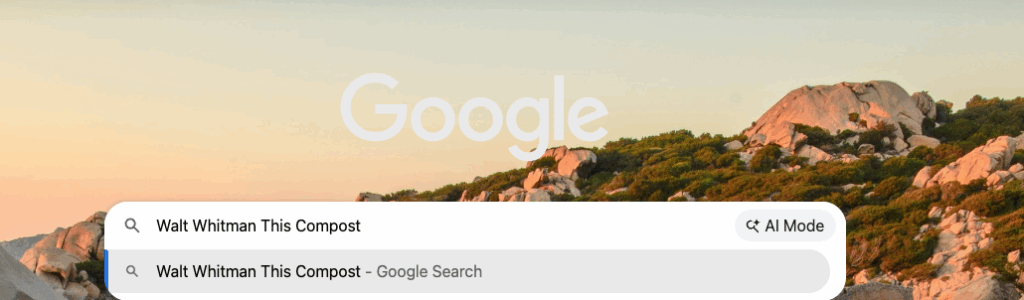
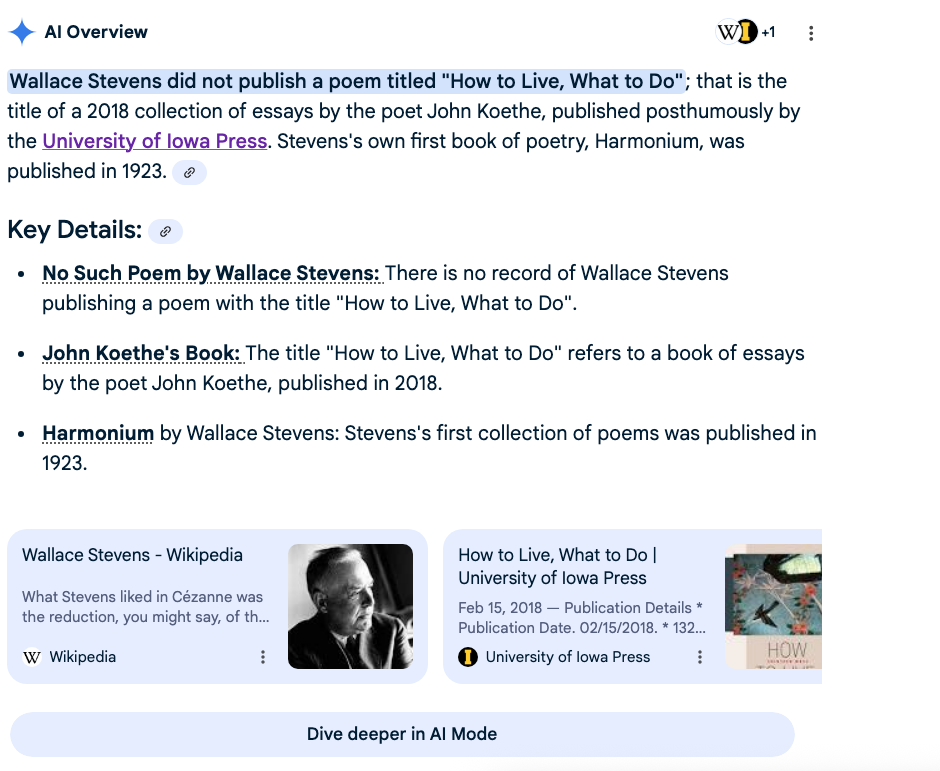
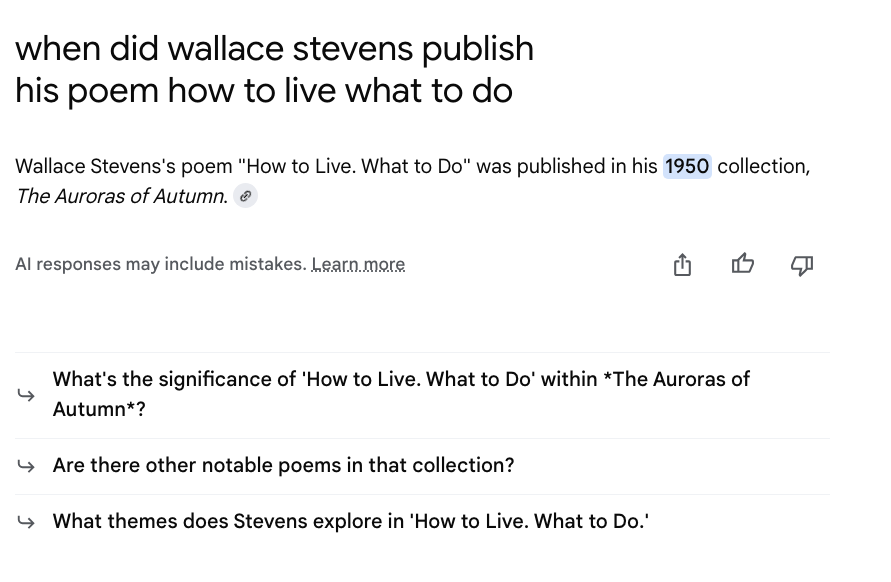
In this case (unless you turn it off) the web browser gives you at the top of your results a GenAI summary:
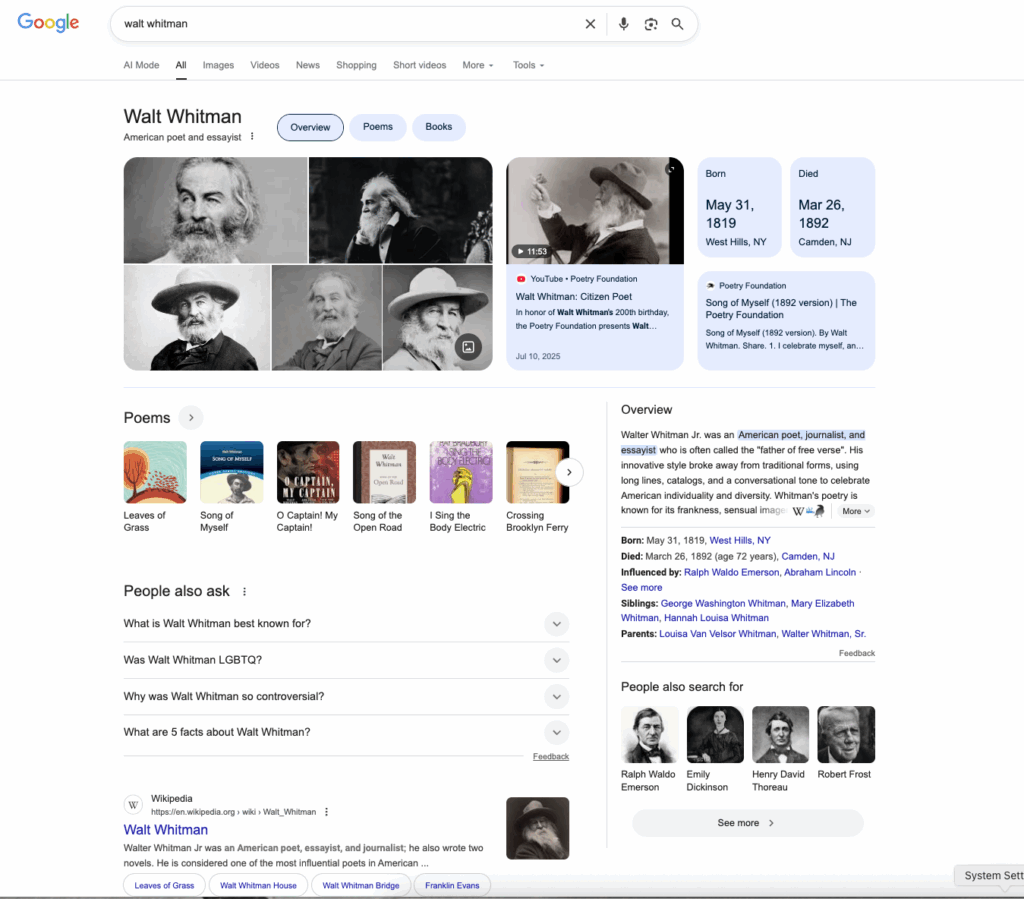
The rewards and the risks of the GenAI Overview are many
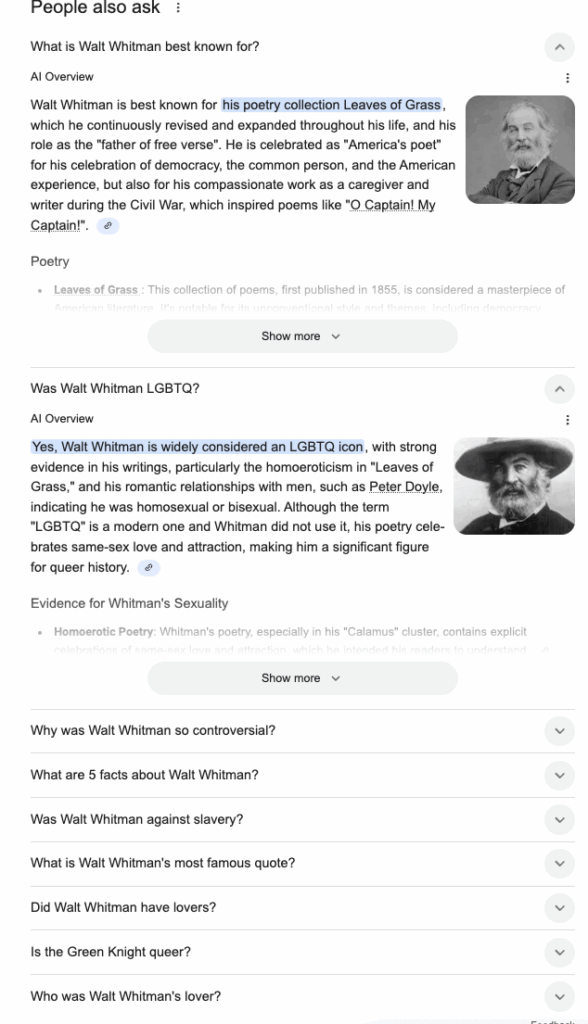
When a user clicks on the link icon they are rewarded with a drop-down list of sources. But who (or what) chose those sources. A predictive algorithm. How do we rank these sources in relation to others in terms of accuracy and reliability and comprehensiveness? If we step out of the GenAI stream (though of course our feet are still wet, as the machine is sifting and sorting and ranking web sites in the results!) we come to The New York Public Library > Where to Start with Whitman (link #13 of 14,400,000 results)
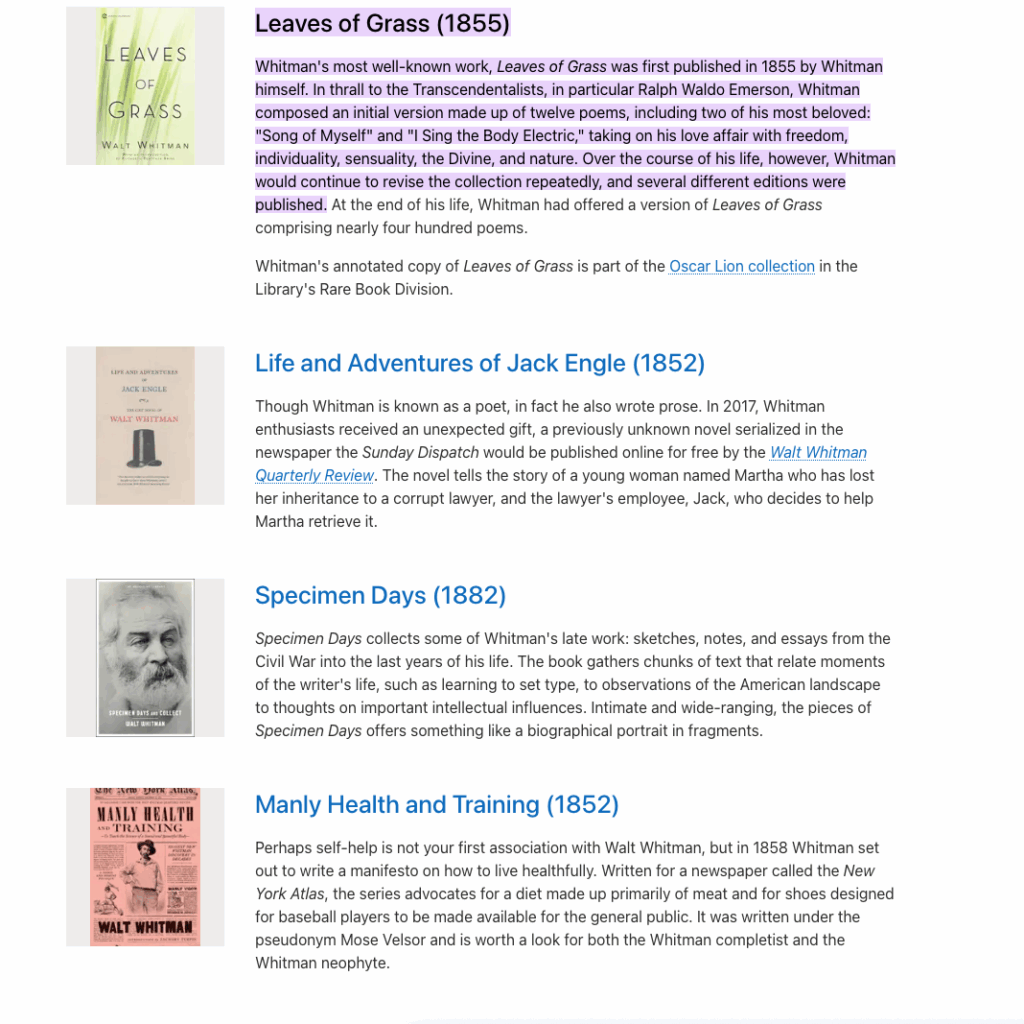
This is, by most measures, a bit more promising. For example, the “Manifesto” offers insights into Whitman’s fascination with the body and bodily health.
Of course networked learning, and the metaphor of the web as a network, has deep roots. The metaphor of Indra’s Jeweled Net, in the Atharva Veda and is used by the Buddhist Tu- Shun (557-640 B.C.E.) to envision a vast net that includes jewels at each meeting point that represent individual life forms (atoms, cells, units of consciousness) that are interconnected; so that a change in one is reflected in all the others. The metaphor has been used, more recently, to describe the complex interconnected networks formed by relationships between objects in a system, in computation, ecological thinking, and in accounts of social networks.
What I am wondering about here is whether this ancient surmise is one antidote to the modern pathology of thinking predicated on individual parts that fuels the individualistic and atomistic patterns of behavior that make it so very difficult to imagine ways to imagine, if not change, the conditions of our lives.