“Research is formalized curiosity. It is poking and prying with a purpose.”
––Zora Neale Hurston
Not words of routine this song of mine,
But abruptly to question, to leap beyond yet nearer bring;
––Walt Whitman, section 42, “Song of Myself”
Questions and Curiosity
How does Whitman conceive of a stranger on the streets of Manhattan? What is it then between us? Where is Whitman (and where are you?) when you read the words in Crossing Brooklyn Ferry “What is it then between us? / What is the count of the scores or hundreds of years between us?” What exactly is the effect of Whitman’s use of enumeration, especially in his longer poems? What is all this talk of love roots and orgies?
Countless questions will arise for Whitman’s readers. And questions can sustain what we call curiosity. When we talked about the poem “Miracles,” for example, the scope of Whitman’s use of the term “miracle” is kind of amazing. He is quite explicit on this point:
These with the rest, one and all, are to me miracles,
The whole referring, yet each distinct and in its place.
And then there is the self. One of the most recognizable lines of poetry is “I celebrate myself” (27). And readers of Song of Myself recognize as the poem unfolds the radical uniqueness and value Whitman grants the individual and, by implication, the other. Every person is unique and has value, he says again and again. And his poems define the individual not as a member of ethnicity or race, and not as confined to a collective historical group such as a nation or state or a religious tradition.
Rather he has a wildly open idea of the self that is described well by Mary Oliver in her essay that we read, “Some Thoughts on Whitman,” in her book Winter Hours. She says that his “message was clear from the first and never changed: that a better, richer life is available to us, and with all his force he advocated it both for the good of each individual soul and for the good of the universe” (63). Whitman’s faith was in the radical contingency of the self as mutable and he welcomed the disruption of the idea of the horizon of the self as predetermined or fixed. He experienced and celebrated the self as a miracle and his poems explore the miraculous privilege of existence as a conscious being.
In Democratic Vistas he makes the point explicitly “This is the thought of identity—yours for you, whoever you are, as mine for me, miracle of miracles, beyond statement, most spiritual and vaguest of earth’s dreams, yet hardest basic fact, and only entrance to all facts.” With words such as these, read back into a poem or other poems, we can see more clearly Whitman’s relentless pursuit of the difficult and ongoing obligation to honor the self and by implication the other. And we can come to see the ways his poems invite us to consider what they know: the freedom and liberation of the human individual, the social value of this process of individuation, and the irrevocable and necessary continuation of this process as a condition of democratic experience.
More on Primary and Secondary Sources
In the commentary you are writing your curiosity, and the questions you are asking, will give you purpose. (If you are not curious, and are not asking questions, then it will be more difficult for you to think and to write about Whitman.)
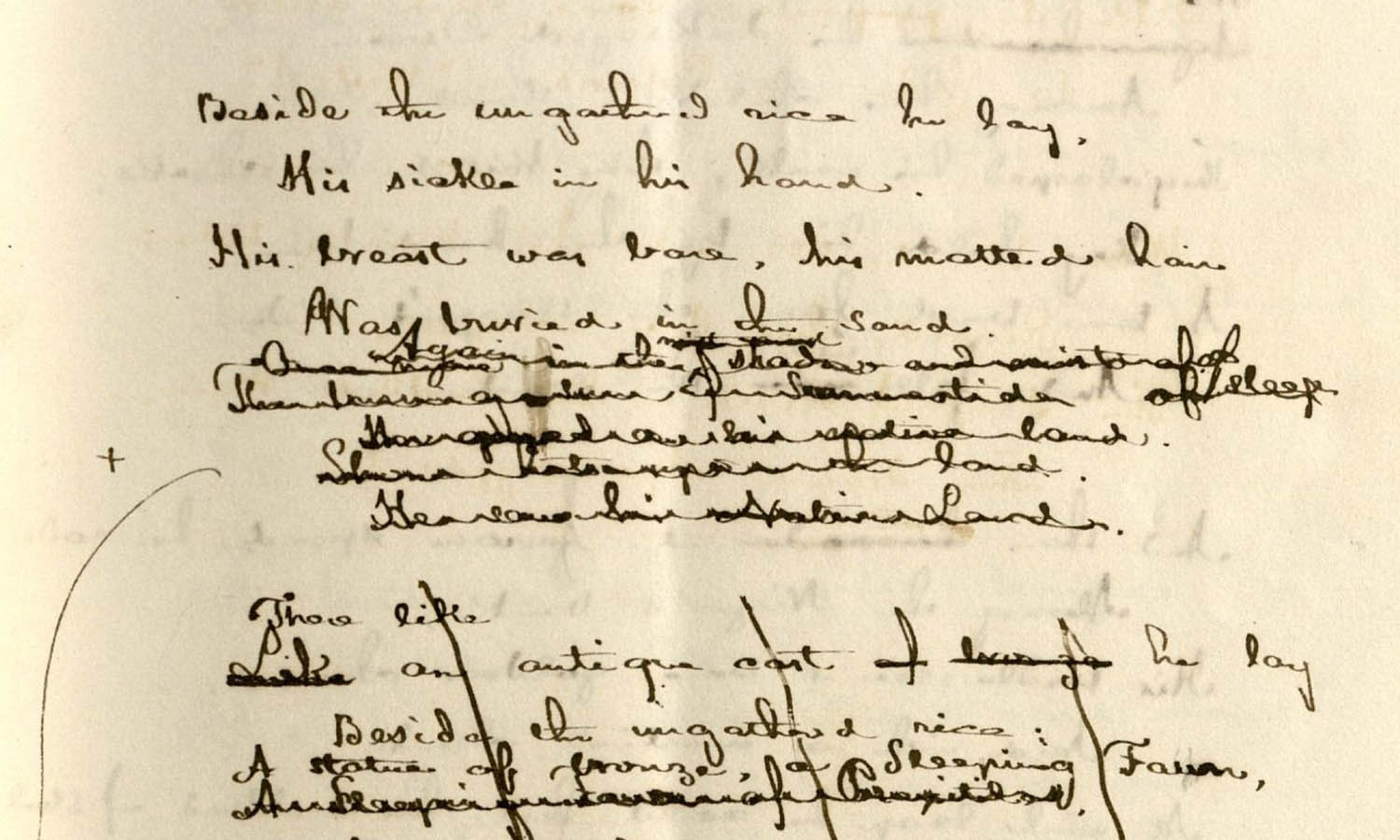
For a few weeks we have been poking and prying with a purpose (to find things out!) in The Walt Whitman Archive. As you have learned, the archive provides provide to facsimile and e-text versions of all the editions of Leaves of Grass (1855, 1856, 1860, 1867, 1871-72, 1881-82, 1891-92.) Also available is an extended biography Folsom and Price, the complete volume of contemporary reviews of Whitman’s work; selected critical essays; all known photographs of Whitman, with annotations; introductions to each edition of Leaves, reprinted from Walt Whitman: An Encyclopedia and, with the Walt Whitman Quarterly Review, a comprehensive bibliography of books, essays, notes, and reviews about Whitman. The searchable bibliography contains articles, books, chapters of books, and poems about Whitman, published from 1975 to the present. There are thousands of entries in the database, most of which are annotated. The archive also includes editions of Whitman’s works printed outside the US: including the first two British editions of Whitman’s poetry and the first full-length Spanish-language translation as well as two Russian translations of Whitman. Finally, the archive makes available sample manuscripts, including Whitman’s drafts of “Live Oak, with Moss,” the “Calamus” sequence, as well as links to Whitman’s recently recovered notebooks from the 1850s and 1860s at the Library of Congress.
Whitman in the Mason Library
The Commentary > Selected Criticism in the Walt Whitman Archive has digital copies (PDF and HTML) of full-length monographs that you can search for relevant information on your poems. But the other resource you have, and one of you has already been asking me about them, is the collection of print sources in the Mason Library at Keene State College. There are hundreds of books and articles that take up Whitman’s writing, as well as his presence in American culture and in other cultures. As you work on your first and second commentaries, I want you to consider these resources.
If you do a broad author search of the print, and digital (journals and ebooks, films, other media) in the library holdings.
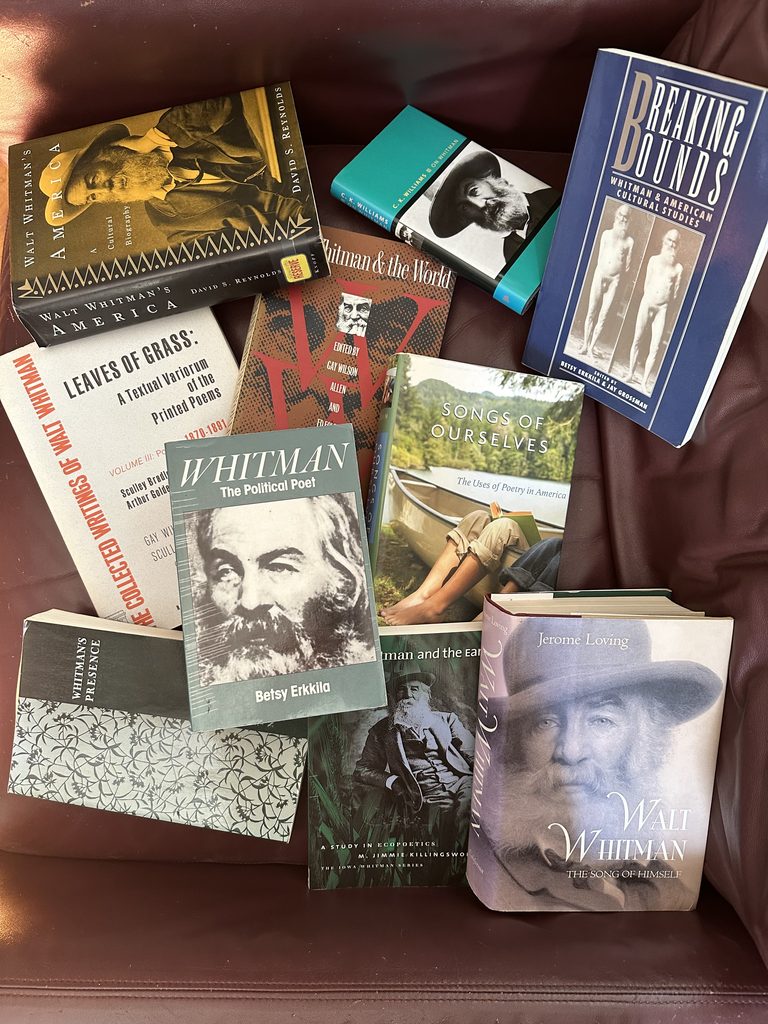
But there is something tangible in finding a book on the shelf that might work for you. Below are the titles (and the call numbers) of books that you can locate on the shelf. There are full-length monographs and chapters in books that might be of use. Please read these books in the library, whenever possible, so that they remain available for other members of the class. If you do check out one of the books, please let the class know so that we can find the book if necessary.
Secondary Criticism
Bohan, Ruth L. Looking into Walt Whitman: American art, 1850-1920. 2006. PS3242.A66 B64
2006
Blake, David Haven. Walt Whitman and the culture of American celebrity. 2006. PS3231 .B58
Reynolds, David S. Walt Whitman. 2005. PS3231 .R475
Walt Whitman: a documentary volume. Ed. Joel Myerson. 2000. PN451 .D5 v.224
Epstein, Daniel Mark. Lincoln and Whitman : parallel lives in Civil War Washington. 2004. E457.2
.E67
Loving, Jerome. Walt Whitman : the song of himself. 1999. PS3231.L68 1999
Walt Whitman: an encyclopedia. Eds. J.R. LeMaster, Donald D. Kummings.
1998. PS3230 .W35 1998
Walt Whitman—the measure of his song. Eds. Jim Perlman, Ed Folsom & Dan Campion. 1998. PS3238 .W37
Greenspan, Ezra. Walt Whitman and the American reader. 1990. PS3237.4.U6 G74
Bauerlein, Mark. Whitman and the American idiom. 1991. PS3238 .B34 1991
Gardner, Thomas. Discovering ourselves in Whitman: the contemporary American long poem. 1989. PS310.S34 G37
Kaplan, Justin. Walt Whitman, a life. 1982, PS3231 .K3
Allen, Gay Wilson. The solitary singer; a critical biography of Walt Whitman. 1955. PS3231 .A69
Leaves of grass : the sesquicentennial essays. Eds. Susan Belasco, Ed Folsom, & Kenneth M. Price. 2007. PS3238 .L34 2007
Garman, Bryan K. A race of singers : Whitman’s working-class hero from Guthrie to Springsteen. 2000. ML3477 .G36
Reynolds, David S. Walt Whitman’s America : a cultural biography. 1995. PS3231 .R48
Folsom, Ed. Walt Whitman’s native representations. 1994. PS3242.A54 F65 1994.
Erkkila, Betsy and Jay Grossman. Breaking Bounds: Whitman and American Cultural Studies. New York: Oxford UP, 1996. PS3238 .B74 1996
Matthiessen, F. O. American Renaissance: Art and Expression in the Age of Emerson and Whitman. New York: Oxford UP, 1941. PS201 .M3 1966
The Nineteenth Century: Origins and Reception
Milton Hindus, ed. Walt Whitman: The Critical Heritage, “Introduction: The Battle for Recognition: 1855–60,” 1–20
Whitman’s Anonymous Self-Reviews” (1856), 34–48
“Thoreau on Whitman” (1856) 67–68
“It is the healthiest book, morally” (1859), 97–98
“Henry James on Walt Whitman” (1865), 110–14
“Anne Gilchrist on Whitman” (1870), 137–41
“A Belated Appreciation” (1873), 152–54
“Peter Bayne on Whitman” (1875), 156–78
“William James on Whitman” (1895), 240–45
William Dean Howells on Whitman” (1895), 246–47
“John Burroughs on Whitman” (1896), 248–51
“Santayana on Whitman” (1900)
Randall Jarrell, “Some Lines on Whitman,” A Century of Whitman Criticism, 216–30
Allen Ginsberg, “Supermarket in California” and “America”
Muriel Rukeyser, “A Culture in Conflict,” The Life of Poetry, 61–84
Hart Crane, “Letter to Allen Tate” and “General Aims and Theories,” The Complete Poems and Selected Letters and Prose of Hart Crane
John Berryman, “‘Song of Myself’”: Intention and Substance,” The Freedom of the Poet, 227–44
Gary Snyder, “Walt Whitman’s Old ‘New World,’” A Place in Space: Ethics, Aesthetics, Watersheds
Mary Oliver, “Some Thoughts on Whitman,” Winter Hours: Prose, Prose Poems, and Poems
Louis Sullivan, The Autobiography of an Idea
Louis Sullivan, “The Tall Office Building Artistically Considered,” Kindergarten Chats and Other Writings
James E. Miller. Jr. “Whitman’s Multitudinous Poetic Progeny: Particular and Puzzling Instances,” Walt Whitman: The Centennial Essays, Ed Folsom, ed., 185–200
William H. Rueckert, “Kenneth Burke’s Encounters with Walt Whitman,” Encounters with
Kenneth M. Price, “Whitman, Dos Passos, and ‘Our Storybook Democracy,’” Walt Whitman: The Centennial Essays, Ed Folsom, ed., 217–25
George B. Hutchinson, “The Whitman Legacy and the Harlem Renaissance,” Walt Whitman: The Centennial Essays, Ed Folsom, ed., 201–16
Brian K. Carman, “Introduction: Be Radical—But Not Too Damned Radical” and “For the Workingman’s Sake: Imagining a Working-Class Hero,” A Race of Singers: Whitman’s Working-Class Hero from Guthrie to Springsteen
Alan Trachtenberg, “The Politics of Labor and the Poet’s Work: A Reading of ‘A Song for Occupations,’” Walt Whitman: The Centennial Essays, Ed Folsom, ed., 120–32
Vivian Pollak, “’In Loftiest Spheres’: Whitman’s Visionary Feminism,” Breaking Bounds: Whitman and American Cultural Studies, eds. Betsy Erkkila and Jay Grossman, 92–111
Betsy Erkkila, “Whitman and the Homosexual Republic,” Walt Whitman: The Centennial Essays, Ed Folsom, ed., 153–71
George Kateb, “Whitman and the Culture of Democracy,” The Inner Ocean: Individualism and Democratic Culture
And if you are curious about Whitman’s reception around the world I recommend Milton Hindus, ed. Walt Whitman: The Critical Heritage and Walt Whitman and the World, Eds. Ed Folsom and Gay Wilson Allen,
“An English Reaction” (1856), 55–60 “Review of the London Edition” (1868), 131–34. Milton Hindus, ed. Walt Whitman: The Critical Heritage,
Walt Whitman and the World, Eds. Ed Folsom and Gay Wilson Allen
“Gerard Manley Hopkins on Whitman” (1882), 195–98
“John Addington Symonds on Whitman” (1893), 224–29
“Basil de Selincourt on Whitman” (1914), 271–84
“M. Wynn Thomas, “Whitman in the British Isles,” 11–20
E. M. Forster, “The Beauty of Life” (1911)
D. H. Lawrence, “Letter to Henry Savage, December 22, 1913” (1913), 52–53
Denis Donoghue, “Walt Whitman” (1975), 65
John Bayley, “Songs of a Furtive Self: Whitman” (1984), 67–68
Tom Paulin, “Minotaur: Poetry and the Nation State” (1991), 69–70
Whitman and the Spanish-Speaking World
Fernando Alegría, “Whitman in Spain and Latin America,” !” 71–95
José Martí, “The Poet Walt Whitman” (1887), 96–106
Rubén Darío, “Walt Whitman” 1890), 106–07
Cebría Montoliú, “Walt Whitman’s Philosophy” (1909), 107–12
Miguel de Unamuno, “Adamic Song” (1930); 113–15
Jorge Luis Borges, Camden, 1892” (1966), 126
Jorge Guillén, “My Relationship with Walt Whitman” (1971), 127
Maria Clara Bonetti Paro, “Whitman in Brazil,” 128–36
Gilberto Freire, “Camerado Whitman” (1948), 137–46
Roger Asselineau, “Whitman in Portugal,” 147–48
Susan M. Brown, “The Case of Fernando Pessoa,” 148–5
Fernando Pessoa, “Salutation to Walt Whitman” (1915), 154–59
Federico García Lorca, “Oda a Walt Whitman/Ode to Walt Whitman”
Mario Vargas Llosa, “Why Literature? The Premature Obituary of the Book,” The New Republic
Sylvia Molloy, “His America, Our America: José Martí Reads Whitman,” Breaking Bounds: Whitman and American Cultural Studies, eds. Betsy Erkkila and Jay Grossman, 83–91
Whitman in Europe, India, China, and Japan
Roger Asselineau, “The European Roots of Leaves of Grass,” Walt Whitman: The Centennial Essays, Ed Folsom, ed., 51–60
Walter Grünzweig, “Whitman in the German Speaking Countries,” 160–72
Ferdinand Freiligrath, “Walt Whitman” (1868), 172–76
Johannes Schlaf, “Walt Whitman (1892), 176–86
Hermann Hesse, “Walt Whitman’s Leaves Of Grass” (1904), 186–87
Gustav Landauer, “Walt Whitman” (1907) 189–93
Herman Bahr, “Walt Whitman” (1919), 193–201
Thomas Mann, “Letter to Hans Reisiger” (1922), 201
Hans Reisiger, “The Heartbeat of True Democracy” (1922), 202–09
Walter Grünzweig, “‘Teach Me Your Rhythm’: The Poetics of German Lyrical Responses to Whitman,” Walt Whitman: The Centennial Essays, Ed Folsom, ed., 226–39
Malcom Cowley, “Song of Myself and Indian Philosophy,” A Century of Whitman Criticism, Edwin Haviland Miller, ed., 231–45
V. K. Chari, “Whitman in India,” Walt Whitman and the World, 396–405
V. K. Chari, “Whitman Criticism in the Light of Indian Poetics,” Walt Whitman: The Centennial Essays, Ed Folsom, ed., 240–50
Giuyou Huang, “Whitman in China,” Walt Whitman and the World, 406–421
Li Yeguang, “To Whitman” (1981), 422–25, and “Walt Whitman in China” (1988), 425–28
Takashi Kodaira and Alfred H. Marks, “Whitman in Japan,” 429–35