Browse Author

thefarfield

(Re)Reading Close Reading

This past spring I found myself rereading the introduction to The Literature Workshop by Sheridan Blau. The book describes a “pedagogical awakening” he experienced, early in his teaching career, when he realized that as long as he was “engaged in the task of teaching [students] what my efforts to construct meaning had yielded for me, all I could do was show them what I had learned” (2). The paradox in Blau’s anecdote is that “as long as teachers are teaching, students are not going to learn, because the kind of experience teachers have that enable them to learn what they have to teach is the experience that students need to have, if they are to be the ones who learn” (2–3). Decades of empirical research into patterns of instruction and experiences of students in the classroom affirm “that insofar as instructors teach interpretations to students, they are not enabling those students to learn either how to acquire a valid and accurate experience of a literary text or how to produce such interpretations for themselves” (“How” 270). The persistence of this pedagogical challenge suggests that disciplinary debates about reading are less engaged with the assumptions about inquiry that structure the shared classroom experiences of teachers and students.

The exception are debates about close reading, especially when centered around interpretation, that engage the challenges students face with complex literary works. But although close reading is concerned with interpretation, Barbara Hernstein Smith reminds us, “the New Critics—certainly the first generation of them—were concerned less with establishing the meaning of a text than with understanding its operative machinery” (60). Jonathan Culler underscores that for the New Critics, the work of close reading was not “primarily to resolve difficulties but above all to describe them, to elucidate their source and implications” (“Closeness” 22). Culler suggests that even today, “close reading need not involve detailed interpretation of literary passages (though there is plenty of that around in close reading, especially when the texts in question are difficult to understand), but especially attention to how meaning is produced or conveyed.” Indeed hermeneutics (in contrast to poetics) is most often privileged in academic settings—whether as a preferred method for teaching reading in secondary or post-secondary institutions. Students are encouraged to generate “readings” of texts to demonstrate evidence of competency, critical literacy, and literary sophistication. A general term, as Peter Middleton puts it, “for a heterogeneous and largely unorganized set of practices and assumptions” (5), close reading remains the name for an organized framework of assumptions and practices.

This framework of assumptions and practices is useful in exploring some of the ways close reading has been used in the disciplinary work of interpretation. This association of close reading with interpretation has determined how we think about not only reading but literary and cultural transmission. More recently, close reading has been debated in critical studies concerned with both the radical discontinuity between past and present ways of thinking about nature, “the end of nature,” and in studies preoccupied with scales of time, for instance, in Jonathan Sachs’ concern with “temporal dissonance” (317) in Romantic writing, the “paradoxical temporality” David Farrier explores in Anthropocene poetics (6)—or what I call in an essay I wrote this past spring, “close reading the end of time.” As it propagates new vocabularies for reading in the Anthropocene, this critical discourse is testing the strengths and the limits of close reading while grappling with the fragility of disciplinary formations in the humanities.

(The essay appears in the book Close Reading the Anthropocene (Routledge 2021), edited by Helena Feder. In “Close Reading at the End of Time,” I suggest that the future of close reading depends on a deeper questioning of the protocols of scholarly reading if not the hermetic institutional structures that reward particular ways of reading. The promise of close reading in the Anthropocene, I argue, begins in accepting the limited social value of demonstrative reading and embracing the constitutive power of close reading as a collective pedagogical practice.

In the editorial process, we decided to drop my (very brief) summary of close reading. I include the material below as it may be useful for other readers and writers.

A Brief History of Close Reading

The history of close reading makes visible complex theoretical and practical questions that preoccupy a disciplinary field organized around the study and interpretation of texts. Close reading took shape during the formation of English studies and contributed to the rise of literary criticism during the first half of the twentieth century. A concern with aesthetic theory and practical criticism informed the applications of close reading for a range of pedagogical, disciplinary, and institutional initiatives—most notably changing the subject matter of English from language to literature and the method of study from scholarship to criticism. The New Critics consolidated the field, explains Catherine Gallagher, “they promised to integrate English studies, overcoming the disjunction between graduate and undergraduate curricula, between specialized knowledge and general educational service; and they promised simultaneously to differentiate English even more sharply from its neighboring disciplines” (135). Close reading proved an effective method for teaching an expanding population of postsecondary students as well. It “benefited from being eminently teachable,” Andrew DuBois argues, “and the entrenchment of its methods, first in universities and then in secondary schools, attests to the amenability of that practice to practitioners of varying sophistication” (2). It is therefore not surprising that general principles and protocols for close reading are ubiquitous both in literacy instruction in K-12 curricula and in college-level courses in reading, writing, and literacy.

The general principles and practical protocols of close reading proved indispensable to both the rise of criticism as well as the need for a specialized practice for scholarship in the rapidly expanding field of literary studies. When “literary studies broadened into cultural studies,” Jane Gallop explains, “it was precisely through the power of this move to close-read nonliterary texts” (183). The result, N. Katherine Hayles observes, was that the “expansion into diverse textual realms meant that literature was no longer the de facto center of the field” (“How” 63). Scholars in literary and cultural studies “found a replacement in close reading, the one thing virtually all literary scholars know how to do well and agree is important.” However, in the professional debates about reading that followed—what it is, and what it is for—it is striking that the debates did not depend on knowing exactly what close reading entailed. Literary scholars “generally think they know what is meant by close reading,” Hayles points out, “but, looked at more closely, it proves not so easy to define or exemplify” (ADE 64). Though Smith makes the case that close reading has actually been exemplified in a number of ways, “from a New Critic unraveling Shakespearian puns in the 1930s to a Marxist scholar exposing the political unconscious of Victorian novels in the 1980s or, today, a first-grader ‘analyzing’ a book by Dr. Seuss in accord with the directives of the American national Common Core Curriculum” (57). Smith adds that the “texts varied from presumed literary masterpieces to works of popular culture and documents of manifest oppression; the discourses that directed their examination varied from Christian humanism to structuralist linguistics to queer theory; and the spirit in which they were examined.” Thus considered in retrospect, across the twentieth century, “whatever the mood, motive, or materials, if one was teaching literature or doing literary criticism in the Anglo-American literary academy, one was likely to be reading at least some individual texts closely” (58). These exemplifications of close reading—as well as the various moods, motives, and materials of literary scholars—demonstrate the persistence and adaptability of close reading.2

At the same time, according to Miranda Hickman, skepticism about the values of particular critics, and their institutional and cultural work, led the New Criticism (and close reading), to be “regarded as superseded in literary studies” and to be dismissed “as emblematic of the apolitical, ahistorical practices of the discipline that had to be overcome through the revolutions in theory, historical scholarship, and politically engaged criticism of the last four decades” (vii). Catherine Devereux, elaborating this association, adds that within “an academic discipline that itself foundationally and pervasively reproduced a system of social and political inequity, then, the New Criticism and its practice of close reading came to be understood as instruments for maintaining that system” (219).3 This understanding was reinforced by a rejection of the literary, and the associated formalist practice of close reading that, while expedient, made it difficult to assess the contributions of New Criticism to the educational project of literacy and as well as critical reflection on the purposes and values of literary and cultural studies.4

It is fair to wonder, then, whether a (re)turn to close reading as a shared practice may be useful, as it was for the New Critics in the early twentieth-century, in furthering the disciplinary preoccupations of scholars in the twenty-first century. For if a return to close reading is associated with what Devereux calls the “exclusionary, and deeply biased notion of the literary and of the discipline” of the New Critics—and close reading is associated with formalist readings of decontextualized aesthetic objects—then it may be time to move along. But for Devereaux, “if literature is not to be differentiated from any other kind of cultural production, the point of a discipline whose purpose is the study of literature becomes unclear (224). Indeed, as it turns out, the perennial debates over the inheritance of close reading are most often about the legacy and coherence of literary studies, the literary practices of reading and writing, and the critical and philosophical problems these practices quite naturally raise across the humanities and social sciences.

Notes

1. The encounter is between human time (at its end) and deep time. I am also thinking here of Bruno Latour’s description of the present condition in An Inquiry into Modes of Existence: An Anthropology of the Moderns, in which he elaborates “an entirely new situation: behind us, attachments; ahead of us, ever more attachments. . . . End of modernization. End of story. Time to start over.” Latour goes on to say that “‘Gaia,’ the ‘Anthropocene’ era, the precise name hardly matters.” The point is cancelling “forever of the fundamental distinction between Nature and Society by means of which they were establishing their system of coordinates, one step at a time. Starting from this event, everything has become more complicated for them” (10).

2. John Guillory makes a distinction, however, between close reading and reading closely, in “Close Reading: Prologue and Epilogue.” Close reading “as a modern academic practice” does not mean the same thing as “reading closely, which arguably describes many different practices of reading from antiquity to the modern era” (8). The literature on close reading as an academic practice is extensive. Lentricchia and DuBois argue that “paying attention to the literary text in and of itself may or may not seem a given; at any rate, it is a notion which, whether or not necessary in the collective mind of our critical era, seems nonetheless natural to scholarship” (4). Examples include Jane Gallop, “The Historicization of Literary Study and the Fate of Close Reading Profession” and “Close Reading in 2009”; John Guillory, “Close Reading: Prologue and Epilogue”; and Jonathan Culler, “The Closeness of Close Reading.” Also see Paul de Man’s account of Ruben Brower’s influence at Harvard in the 1950s ‘‘Students,’’ writes de Man, “were not to say anything that was not derived from the text they were considering. They were not to make any statements that they could not sup- port by a specific use of language that actually occurred in the text. They were asked, in other words, to begin by reading texts closely as texts and not to move at once into the general context of human experience or history. Much more humbly or modestly, they were to start out from the bafflement that such singular turns of tone, phrase, and figure were bound to produce in readers attentive enough to notice them and honest enough not to hide their non-understanding behind the screen of received ideas that often passes, in literary instruction, for humanistic knowledge” (23).

3. Devereux’s description of the fate of New Criticism appears in “‘A Kind of Dual Attentiveness’: Close Reading after the New Criticism,” in which she explains that in some of the “late-twentieth-century debates about the destructive implications for English studies of race theory, feminist critique, postcolonialism, queer, class, cultural, and popular culture studies, close reading came to be represented by scholars outside the theory camp as the whipping boy of various leftist agendas” (331). The New Criticism’s “role in an unequal workplace had to be assessed, and its effects on the discipline had to be addressed. Also see Jane Gallop, who writes, “The time was ripe for . . . a course correction: ahistoricism had been persuasively linked to sexism, racism, and elitism; attacks on the canon had called into question the notion of timeless works; literary studies had been ahistorical for too long” (181).

4 Brenkman, “Extreme Criticism,” provides a polemical account. For a more generous reassessment of New Criticism, see Miranda B. Hickman and John D. McIntyre, Rereading the New Criticism. They write in their “Preface” that the strategy of the New Critics “in order to establish the distinctness of the literary–critical endeavor also contributed to this widespread understanding of their criticism as dismissing what was beyond the text: they turned decisively away from approaches in the field of English that focused on literary history, read literature for philosophical insights, or appraised literature through overtly moral criteria.” As Hickman and McIntyre explain, their polemical move “to define and legitimize criticism during an era when criticism was widely regarded as a slight endeavor that ‘anyone could do—often suggested that the work of these other approaches was less worthwhile than that of literary criticism. But according to New Critics such as Ransom and Brooks, New Critical distinctions between the ‘work itself’ and what lay beyond it, and between criticism and other kinds of work with respect to literature, never implied that commentary that engaged extratextual matters was without value, nor that they themselves ignored such matters altogether” (26).

What If?

Experiments often begin with “what if” questions. As I compose this post in the fall of 2020 one of the questions emerging at Keene State College is whether we will be able to support a portfolio platform to promote college-wide learning. What we mean by “college-wide learning” is less clear; and the connections we hope to make possible in our community of teaching and learning keep running up against the persistent inertia of institutional life.

We want our students to make connections across their experiences both in and outside the classroom. We want faculty and staff and students to work together to build learning pathways, or a network, that will integrate their learning as well as connect their college experiences to the first stages of their life and career beyond school. So far so good.

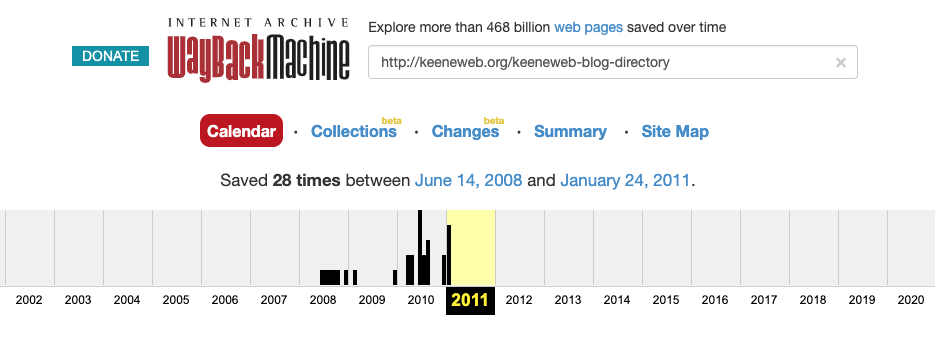
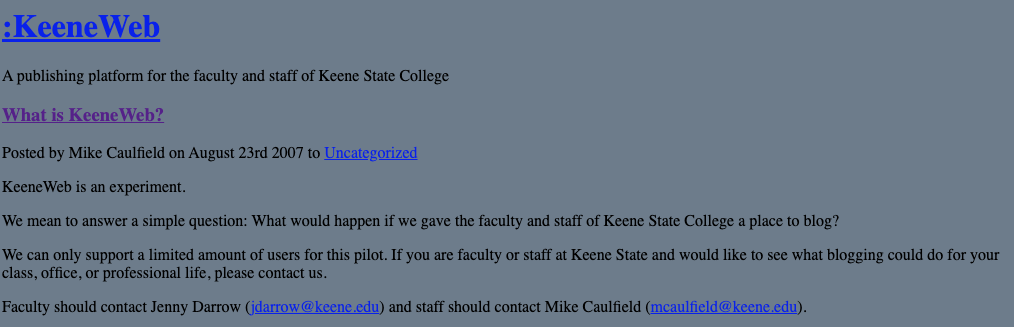
For some of us these aspirations are familiar. Some time ago, back in 2007 to be a bit more precise, a similar “what if?” question emerged : “What if the faculty and staff of Keene State College were given a place to blog?” The Wayback Machine at the Internet Archive offers a glimpse of that dusty virtual page in the vast archive of the web where that fabulous question lives on:

Screen shots of :KeeneWeb are from the Internet Archive Wayback Machine

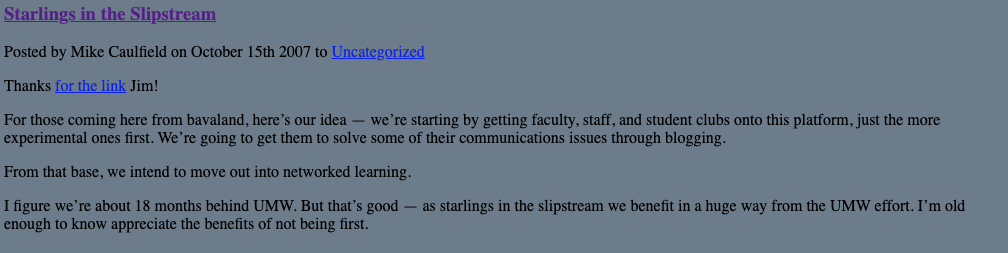
The experiment was a publishing platform. Our in-house instructional designer Mike Caulfield explained in a blog post Starlings in the Slipstream, would help us develop more meaningful communications and connections at the College. Mike connected the project to Jim Groom at the University of Mary Washington, who is another protagonist in the history of this question: for he had helped to design a platform to facilitate communications among faculty, staff, and students at UMW that would evolve into something more, what Jim called “networked learning.”

Back at Keene State College, Mike (and Jenny Darrow, his colleague in the Center for Excellence in Teaching and Learning) made possible some creative work using a Word Press multi-user blogging system with the option of building in RSS feeds for content. A few of us had already set up professional web pages on our own. (My forays in building a digital presence on the web began a couple of years after coming to the College, in 2000, with the assistance of a digital consultant, Maria Erb.) But a wider network began to become visible and by 2011 the Keeneweb Blog Directory listed over 200 active sites––faculty pages, teaching and research projects, and digital hubs for institutional initiatives. But the Internet Archive also shows that the network was active from 2008 to 2011.

In an early presentation to the campus community, a former colleague who I worked with in the first-year writing program, Tracy Mendham, pulled together a slide set and talk, “Pathway to Pedagogy,” in which she advocated for networked learning. Tracy was a trailblazer who taught a section of essay writing with the title “A Blog of One’s Own” in which her students found themselves writing on a blog. At the end of her presentation, she offered some advice that included two points that have guided many of us since:

  • Stop worrying and learn to love the Web
  • Make teaching and learning an experience for yourself as well as your students

The first piece of advice is an artifact in a discourse of which we were a part, a reminder of where we were––that is, worrying about the web. The second piece of advice is what I might want to describe as a threshold concept. For while the Wayback timeline represents the demise of a brilliant idea to support connected teaching and learning at Keene State College, it is also the case that a number of people have been thinking and making connections in new ways ever since. In fact, with the dedication and hard work of Jenny Darrow––one through line in this story––and my colleague in Biology, the open education superhero Karen Cangialosi––we are no longer worried about the web. We are instead working alongside faculty and students exploring the experience of teaching a learning at KSCopen.

My own professional work was irrevocably transformed. At the time a department chair, I began building things: a site to facilitate faculty exchange and make visible the extraordinary work of my colleagues; a web site for the English department; an English department course and syllabus archive; and a site for our Thinking and Writing faculty. Too, I found myself blogging and discovering the generative process of representing my professional work. My goal was to make visible the work of a college English professor. My working assumption was that a more visible story of a professor and students at work might offer reasons for people to value the intellectual work of teachers and students in public higher education.

Making Connections

But the most lasting and transformative impact of this moment at Keene State College was in the learning experience of my students. Tracy’s pedagogical insights into what she called at the time “social computing as means of facilitating academic discourse and developing writing skills” opened my mind. I could then fully appreciate what a colleague of mine was doing with his students at Washington College. Sean’s Comp| Post site was another node in a developing idea.

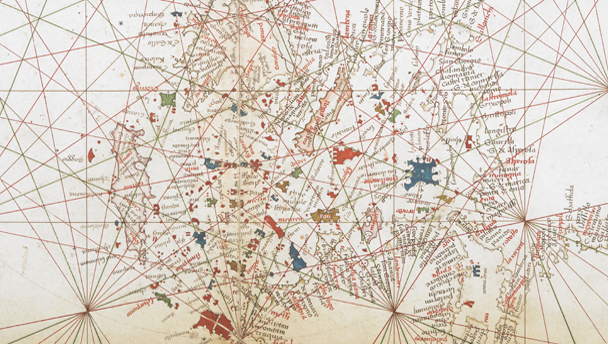
The idea, I can now see, was the network. My project exploration a kind of portolano chart with coordinates and sailing directions for thinking about teaching and learning.

From the British Library Pelagios Project: Portolano. Egerton MS 2855. Public domain.

That is, I had no mappa mundi with which to navigate the parts and the whole. And so I filled in my chart in medias res, learning by going where I had to go: I was learning to navigate open source software, for me Word Press, in an effort to integrate the pieces of my professional and personal life; and, most importantly, my chart began to trace new vectors as my students set up blogs and begin writing and making new connections with me, what they were learning, and their readers.

The idea of a portfolio of artifacts is familiar to those of us trained in the teaching of writing. And I had been using them since I began teaching in graduate school. Student course blogs, though, presented new opportunities to make the idea of an audience for writing, to take one example, less an abstract idea and more a real, lived experience of connecting with readers by writing on the open web. The public portfolio, moreover, led to students making connections across their courses and learning experiences beyond the classroom. Some students built sites that were repurposed for a job search or for projects beyond graduation.

But first and foremost, I was experiencing students learning more about writing, and themselves as writers, by using these tools. The other pedagogical possibilities of digital portfolios were showing up in metacognitive and experiential activities that decades of research has shown to be positively associated with genuine learning. However, what I also came to realize is that if we are going to ask students to engage in metacognitive work then it would make a lot of sense for teachers to model the very learning process that we know can make a difference.

So I started writing with my students. I began building my own portfolio across a semester (and across courses and teaching experiences) to make visible my growth and learning as a teacher. In one instance, I found myself writing a post in a class with students, Houses and Chairs, in which I say that writing on the web

“is different than writing for the web. When you graduate from college you will be writing more for the web. Why might this matter? The musicologist and digital media specialist Kris Schaffer proposes the following answer to the question:

Think about it this way. If I’m the first person to take a primary source, transcribe (or translate) it, and annotate it with hyperlinks, and my public, digital writing gains traction, it will fast become the go-to source at the top of the search results. My hyperlinks and commentary will become the portal to the resources that people engage to gain context, background, and nuance. It’s a tremendous responsibility, but also a tremendous opportunity, to connect my skills as an academic and a humanist to the issues of the day, in an attempt to bring nuance and truth to the public consciousness.

The essay I am quoting from here is written for students with a particular end in mind: I am (re)introducing them to the hyperlink. At the same time, my intent is to build out an argument about reclaiming the web as a network––enacting the very thing I am writing about. The post is an example of what more and more people have learned recently to call asynchronous pedagogy, or what I have learned to call on my teaching blogs “Teacher Talk.” Perhaps I will write a bit more about this dimension of my pedagogical approach to teaching reading and writing in the coming weeks. For now, though, if anyone is interested, the terminal moraine of these reflections and connections is right here, where you are right now, at The Far Field.

On Rediscovering the Network

What if we really did want our students to make connections across their experiences both in and outside the classroom? What if we really wanted faculty and staff and students to work together to build learning pathways, or a network, to integrate learning as well as to guide students as they connect their college experiences to stages of life or careers outside of school?

One place to start would be with the metaphorical structure of our thinking. Of course networked learning, and the web as a network, has deeper roots. The metaphor of Indra’s Jeweled Net, which appears in the Atharva Veda and is used by the Buddhist Tu- Shun (557-640 B.C.E.) to envision a vast net that includes jewels at each meeting point that represent individual life forms (atoms, cells, units of consciousness) that are interconnected so that a change in one is reflected in all the others. The metaphor has been used, more recently, to describe the complex interconnected networks formed by relationships between objects in a system, in computation, ecological thinking, and in accounts of social networks.

What I am wondering about here is whether this ancient surmise is one antidote to the modern pathology of thinking predicated on individual parts that fuels the individualistic and atomistic patterns of behavior that make it so very difficult to imagine ways to change the conditions of teaching and learning for the better. It is the manner of thinking and being in a system composed of parts––”departments,” “divisions,” “schools,” an so on––that just can’t seem to get around themselves when it is time to move. Most useful, then, at the moment, might be to pursue the provocative question, “what if?”

The question is, once again, the opportunities: how do we hold ourselves accountable to the space of minds thinking together before we develop plans within and beyond the constraints of the established systems of which we are a part?

Featured photo credit: John Dittli

In Memory

(Published on the web site of the Association for the Study of Literature and the Environment,) In Memoriam: Mary Oliver, 1935–2019

By Mark C. Long, Keene State College

The poet Mary Oliver passed away on January 17, 2019. An honorary member of our association, Oliver published over thirty books of poetry and prose that brought the concerns of ASLE to more readers than any other poet of her generation.

Oliver published her first book, No Voyage and Other Poems, in 1963. Over the next fifty years, Oliver offered us new ways to think about the gift of human life and the fragile beauty of the more-than-human world. As the poems kept coming, Oliver rekindled the uses of poetry in our culture—in lyrics, sequences, a book-length poem, prose poems, and essays. And her audience kept expanding, too, her book sales, running into the millions, reminding us of the singular power of her distinctive voice.

Oliver’s life and work are at once inspiration and provocation—most acutely to those of us preoccupied with environmental concern, equity, and justice. How does our thinking and writing, our art and our activism, reach the audiences who most need us? How do we live convincing lives for those who need to be inspired? “Teach the children. We don’t matter so much, but the children do,” Oliver reminded us. “Give them peppermint to put in their pockets as they go to school. Give them the fields and the woods and the possibility of the world salvaged from the lords of profit. Stand them in the stream, head them upstream, rejoice as they learn to love this green space they live in, its sticks and leaves and then the silent, beautiful blossoms.”

Although Oliver once stood in that water, and found her way upstream, her generous provocations are for us—whether we find ourselves in a stream or on a city sidewalk. Her belief that we can learn to love the world came from Walt Whitman, she told us, for his “message was clear from the first and never changed: that a better, richer life is available to us, and with all his force he advocated it both for the good of each individual soul and for the good of the universe.”

This potential for goodness in a world that appears otherwise is the heartbeat of Oliver’s advocacy. It is no wonder, then, that Oliver’s poems come into our lives across experiences, generations, and occasions—as children, adolescents, young adults, middle-age and older adults, in schools and libraries, family and community gatherings, and places of worship.

She prodded us to be in the world—with awareness, imagination, compassion, and agency. She excited our consciences and awakened our emotions. And she offered those of us more familiar with thinking about poems something less familiar: an invitation to think with poems that wrestle with our commonplaces about the world, honestly and openly, to guide us into the material and spiritual condition of our lives.

“Here is a story / to break your heart. / Are you willing? With these lines Oliver begins the poem “Lead,” a story of loons dying in the harbor “of nothing we could see,” a poem that ends with the story she has been sharing with us for over fifty years:


I tell you this
to break your heart,
by which I mean only
that it break open and never close again
to the rest of the world.

 __________________________________________________________________

An informal gathering to honor the literary and cultural contributions of the poet Mary Oliver will be held from 12:15-1:15 pm on June 28, 2019 during the 2019 ASLE Conference. The reading will take place in the T. Elliot Weier Redwood Grove located in the UC Davis Arboretum and Public Garden. Participants are invited to read one of Oliver’s poems, or a selection from her prose. Brief comments on Oliver’s work are also welcome. If you plan to attend this event, please RSVP Mark C. Long at mlong@keene.edu.

In choice of place

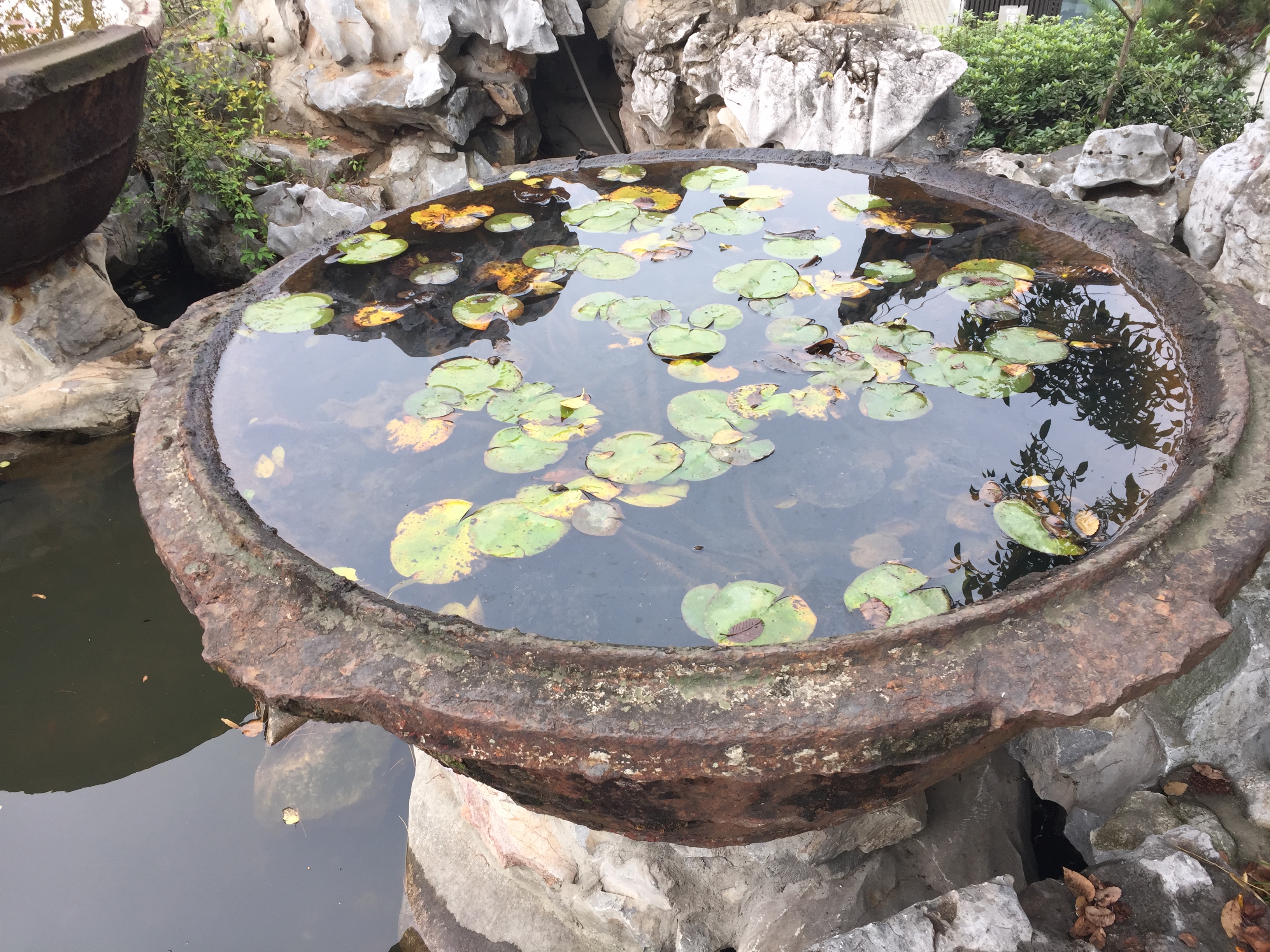
Poem by Gary Snyder, “Rip Rap.” Images by Mark Long, Jiangsu, China, fall 2018

Lay down these words

Before your mind like rocks.

             placed solid, by hands   

In choice of place, set

Before the body of the mind

             in space and time:


Solidity of bark, leaf, or wall

           riprap of things:

Cobble of milky way,

             straying planets,

These poems, people,

             lost ponies with

Dragging saddles —

            and rocky sure-foot trails.   

The worlds like an endless   

             four-dimensional

Game of Go.

ants and pebbles

In the thin loam, each rock a word   

             a creek-washed stone

Granite: ingrained

             with torment of fire and weight   

Crystal and sediment linked hot

             all change, in thoughts,   

As well as things.


Coming into the Country

“If you have to ask that question, you wouldn’t understand the answer.”

––John McPhee, Coming into the Country

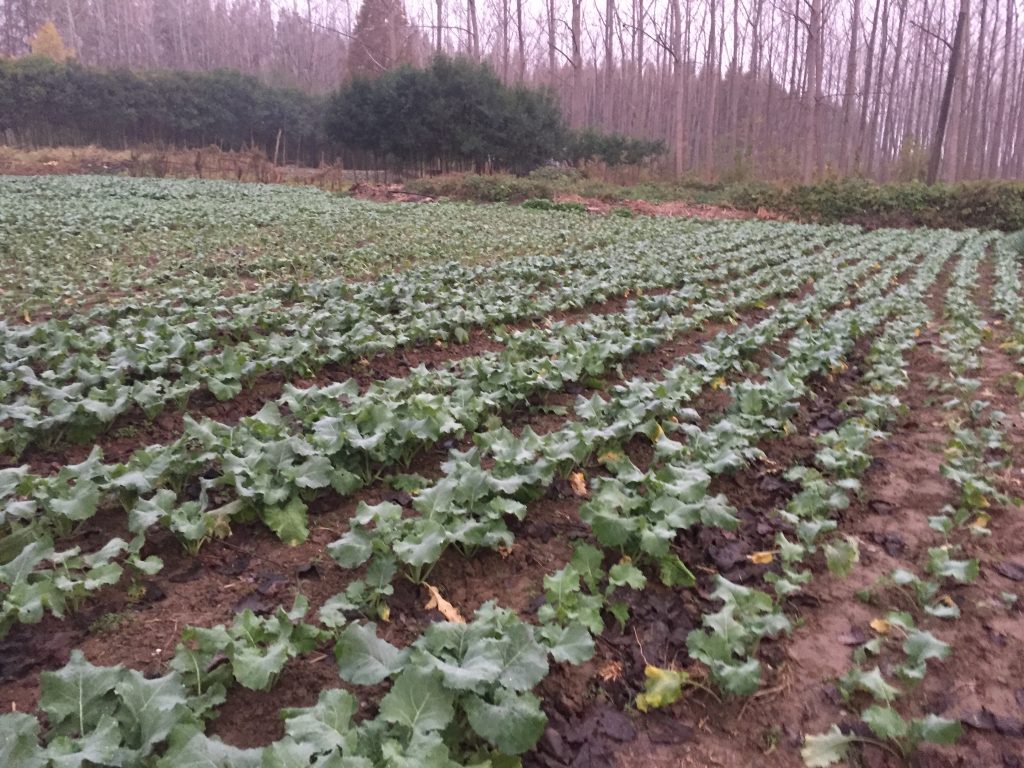
Field edges, sloped margins of fish ponds, straight irrigation trenches and tawny checkerboard fields of wheat, little groves of cultivated trees—all stitched with rows of leafy greens, backs of houses and industrial buildings as if set down in the orderly rows of greens that surround them, and out in the fields an electric scooter leaning against a fence and a crouched figure pulling weeds. Today we are driving north of the Yangtze River to the city of Yancheng. 

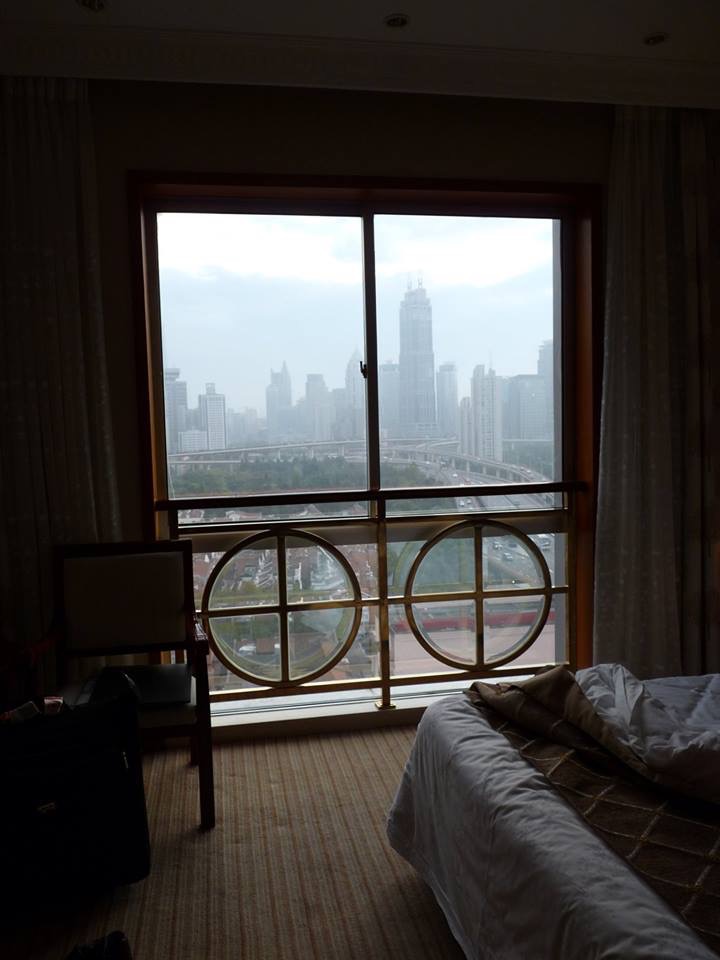
Yesterday afternoon we arrived in Shanghai. It is a long haul from Toronto, Canada, and the first glimpse of China’s largest metropolis, a city of over twenty-four million people on the Yangtze River Delta, is difficult to describe. From the window seat a view of tight clusters of high-rise buildings built into networks of roads and open spaces that lead to other tight clusters of high-rise buildings stretching as far as the eyes can see. As the plane banks to position for landing, through surprisingly clear air, the afternoon light glitters on the surface of the Hangpu River.

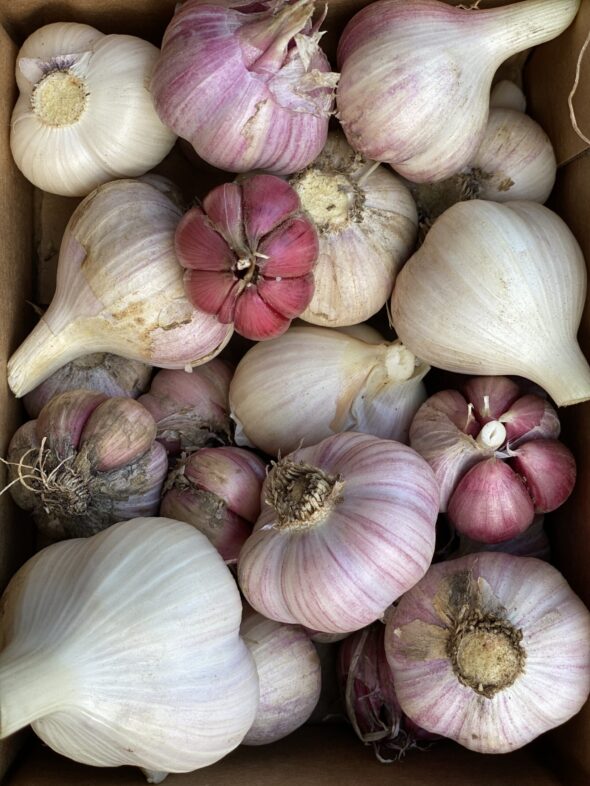
Cultivation in the suburbs north of Shanghai

We are coming into the country; and I sense that the world will no longer be the same. We will pay attention. We will see. We will change. Still, our slow descent onto the alluvial plain of the Yangtze River does not yet betray what we are experiencing:the most densely populated place on the planet. The Jiangnan—or the area south of the river—is now inhabited by the twenty-four million people of Shanghai as well as the other urban areas across the Yangtze River Delta region. The number of Chinese people in this small piece of the People’s Republic is 140 million.

Shanghai, China

Not only is the scale of the metropolis in China baffling but the clean and bustling and orderly Chinese city is incongruous. For we have come to thePeople’s Republic to gather with pastoral poets. While the pastoral has many versions, the tradition of values and poetics associated with this mode of thinking and poetic practice is the bridge we are walking between continents. WhatI find most exciting in this opportunity is to slip into the world of poets and poetry in a country with the longest continuous literary tradition in human history. At the same time, as I walk the streets of Shanghai, I remind myself of my plan to share with our hosts and audiences in Yancheng a pastoral impulse in our poetry and poetics that has yet to come to terms with the experience of living in the Anthropocene. Perhaps it is this place, after all, that signals most that we are living in a different world than we might have imagined.

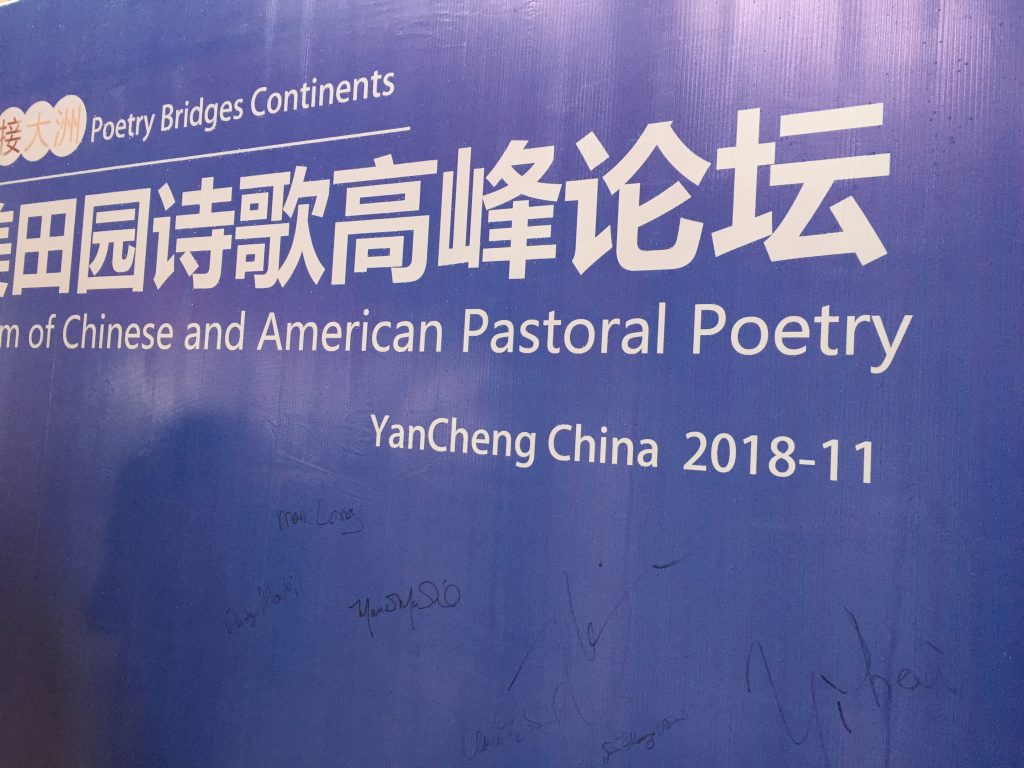
We are here in China as the featured guests at the Poetry Bridging Continents: From Walden to the Yellow Sea Symposium at Yancheng Teachers University. We are the poet Roger Martin, the visionary organizer of our trip, poets Susan O’Brien, Claire Golding, and Maura MacNeil, and my colleagues from Keene, archivist Rodney Obien and the dean of the Mason library, Celia Rabinowitz.

Mural welcoming guests in the lobby of the campus hotel at Yancheng University

On the one hand, our trip to China is breaking new ground. We are here as protagonists in a sequel to the October 2017 colloquium “TheMagic of Monadnock: Poetry Bridging Continents” that brought Chen Yihai, from YanchengTeachers University, and Zi Chuan, poet and calligrapher, to the MonadnockRegion in New Hampshire.  On the other hand, our travels are a continuation. We are here because of a cultural exchange that began thirty years ago with a collaboration between Michael True and a scholar and translator we are traveling with this week, Zhang Ziqing. We are here because of a 2006 anthology published in China, On American Pastoral Poetry that introduced the Monadnock Pastoral Poets, including Rodger Martin, Jim Beschta, Pat Fargnoli, Susan Roney-O’Brian, John Hodgen. And we are here because the cultural exchange continued with a 2011 visit by Beijing poet Bei Ta to New England that led to Roger’s 2012 sojourn to Hangzhou as part of the International Prominent Figure Celebration at West Lake. In 2015 Roger then returned to teach at Nanjing University and Shanghai University of International Business and Economics. 

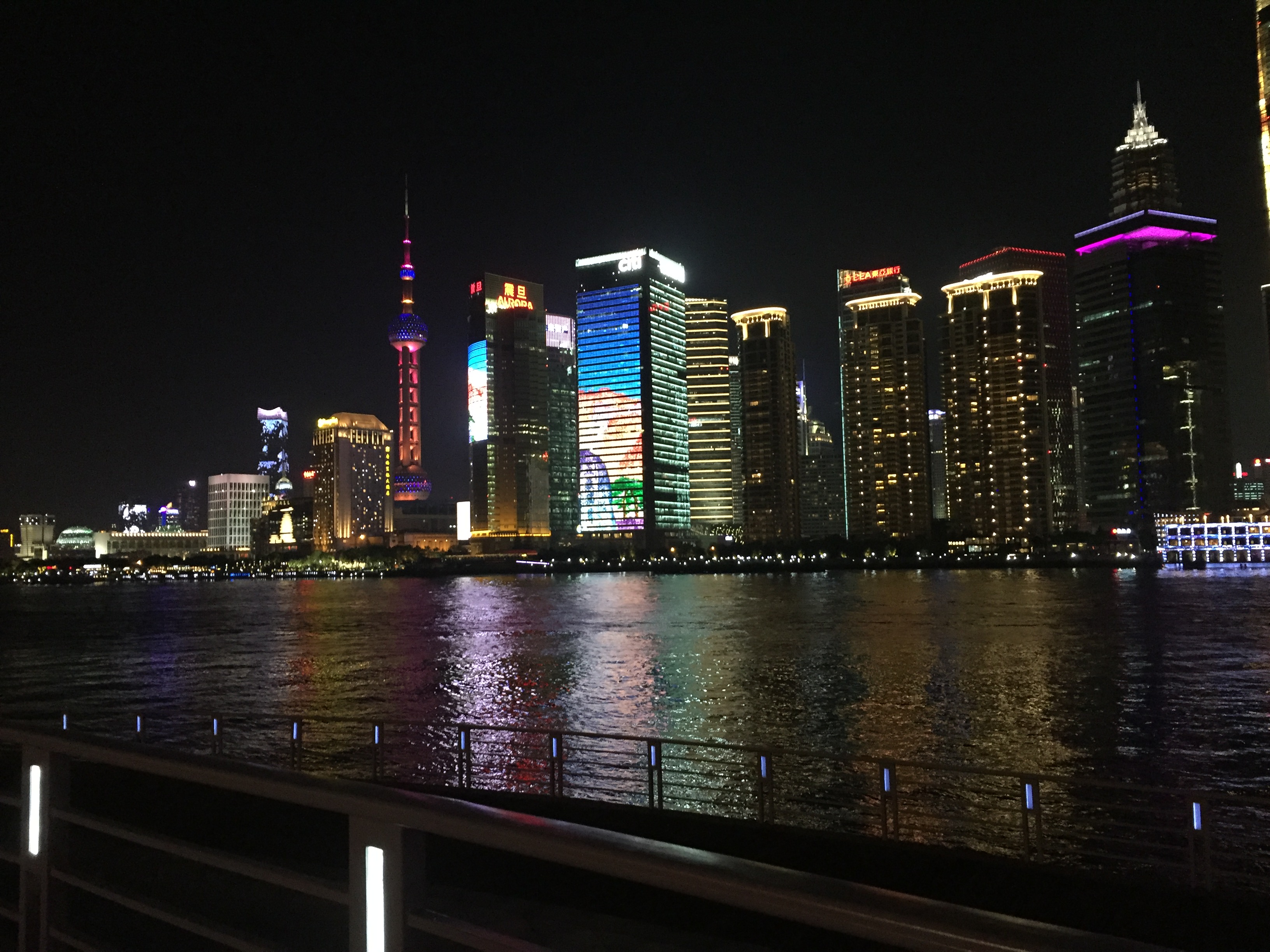
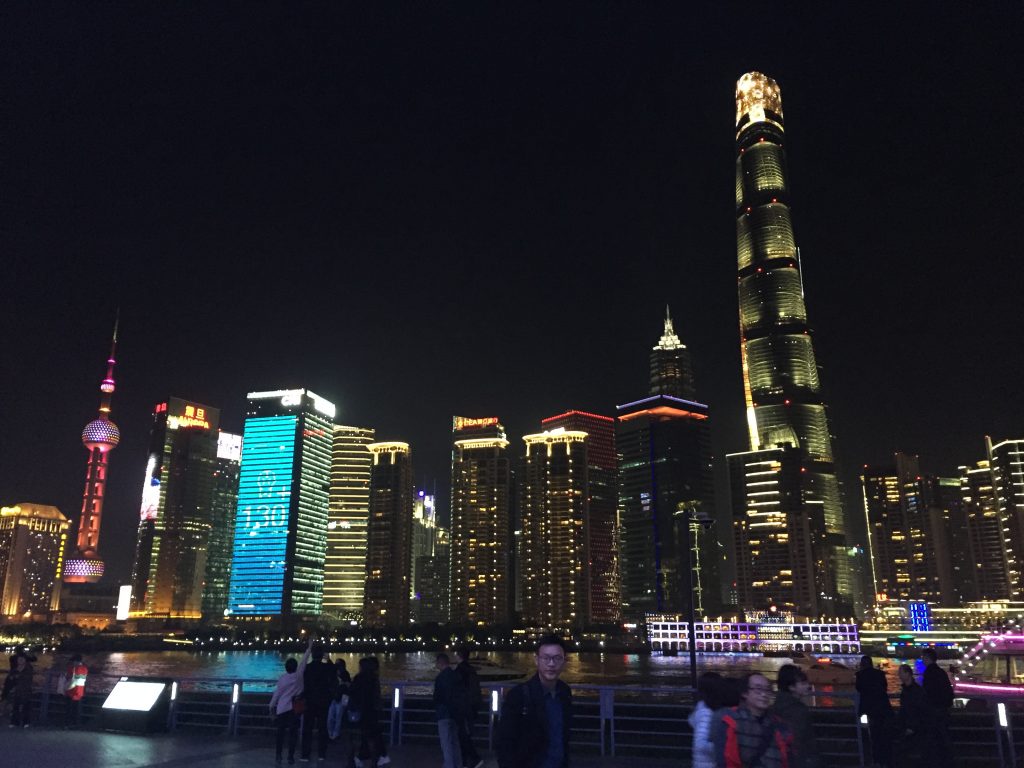
And so here we are. After settling in our Shanghai hotel on our evening of arrival, and enjoying our first taste of Chinese food, we walk the waterfront promenade, theBund, that is lined with colonial buildings. We join hundreds of others in the dark evening, drawn by the spectacle of the futuristic skyline of the Pudong district directly across the river from Shiliupu. Between making photographs of the lights and lining up to gather images of our first night in China, I can hear lines from a city poem in my head, from Gary Snyder’s Mountains and Rivers Without End:

Beautiful buildings we float in, we feed in,
Foam, steel, gray
Alive in the Sea of Information.

The Shanghai Tower soars six hundred and thirty meters above a river filled with illuminated boats cruising the dark waters and the Oriental Pearl TV Tower pokes out among dozens of square buildings plunging upwards into the dark sky. Each of the buildings are light screens flashing brilliant colors and patterns. At the top of the Tower, a cap of light streams race upwards into the darkness—as if to release into the sky. 

Beautiful buildings for sure. When we return to the hotel everyone gathers their jet lag and heads to their rooms.Rodney and I decide to walk into the city night where we find a small bar and a cold beer to celebrate our first night in the People’s Republic of China–coming into the country.