“Since our office is with moments, let us husband them.”
—Ralph Waldo Emerson, “Experience”
In late October, 2018, I found myself considering a question from the Chinese poet, translator, scholar, Zhang Ziqing about a passage from Henry David Thoreau’s essay “Walking.” This is the essay that begins with a sentence that has drawn readers ever since Thoreau delivered the talk, “Walking, or the Wild,” in Concord, Massachusetts, on April 23, 1851. “I wish to speak a word for Nature, for absolute freedom and wildness, as contrasted with a freedom and culture merely civil,––to regard man as an inhabitant, or part and parcel of Nature, rather than a member of society.” Thoreau asks his audience to consider “absolute” freedom against a “freedom and culture merely civil.” Or as he asks later in the essay, “give me a wildness no civilization can endure.”
Nearly a century later the poet Gary Snyder points out that wildness is clearly not difficult to find. Although, as he adds, “It is harder to imagine a civilization that wildness can endure.” Snyder then reframes Thoreau’s outlook to meet the challenges of our time. ”Wildness is not just the ‘preservation’ of the world, it is the world. Civilizations east and west have long been on a collision course with wild nature, and now the the developed nations in particular have the witless power to destroy not only individual creatures, but whole species, whole processes, of the earth.”
The question from Zhang Ziqing, though, was about a specific passage in Thoreau’s “Walking”:
“I would not have every man nor every part of man cultivated, any more than I would have every acre of earth cultivated: part will be tillage, but the greater part will be meadow and forest, not only serving an immediate use, but preparing a mould against a distant future, by the annual decay of the vegetation it supports.”
Is “mould” a kind of beneficial bacteria?, he asked. Zhang Ziqing was translating a talk I was preparing for the Poetry Bridging Continents Symposium, at Yancheng University, in the Western Chinese province of Jiangsu. The international symposium would bring together Chinese and American poets, scholars, translators, and students for three days of readings and discussion. And I was presenting one of the keynotes that I titled “From Pastoral to Ecopoetics in the Anthropocene.” What followed was a series of exchanges between professor Zhang Ziqing at Nanjing University as I prepared for our poetry exchange in China.
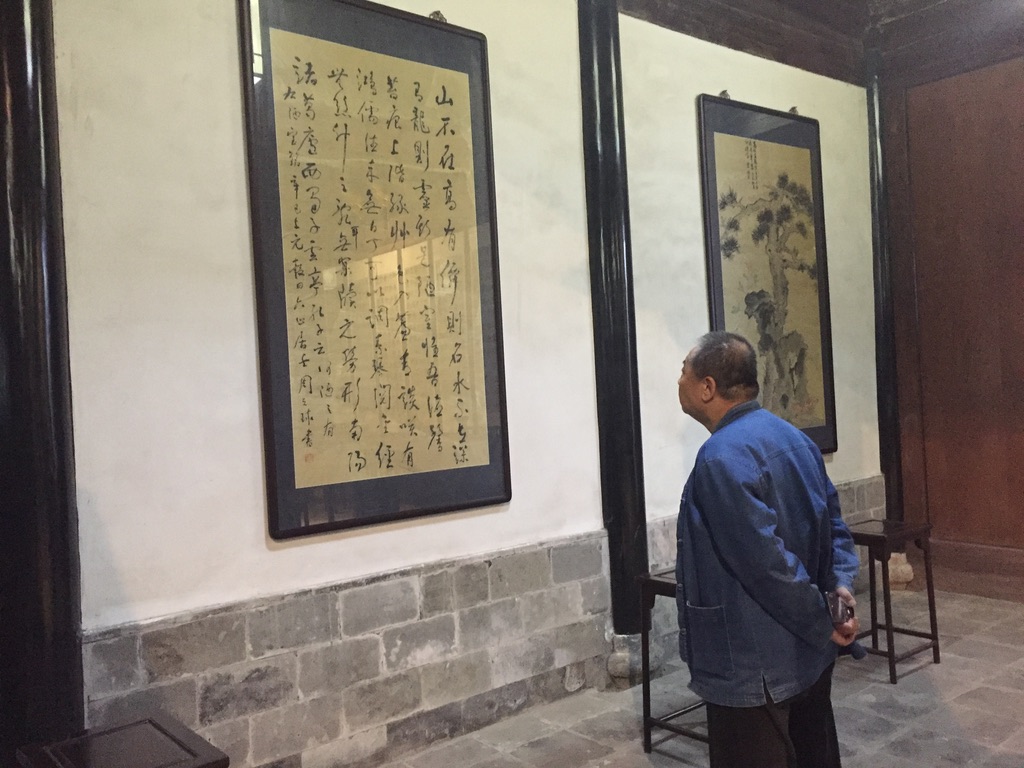
Poet and calligrapher Huang Bo in Suzhou
For those of us who work in the fields of language and literature, editorial exchanges are most often unexceptional. Though when this week I learned from another Chinese friend and colleague, Chen Yihai, that Zhang Ziqing had passed away, I recalled the delightful conversations with him that opened up in the translation process, a conversation that continued during my ten-day visit to China.
The process of intellectual exchange is an unending conversation that unfolds in moments of time at once ephemeral and lasting. Those of us trained in and habituated to the arts of attention to language and literature experience in these moments of exchange the lasting rewards of the collaborative process that constitute the intellectual work of essays and books. But in husbanding these moments, if we are fortunate, we find what we are looking for.
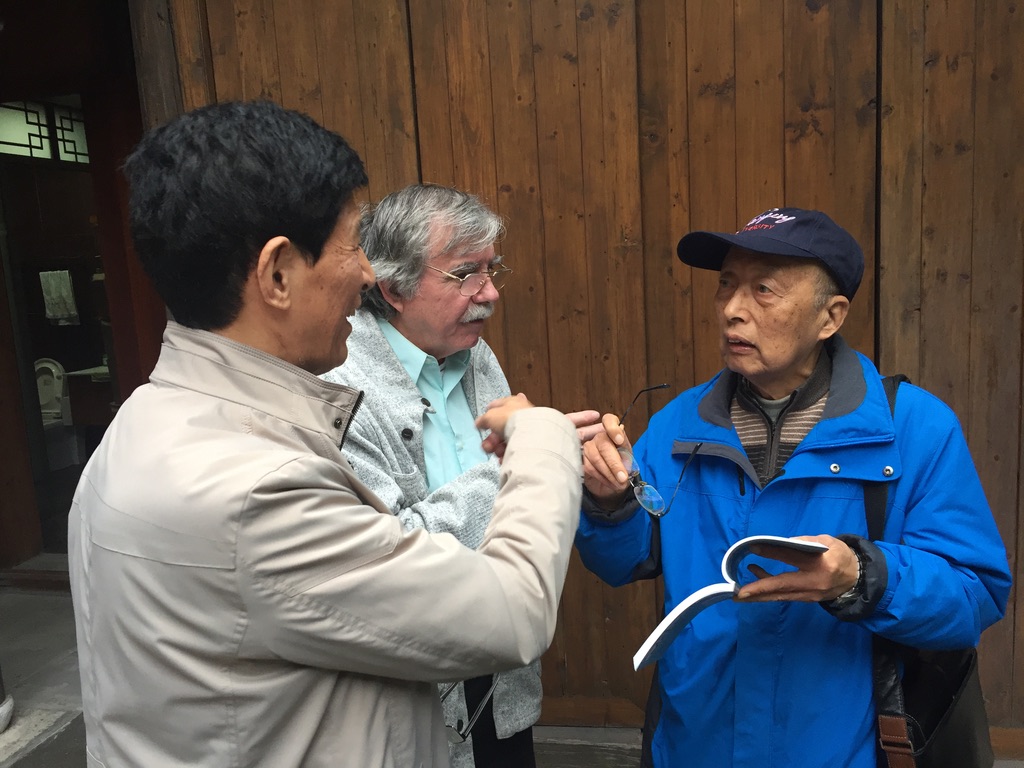
Poet and calligrapher, Zi Chuan, Roger Martin, Zhang Ziqing
Soon after I responded to his query about the passage in which Thoreau talks of “preparing a mould against a distant future” I received another series of questions from Zhang Ziqing. He asked about the passage that follows in the essay. “There are other letters for the child to learn than those which Cadmus invented,” Thoreau explains. “The Spaniards have a good term to express this wild and dusky knowledge—Gramatica parda—tawny grammar, a kind of mother-wit derived from that same leopard to which I have referred.” Here are the instructions I received in an email from Zhang Ziqing:
- Please translate the Spanish phrase “Gramatica parda”into English.
- Does “Gramatica parda” mean “deceptively smooth” or “as slippery as an eel”?
- What does “tawny grammar” mean?
- Ὡς τὶ νοῶν, οὐ κεῖνον νοήσεις,” A phrase in Greek? Is its English translation “You will not perceive that, as perceiving a particular thing”?
As it happens, this particular passage is lifted into the light by Gary Snyder in an essay he titles “Tawny Grammar” and in which he quotes this very passage. Over many years I have taught this essay and, in doing archival research on Snyder’s contributions to American poetry, I have been learning more about classical Chinese poetry in translation through American poets engaged with the Chinese tradition—including Ezra Pound, Kenneth Rexroth, and Gary Snyder.
So I wrote back Zhang Ziqing thanking him for his questions:
“1. The Spanish “grammatica parda” literally means “brown grammar”
2. The phrase refers figuratively to wisdom and knowledge of the world that is not learned in school and does not require education to learn. We have a phrase in English, “street smarts,” that might be apposite here, or it might be somewhat like the practical knowledge a farmer knows from experience.
3. In the passage we are discussing here Thoreau calls it “wild and dusky knowledge” and he translates the word “brown” as “tawny.” The literal definition of “tawny” is orange or yellowish brown in color. (The origin of the world is taune, or tanned.)
4. For Thoreau, “tawny grammar” is what he calls a “mother wit.” The mother is Nature. This interpretation can be derived from an earlier passage in the text of “Walking,” where Thoreau writes: “that leopard to which I referred.” Here is the passage he is talking about: “this vast, savage, howling mother of ours, Nature, lying all around, with such beauty, and such affection for her children, as the leopard; and yet we are so early weaned from her breast to society.” So “tawny grammar” means essentially the knowledge of nature. The poet Gary Snyder has an essay called “Tawny Grammar” in which he quotes Thoreau and defines grammar as more than language but also including culture, civilization, and nature.
5. The Greek is translated by Thoreau in the phrase that he follows the Greek phrase with, “You will not perceive that, as perceiving a particular thing.”
6. Yes: “mould” is a kind of beneficial bacteria.”
To which he replied:
“Thank you for your prompt reply. It’s hard for me to translate ‘brown grammar’ into Chinese as it would sound nonsensical if I do an literal translation (translate it word for word) of the phrase. So, could I translate it as ‘the wisdom of wild’ or ‘the practical knowledge of wild?'”
Though it was not until I found myself in China in the week following the poetry Symposium in Yancheng, in a small group of American and Chinese poets and calligraphers on a multi-day bus trip, that I learned of our common interests. We continued our conversations as we went about the featured events of our trip, including an open-air evening poetry reading at the Yellow Sea Forest Park; a meeting with poets, filmmakers, and the cultural development minister at the Taizhou International Writing Center; and a workshop at the Yinxi Academy, a calligraphy studio in the ancient city of Shaxi.
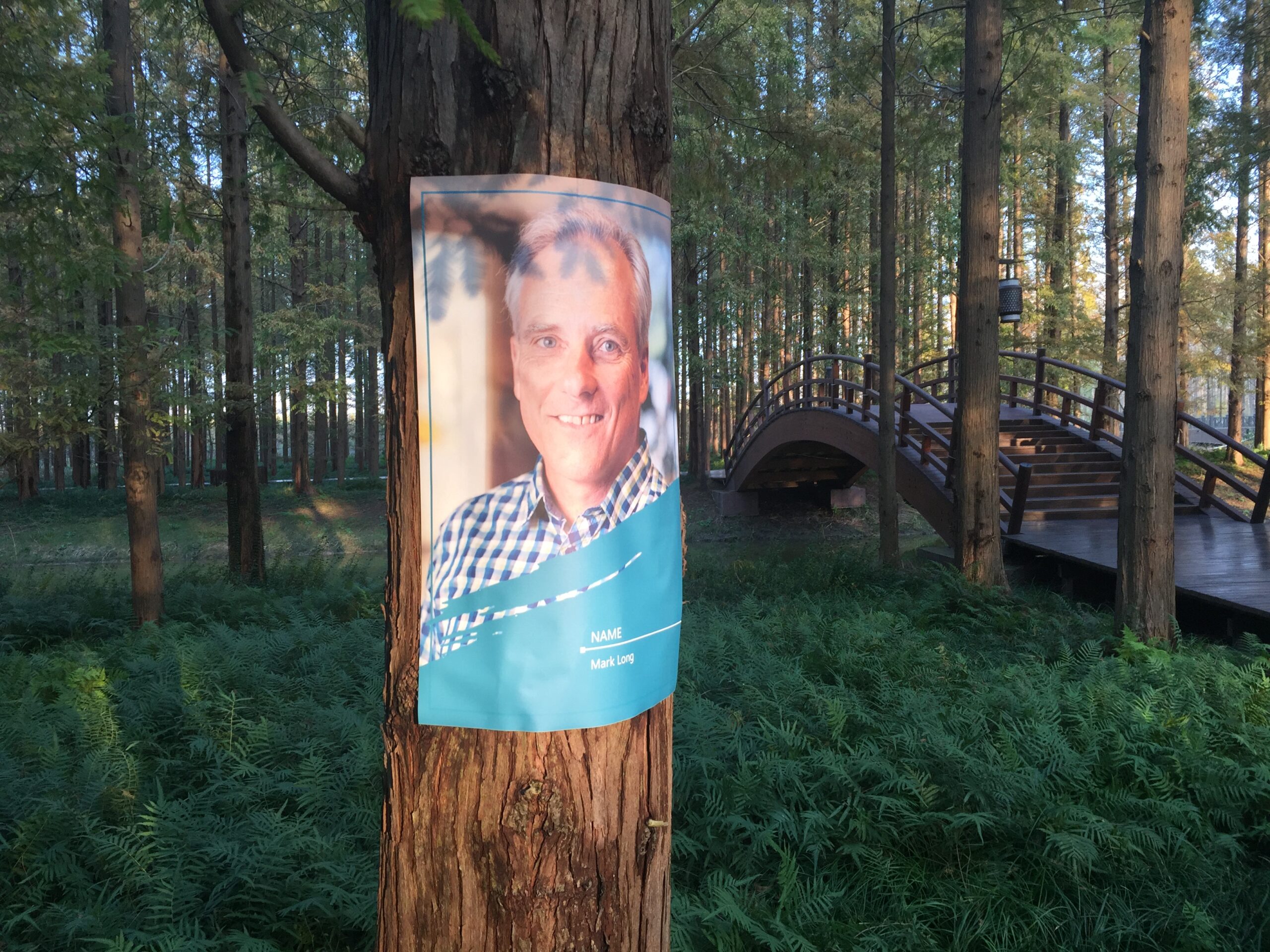
A poster pasted on a metasequoia tree at Yellow Sea Forest Park before an open air poetry reading party, and interview with me, at the opening ceremony for the new “Poet’s House,” Dongtai, Jaingsu Province
I learned that that in the early 1980s Zhang Ziqing completed a post-doctoral fellowship at Harvard University, was a Fulbright Scholar at Harvard and the University of California at Berkeley, and was a member of the Standing Committee of China Association for the Study of American Literature. We talked about his time in the Bay Area where he later met a range of poets, including Allen Ginsberg, Lawrence Ferlinghetti, Philip Whalen, Michael McClure, Anne Waldman, and Jack Foley, among others.
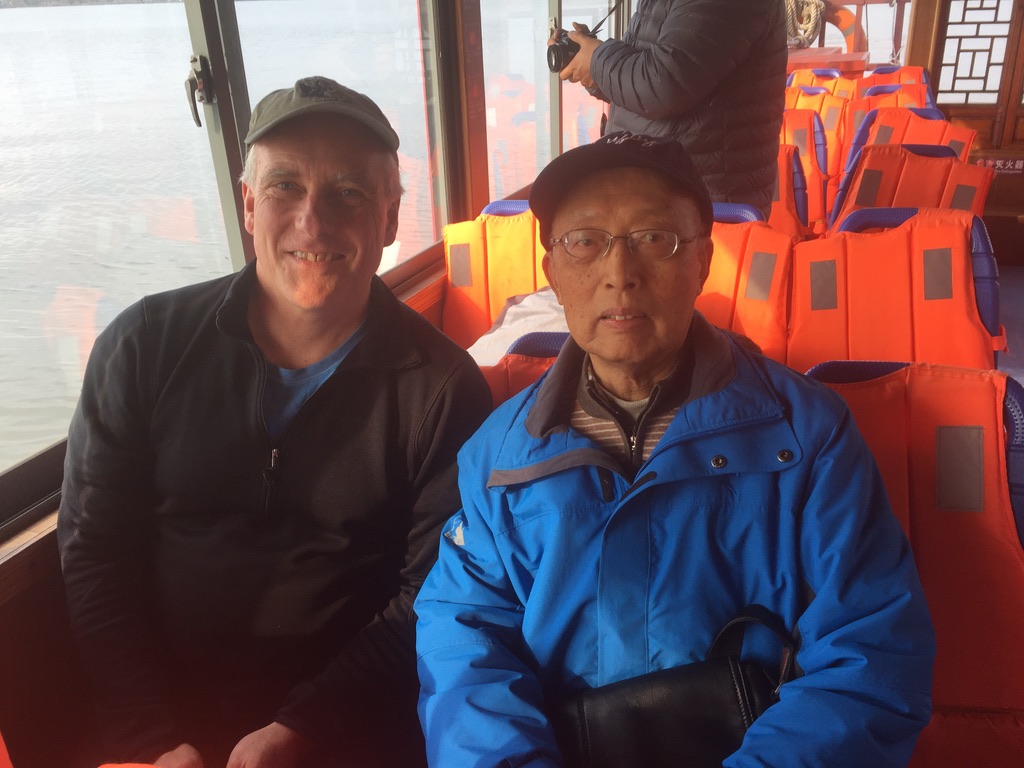
On a boat at QuinHu Lake with Zhang Ziqing, Jaingsu, China
Our conversations were about continents but traditions and histories, and about plainspoken poems written in cadences that bring to mind the ancient rivers-and-mountains (shan-shui) tradition, as well as the focus on poetic language and method among poets in the US during the second half f the twentieth century. Whether written in Chinese or English, set in China or North America, our shared interest was in traditions of poems with an interest in urban and rural landscapes, memory and place, the artifice of language and the natural world, as well as the social and cultural process of intellectual exchange.
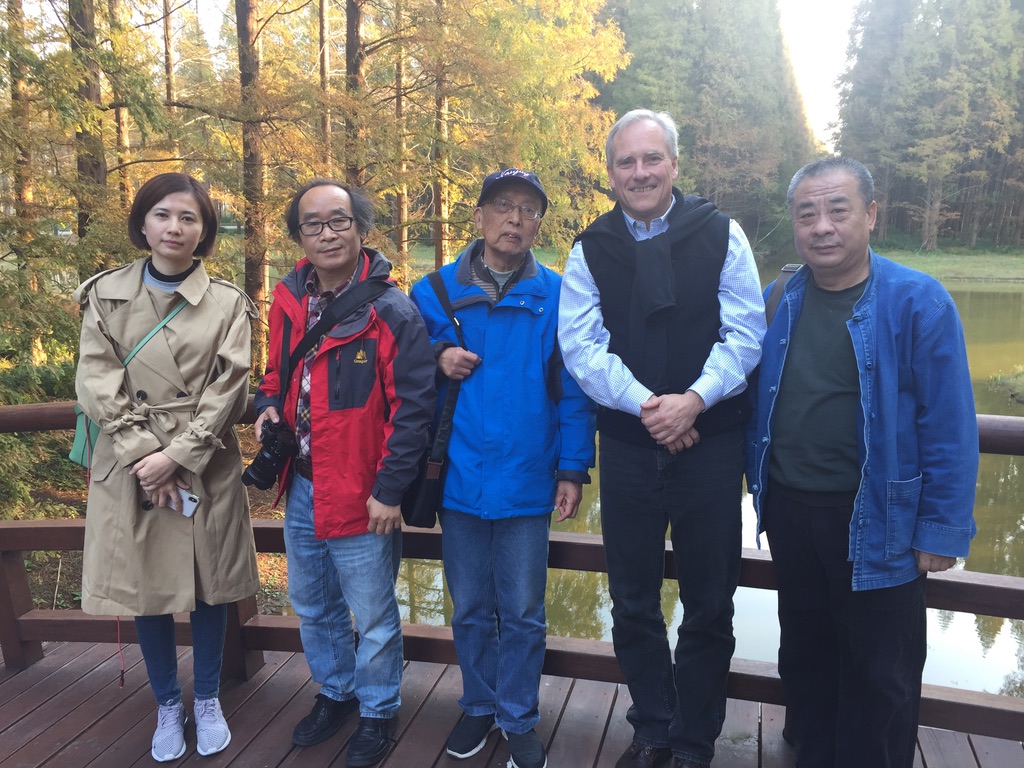
Out and about with Chinese friends
Dear Mark, Zhang wrote to me the year following our visit to China,
“Happy Spring Festival in the Lunar Year of Mouse!
I still vividly remember your talk given in China: ‘Pastoral and Ecopoetics in the Anthropocene.’ I wish to read and introduce your essay ‘Pastoral and Ecopoetics in the Anthropocene’ to China when you send me its full text (that is, you added and revised it when you went back from China) at your convenience.”
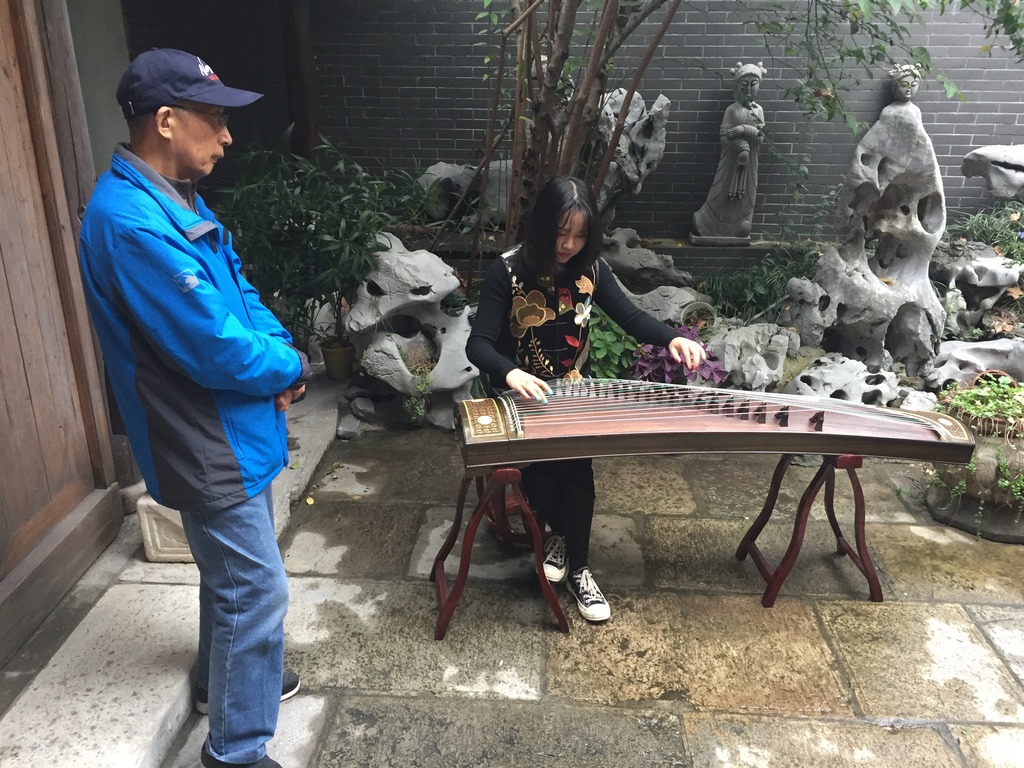
At the literary and cultural center in Zhangzhou
I sent along the essay, with my best wishes. Though I am now now thinking of lines written by Gary Snyder:
This present moment
that lives on
to become
long ago
(Other notes on Zhang Ziqing’s passing include Charles Bernstein’s brief remembrance here.)
