Category Archives: Poems

Responding to Whitman

The poems of Walt Whitman are nothing if not provocative. They have (and continue) to generate response. One way to find your way to these responses, if you are interested in tracing Whitman’s reception (among poets and readers of poetry, is to do an author search for Walt Whitman at the Poetry Foundation. If you click on that link, there are 271 results––including a handy-dandy menu at the top that breaks out some of the items by category:

There are 74 poems, many by Whitman himself, but including Ode to Walt Whitman (January 1955), by the Spanish poet Federico García Lorca, and a poem by Martin Espada, Vivas To Those Who Have Failed: The Paterson Silk Strike, 1913 (2015) that begins with an epigraph from Whitman, lines from section 18 of Song of Myself:

With music strong I come, with my cornets and my drums,
I play not marches for accepted victors only, I play marches for conquer'd and slain persons.

Have you heard that it was good to gain the day?
I also say it is good to fall, battles are lost in the same spirit in which they are won.

I beat and pound for the dead,
I blow through my embouchures my loudest and gayest for them.

Vivas to those who have fail'd!
And to those whose war-vessels sank in the sea!
And to those themselves who sank in the sea!
And to all generals that lost engagements, and all overcome heroes!
And the numberless unknown heroes equal to the greatest heroes known!

The category “Prose from Poetry Magazine” includes a range of fascinating responses to Whitman, such as Espada’s Filthy Presidentiad: Walt Whitman in the Age of Trump (2019), an essay that weaves together Whitman’s project with the unfolding spectacle of the current American political regime. (It is difficult if not impossible, at least I have found, to read Democratic Vistas without finding in Whitman’s diagnosis an analogue to our moment in the history of democratic experience and culture.)

Below are three poems, by Ezra Pound, Alan Ginsberg, and Sherman Alexie to suggest how poets have been pulled into the presence of Whitman in the long arc of American literary and cultural history.

A Pact

I make truce with you, Walt Whitman—
I have detested you long enough.
I come to you as a grown child
Who has had a pig-headed father;
I am old enough now to make friends.
It was you that broke the new wood,
Now is a time for carving.
We have one sap and one root—
Let there be commerce between us.

––Ezra Pound

A Supermarket in California

What thoughts I have of you tonight, Walt Whitman, for I walked down the sidestreets under the trees with a headache self-conscious looking at the full moon.
         In my hungry fatigue, and shopping for images, I went into the neon fruit supermarket, dreaming of your enumerations!
         What peaches and what penumbras! Whole families shopping at night! Aisles full of husbands! Wives in the avocados, babies in the tomatoes!—and you, Garcia Lorca, what were you doing down by the watermelons?

         I saw you, Walt Whitman, childless, lonely old grubber, poking among the meats in the refrigerator and eyeing the grocery boys.
         I heard you asking questions of each: Who killed the pork chops? What price bananas? Are you my Angel?
         I wandered in and out of the brilliant stacks of cans following you, and followed in my imagination by the store detective.
         We strode down the open corridors together in our solitary fancy tasting artichokes, possessing every frozen delicacy, and never passing the cashier.

         Where are we going, Walt Whitman? The doors close in an hour. Which way does your beard point tonight?
         (I touch your book and dream of our odyssey in the supermarket and feel absurd.)
         Will we walk all night through solitary streets? The trees add shade to shade, lights out in the houses, we’ll both be lonely.
         Will we stroll dreaming of the lost America of love past blue automobiles in driveways, home to our silent cottage?
         Ah, dear father, graybeard, lonely old courage-teacher, what America did you have when Charon quit poling his ferry and you got out on a smoking bank and stood watching the boat disappear on the black waters of Lethe?

––Alan Ginsberg, 1955

Defending Walt Whitman

Basketball is like this for young Indian boys, all arms and legs

and serious stomach muscles. Every body is brown!

These are the twentieth-century warriors who will never kill,

although a few sat quietly in the deserts of Kuwait,

waiting for orders to do something, to do something.

God, there is nothing as beautiful as a jumpshot

on a reservation summer basketball court

where the ball is moist with sweat,

and makes a sound when it swishes through the net

that causes Walt Whitman to weep because it is so perfect.

There are veterans of foreign wars here

although their bodies are still dominated

by collarbones and knees, although their bodies still respond

in the ways that bodies are supposed to respond when we are young.

Every body is brown! Look there, that boy can run

up and down this court forever. He can leap for a rebound

with his back arched like a salmon, all meat and bone

synchronized, magnetic, as if the court were a river,

as if the rim were a dam, as if the air were a ladder

leading the Indian boy toward home.

Some of the Indian boys still wear their military hair cuts

while a few have let their hair grow back.

It will never be the same as it was before!

One Indian boy has never cut his hair, not once, and he braids it

into wild patterns that do not measure anything.

He is just a boy with too much time on his hands.

Look at him. He wants to play this game in bare feet.

God, the sun is so bright! There is no place like this.

Walt Whitman stretches his calf muscles

on the sidelines. He has the next game.

His huge beard is ridiculous on the reservation.

Some body throws a crazy pass and Walt Whitman catches it

with quick hands. He brings the ball close to his nose

and breathes in all of its smells: leather, brown skin, sweat,

black hair, burning oil, twisted ankle, long drink of warm water,

gunpowder, pine tree. Walt Whitman squeezes the ball tightly.

He wants to run. He hardly has the patience to wait for his turn.

“What’s the score?” he asks. He asks, “What’s the score?”

Basketball is like this for Walt Whitman. He watches these Indian boys

as if they were the last bodies on earth. Every body is brown!

Walt Whitman shakes because he believes in God.

Walt Whitman dreams of the Indian boy who will defend him,

trapping him in the corner, all flailing arms and legs

and legendary stomach muscles. Walt Whitman shakes

because he believes in God. Walt Whitman dreams

of the first jumpshot he will take, the ball arcing clumsily

from his fingers, striking the rim so hard that it sparks.

Walt Whitman shakes because he believes in God.

Walt Whitman closes his eyes. He is a small man and his beard

is ludicrous on the reservation, absolutely insane.

His beard makes the Indian boys righteously laugh.

His beardfrightens the smallest Indian boys. His

beard tickles the skin

of the Indian boys who dribble past him. His beard, his beard!

God, there is beauty in every body. Walt Whitman stands

at center court while the Indian boys run from basket to basket.

Walt Whitman cannot tell the difference between

offense and defense. He does not care if he touches the ball.

Half of the Indian boys wear t-shirts damp with sweat

and the other half are bareback, skin slick and shiny.

There is no place like this. Walt Whitman smiles.

Walt Whitman shakes. This game belongs to him.

—Sherman Alexie
On Literary Form, Production, and Reception

“Books are the best of things, well used; abused, among the worst. What is the right use? What is the one end, which all means go to effect? They are for nothing but to inspire. I had better never see a book, than to be warped by its attraction clean out of my own orbit, and made a satellite instead of a system. The one thing in the world, of value, is the active soul.”

––Ralph Waldo Emerson, The American Scholar (1837)

In our work ahead with the poems of Walt Whitman, you will be learning how to make use of primary and secondary materials. You will be learning to navigate a digital archive. And you will be learning to enlarge your attention to matters of literary form, production, and reception. These are three coordinates especially useful for readers in college and beyond: 1) paying attention to the way a text is put together, 2) exploring the conditions (social, historical, biographical, ideological) in which a text was produced by an author; and 3) considering the tradition of commentary, or reception, of a text.

I am grateful for Clover’s first annotation on “I Celebrate Myself,” the poem from the 1855 edition that would evolve into perhaps Whitman’s most well-known poem, “Song of Myself.” Here is the annotation:

Walt Whitman is a transcendentalist. He believes that humans should be independent and society corrupts the human experience.

A reader and scholar of Whitman, Roger Asselineau, in his entry Transcendentalism in the Walt Whitman: An Encyclopedia, offers the next step to take:

Properly speaking, for geographical and social reasons, Walt Whitman was not a transcendentalist, since transcendentalism was a New England phenomenon affecting American scholars and clergymen’s relatives. Yet he can be considered the poet of transcendentalism whose coming Emerson had prophesied, but which he failed to be himself, because his poetry was more intellectual than inspired and was, besides, hampered by the straitjacket of traditional prosody. Emerson remained on the threshold of the Promised Land, but his works were the fountain-spring of Whitman’s poetry, if we are to believe what Whitman himself said on several occasions, notably to J.T. Trowbridge in 1860: “I was simmering, simmering, simmering; Emerson brought me to a boil” (qtd. in Trowbridge 166). 

This is a generative qualification of the general comment about what Whitman is, “a Transcendentalist”. It is not a correction but rather a qualification.

I am deliberately modeling how to move to secondary criticism (the reception of Whitman by readers). And I am demonstrating how we will be making use of the Walt Whitman Archive: in this case, connecting us to Whitman’s reception by an informed reader (a Whitman scholar), using secondary source material in our thinking and writing about a text by Whitman. My point here is that there are first thoughts. There are second thoughts. And there can be a series of thoughts to follow.

Let’s say, to continue, that you keep coming across that often cited “simmering” comment Whitman made to Trowbridge. One direction to take would be to Emerson and his writing, specifically his essay The Poet, where he says a number of things that might open up Whitman’s project for you.

(Note well, too, how I am using hyperlinks to “read laterally” to the primary source materials we are using here.)

Here is a list of excerpts from that essay that might contribute to Clover’s first statement about Whitman:

“The fate of the poor shepherd, who, blinded and lost in the snow-storm, perishes in a drift within a few feet of his cottage door, is an emblem of the state of man. On the brink of the waters of life and truth, we are miserably dying. The inaccessibleness of every thought but that we are in, is wonderful. What if you come near to it, — you are as remote, when you are nearest, as when you are farthest. Every thought is also a prison; every heaven is also a prison” (302).

“For it is not metres, but a metre-making argument, that makes a poem, — a thought so passionate and alive, that, like the spirit of a plant or an animal, it has an architecture of its own, and adorns nature with a new thing. The thought and the form are equal in the order of time, but in the order of genesis the thought is prior to the form. The poet has a new thought: he has a whole new experience to unfold; he will tell us how it was with him, and all men will be the richer in his fortune. For, the experience of each new age requires a new confession, and the world seems always waiting for its poet” (290-01).

“Man, never so often deceived, still watches for the arrival of a brother who can hold him steady to a truth, until he has made it his own. With what joy I begin to read a poem, which I confide in as an inspiration! And now my chains are to be broken; I shall mount above these clouds and opaque airs in which I live, — opaque, though they seem transparent, — and from the heaven of truth I shall see and comprehend my relations. That will reconcile me to life, and renovate nature, to see trifles animated by a tendency, and to know what I am doing. Life will no more be a noise; now I shall see men and women, and know the signs by which they may be discerned from fools and satans. This day shall be better than my birth-day: then I became an animal: now I am invited into the science of the real. Such is the hope, but the fruition is postponed. Oftener it falls, that this winged man, who will carry me into the heaven, whirls me into the clouds, then leaps and frisks about with me from cloud to cloud, still affirming that he is bound heavenward; and I, being myself a novice, am slow in perceiving that he does not know the way into the heavens, and is merely bent that I should admire his skill to rise, like a fowl or a flying fish, a little way from the ground or the water; but the all-piercing, all-feeding, and ocular air of heaven, that man shall never inhabit. I tumble down again soon into my old nooks, and lead the life of exaggerations as before, and have lost my faith in the possibility of any guide who can lead me thither where I would be” (291-92).

“This insight, which expresses itself by what is called Imagination, is a very high sort of seeing, which does not come by study, but by the intellect being where and what it sees, by sharing the path, or circuit of things through forms, and so making them translucid to others” (298).

“But the quality of the imagination is to flow, and not to freeze. The poet did not stop at the color, or the form, but read their meaning; neither may he rest in this meaning, but he makes the same objects exponents of his new thought. Here is the difference betwixt the poet and the mystic, that the last nails a symbol to one sense, which was a true sense for a moment, but soon becomes old and false. For all symbols are fluxional; all language is vehicular and transitive, and is good, as ferries and horses are, for conveyance, not as farms and houses are, for homestead” (302).

It is not difficult to identify in these passages a way of talking about poetry that might lead us to other primary and secondary sources in our continuing study of Whitman.

From the Fireside to the Open Road

We watched the first red blaze appear,
Heard the sharp crackle, caught the gleam
On whitewashed wall and sagging beam,
Until the old, rude-furnished room
Burst, flower-like, into rosy bloom;

—from
 Snow-Bound, John Greenleaf Whittier

Afoot and light-hearted I take to the open road,
Healthy, free, the world before me,
The long brown path before me leading wherever I choose.
Henceforth I ask not good-fortune, I myself am good-fortune,
Henceforth I whimper no more, postpone no more, need nothing,
Done with indoor complaints, libraries, querulous criticisms,
Strong and content I travel the open road.

––from Song of the Open Road, Walt Whitman

Any story of nineteenth-century American poetry and poetics is one among many—starting somewhere, in our case with Whitman; touching on a few selected poems to provide useful coordinates for further study. But to get your head around Whitman it helps to consider other poems and poets from the nineteenth century. It helps because in comparison you begin to see Whitman’s singular intervention into the very idea of poetry, or what I am calling here the path from the fireside to the open road.

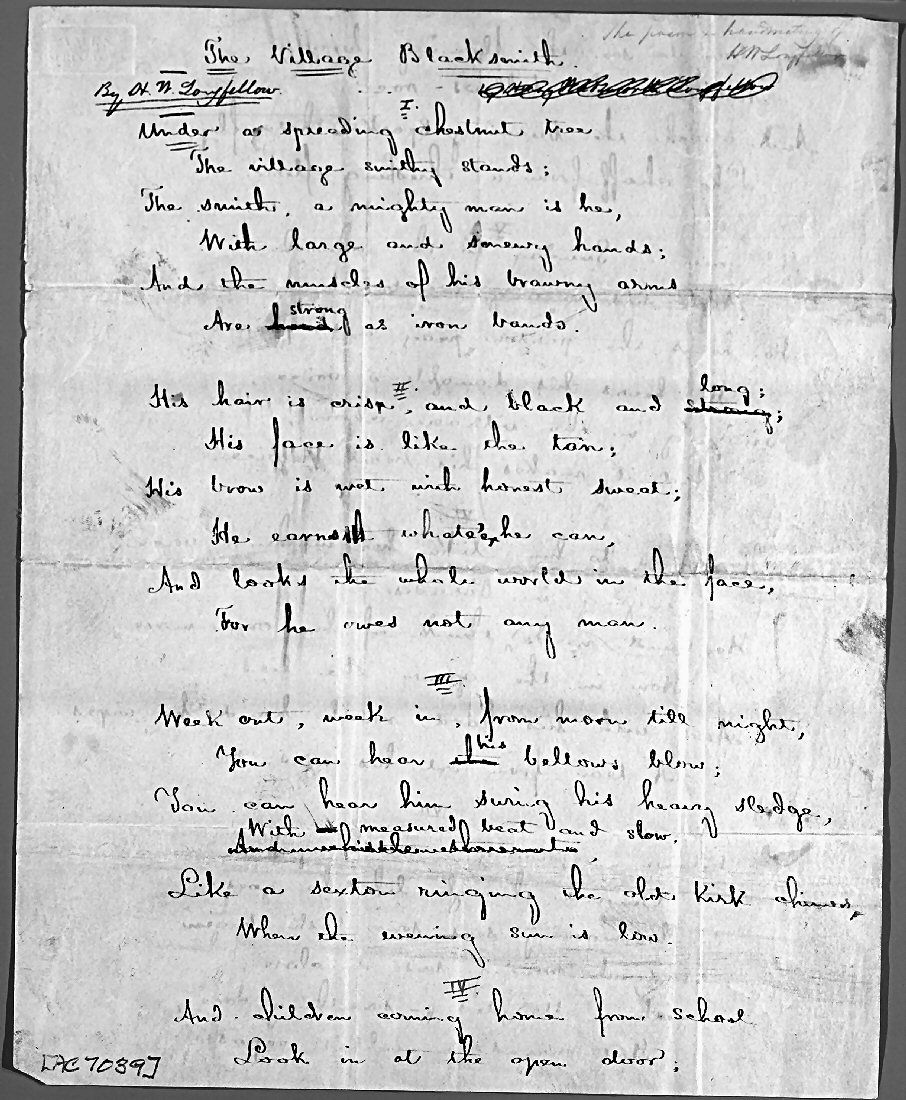
A first encounter with Whitman can be enhanced by thinking about poems and poetry in nineteenth century America. Longfellow’s poems show a master poet who is masterly adept at versification and storytelling. Have a look at the elegiac Mezzo Camin, the ballad The Village Blacksmith, or the nine-part poem The Courtship of Miles Standish. Or read in the long narrative poems, including the wildly popular narrative poem (written in unrhymed dactylic hexameters) Evangeline: A Tale of Acadie, a story based on the three thousand French settlers who were expelled from Acadie, near present day Nova Scotia. (This poem has appeared in over 270 editions and over 130 translations in ten different languages.) Or read the twenty-two cantos of The Song of Hiawatha (written in trochaic tetrameter, after the Finnish epic poem Kalevala), a passionate and sentimentalized white man’s account of native American culture and tradition based on the author’s reading in George Catlin’s Letters and Notes on the Manners, Customs, and Conditions of the North American Indians (1841), the ethnographical studies of Henry Rowe Schoolcraft, and the literary writings of the Ojibwe Jane Johnston Schoolcraft, whose poems and stories were sources for Longfellow’s North American epic.

The Fireside Poets

Longfellow, along with John Greenleaf Whittier, Oliver Wendell Holmes, James Russell Lowell, and William Cullen Bryant—these “fireside or “schoolroom” poets were enormously popular in their time and in the decades that followed their lives. These artists and intellectuals wrote not only poetry but sermons, lectures, essays, and journalism. They were among the first groups to imagine a distinctly American literary culture. And they were socially engaged and activist by temperament––though their sensibilities and poetics are perhaps described as more Victorian than democratic, and many readers have charged them with an overly sentimental or moralizing tone.

The poetic conventions and affirmative themes of these poets are evident in their works. Consider, for example, a sampling of poems: James Russell Lowell, The Present Crisis, Ralph Waldo Emerson, Concord Hymn and Each and All, William Cullen Bryant, Thanatopsis, John Greenleaf Whittier, Burning Drift-Wood or Snow-Bound: A Winter Idyll, and Oliver Wendell Holmes’ Old Ironsides. The use of conventional poetic forms, metrical cadences ideal for the use of poetry by many readers in nineteenth century America—for enjoyment, memorization, and recitation, whether at school or at home. And while one can point to the abolitionist writings of Whittier, Lowell and Emerson, for the most part the poems taken as representative of the Fireside poets affirm the dominant culture and promote social conformity.

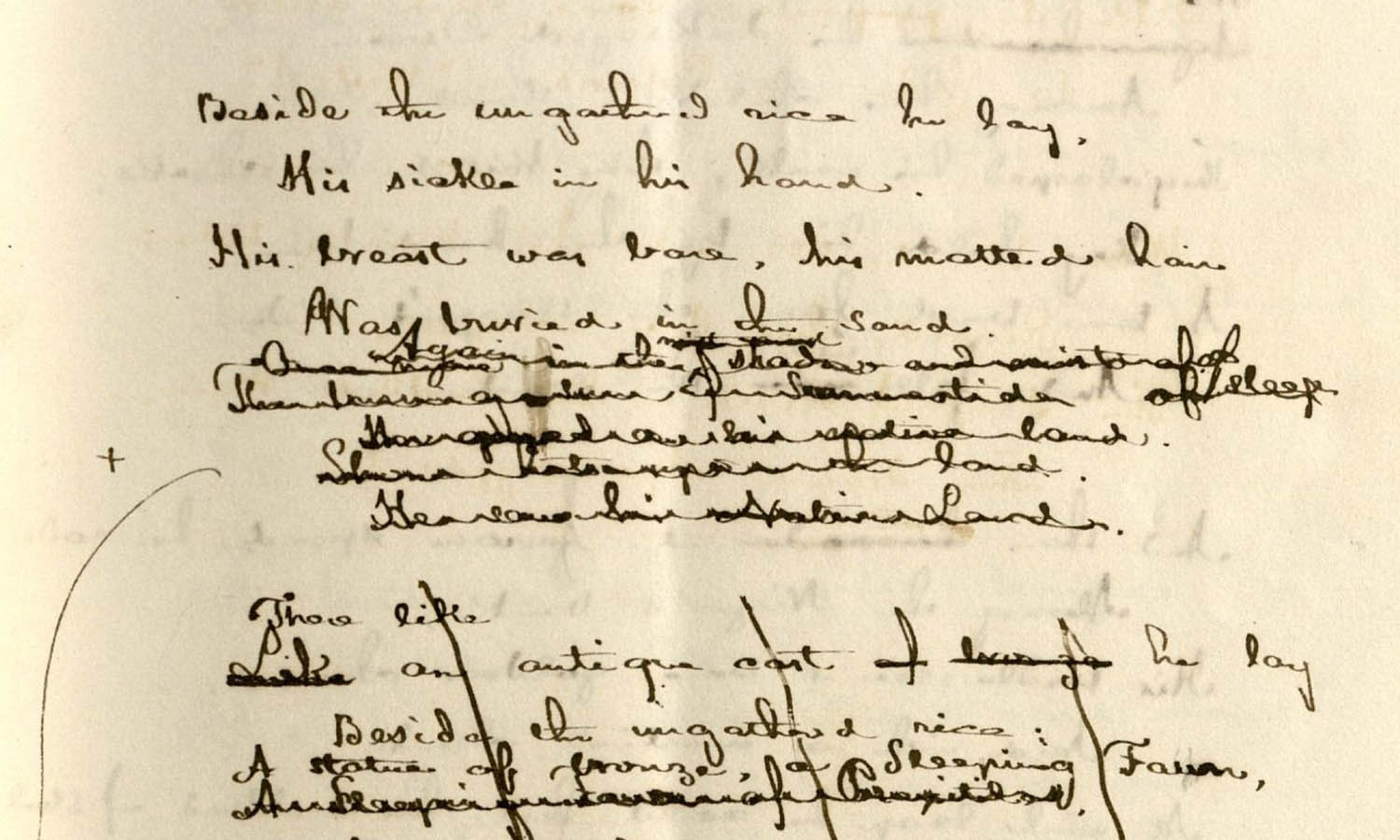
Henry Wadsworth Longfellow (1807-1882) “The slave’s dream” in Poems on slavery: autograph manuscript, ca. 1842. MS Am 1340 (76) – Trustees of the Longfellow House Trust, 1976.

Longfellow was the most popular and revered American poet of the century: a teacher of modern languages at Bowdoin and Harvard, an accomplished scholar, and a promiscuous world traveler. Longfellow

  • mirrored and helped to shape a distinctive American literary culture that reflected ideological investments in definitions of domesticity, community and national identity
  • reflects and shapes in his poems mainstream public opinion and national mythologies, hence embody the internal contradiction of nineteenth-century ideology as well as shared in the most enlightened viewpoints of his era
  • embodied a public vision of poetry as forum for not personal confession or private feeling but for identification (and definition) of self with the public
  • cultivated a distinctive transatlantic and cosmopolitan vision for American literature (that differed from the nationalism of his contemporary Walt Whitman, who very few people read)
  • wrote in an extraordinary range of forms: narrative and lyric, popular ballads and classical lines (Evangeline is written in unrhymed dactylic hexameters, for example)
  • translated major works and adapted poetic forms; he produced a well-received English edition of Dante and his literary adaptations, of the epic Finnish poem the Kalavela, to take a notable example, offered Longfellow the measure for his long poem Hiawatha
  • collaborated as an anthologist, producing the anthology The Poets and Poetry of Europe as well as the massive multivolume collection Poems of Places.

Still, Longfellow’s legacy has been mixed. A young poet named Edgar Allen Poe wrote in admiration of Longfellow but as Poe developed as a poet he opined that Longfellow was “a determined imitator and a dextrous adapter of the ideas of other people.” Similarly, others charged Longfellow with merely imitating European literature and affirming cultural commonplaces. And as American literature took shape in the United States in the twentieth century, critics such as F.O. Mathiessen effectively ignored Longfellow in the literary renaissance that produced the first installment in American literary history.

Manuscript page of “The Village Blacksmith”

As Dana Gioia writes, “If Whitman and Dickinson stand at the beginning of modern American literary consciousness, Longfellow represents a culmination” (67). Consider the editorial decisions of successive editors of the Oxford Book of American Verse:

  • Bliss Carmen, in 1927: more Longfellow than any other poet, 17 poems and 35 pages
  • F. O.Matthiessen (American Renaissance), in 1950, doubled page count from 680 to 1132, prints 14 Longfellow poems, 39 pages
  • Richard Ellman, New Oxford Book of American Verse, 1976, 11 poems, 12 pages
  • David Lehman, Oxford Book of American Poetry, 2006, 6 poems, 9 pages (all short lyrics)

In Lehman’s 2006 edition, by comparison, Whitman has 12 poems and 71 pages, Dickinson has 44 poems and 23 pages. Among the illuminating accounts of Longfellow’s fate and a critique of the biases of modernist poetics is Dana Gioia’s essay “Longfellow in the Aftermath of Modernism,” in The Columbia History of American Poetry, edited by Jay Parini and Brett C. Millier. (I highly recommend Christoph Irmscher’s book-length study Longfellow Redux (University of Illinois Press, 2006) as well.) Here is Gioia elaborating on the process that effaced Longfellow’s presence in American literary history: “Modernism declared narrative poetry at best obsolete and at worst a contradiction in terms. By prizing compression, intensity, complexity, and elipsis, it cultivated an often hermetic aesthetic inimical to narrative poetry. Perfecting poetry’s private voice, Modernism––at least American Modernism––lost the art’s public voice” (79).

Walt Whitman and Democratic Literacy

Closer yet I approach you,
What thought you have of me now, I had as much of you—
I laid in my stores in advance,
I consider’d long and seriously of you before you were born.

Who was to know what should come home to me?
Who knows but I am enjoying this?
Who knows, for all the distance, but I am as good as looking
at you now, for all you cannot see me?

––Walt Whitman, Crossing Brooklyn Ferry

Reading and Literacy

We are transitioning into the second phase of our work together this semester: reading and thinking and writing with the poems (and prose) of Walt Whitman. You will be immersed in Whitman’s writing as you continue to develop as readers, thinkers, and writers; and you will be learning to make productive use of digital and print archives.

Our inquiry into Whitman’s corpus will be immersive—a method of reading we will be practicing together through the end of October. But the quality and reach of our immersive reading project will begin with you: with your motivation to immerse yourself in a textual corpus and to ride your curiosity from passage to passage, from text to text. This kind of intellectual immersion requires patience and persistence as your reading experience is challenged by singular texts that are, in both a literal and a figurative sense, beyond you.

In the MLA AI Literacy document I cited in my most recent “Teacher Talk” piece the authors write that “developing literacy in reading means being able to reread, tackle increasingly difficult texts, and do research in order to further build your capability as a reader. Literacy also assumes you have enough knowledge to question and evaluate what you are studying.” Following this, I included my own definition of what can happen when we experience the kind of reading I am describing here as part of what I have come to call “democratic literacy.” I write,

reading, thinking, and writing are by definition creative activities that we learn and refine as we develop as human beings. In reading we learn to process language and information, to access ideas, and open ourselves to minds and worlds that differ from our own; in thinking we learn to recognize patterns, make inferences, and evaluate evidence, as well as to access concepts and principles, understand cause and effect, temporality, and to consider moral and ethical questions in complex situations we face in our lives; and in writing we discover and formulate and learn to share thoughts and ideas, communicate with different audiences, and learn to use language and discourse effectively in differing rhetorical contexts.

I call this literacy “democratic” in part because of the inherent responsibilities we have as people living together in what Whitman and others have called a “culture of democracy.”

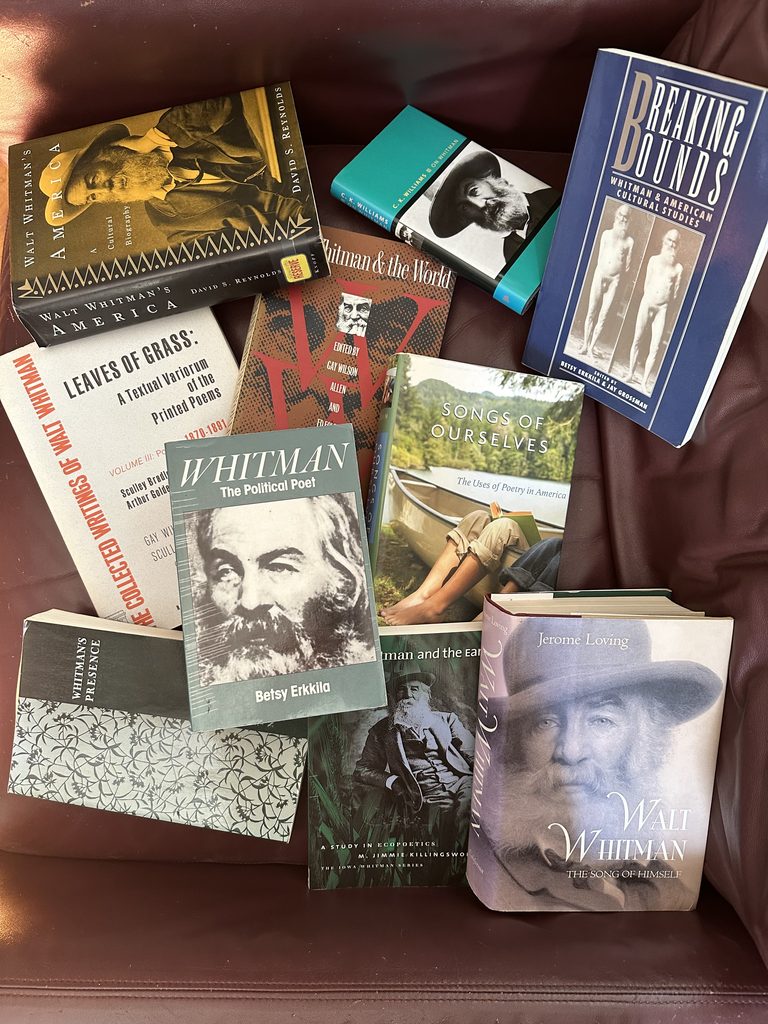
ten books with Walt Whitman in the title


The Walt Whitman Archive

In our class meeting this week I confessed my bias toward books. And I believe that reading Walt Whitman’s Leaves of Grass is an experience that everyone should have with a copy of the book in their hands. But I also want to save you the cost of purchasing another book; and, in using the Walt Whitman Archive, we will be reading in (and learning to navigate) a digital archive––one of the learning experiences that I believe is important for every student in college.

Over the next few weeks ,we will be reading and doing research on primary and secondary materials—all available in The Walt Whitman Archive. As you begin the first week in our study of Leaves of Grass, I recommend starting with the 1855 edition of Leaves of Grass, specifically the page that lists the poems. (This repository will be easier for you to navigate than the Complete Edition text.) However, in the spirit of immersion, I want you to allow your curiosity to lead you to the Background, and also “The Preface” to the 1855 edition available using the Complete Edition link. The background essay includes a fascinating account of the material process of publishing a book in the nineteenth century, and the complete edition of the book will give you access to the actual manuscript pages of the first edition.

The “Background” essay makes useful disclosures about the organization of the text as well. For instance, the author Ivan Marki writes that

it is also possible, as Ed Folsom has proposed, that the arrangement of the poems had less to do with thematics and more to do with the odd circumstances of the printing of the volume. Perhaps the final six poems contain no “Leaves of Grass” title because Whitman was trying to squeeze all of his poems into twelve signatures; thus, starting with the fourth poem, he stopped leaving blank space between poems, and, starting with the seventh poem, he omitted the repeated titles, moving the shorter poems to the end of the volume in case he would have to delete one in order to stay within the allotted number of pages (he was, after all, paying for the paper himself).

Our Week 3 Timeline on the course web site has a link to the page where you can read the two poems we will dig into on Tuesday next week, “I Celebrate Myself” and “Come Close to Me.”

Most of the work we will be doing in the weeks to come will be with the text of the complete (or “Deathbed Edition”) of Leaves of Grass (1891–92). The Individual Poems and Clusters is the page you will likely want to bookmark for the work ahead. 

One of the lessons for us is that the poems that appear in published works are written. In other words, as we have already talked about in class, composing is a process. And Whitman’s case is fascinating, as he worked on his poems for most of his adult life—revising, reordering them in sequences, and reflecting on the placement of the poems in the book Leaves of Grass. One of your jobs in the coming weeks will be to become interested in these intellectual and textual processes and to learn how to use research methods to trace them.

Navigating the Archive

In this section on navigating the Archive I’ll start with an example. Let’s say I read and become interested in the poem “This Compost.” And then I want to learn more about the poem. How do I navigate this digital archive? One pathway to follow, click by click on my desktop machine, leads me to what I might be looking for:

Published Writings > U.S. Editions of Leaves of Grass > Leaves of Grass (1891-92) > Autumn Rivulets > This Compost

One question we will be asking is when individual poems first appear in Leaves of Grass. This question will lead us to questions about the provenance of the lines of the poem, which would likely lead to a search in the archive for “This Compost.” As it happens, the search prompt turns up 59 results. One of the items is written by Harold Aspiz, “”This Compost” (1856),”includes a descriptive textual history of the poem:

Originally titled “Poem of Wonder at The Resurrection of The Wheat,” this exquisite lyric meditation on death was number 4 in the “Leaves of Grass” cluster in the 1860 edition, received its present intriguing title in 1867, and (having undergone several textual changes over the years) attained its present form in 1881, when it was placed in the “Autumn Rivulets” cluster of Leaves of Grass together with many other poems about death.

(Note well the descriptive mode of writing here. For you will be writing a textual history for each of the two poems that you will choose from Leaves of Grass for your descriptive commentaries.)

But there is more. The Archive includes letters and textual fragments and notebook entries that document the emergence and writing of the poem. There are other points of entry into the materials as well, pages such as the Integrated Catalog of Walt Whitman’s Literary Manuscripts that combines the catalogs of each repository––describing all of Whitman’s literary manuscripts, organized around the concept of Whitman’s “works.”

The other interest we will have, as a curious collective of critical readers, is how published literary works were read and received. The Archive has a repository, Commentary, a fascinating compilation of early commentary on Whitman’s writing, and Reviews (1855-1892), that includes all of the items found in Walt Whitman: The Contemporary Reviews, ed. Kenneth M. Price (Cambridge University Press, 1996) as well as more than 100 reviews not included in that volume because of space considerations or because they had not been discovered. The repository Selected Criticism includes some of the copyrighted criticism, some out-of-copyright commentary, and a few of the many full-length book studies by several scholars. And there is a Bibliography that includes articles, books, chapters of books, and poems about Whitman, published from 1838 to the present.