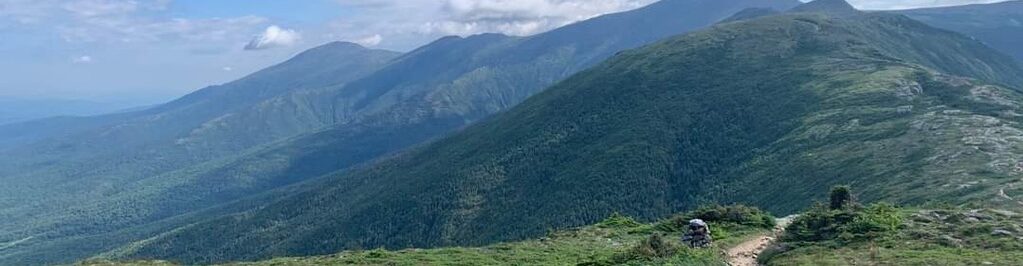
Closer yet I approach you,
What thought you have of me now, I had as much of you—
I laid in my stores in advance,
I consider’d long and seriously of you before you were born.
Who was to know what should come home to me?
Who knows but I am enjoying this?
Who knows, for all the distance, but I am as good as looking
at you now, for all you cannot see me?
––Walt Whitman, Crossing Brooklyn Ferry
Reading and Literacy
We are transitioning into the second phase of our work together this semester: reading and thinking and writing with the poems (and prose) of Walt Whitman. You will be immersed in Whitman’s writing as you continue to develop as readers, thinkers, and writers; and you will be learning to make productive use of digital and print archives.
Our inquiry into Whitman’s corpus will be immersive—a method of reading we will be practicing together through the end of October. But the quality and reach of our immersive reading project will begin with you: with your motivation to immerse yourself in a textual corpus and to ride your curiosity from passage to passage, from text to text. This kind of intellectual immersion requires patience and persistence as your reading experience is challenged by singular texts that are, in both a literal and a figurative sense, beyond you.
In the MLA AI Literacy document I cited in my most recent “Teacher Talk” piece the authors write that “developing literacy in reading means being able to reread, tackle increasingly difficult texts, and do research in order to further build your capability as a reader. Literacy also assumes you have enough knowledge to question and evaluate what you are studying.” Following this, I included my own definition of what can happen when we experience the kind of reading I am describing here as part of what I have come to call “democratic literacy.” I write,
reading, thinking, and writing are by definition creative activities that we learn and refine as we develop as human beings. In reading we learn to process language and information, to access ideas, and open ourselves to minds and worlds that differ from our own; in thinking we learn to recognize patterns, make inferences, and evaluate evidence, as well as to access concepts and principles, understand cause and effect, temporality, and to consider moral and ethical questions in complex situations we face in our lives; and in writing we discover and formulate and learn to share thoughts and ideas, communicate with different audiences, and learn to use language and discourse effectively in differing rhetorical contexts.
I call this literacy “democratic” in part because of the inherent responsibilities we have as people living together in what Whitman and others have called a “culture of democracy.”
The Walt Whitman Archive
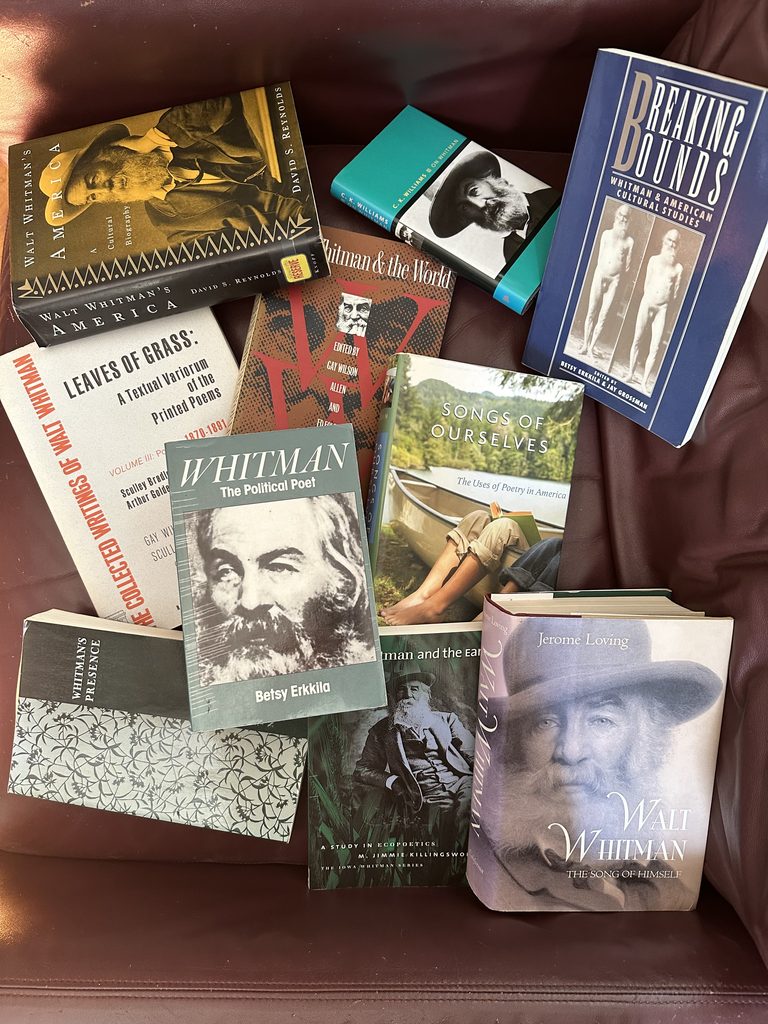
In our class meeting this week I confessed my bias toward books. And I believe that reading Walt Whitman’s Leaves of Grass is an experience that everyone should have with a copy of the book in their hands. But I also want to save you the cost of purchasing another book; and, in using the Walt Whitman Archive, we will be reading in (and learning to navigate) a digital archive––one of the learning experiences that I believe is important for every student in college.
Over the next few weeks ,we will be reading and doing research on primary and secondary materials—all available in The Walt Whitman Archive. As you begin the first week in our study of Leaves of Grass, I recommend starting with the 1855 edition of Leaves of Grass, specifically the page that lists the poems. (This repository will be easier for you to navigate than the Complete Edition text.) However, in the spirit of immersion, I want you to allow your curiosity to lead you to the Background, and also “The Preface” to the 1855 edition available using the Complete Edition link. The background essay includes a fascinating account of the material process of publishing a book in the nineteenth century, and the complete edition of the book will give you access to the actual manuscript pages of the first edition.
The “Background” essay makes useful disclosures about the organization of the text as well. For instance, the author Ivan Marki writes that
it is also possible, as Ed Folsom has proposed, that the arrangement of the poems had less to do with thematics and more to do with the odd circumstances of the printing of the volume. Perhaps the final six poems contain no “Leaves of Grass” title because Whitman was trying to squeeze all of his poems into twelve signatures; thus, starting with the fourth poem, he stopped leaving blank space between poems, and, starting with the seventh poem, he omitted the repeated titles, moving the shorter poems to the end of the volume in case he would have to delete one in order to stay within the allotted number of pages (he was, after all, paying for the paper himself).
Our Week 3 Timeline on the course web site has a link to the page where you can read the two poems we will dig into on Tuesday next week, “I Celebrate Myself” and “Come Close to Me.”
Most of the work we will be doing in the weeks to come will be with the text of the complete (or “Deathbed Edition”) of Leaves of Grass (1891–92). The Individual Poems and Clusters is the page you will likely want to bookmark for the work ahead.
One of the lessons for us is that the poems that appear in published works are written. In other words, as we have already talked about in class, composing is a process. And Whitman’s case is fascinating, as he worked on his poems for most of his adult life—revising, reordering them in sequences, and reflecting on the placement of the poems in the book Leaves of Grass. One of your jobs in the coming weeks will be to become interested in these intellectual and textual processes and to learn how to use research methods to trace them.
Navigating the Archive
In this section on navigating the Archive I’ll start with an example. Let’s say I read and become interested in the poem “This Compost.” And then I want to learn more about the poem. How do I navigate this digital archive? One pathway to follow, click by click on my desktop machine, leads me to what I might be looking for:
Published Writings > U.S. Editions of Leaves of Grass > Leaves of Grass (1891-92) > Autumn Rivulets > This Compost
One question we will be asking is when individual poems first appear in Leaves of Grass. This question will lead us to questions about the provenance of the lines of the poem, which would likely lead to a search in the archive for “This Compost.” As it happens, the search prompt turns up 59 results. One of the items is written by Harold Aspiz, “”This Compost” (1856),”includes a descriptive textual history of the poem:
Originally titled “Poem of Wonder at The Resurrection of The Wheat,” this exquisite lyric meditation on death was number 4 in the “Leaves of Grass” cluster in the 1860 edition, received its present intriguing title in 1867, and (having undergone several textual changes over the years) attained its present form in 1881, when it was placed in the “Autumn Rivulets” cluster of Leaves of Grass together with many other poems about death.
(Note well the descriptive mode of writing here. For you will be writing a textual history for each of the two poems that you will choose from Leaves of Grass for your descriptive commentaries.)
But there is more. The Archive includes letters and textual fragments and notebook entries that document the emergence and writing of the poem. There are other points of entry into the materials as well, pages such as the Integrated Catalog of Walt Whitman’s Literary Manuscripts that combines the catalogs of each repository––describing all of Whitman’s literary manuscripts, organized around the concept of Whitman’s “works.”
The other interest we will have, as a curious collective of critical readers, is how published literary works were read and received. The Archive has a repository, Commentary, a fascinating compilation of early commentary on Whitman’s writing, and Reviews (1855-1892), that includes all of the items found in Walt Whitman: The Contemporary Reviews, ed. Kenneth M. Price (Cambridge University Press, 1996) as well as more than 100 reviews not included in that volume because of space considerations or because they had not been discovered. The repository Selected Criticism includes some of the copyrighted criticism, some out-of-copyright commentary, and a few of the many full-length book studies by several scholars. And there is a Bibliography that includes articles, books, chapters of books, and poems about Whitman, published from 1838 to the present.