Browse Author

thefarfield

What Was ITW

What is the relationship between thinking and writing? The problem with asking this question is that most responses begin with commonplace practices teaching writing in school. Students in primary and secondary grades experience writing mostly through routine tasks that promote mastery of a discrete set of skills. College undergraduates are asked to produce essays that demonstrate whether or not they have a working understanding of course content. Graduate students produce readings of books and other artifacts that apply ready-made protocols to generate arguments as a quantitative measure for professional advancement. And professors, having internalized the imperative to publish or perish, produce reams of writing that very few people have reason to read.

The situation is a classic case of what the critic Kenneth Burke once called the beauracratization of the imaginative—a phrase, as he put it, “as bungling as the situation it seeks to describe.” In most colleges and universities, in fact, first-year students find themselves writing essays with little to no intellectual investment; and their teachers find themselves reading essays that no one should ever be asked to read. It is no surprise that tenure-stream faculty routinely abandon the first-year course while effectively ignoring the working conditions of the contingent faculty they hire to teach it.

In what follows I look back at an alternative model: a curricular project that replaced a first-year English writing requirement. Among the salient features of this multi-decade project at Keene State College was our attempt to situate writing as a primary intellectual activity across academic disciplines. Our model was built around the idea that students’ writing ability is largely a function of their ability to think. Hence the challenge was how a first-year course might re-imagine reading, thinking and writing as a process of reasoning. One of the constitutive features of the project, as I elaborate below, was a convergence of ideas from writing studies and developmental psychology. My motivation is in part to recount the singular moment that produced a generative first-year writing experience, as well as to consider some of the reasons that the course persisted for two decades—a remarkable run that surely had something to do with the integrity of the project and the intellectual investments of those of us who nurtured it.
From a Culture of Complaint to a Culture of Conversation

Institutional changes are notoriously complex. Hence my story of the activities and initiatives that contributed to this curricular transformation will be truncated at best. Though I should say right off that a college like Keene State is relatively small, and therefore vulnerable to people with ideas and initiative. In fact, the genesis of the Integrative Thinking and Writing (ITW) course, as I will elaborate in the first part of this reflection, was inextricable from a long foreground: a multi-year campus-wide conversation about the teaching and learning of effective writing. This conversation would culminate in pilot sections of ITW course and its eventual implementation as one of two foundational courses in Keene State College’s Integrative Studies Program (ISP).

In the early 1990s faculty from the then tripartite divisions of the College––sciences, professional studies and humanities––convened a “Writing Task Force” to talk about thinking and writing. Our Writing Task force was made up of people who shared the conviction that we need to challenge students with authentic writing across four years of an undergraduate education. (We were people who had come to Keene State with the belief that the study of the liberal arts should not be a privilege for only those able to attend a private school.) The Task Force on Writing was a tour de force: we sponsored dozens of workshops to assist faculty around such issues as creating good writing assignments, preventing plagiarism, and techniques for commenting on students’ papers. The Task Force initiated campus-wide research projects and newsletters; facilitated conversation about writing on campus; supported and advanced writing-across-the curriculum projects; supported faculty teaching the course to improve the practice of teaching writing; and collaborated with the undergraduate students in the College’s Writing Center.

In 2004 the Task Force refined its mission and articulated a vision for writing consistent with Keene State’s mission as a liberal arts college: that students should be able to use writing for a variety of purposes: to wrestle with complex ideas; to compose well-supported arguments; to express themselves creatively; to communicate effectively; to demonstrate learning; and to better understand what it means to write both as members of an academic discipline and as liberally educated people. By design the Task Force did not advocate for a particular course or curriculum: it was decidedly ecumenical and deliberately not engaged with curriculum. Instead, it offered the campus a broad vision for writing at the College: “In order for Keene State students to learn how to use writing for a variety of purposes, they must be provided with sustained writing instruction. Writing should permeate the curriculum rather than remain relegated to English 101 and the few discipline-specific writing courses now offered,” we insisted. Hence the practical work of the Task Force was sustaining a campus-wide conversation about the teaching of writing.

Though of course as faculty teaching in academic programs our work was curriculum adjacent. In fact, among the generative discussions sparked by the Task Force was about the relative effectiveness of our required English 101 course. In a Task Force Newsletter, we asked the entire campus community to think seriously about whether our English 101 course was a good idea. Based on a traditional model of required first-year writing courses, students in English 101 were asked to write five essays, most of which were narrative compositions that, to our minds, neither furthered students’ research skills nor asked them to investigate meaningful academic issues. How might we get more faculty involved in teaching writing and curious about the relationship between thinking and writing in their own academic fields of study?

More workshops and newsletters, we realized. could only take us so far. So we set to work on how we might engage more faculty in the conversation. In 2002 Dr. Phyllis Benay, professor of Interdisciplinary Studies and Director of the Center for Writing, Dr. Kirsti Sandy, then associate professor of English, and Dr. me, professor of English and American Studies, designed and received external funding for a faculty institute on the teaching of writing. With generous multi-year funding from Boston’s Calderwood Foundation, our Calderwood Institute set out to improve student writing by helping faculty across all disciplines become better teachers of writing.For over a decade, the Institute offered eight Keene State faculty members each year an immersive week engaging in reading, reflection, and dialogue around more effective ways to teach, assign, and evaluate student writing. Drawing on readings about student writing and its relationship to learning, participants examined what we know about students as writers, and the relationship between writing and cognitive development. Participants then worked individually and collaboratively (as well as with the three facilitators) throughout the academic year to transform their own writing assignments, methods of evaluation, and course design.

We asked participants, first, to locate themselves as writers––to critically examine the link between what they value in student writing and the disciplines and institutional contexts that have shaped these values; we then asked them to locate the student––to read and discuss selected research and theory on student learning and the teaching of writing; and then the participants were encouraged participants to 1) develop a working vocabulary in concepts associated with the teaching of writing; 2) approach writing as a discipline with a history that can be applied to their disciplinary contexts and objectives; 3) critically examine the role of writing in at least one of their courses; and 4) design (or re-design) a sequence of writing assignments in one course based on their reading and thinking in the institute.

The overarching pedagogical strategy of the Institute was encouraging faculty to forge connections between their own writing process and practice and the teaching of writing in their classes. As a professor of Anthropology, Rosemary Gianno, wrote in a post-Institute reflection, “It drove home to me how much writing itself is a way of learning, not just a way of demonstrating learning. While I have myself learned a lot from the writing I have done I was never conscious enough of this process to convey that or emphasize that in my classes. This new way of thinking about the role of writing in learning provides a sounder basis for its use in the classroom.” Another participant, a professor of Sociology, Peggy Walsh, voiced the sense of the excitement we were all feeling after a week together in the summer Institute. “As I finalize my syllabi, I have been reviewing my materials from the Writing Institute, reflecting on what I learned and making changes—some subtle, some dramatic—to my assignments. I am excited to share these ideas with students.” Could we have asked for more?

Over the duration of the multi-year Calderwood project we worked with close to seventy-five members of the faculty. One of the questions we were asking participants emerged out of the intellectual streams feeding into the project: how do we think about the relationship between cognition and writing? Given the nature of this question, it will come as no surprise that one of the project leaders, Phyllis, had a doctorate in developmental psychology. Soon after I began spending time with her, I recall, she stopped by to visit me in Parker Hall. I watched her eyes scan the one-thousand or so books lined up on the shelves that lined the walls of my office; then a week later she told me that she had caught sight of the blood-red spine of Robert Keegan’s The Evolving Self: Problem and Process in Human Development (1982) and had left wondering about when (and why) I had the book. As it happened, I picked it up at a used book sale in the University District of Seattle, during graduate school, at a time I was thinking through the very idea of the “self,” reading in the work of the American pragmatists Charles Sanders Peirce and William James for my thesis, and considering the history and construction of modern subjectivity with the philosopher Charles Taylor––in another book that also lived on my office shelf––The Sources of the Self: The Making of Modern Identity (1989).

Keegan, a professor at Harvard University, offers a persuasive model for thinking about meaning-making as a lifelong activity that evolves through a series of life stages. Not incidentally, Phyllis had spent time in the classroom with Keegan, and in her doctoral thesis had applied the developmental theory of William Perry, who argued that people’s thinking and understanding evolve over time. Perry’s focus on cognitive development in college students, in conversation with process-based writing theories of scholars such as Peter Elbow, proved to be central to the idea that was ITW: that is, student thinking and writing, ideally, would evolve from more simplisitic (dualistic) thinking to more complex (multiplist and contextual) thinking.

In our faculty workshops we intentionally mapped Perry’s schema onto the thinking and writing process. In the process we were formulating an audacious faith: that students would find in the struggle of thinking through writing a less authority-dependent outlook with the capacity to take their writing as “object” (that is, to examine) instead of being “subject” to (that is, embedded in) the writing. This movement from unreflective dependence to reflective autonomy would unfold differently for every student, we were aware, and the developmental schema would (ideally, of course) offer students a workshop in the thinking (and writing) they would be expected to do through their four years of college––and, if we did our work well, on into their lives as adults. The ITW project had in mind from the outset the idea of transfer: that is, how was the thinking and writing students were experiencing in going to show up in writing experiences beyond the first year?

And so there we were. We were planning courses with the idea that in a semester we could somehow move students from dualism, through multiplism, to contextualism. Or at the very least, we could try! Our students were like most young people, quite naturally thinking dualistically, and therefore mildly if not militantly resistant to the value of writing for a teacher who (of course!) knows everything already. Many of them were habitual users of signal phrases of the multiplist (“in my opinion” and “personally”). Many of them were summarizing and repeating claims to avoid what they think or do not think, or know or do not know, as we introduced them to the idea of discourse. And many of them were groping their way, as we all do, toward the contextualist recognition that there might be something to contribute to any conversation, and that their voices might become part of the multiple perspectives circulating around the questions and ideas and contexts they were navigating in their lives and at school.
From a Culture of Conversation to a Culture of Commitment

The movement from a culture of complaint to a culture of conversation led us to what we might not have envisioned when we began this work: the very real possibility of a campus commitment to the teaching of writing. At the time, the faculty was turning its attention (once again) to a revision of the general education program, and I volunteered for the committee. But my first job of work, as chair of the department of English, was to convince my literature colleagues to give up the freshman composition course. While the irony of people arguing for a course that no one wanted to teach is worth noting here, we all knew the shortcomings of the first-year writing course—a course that defined writing as a set of discrete skills that would be acquired in a fifteen-week term in preparation for college-level reading and writing. It was our good fortune, too, that a few years earlier we had hired a talented specialist in writing (Kirsti) who, like me, had graduate-school experience in writing program administration. We were also blessed with key administrative support when it mattered most.

The fundamental premise of the ITW course was significantly different than English 101. ITW would ask students to write about an issue of interest by focusing on a creative and complex question—investigating the question with critical analysis of readings, research and data, and using appropriate research techniques in documentation. Moreover, the course would take seriously its role furthering the process whereby students make the transition to college. As former Director of Expository Writing at Harvard University Nancy Sommers describes this process, “In entering a live debate—a conversation in which more than one view is acceptable and for which there are no easy answers—freshmen see that something is at stake in their work, that their writing is not simply ‘academic’” (137). ITW students would not merely quote from sources and compile a research report. They would be asked to engage with the thoughts and words of others and to construct their point of view from a generative reading of their sources. Students would benefit from sustaining their writing projects across the semester in multiple drafts; and faculty and students would learn together the value of ongoing and constructive feedback during this process.

Yet there was work to do. We first needed to persuade the general education committee to think of a course that would be more than the standard freshman seminar. First, we argued that seminars rarely engage the relationship between thinking and writing. Surely, we all want students to be in classrooms with people preoccupied with the problems and questions that organize their fields of study, we explained. Second, we envisioned writing as the activity through which students recognize those problems and questions, as well as develop their capacity to reason through reading (and rereading) the texts that make up these traditions of thought. It is worth mentioning here that we failed to convince our colleagues that reading was a third key term to feature in the design and pedagogy of the course. As we developed the learning outcomes for the Integrative Studies Program (ISP), in fact, faculty from across the College appeared content with the assumption that reading was a dimension of literacy that had already been acquired by our incoming students in primary and secondary school.

The course we proposed, “Thinking and Writing,” or ITW, would be devoted to the two terms in its title. Our rationale for ITW was that thinking takes shape in the labor of writing—a process most of us experience as trained scholars. Yet most course designs and writing assignments, we argued, simply do not offer students an opportunity to wrestle with genuine intellectual questions and problems. Yes, professors routinely expect critical thinking from students. Yet their assignments do not offer students a sufficient timeline to do the kind of thinking they expect. The notion of a sustained writing project emerged as the organizing principle for the student work in the course. The assumption—and it was proven to be mostly right—would be that even if students did not produce brilliant writing, the challenge of being asked to think for themselves in the first-year course would develop their intellectual abilities in potentially transformative if not lasting ways.

We were fortunate in this effort to have the guidance and support of Nancy Sommers, at the time directing the expository writing program at Harvard, whose longitudinal study of student writers offered empirical evidence for our claims. Nancy’s study suggested that students develop as writers across four years of college—but only insofar as they are given genuine opportunities to think and to write from the first-year course to the senior seminar. We understood writing as a process that calls out half-formulated or unformulated thoughts, gives these thoughts some semblance of form, and extends those thoughts by making new connections. Writing was understood in the course, then, as continuous with reading and thinking. In one sense, the problem of reading would become the focus of writing as students would be asked to sustain their thinking about what they were reading. Reading (and re-reading) through writing would allow students to confront their limited experiences with books, and with experiences, ideas and representations that might differ from their own. The pedagogical challenge was to convince students (and members of the faculty!) that this kind of experience is possible, indeed generative. The curricular challenge was to convince faculty that there are alternatives to our commonplace ways of teaching reading and writing in school.

Three years into this experiment we were offering students ITW sections with biologists, mathematicians, psychologists, historians, as well as scholars working in American, women’s, religious, and environmental studies. One section, for example, taught by a geneticist, asked students to read and write through the cultural implications of the genetic engineering of plants and animals, pre-implantation genetic diagnosis, cloning, and stem cell and reproductive technologies. One of my own sections, “What is Nature?,” traced representations of nature in the Americas, Africa, China, Europe, India and the Arab World. A few years in, we asked faculty about their experience with the sustained writing project––and the commitment to the idea in a first year course. “Teaching this course—and all that teaching this course requires—is as rigorous and relentless an experience as I have ever encountered,” wrote one instructor. “Entering first-year students are unprepared in so many ways for the challenge of a lengthy research-based paper that asks them to take positions about complicated issues.”

Another instructor endorsed the idea of a course based on the process of writing and the idea of organizing a course around the interrelated process of thinking and writing. “Students should continue to write researched papers and sustained writing projects. Multiple drafts and concrete, specific feedback are crucial to this process. Academic argument is the heart of higher education––that’s what scholars do! In her course “Breaking Rules: Women of the Beat Generation,” this faculty member reported, “students are submitting paper proposals; conferencing individually with me; submitting late-stage drafts; and revising drafts for a final paper. How could one do it any other way? By lecture and exam alone? Regurgitation is not learning and it won’t be remembered. I want them to struggle with a focused topic, conducting research in order to learn and contribute to current scholarship.” The instructor concluded, “Students will need research and argument skills in their professional careers. They aren’t going to be required to memorize much data (not in the internet age) but they will need to know where to go to find the data and how to interpret it––that’s what they’ll learn in a sustained writing project.”

But what did our students have to say about ITW? In one narrative assessment of writing experiences at the College sophomore and junior-level students confessed that the opportunity to write about something that mattered to them in ITW was both exciting and terrifying. They talked about their uncertainty completing a sustained writing project. And they described hours of work in the library and their surprise that others had thought deeply about their areas of interest. Yet more importantly, perhaps, was that the students who completed ITW now had a vocabulary to talk about their own thinking and writing as a process. Writing in a substantive intellectual context, they told us again and again, taught them that good thinking takes time. Moreover, they understood that persuasion requires curiosity and careful reading of, in the memorable words of one student, “interesting people with different views on a topic.” Another student was able to say it this way:  “The most effective essays are written by those who truly believe what they are saying, have a well rounded knowledge of the subject, and have put a lot of thought into how to address opposing claims.”

In addition to understanding writing as a process these students experienced the challenge of being asked to think about something. Again and again, they pointed to the unexpected freedom (and responsibility) of being asked to write about something they care about. Describing her experience with the semester-long essay, one student excitedly described developing a “tone of authority combined with credibility, a strong format and use of language.” Another student confessed that he now goes into an argumentative essay believing that he will come out of the process “with a whole new perspective.” And yet another student, writing about encountering adulthood, commented that she was able to “share her experiences with love, death, happiness, and sorrow, and connect it all back to show how these experiences helped me grow and mature.” In doing so, she concluded, “I learned a lot about myself as a person, and was able to explore “my beliefs, my opinions, and my biases.”

In these testimonials we were hearing the kinds of changes that take place as students navigate the difficult transition to college-level writing. The most lasting of these changes involved the experience of being challenged to think on one’s own as well as receiving support to meet those challenges. One student writes, “I put an extreme amount of effort into this essay, and the final product was a huge success.” Another student, however, says something that has stayed with me. “At the end I did not get a really good grade. But I was interested in learning. And I found out a lot about the modern world.”

These student comments left us once again with the question of the opportunities: whether a curriculum that takes thinking and writing to be one of the primary pathways across four years of study was measuring up to the more ambitious goals our students were now setting for themselves. The question was whether we were ready to meet them where they were.
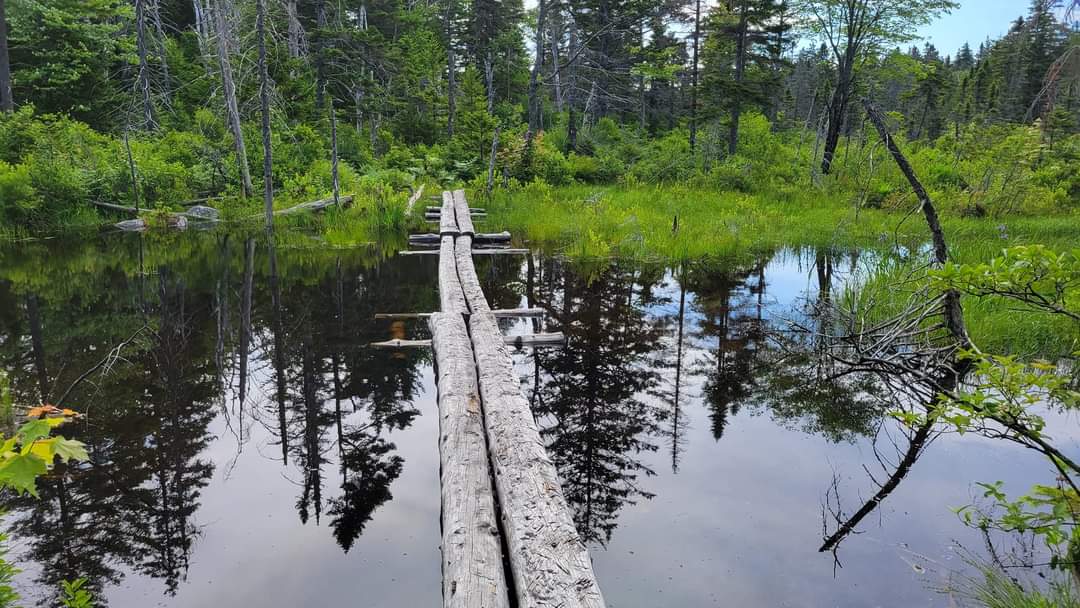
On Thinking Through Writing

In the fall of 2007 I set out to make visible the intellectual work of the cohort teaching in the ITW program. My goal was to embrace and honor the challenges of that work, to document the course, and to archive faculty and student experiences. The Thinking and Writing site I built included a description, core principles and practices, and pages with faculty resources. Still extant, the web log features a fascinating archive of blog posts I composed between 2007 and 2017 that capture a decade of reflections and reports on our evolving project––twenty-three posts in all, from course profiles such as Lorianne DiSabato’s section The Art of Natural History to reflections on ITW such as Something Resembling Authenticity. The web site documents the ebb and flow of reflective practice in medias res and, in doing so, captures the collaborative spirit of inquiry that animated the ITW project from its inception.

In composing this reflection I have been reminded how challenging it really is to sustain the idea of a course among faculty and administrators who too-readily fall back on commonplace ideas of reading, thinking and writing as discrete skills, the so-called opposition between skills and content, and the always-too-general learning outcomes in a common curriculum. It is difficult to hold ideas and keep them in play as disciplines and institutions evolve. Though if this reflection is in part a requiem it is also a reminder that ideas do change and that programs need to evolve and change with the weather––whether handsome or unhandsome. The very idea that a first-year college writing course should be organized around a particular genre, the so-called “academic” or “research” paper, after all, may not be the most efficacious in a first-year college course––especially given the ways that writing has been transformed in digital and multimodal contexts, not to mention the affordances (and risks) of the more recent large language AI tools students now routinely use in the writing process. There is no question that the pedagogical, cultural, and technological conditions for thinking and writing have changed.

The Calderwood Institute and ITW did change how faculty in other areas of study engaged students with writing. The faculty were shaped by thinking and writing too. We have evidence, moreover, that tenure-track faculty who taught ITW engaged their colleagues with the use of writing as learning in their disciplines. But building and sustaining a culture of writing in higher education is ongoing and challenging work I have been thinking since I accepted an invitation to be an external evaluator for the English program in the Department of Global Humanities at Norwich College in Northfield, Vermont. Their two-semester writing sequence––EN 110 Writing and Inquiry in Public Contexts and EN 111 Writing and Inquiry in Academic Contexts––reminded me what we did not accomplish during the more than two decades I served as a full-time member of the faculty at Keene State: a developmental sequence of writing courses in the general education program and/or in the disciplines. Like many colleges and universities, of course, Norwich faces the familiar challenge of engaging more faculty in what should be common work. It reminded me of the many years at Keene State when the monthly ITW dinner meetings, attended by mostly committed contingent faculty, was where the most exciting conversations about student learning were taking place. With these energies circulating on the margins, I guess it is not surprising that the tenure-track faculty teaching model we envisioned for ITW never happened, or that we failed to implement a developmental sequence of meaningful writing experiences in the curriculum.

In my current role as faculty emeritus, my plans include teaching ITW—or, whatever the faculty will end up naming the course––if they will have me. But I need to confess that this coming fall, when I step into another classroom of first-year students, I will undoubtedly be carrying with me the questions and assumptions of the ITW project. As I compose writing prompts, I will think carefully about the level of complexity of the assignment and whether or not it invites my students into the world of ideas / concepts / theories of the course I will be teaching, “Poetry as a Way of Knowing.” I will ask my students to talk with me about the real purpose of my writing prompts to find out whether they are clear to them, and just as important to me. “What do you really, really want them to get from the experience of putting word after word on paper, in other words, what is my hidden agenda, my real agenda,” I will hear my friend Phyllis asking me. I will keep the level of intellectual challenge as high as possible because, as Phyllis’ voice will remind me, “that’s the only way to reinforce what you really, really want.” And I will work with the students to reach a shared understanding of what it is I am asking of them––and why.

Most of these principles are predicated on “meaningful writing,” the felicitous term Anne Ellen Geller, Michele Eodice, and Neal Lerner use in making their case for metacognitive pedagogical reflection on our assignments. I want to be honest with myself whether or not the work is something worth doing; and I want to challenge my conviction that the language of my assignments is somehow transparent to my students. I am pretty sure, too, other lessons from ITW will be a menace to any and all of my pedagogical complacencies. Does my assignment really challenge students—beyond asking them to demonstrate an understanding of a subject or an idea? How can writing for multiple audiences help students “transcend the assignment” and claim ownership of their ideas? How am I reading for, commenting on, and responding to student writing? How will I incorporate a holding environment into the writing process? That is, as my students struggle, how will I show up? How will I create the tension in learning to help them through the writing process without diminishing the purpose or level of complexity? (Come to think of it, I may even go back and fortify myself by rereading two essays I routinely shared with faculty working with student writers by Gordon Harvey: “Asking For It: Imagining the Role of Student Writing” (1997) and “Repetitive Strain: The Injuries of Responding to Student Writing” (2003). Mostly, though, I will be thinking about how to teach beyond the ending: that is, by asking myself how the way I design and teach my course might change not so much the writing of a student but the student as a thinker and writer.

What is it that we know? What is it that we need to know? One thing we know is that snapshot assessments of artifacts seeking to assess student writing divert our attention from the changes taking place in a writer as they move through and beyond the first year. As Nancy Sommers and Laura Saltz write in the essay I cited earlier, The Novice as Expert: Writing the Freshman Year, a longitudinal perspective on student writers suggests that changes in attitude about academic work and the ability to see a greater purpose in writing beyond completing an assignment are crucial to continued development across the four years of an undergraduate education. “The story of the freshman year is not one of dramatic changes on paper,” they remind us, “it is the story of changes within the writers themselves” (144). The promise of this kind of development was always central to ITW––an uncommon pedagogical collaborative that for better and worse has come to an end.

Note

I began writing this reflection on the ITW project as Keene State College moved toward approving a new General Education curriculum that includes, not incidentally, a new first-year writing course. This essay is written in memory of my dear friend, the late Phyllis Benay, who is most responsible for the success and integrity of the ITW project. Though without the creative thinking and critical acumen of Kirsti Sandy, the conception and implementation of ITW might not have ever come to be. Others helped along way as well, notably Jan Youga, Nona Fienberg, Kate Tirabbassi, and Celia Rabinowitz.

Though it was the intelligence, commitment, and energy of tenure-track and contingent faculty who sustained the ITW project. They include Anne-Marie Mallon, Jack Hitchner, Daryl LeDuc, Steve Kessler, Tracy Mendham, Jack Bouley, Tracy Botting, George Russell, Beth Stickney, Heather Gigliello, Vesta Hornbeck, Laurie Stulbarg, and Alice Foley (English); Ali Lichtensein (English and Women’s Studies); Richard Foley (Technology, Design & Safety); Mike Wakefield and Ellen Moynihan (English and Communications); Helen Frink (Modern Languages); Robert Rubin, Nick Germana, Graham Warder, and Greg Knouff (History); Allyson Mount (Philosophy); Susan Whitemore and Kristen Porter-Utley (Biology); PeggyRae Johnson (Theater and Dance); Tatiana Schreiber (Environmental Studies), Becky Dunn (Health Science); Rosemary Gianno (Anthropology), Sara Hottinger (Philosophy and Women’s Studies); Deborah White Stanley (Film) and David Gonthier (Film and English); Mark Timney (Journalism); Wanda Swiger (Physical Education); Jennifer Ditkoff, Irene McGarrity, and Elizabeth Dolinger (Mason Library); and Dottie Bauer, Len Fleisher, Tanya Sturtz, and Daryl Hucks (Education), and Molly Parsons (The Center for Writing). 

Photo credit: Mark C. Long
In Memoriam: Zhang Ziqing

“Since our office is with moments, let us husband them.”

—Ralph Waldo Emerson, “Experience”

In late October, 2018, I found myself considering a question from the Chinese poet, translator, scholar, Zhang Ziqing about a passage from Henry David Thoreau’s essay “Walking.” This is the essay that begins with a sentence that has drawn readers ever since Thoreau delivered the talk, “Walking, or the Wild,” in Concord, Massachusetts, on April 23, 1851. “I wish to speak a word for Nature, for absolute freedom and wildness, as contrasted with a freedom and culture merely civil,––to regard man as an inhabitant, or part and parcel of Nature, rather than a member of society.” Thoreau asks his audience to consider “absolute” freedom against a “freedom and culture merely civil.” Or as he asks later in the essay, “give me a wildness no civilization can endure.”

Nearly a century later the poet Gary Snyder points out that wildness is clearly not difficult to find. Although, as he adds, “It is harder to imagine a civilization that wildness can endure.” Snyder then reframes Thoreau’s outlook to meet the challenges of our time. ”Wildness is not just the ‘preservation’ of the world, it is the world. Civilizations east and west have long been on a collision course with wild nature, and now the the developed nations in particular have the witless power to destroy not only individual creatures, but whole species, whole processes, of the earth.”

The question from Zhang Ziqing, though, was about a specific passage in Thoreau’s “Walking”:

“I would not have every man nor every part of man cultivated, any more than I would have every acre of earth cultivated: part will be tillage, but the greater part will be meadow and forest, not only serving an immediate use, but preparing a mould against a distant future, by the annual decay of the vegetation it supports.”

Is “mould” a kind of beneficial bacteria?, he asked. Zhang Ziqing was translating a talk I was preparing for the Poetry Bridging Continents Symposium, at Yancheng University, in the Western Chinese province of Jiangsu. The international symposium would bring together Chinese and American poets, scholars, translators, and students for three days of readings and discussion. And I was presenting one of the keynotes that I titled “From Pastoral to Ecopoetics in the Anthropocene.” What followed was a series of exchanges between professor Zhang Ziqing at Nanjing University as I prepared for our poetry exchange in China.

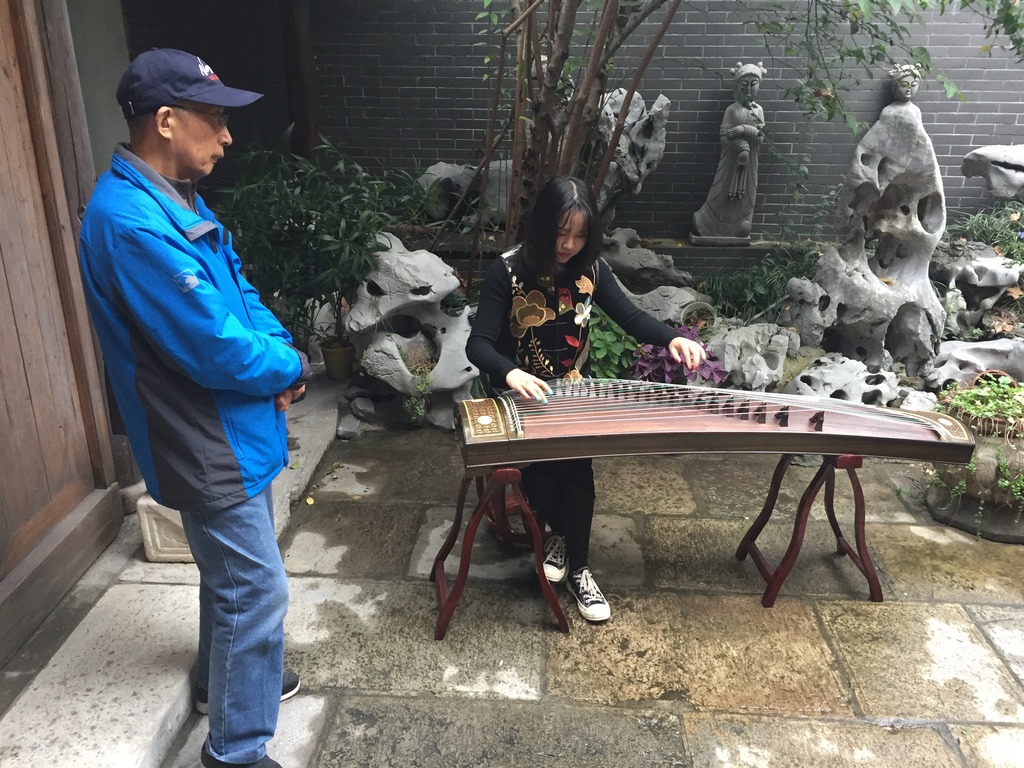
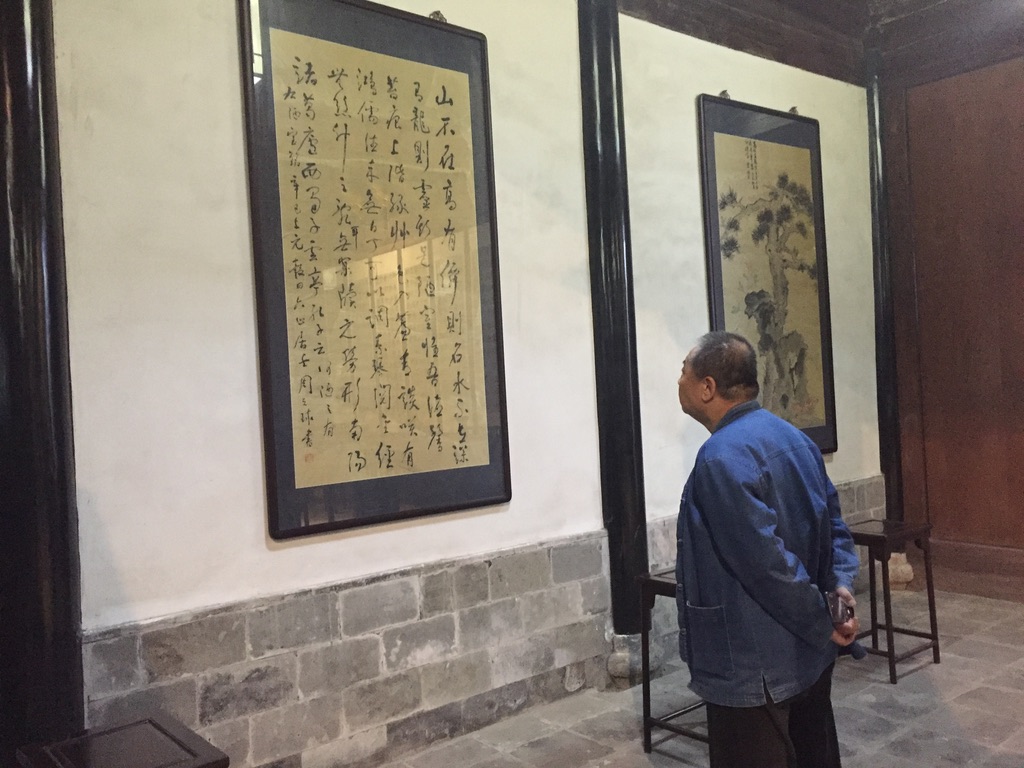
Poet and calligrapher Huang Bo in Suzhou

For those of us who work in the fields of language and literature, editorial exchanges are most often unexceptional. Though when this week I learned from another Chinese friend and colleague, Chen Yihai, that Zhang Ziqing had passed away, I recalled the delightful conversations with him that opened up in the translation process, a conversation that continued during my ten-day visit to China.

The process of intellectual exchange is an unending conversation that unfolds in moments of time at once ephemeral and lasting. Those of us trained in and habituated to the arts of attention to language and literature experience in these moments of exchange the lasting rewards of the collaborative process that constitute the intellectual work of essays and books. But in husbanding these moments, if we are fortunate, we find what we are looking for.

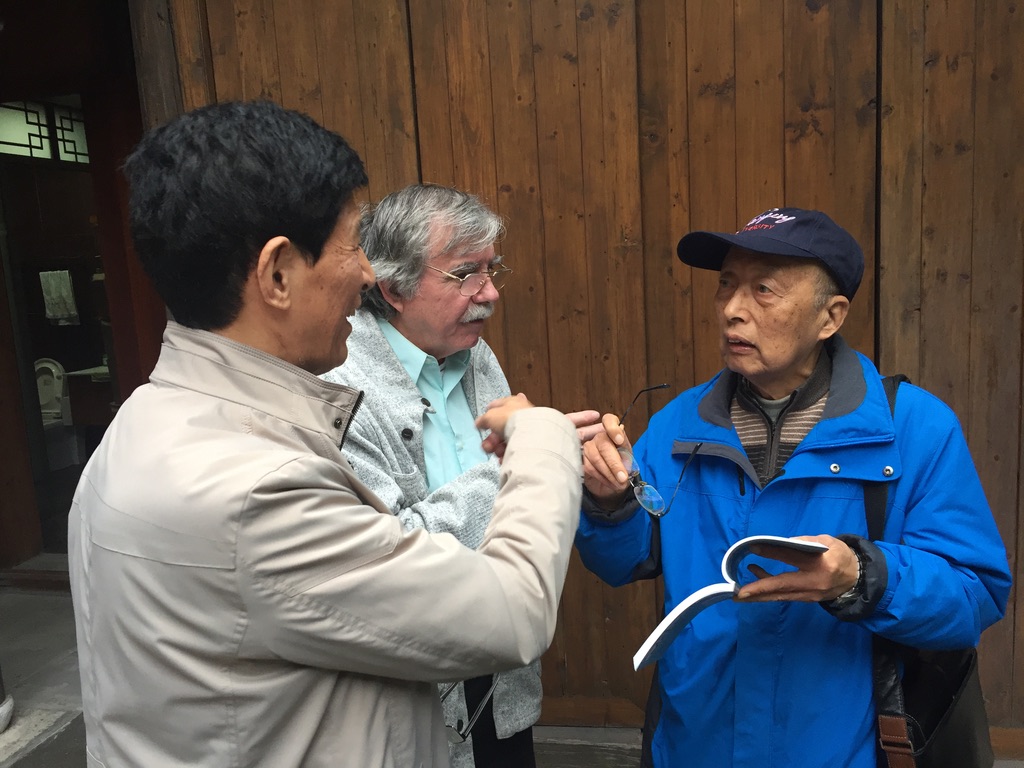
Poet and calligrapher, Zi Chuan, Roger Martin, Zhang Ziqing

Soon after I responded to his query about the passage in which Thoreau talks of “preparing a mould against a distant future” I received another series of questions from Zhang Ziqing. He asked about the passage that follows in the essay. “There are other letters for the child to learn than those which Cadmus invented,” Thoreau explains. “The Spaniards have a good term to express this wild and dusky knowledge—Gramatica parda—tawny grammar, a kind of mother-wit derived from that same leopard to which I have referred.” Here are the instructions I received in an email from Zhang Ziqing:

  1. Please translate the Spanish phrase “Gramatica parda”into English.
  2. Does “Gramatica parda”  mean “deceptively smooth” or “as slippery as an eel”?
  3. What does “tawny grammar” mean?
  4. Ὡς τὶ νοῶν, οὐ κεῖνον νοήσεις,” A phrase in Greek? Is its English translation “You will not perceive that, as perceiving a particular thing”?

As it happens, this particular passage is lifted into the light by Gary Snyder in an essay he titles “Tawny Grammar” and in which he quotes this very passage. Over many years I have taught this essay and, in doing archival research on Snyder’s contributions to American poetry, I have been learning more about classical Chinese poetry in translation through American poets engaged with the Chinese tradition—including Ezra Pound, Kenneth Rexroth, and Gary Snyder.

So I wrote back Zhang Ziqing thanking him for his questions:

“1. The Spanish “grammatica parda” literally means “brown grammar”

2. The phrase refers figuratively to wisdom and knowledge of the world that is not learned in school and does not require education to learn. We have a phrase in English, “street smarts,” that might be apposite here, or it might be somewhat like the practical knowledge a farmer knows from experience.

3. In the passage we are discussing here Thoreau calls it “wild and dusky knowledge” and he translates the word “brown” as “tawny.”  The literal definition of “tawny” is orange or yellowish brown in color. (The origin of the world is taune, or tanned.) 

4. For Thoreau, “tawny grammar” is what he calls a “mother wit.” The mother is Nature. This interpretation can be derived from an earlier passage in the text of “Walking,” where Thoreau writes: “that leopard to which I referred.” Here is the passage he is talking about: “this vast, savage, howling mother of ours, Nature, lying all around, with such beauty, and such affection for her children, as the leopard; and yet we are so early weaned from her breast to society.” So “tawny grammar” means essentially the knowledge of nature. The poet Gary Snyder has an essay called “Tawny Grammar” in which he quotes Thoreau and defines grammar as more than language but also including culture, civilization, and nature. 

5. The Greek is translated by Thoreau in the phrase that he follows the Greek phrase with, “You will not perceive that, as perceiving a particular thing.”

6. Yes: “mould” is a kind of beneficial bacteria.”

To which he replied:

“Thank you for your prompt reply. It’s hard for me to translate ‘brown grammar’ into Chinese as it would sound nonsensical if I do an literal translation (translate it word for word) of the phrase. So, could I translate it as ‘the wisdom of wild’ or ‘the practical knowledge of wild?'”

Though it was not until I found myself in China in the week following the poetry Symposium in Yancheng, in a small group of American and Chinese poets and calligraphers on a multi-day bus trip, that I learned of our common interests. We continued our conversations as we went about the featured events of our trip, including an open-air evening poetry reading at the Yellow Sea Forest Park; a meeting with poets, filmmakers, and the cultural development minister at the Taizhou International Writing Center; and a workshop at the Yinxi Academy, a calligraphy studio in the ancient city of Shaxi.

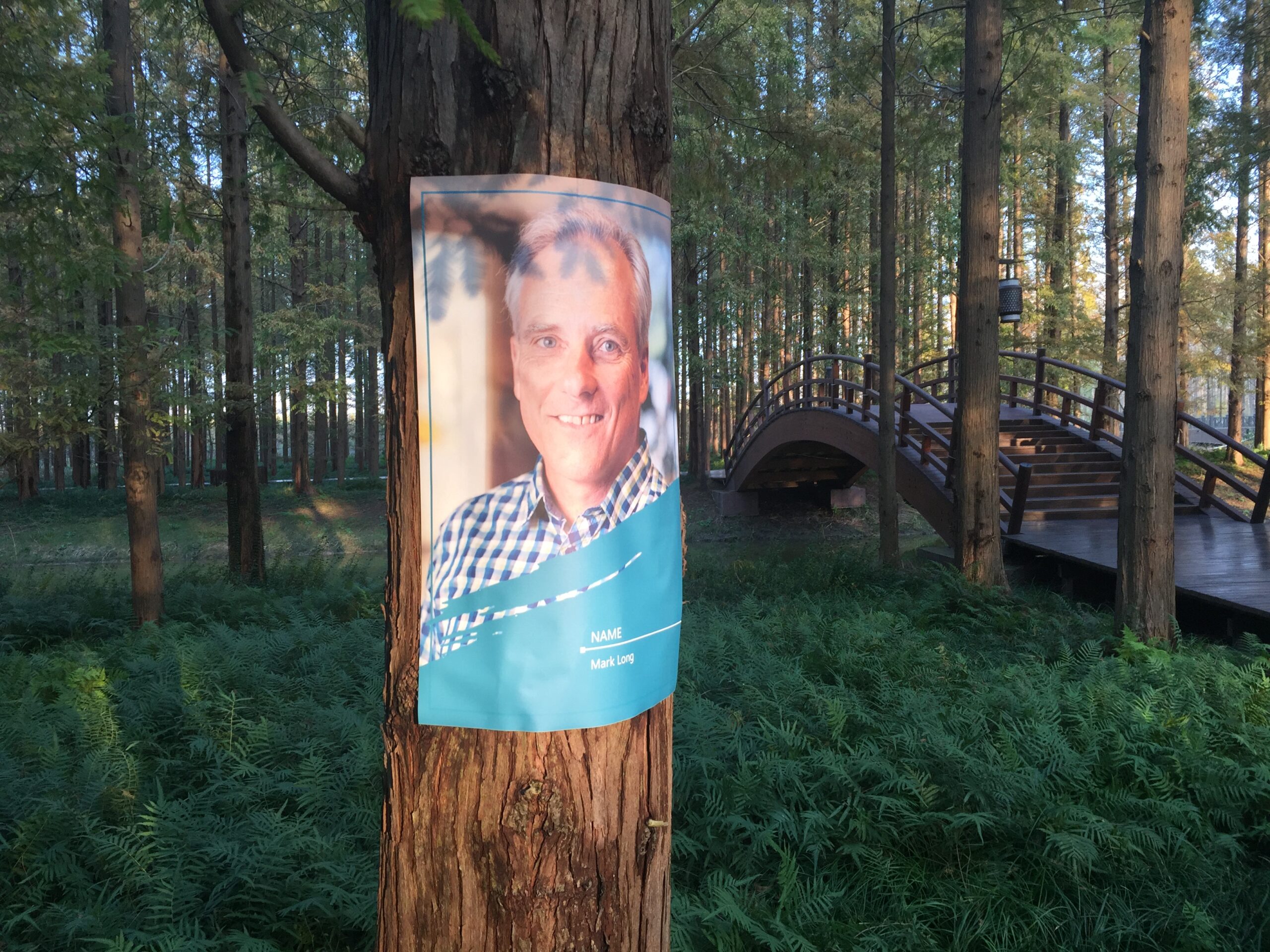
A poster pasted on a metasequoia tree at Yellow Sea Forest Park before an open air poetry reading party, and interview with me, at the opening ceremony for the new “Poet’s House,” Dongtai, Jaingsu Province

I learned that that in the early 1980s Zhang Ziqing completed a post-doctoral fellowship at Harvard University, was a Fulbright Scholar at Harvard and the University of California at Berkeley, and was a member of the Standing Committee of China Association for the Study of American Literature. We talked about his time in the Bay Area where he later met a range of poets, including Allen Ginsberg, Lawrence Ferlinghetti, Philip Whalen, Michael McClure, Anne Waldman, and Jack Foley, among others.

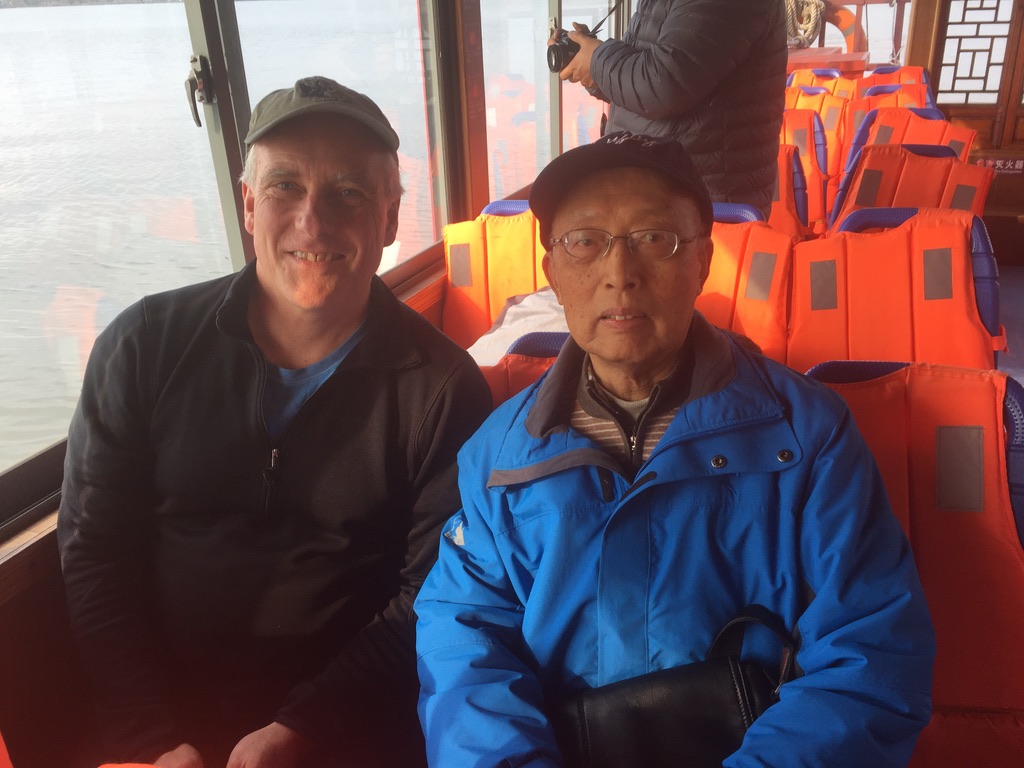
On a boat at QuinHu Lake with Zhang Ziqing, Jaingsu, China

Our conversations were about continents but traditions and histories, and about plainspoken poems written in cadences that bring to mind the ancient rivers-and-mountains (shan-shui) tradition, as well as the focus on poetic language and method among poets in the US during the second half f the twentieth century. Whether written in Chinese or English, set in China or North America, our shared interest was in traditions of poems with an interest in urban and rural landscapes, memory and place, the artifice of language and the natural world, as well as the social and cultural process of intellectual exchange.

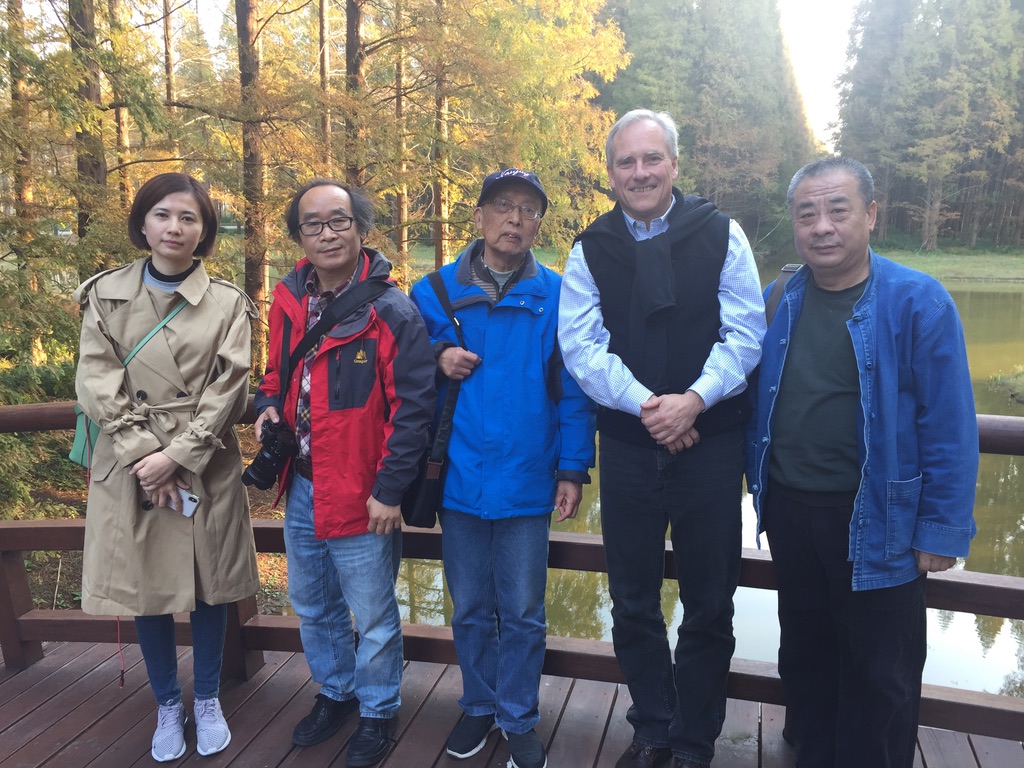
Out and about with Chinese friends

Dear Mark, Zhang wrote to me the year following our visit to China,

“Happy Spring Festival in the Lunar Year of Mouse! 

I still vividly remember your talk given in China: ‘Pastoral and Ecopoetics in the Anthropocene.’ I wish to read and introduce your essay ‘Pastoral and Ecopoetics in the Anthropocene’  to China when you send me its full text (that is, you added and revised it when you went back from China) at your convenience.”

At the literary and cultural center in Zhangzhou

I sent along the essay, with my best wishes. Though I am now now thinking of lines written by Gary Snyder:  

This present moment
that lives on

         to become

         long ago

(Other notes on Zhang Ziqing’s passing include Charles Bernstein’s brief remembrance here.)

A Rather Ugly Little Heap of Stones 

It is July. It is hot. And I am with my friend Ian, near Concord, Massachusetts, on a day organized around the kind of literary activities we both enjoy. Our plan is to spend the morning in the archive at the Thoreau Institute and, after sifting through a few old books and images, to take a walk in the woods. Not just any walk, but a deliberate circumambulation around the hallowed waters of Walden Pond.  

Both our visit to the Institute and our Thoreauvian circum-saunter is research for Ian’s next book. It is also a fine excuse to be together on a sticky mid-summer New England day. But soon after we are on the trail, and our conversation about poetry and conviviality runs its course, we feel the heat and meander off the trail to the pond’s edge. There we shed our shoes and wriggle our toes into the moist sand as we wade out into the shallows. 

Walden pond is a lovely place for a swim––and we are not the only people floating about in the cool water. There are swimmers in goggles, and there are people in kayaks and canoes, as well as various kinds of floaties. The scene is downright convivial. But then, after a dive under the cool water, I surface and see down the shoreline two towers of stacked stones.  

It seems there is a great deal of interest in stacking stones––wherever one might find them. Though the practice is not without controversy. Consider the title of a recent essay in The Guardian: “Stone stacking: cool for Instagram, cruel for the environment.” But whether cool or cruel, the impacts of this freelance stonework are, as one writer not-too-cleverly puts it, “stacking up.”  

The debate about today’s stone stackers is part of the cultural history of cairn building. Though “the differences between the two are immense,” according to one learned commentator: 

“A cairn is an officially established pile of rocks designed to mark a trail. These are made by land managers to properly blaze the designated trail so hikers will follow the most durable surfaces. In many cases, cairns are used above tree line and in alpine type environments where painted blazes are not as visible in the relatively open landscape. Tampering with them can lead other visitors to become lost and/or trample sensitive vegetation. . . . “

The “officially” sanctioned and “properly” placed cairns, this writer intones, “must be left as they are, following the fourth principle of Leave No Trace, Leave What You Find.” The idea here, to follow this writer’s reasoning, is that cairns built by “land managers” to control human impact in sensitive areas are different from rock pile enthusiasts who build cairns for fun and creative expression or as part of a more reverential or spiritual ritual.  

But as more and more people find reasons to stack stones, according to Robyn Martin in High Country News, the more we are faced with an annoying plague of rearranged pieces of rock balanced carefully atop one another in the West: 

“These piles aren’t true cairns, the official term for deliberately stacked rocks. From middle Gaelic, the word means ‘mound of stones built as a memorial or landmark.’ There are plenty of those in Celtic territories, that’s for sure, as well as in other cultures; indigenous peoples in the United States often used cairns to cover and bury their dead. Those of us who like to hike through wilderness areas are glad to see the occasional cairn, as long as it’s indicating the right way to go at critical junctions in the backcountry.” 

There is that word “official” again. Not to mention the definitive “true cairns.” As it happens, the comments on this article include people on all sides of the debate. One is from an earnest and “avid stone balancer” named Peter Juhl: 

“I teach classes on the art form and give presentations on it regularly. I published the first widely available guidebook on rock and stone balancing. I love this art form and want to see it grow. However, I am very concerned about the practice of leaving stacks of stones littering natural areas. There is a large worldwide community of stone balance artists who share this concern, and who practice a leave-no-trace approach in creating our temporary art. We build our balances, take some photos, and then dismantle. We strive especially to avoid disturbing natural and protected areas.”

While I can’t think of anything worth doing or any place worth going that has been improved by a guidebook––or for that matter “the practice of leaving stacks of stones littering natural areas”––I must admit that a part of me admires Juhl’s enthusiasm for stacking stones. Decades ago, guiding a sea kayaking expedition in Glacier Bay, Alaska, I came across a rocky shoreline festooned with stacked stone towers that fell into the waters with the rising tide. Looking back, it seems to me that a tidal shoreline may in fact be a perfect place for stacked stone towers: for as the tide rose the sound of falling stones marked an elegant reclamation of the displaced stones, almost even a “leave-no-trace approach” and the creation of “temporary art”––that is, if one does not factor in the critters living in the tidal stone beds along the shore.

So maybe we do need Martin’s less equivocal point of view. “Pointless cairns are simply pointless reminders of the human ego.” 

This line of thinking about stacking stones began in conversation with a group of friends a couple of years ago––on a trail in the Dolly Sods wilderness in West Virginia. The conversation included a spontaneous debate about cairns. My own view of cairns had been shaped by decades of hiking and climbing in the West. I had considered the uses (and abuses) of those little (or larger) rock piles that guide hikers and climbers and keep them on the trail, especially in rough terrain. And for decades I instinctively kicked over cairns because I was not convinced that they were necessary to keep people off vulnerable areas near the trail. But then this was decades ago, at a time when hiking was less popular and hence there was less pressure on vulnerable plants in these high mountain areas.  

In West Virginia, the conversation warmed a bit when I announced my aversion to the cairn––both the idea and the thing. In fact, on less-traveled routes in the high mountains of the far west, I explained to my friends, I routinely ( if not righteously) knocked down small cairns that I had determined were unnecessary. But back east, in the Dolly Sods, we were on a well-travelled trail. And wouldn’t you know it, we lost our way a couple of times and were forced to backtrack through bushes and brambles to reconnect with the trail. When descending, later in the day, we spotted a stone cairn in a dry riverbed. And before I knew it the most irreverent in our group picked up a stone, looked over at me, and tossed it at the cairn. 

We might call the practical study of such matters “cairnology.” It might be the case, in fact, that “comparative ciarnology” would document their uses in distinct cultures and landscapes. I began my own studies in the field with John Cair’s entry on the cairn in the 1911 Encyclopædia Britannica, a fine overview of the ancient history of cairns, perhaps as good a place as any to begin. The entry begins with the etymology of the world and then recounts the history (“CAIRN (in Gaelic and Welsh, Carn) of heaps of stones piled up in a conical form.”  

In modern times, Cair explains, cairns were often erected as landmarks. In ancient times, however, “they were erected as sepulchral monuments.” And a dedicated cairnologist might find this piece of information in his entry of interest: 

“The Duan Eireanach, an ancient Irish poem, describes the erection of a family cairn; and the Senchus Mor, a collection of ancient Irish laws, prescribes a fine of three three-year-old heifers for “not erecting the tomb of thy chief.” Meetings of the tribes were held at them, and the inauguration of a new chief took place on the cairn of one of his predecessors. It is mentioned in the Annals of the Four Masters that, in 1225, the O’Connor was inaugurated on the cairn of Fraech, the son of Fiodhach of the red hair.” 

“In medieval times cairns are often referred to as boundary marks, though probably not originally raised for that purpose. In a charter by King Alexander II. (1221), granting the lands of Burgyn to the monks of Kinloss, the boundary is described as passing ‘from the great oak in Malevin as far as the Rune Pictorum,’ which is explained as ‘the Carne of the Pecht’s fieldis.’ In Highland districts small cairns used to be erected, even in recent times, at places where the coffin of a distinguished person was ‘rested’ on its way to the churchyard. Memorial cairns are still occasionally erected, as, for instance, the cairn raised in memory of the prince consort at Balmoral, and “Maule’s Cairn,” in Glenesk, erected by the earl of Dalhousie in 1866, in memory of himself and certain friends specified by name in the inscription placed upon it. “

In the annals of cairnology, again and again, one finds that the stacking or heaping of stones is intimately related to cultural practices––whether these practical uses such as marking boundaries or communal acts of memory and commemoration. Like carving our initials into the soft white bark of a birch or chopping a blaze into a small pine or spruce tree long the trail, the cairn has proved to be a widely-used marker of human presence and passage. 

Back at Walden Pond we left the stacked stones standing in the water. Though there are no tides in this famous New England pond. We also knew as readers of Thoreau that we had other lives to live. So we laced up our shoes and continued on our way. We passed alongside the railway bed to the cabin site. Where once again we found ourselves face-to-face with a cairn. For among those who had made a pilgrimage to the cabin site were people had built their own stone towers on top of the cairn. There were literally dozens of them. The stone balance artists had come and gone. The stones remained. . . . “Stacks of stones littering natural areas.” 

Back home at my desk I considered that the stacks of stones were not littering a “natural” area. Thoreau’s cabin site is not natural. The stacked stones were all resting on a less artful pile of stones. As it turns out, in September 1863, Bronson Alcott and his daughter Abigail May noted on a walk to Walden Pond that “the grounds are much overgrown with shrubbery, and the site of the hermitage is almost obliterated.” On a later date William Ellery Channing noted the same. Then, in June 1872, Mrs. Mary Newbury Adams, of Dubuque, Iowa, inaugurated the memorial cairn to commemorate the site. Here is the account by the geologist Robert Thorson: 

She had been in town visiting the Emersons when Bronson Alcott stopped by on his way to the Unitarian Church picnic at Walden Pond. Mrs. Adams joined him for the walk and relayed the experience to her daughter, who later described it in the following  way: 

“When they reached the spot where Thoreau’s little house used to stand, mother said it was a pity there was nothing to mark the place, so strangers might know it. ‘Well, said Mr. Alcott, ‘a cut stone would hardly be appropriate, would it, for Thoreau?’ She suggested building a cairn and then let everyone who loved Thoreau add a stone and said she was going to start it right then. She got a stone and with a little improvised ceremony laid it down in her own name. Then Mr. Alcott got one for himself and one for Mrs. Alcott. “

The other pity, I might suggest, was the comment from the woman named Mary from Iowa.  

In the Thorson account, “Mrs. Adams and Mr. Alcott began their cairn near the former front door of the house. Over the years, it became a growing cone of loose stone. A bronze plaque was later affixed to a nearby boulder to communicate what was being marked. By the late 1870s, pilgrims were coming from afar, often escorted by Ralph Waldo Emerson, Bronson Alcott, Ellery Channing, Frank Sanborn, or Fred Homer.  

As a reader and scholar of Emerson, I am still coming to terms with him as a Cairn enabler. Though Walt Whitman took a step further, as I learned in reading his September 1881 entry in Specimen Days on a visit to the cabin site. “On the spot in the woods where Thoreau had his solitary house is now quite a cairn of stones, to mark the place,” Whitman writes. ” too carried one and deposited it on the heap.”

And so the cairn grew, as cairns will do. Until in 1975, as Thorson explains, 

“without consulting the Thoreau Society, the park director had the previous cairn trucked away because he thought it looked ugly. When the Thoreau Society learned that their sacred memorial had gone missing, their howls of protest forced the director to rethink his decision. With reluctance, the state of Massachusetts trucked the stones back to create the modern mound.” 

The further this story unfolds the more absurd it becomes. A god-damned truck took the cairn away and then the truck brought it back! And all of this at Walden Pond.  

The account of this affair led my ambivalence about cairns to bubble up like a canker sore on my lip—that is, until I read what E. B. White included in his posthumous personal letter to Henry: 

“Your front yard is marked by a bronze tablet set in a stone. Four small granite posts, a few feet away, show where the house was… Back of it is a pile of stones, a sort of cairn, left by your visitors as a tribute I suppose. It is a rather ugly little heap of stones.” 

Perfect. “A sort of cairn,” raising once again the existential question, although the venerable White brings it back to the quotidian with a fine little phrase, “a rather ugly little heap of stones.” 

Having considered some of the foundational questions in the discipline of cairnology I am more informed about both the uses and the abuses of heaping stones. On well-travelled routes, the cairn has its uses, I will admit, as cairns can keep the less attentive among us (or less experienced) off delicate terrain, most especially the sites with vulnerable plants or other areas susceptible to the stiff rubber edge of a vibram sole.  

But I can be stubborn. And my position has not changed. If I had to choose a term to describe my position on cairns it would be ambivalent. Though to be perfectly honest I really do loathe cairns. For me, the cairn is first and foremost an affront to the way things are (or were). Because the cairn is intended to mark the presence and/or passage of people in an otherwise mostly-unpeopled place, too often the cairn is a stand in for the route-finding skills of a mountain traveler. (The other problem is the ecological one, as moving stones from their places is inevitably going to displace one creature or another.) 

A cairn, for example, might mark a route over a steep col that might otherwise be less obvious to a mountaineer seeking safe passage over into a new drainage. Years ago, two days from the trailhead, descending a high alpine cirque, we were drawn to one of three notches in a tangled stone crest. We climbed for over an hour and, guided by the contour lines of a printed map, we chose the one to the south: only to find, when we reached the crest, that the West side offered no possibility of a descent without a rope—which we did not have with us on this trip. And so, we picked our way back down a field of scree to the top of the hanging valley where we ascended once again to the crest a second time. In another instance, descending from a 13,000’ summit, we found ourselves on a slanting ledge of polished stone above multiple gullies plunging over a thousand feet below us––some with steep rock bands that would require more time and skill to descend.  

In the first instance, a cairn at the top of the cirque might have helped us choose the right notch, as contour lines on a USGS map only offer so much information. And in the second instance, a cairn placed at the top of the most probable gulley could help us descend more safely, or at least keep us out of a situation we might otherwise avoid. But in both cases, when we come to rely on a cairn (or a similar fixed marker or tool) there is no question that our experience will be different.

We should be responsible for our choices in terrain we seek out precisely because we are looking to find experiences that are less determined by trails and paths that have been established to keep a steady stream of hikers from mindlessly (or selfishly) walking over delicate alpine plants above the tree line or causing erosion by cutting trails on a steep slope. The point here is not to find some escape into wilderness to escape from civilization. Rather the experience of finding one’s way, off the trail, on one’s own or with a friend, can make all the difference.  

We enjoyed our lunch at the cabin site near Walden Pond. Though I was perhaps too preoccupied with the very idea of a cairn. Still, I remember how good it felt when my companion Ian assured me that the Pond itself (the character and narrator of his forthcoming book) had reached its own conclusion about cairns that, as it happens, came down somewhere near my own. 

Cruzando Fronteras

One of my projects this year has been organizing the tenth Biennial Conference of the Williams Carlos Williams Society at the University of Puerto Rico Mayagüez February 15–17 2024. The Biennial will focus on Williams’s Hispanic heritage, his indebtedness to the traditions of Puerto Rican, Peninsular and Colonial Spanish literatures, as well as issues of borders and translation in the broadest sense—linguistic, geographic, cultural—as well as Williams and the medical humanities, health, and culture.

Our keynote speakers will be Marta Aponte Alsina, author of La Muerte Feliz de William Carlos Williams, and Julio Marzan, author of The Spanish American Roots of William Carlos Williams. The conference, free and open to the public, will include participation from local artists and writers, poetry readings in Spanish and English, as well as a tour of the city of Mayagüez—the birthplace of Williams’s mother, Raquel Héléna Rose Hoheb Williams, and the site of his uncle and namesake Carlos Hoheb’s medical practice.

I am grateful to the English and Humanities faculty at UPRM for their interest in Williams, and their many contributions to the planning process.

How Poetry Comes to Me

“If the doors of perception were cleansed, everything would appear to man as it is, infinite. For. Man has closed himself up, ‘til all he sees is through narrow chinks of his cavern.” –William Blake, The Marriage of Heaven and Hell

“I like that boy Snyder on Sourdough. He’s a calm son of bitch.” -Blackie Burns

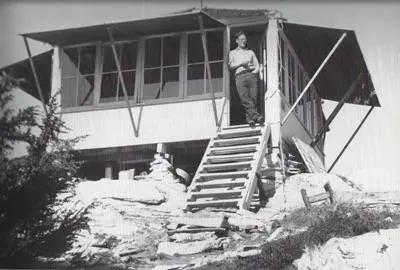
Nearly thirty years ago I drove north from Seattle to the Skagit valley in Washington, with my friend Kevin Craft, for a walk up to the summit of Sourdough Mountain. A series of backcountry tours and climbs with my friend John, a backcountry/climbing range in the national park, had acquainted me with the surrounding peaks and valleys, though the terrain was less familiar to my companion Kevin.

The lookout on Sourdough was built by Glee Davis in 1917. (A peak to the west of Sourdough is named for the Davis family.) The lookout was rebuilt in 1933 and restored in 1998-99. But to get there requires working up a series of broad switchbacks—three-thousand feet in the first three miles—to the four-thousand foot summit.

Kevin happens to be a gifted poet, who has published many poems, books of poems, and has served as the editor of Poetry Northwest. Our late-fall hike went well. And on our walk we both had in mind a poet who had spent time in the North Cascades, Gary Snyder, whose poems are alive with the mountains and valleys of the far West. Here is one:

How Poetry Comes to Me

It comes blundering over the
Boulders at night, it stays
Frightened outside the
Range of my campfire
I go to meet it at the
Edge of the light.

Then, the day following our walk, Kevin sent me a lovely little homage:

How Poetry Comes to Me

After Gary Snyder

Or sometimes I go to meet it
In broad daylight at the lookout
It’s afternoon all morning the light
Slant and subdued running down
The dry creek bed our skin
Sweat-cool stopping to rest the red
Leaves of huckleberry flaring
Like patch fires in the scrub
Going mauve as we pass
The veined skin of their fingers
Now down on all fours
The plump berries clustered there
Not in fear but shriveling
With the season we work through
The dead-end detritus of a sentence
To reach a few ripe words
Like tart and juice at the turn of the trail.

The conversation between these two poems might lead to another poem by Snyder, “Mid-August at Sourdough Mountain Lookout,” first published in Riprap and Cold Mountain Poems: 

Down valley a smoke haze
Three days heat, after five days rain   
Pitch glows on the fir-cones
Across rocks and meadows
Swarms of new flies.

I cannot remember things I once read   
A few friends, but they are in cities.   
Drinking cold snow-water from a tin cup   
Looking down for miles
Through high still air.

Snyder spent six weeks at the fire lookout on Sourdough in the summer of 1953—packed in by an old Park Service employee, Blackie Burns. I have been thinking about Snyder since last year when I read Snyder’s Lookout Journals during a week in the archives during a research project. Snyder’s journals are exciting and document a mind on fire—reading William Blake, among others.

Another poet, and close friend of Snyder during their years at Reed College and after, Phillip Whalen, also put in time working as a lookout, and here is his poem “Sourdough Mountain Lookout,” from The Collected Poems of Philip Whalen: 

Sourdough Mountain Lookout

Tsung Ping (375—443): “Now I am old and infirm. I fear I shall no more be able to roam among the beautiful mountains. Clarifying my mind, I meditate on the mountain trails and wander about only in dreams.” ––in The Spirit of the Brush, tr. by Shio Sakanishi

for Kenneth Rexroth

I always say I won’t go back to the mountains

I am too old and fat there are bugs mean mules

And pancakes every morning of the world

Mr. Edward Wyman (63)

Steams along the trail ahead of us all

Moaning, “My poor feet ache, my back

Is tired and I’ve got a stiff prick”

Uprooting alder shoots in the rain

Then I’m alone in a glass house on a ridge

Encircled by chiming mountains

With one sun roaring through the house all day

& the others crashing through the glass all night

Conscious even while sleeping

    Morning fog in the southern gorge

    Gleaming foam restoring the old sea-level

    The lakes in two lights green soap and indigo

    The high cirque-lake black half-open eye

Ptarmigan hunt for bugs in the snow

Bear peers through the wall at noon

Deer crowd up to see the lamp

A mouse nearly drowns in the honey

I see my bootprints mingle with deer-foot

Bear-paw mule-shoe in the dusty path to the privy

Much later I write down:

    “raging. Viking sunrise

    The gorgeous death of summer in the east!”

(Influence of a Byronic landscape—

Bent pages exhibiting depravity of style.)

Outside the lookout I lay nude on the granite

Mountain hot September sun but inside my head

Calm dark night with all the other stars

HERACLITUS: “The waking have one common world

But the sleeping turn aside

Each into a world of his own.”

I keep telling myself what I really like

Are music, books, certain land and sea-scapes

The way light falls across them, diffusion of

Light through agate, light itself . . . I suppose

I’m still afraid of the dark

    “Remember smart-guy there’s something

    Bigger something smarter than you.”

    Ireland’s fear of unknown holies drives

    My father’s voice (a country neither he

    Nor his great-grandfather ever saw)

    A sparkly tomb a plated grave

    A holy thumb beneath a wave

Everything else they hauled across Atlantic

Scattered and lost in the buffalo plains

Among these trees and mountains

From Duns Scotus to this page

A thousand years

    (“. . . a dog walking on this hind legs—

    not that he does it well but that he   

    does it at all.”)

Virtually a blank except for the hypothesis

That there is more to a man

Than the contents of his jock-strap

EMPEDOCLES: “At one time all the limbs

Which are the body’s portion are brought together

By Love in blooming life’s high season; at another

Severed by cruel Strife, they wander each alone

By the breakers of life’s sea.”

Fire and pressure from the sun bear down

Bear down centipede shadow of palm-frond

A limestone lithograph—oysters and clams of stone

Half a black rock bomb displaying brilliant crystals

Fire and pressure Love and Strife bear down

Brontosaurus, look away

My sweat runs down the rock

HERACLITUS: “The transformations of fire

are, first of all, sea; and half of the sea

is earth, half whirlwind. . . .

It scatters and it gathers; it advances

and retires.”

I move out of a sweaty pool

       (The sea!)

And sit up higher on the rock

Is anything burning?

The sun itself! Dying

Pooping out, exhausted

Having produced brontosaurus, Heraclitus

This rock, me,

To no purpose

I tell you anyway (as a kind of loving) . . .

Flies & other insects come from miles around

To listen

I also address the rock, the heather,

The alpine fir

BUDDHA: “All the constituents of being are

Transitory: Work out your salvation with diligence.”

(And everything, as one eminent disciple of that master

Pointed out, had been tediously complex ever since.)

There was a bird

Lived in an egg

And by ingenious chemistry

Wrought molecules of albumen

To beak and eye

Gizzard and craw

Feather and claw

My grandmother said:

“Look at them poor bed-

raggled pigeons!”

And the sign in McAlister Street:

            “IF YOU CAN’T COME IN

            SMILE AS YOU GO BY

                   LOVE

               THE BUTCHER”

I destroy myself, the universe (an egg)

And time—to get an answer:

There are a smiler, a sleeper and a dancer

We repeat the conversation in the glittering dark

Floating beside the sleeper.

The child remarks, “You knew it all the time.”

I: “I keep forgetting that the smiler is

Sleeping; the sleeper, dancing.”

From Sauk Lookout two years before

Some of the view was down the Skagit

To Puget Sound: From above the lower ranges,

Deep in the forest—lighthouses on clear nights.

This year’s rock is a spur from the main range

Cuts the valley in two and is broken

By the river; Ross Dam repairs the break,

Makes trolley buses run

Through the streets of dim Seattle far away.

I’m surrounded by mountains here

A circle of 108 beads, originally seeds

    of ficus religiosa

          Bo-Tree

A circle, continuous, one odd bead

Larger than the rest and bearing

A tassel (hair-tuft) (the man who sat

             under the tree)

In the center of the circle,

a void, an empty figure containing

All that’s multiplied;

Each bead a repetition, a world

Of ignorance and sleep.

Today is the day the goose gets cooked

Day of liberation for the crumbling flower

Knobcone pinecone in the flames

Brandy in the sun

Which, as I said, will disappear

Anyway it’ll be invisible soon

Exchanging places with stars now in my head

To be growing rice in China through the night.

Magnetic storms across the solar plains

Make Aurora Borealis shimmy bright

Beyond the mountains to the north.

Closing the lookout in the morning

Thick ice on the shutters

Coyote almost whistling on a nearby ridge

The mountain is THERE (between two lakes)

I brought back a piece of its rock

Heavy dark-honey color

With a seam of crystal, some of the quartz

Stained by its matrix

Practically indestructible

A shift from opacity to brilliance

(The Zenbos say, “Lightening-flash & flint-spark”)

Like the mountains where it was made

What we see of the world is the mind’s

Invention and the mind

Though stained by it, becoming

Rivers, sun, mule-dung, flies—

Can shift instantly

A dirty bird in a square time

Gone

Gone

REALLY gone

Into the cool

O MAMA!

Like they say, “Four times up,

Three times down.” I’m still on the mountain.

(note: The quotes of Empedocles and Heraclitus are from John Burnet’s Early Greek Philosophy, Meridian Books, New York.)

In his Lookout Journals, Snyder copied out the words from William Blake in the epigraph to this post followed by a single word of commentary: “Ah”