“Not the book needs so much to be the complete thing, but the reader of the book does. That were to make a nation of supple and athletic minds, well-train’d, intuitive, used to depend on themselves, and not a few coteries of writers.”
—Walt Whitman, “Democratic Vistas”
Back in the classroom. Grateful for the opportunity. And for the past few weeks thinking with my students about literacy in the twenty-first century. What I have been thinking about, a professor who has been reading with students in a classroom since the early 1990s, is the experience of reading.
We are doing a lot of reading and writing, talking about literacy, and the literary arts of writing and reading poems in my course Poetry as a Way of Knowing. We are thinking about literacy, but also the more capacious domain of democratic literacy. Terry Tempest Williams, in her The Open Space of Democracy (2004) offers one way to name this wider field of action “Democracy depends on engagement,” she writes, “a firsthand accounting of what one sees, what one feels, and what one thinks, followed by the artful practice of expressing the truth of our times through our own talents, gifts and vocations.”
Williams’s audacious formulation for engagement is pretty much what I hope for my students. To this end, as they become familiar with the artful practices of poets, poems, and poetry, I do what I do: engage them in the adjacent artful practices of their own reading, thinking, and writing. I read, think, and write with my students as well, a pedagogical practice that is generating these notes from the classroom, as well as four essays that emerged during the first four weeks of our class: a “welcome” essay that explains the premise of the course, a reflection on our reading and writing, “Know Thyself,” a commentary on the use of Generative AI (GAI), and “Walt Whitman and Democratic Literacy,” a pedagogical missive that looks out over a five-week immersion in the poetry and prose of Walt Whitman.
But, to circle back to where I started, thinking about the experience of reading––and how the reading experiences of my students might contribute to their education. . . .
For over twenty-five years I have been teaching at a liberal arts college. And as an English professor, naturally, the question of reading has been at the center of my work. One example that comes to mind unfolded more than a decade ago. I was working out the contours of a new general studies program with a gaggle of college professors, and a few of us proposed that we include “reading” as one of the program outcomes. But the few of us were surprised when faculty from across the college made a case that reading was a “skill” that our incoming students had already mastered.
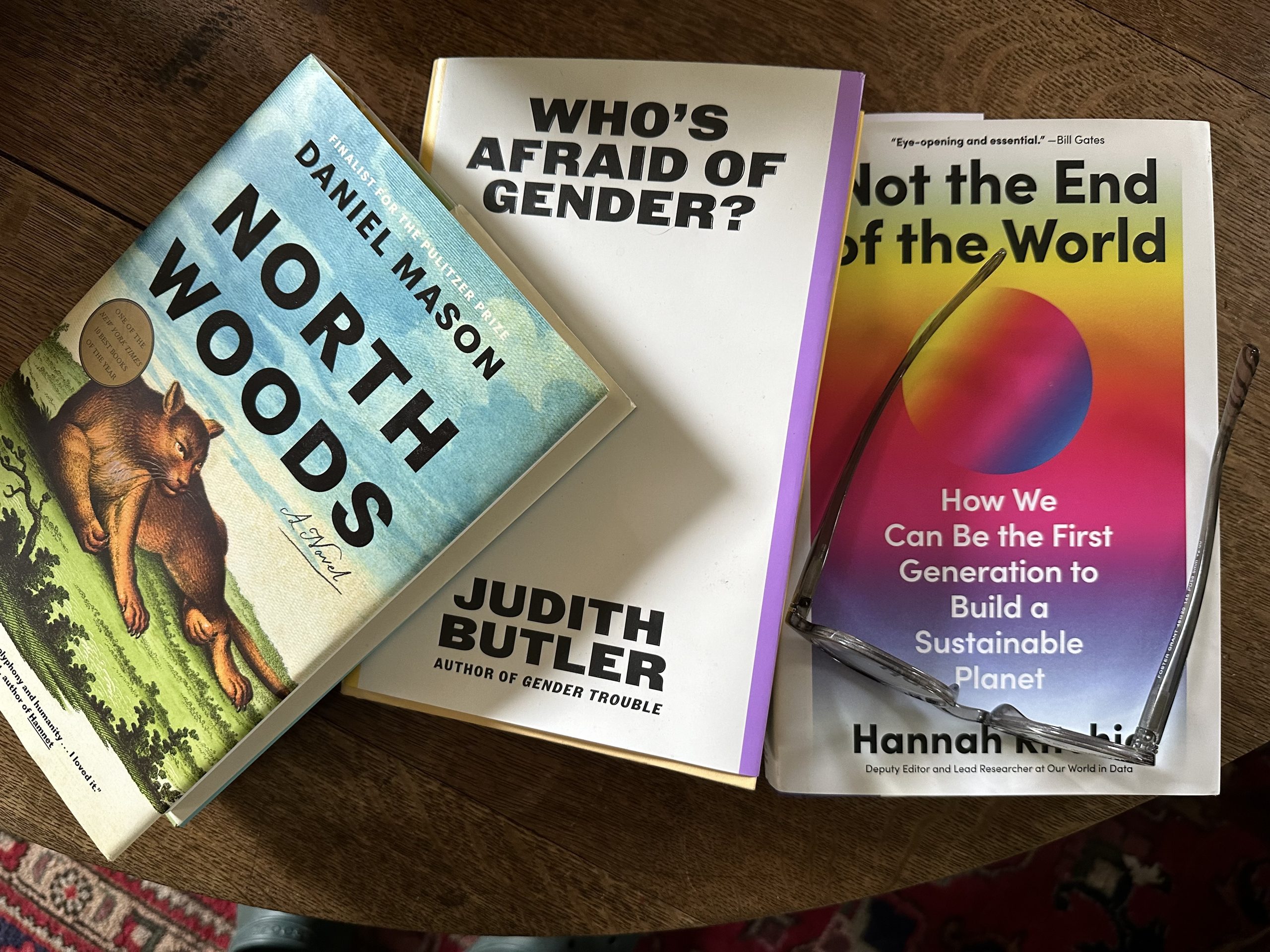
Now that this fall semester in full swing, and this professor emeritus is back in the classroom with a bright-eyed group of first-year honors students, once again, I am thinking about reading. At this point, three weeks in, we have read essays by Walker Percy, José Ortega y Gasset, Adrienne Rich, James Baldwin, Ralph Waldo Emerson, as well as a few contemporary articles that touch on the precarious bundle of human capacities we educators call “literacy.”
Of course I am reading other things as well. The writer Annie Dillard passed this week. And my friend John forwarded an article by Dana Saverin, The Thoreau of the Suburbs, published in The Atlantic in 2015. The essay is about Dillard’s process writing her book Pilgrim at Tinker Creek, one of the great books of the twentieth century, a book that describes her explorations in the Virginia valley where she lived, and that received the 1975 Pulitzer Prize for nonfiction. Reading about the imaginative process of an author, and thinking about the immersive experience of thinking and writing in my class, I am (once again) revisiting how to make it possible for the experience of thinking and writing to happen, which is a genuine if not heroic challenge given the mediating situation of the classroom and education, and in the shadow of the cultural and technological moment.
Another article I read this week, in the New Yorker, “Flight Risk,” by Rivka Galchen, reminded me of the pleasures of reading really, really good writing. Galchen’s story of “the perils and triumphs of the astonishing migration of the Hudsonian godwit” is beautifully put together. It is the kind of prose that reminds me of how the human activities of thinking and writing about the more-than-human world can enrich our minds and spirit.
Reading poems with students, too, is enriching: in the encounter with the radical specificity of a poem, reading (and reading together), surfacing in our ears and in our minds the particular elements as well as their relations, probing the musical cadences of words and phrases and lines, grammar and syntax, and formal conventions. For most of if not all of my students, the experience of reading poems and, more specifically, thinking with poems, to use my pedagogical language, is less familiar.
My objectives from the class syllabus below are organized around reading, thinking, and writing. I describe these objectives in this way: Reading to break new ground––to imagine ways of writing beyond personal and cultural commonplaces; and to unsettle distinctions between the personal and the academic, between lived experience and the thinking of others. One of the ways we cultivate the human capacity to use language is through reading––as well as by thinking (and writing) with what we read; Thinking to open yourself to the insights and ideas of others: in your reading and research; in showing up for class and listening and speaking, making connections across class meetings, and with other classmates, classes, and experiences beyond school; and thinking with me during scheduled conferences and/or in weekly office hours; and Writing to develop more complex thinking. Writing is one of the ways we become ourselves: we use language not merely to express ourselves, but to constitute ourselves by thinking, and by trying to understand what we think.
During the first three weeks of class we have also been talking about the social and technological realities of the digital age. This conversation, by design, has included the ubiquitous generative AI (GAI) tools that mediate our access to information, and that are marketed as if they are benign or even necessary. Last week, the students began drafting guidelines for using GAI in a classroom. And I found my way to some language to explain my concerns as an experienced teacher who remains open to but deeply skeptical of these rapidly developing material and technological tools:
So maybe it is not so much “losing” a skill as making it less possible to access the opportunity to experience the creative mind at work. “There is then creative reading as well as creative writing,” the nineteenth-century American thinker Ralph Waldo Emerson writes in his singular 1836 oration The American Scholar. He continues, “When the mind is braced by labor and invention, the page of whatever book we read becomes luminous with manifold allusion. Every sentence is doubly significant, and the sense of our author is as broad as the world.” We might compare Emerson’s expanding circle of the self (“broadness”) to Whitman’s aspiration for the reader in the second epigraph to this class note. “Not the book needs so much to be the complete thing, but the reader of the book does.”
Emerson and Whitman are chasing a simple formulation, really: it is that reading, thinking, and writing are by definition creative activities that we learn and refine as we develop as human beings. In reading we learn to process language and information, to access ideas, and open ourselves to minds and worlds that differ from our own; in thinking we learn to recognize patterns, make inferences, and evaluate evidence, as well as to access concepts and principles, understand cause and effect, temporality, and to consider moral and ethical questions in complex situations we face in our lives; and in writing we discover and formulate and learn to share thoughts and ideas, communicate with different audiences, and learn to use language and discourse effectively in differing rhetorical contexts. These creative activities––reading, thinking, research, writing––are what this class is all about.
What can you do with this poem? How does this poem help you think? How do you think with a poem? What can you do with what you know? These questions bring to mind another comment that one of you made, that “using AI completely defeats the purpose of any assignment because it does it for you.” What is the purpose of the reading, thinking, and writing assignments in this class? The purpose––and forgive me for reaching for more abstract language to capture the purpose––is to engage you in activities that constitute you, as a writer and as a thinking subject with agency in the world.
Much like the discourse of “excellence” so prevalent in high education a decade ago––described in Bill Readings The University in Ruins––the emergent discourse in higher education today uses ready-made terms such as “AI literacy” and faculty in curriculum discussions debate the merits of an “AI-ready curriculum.” A few months ago, in fact, I came across a college professor arguing that reading in the future (presumably writing, too?) would become “optional” for college graduates. In making the case that “the future of learning is going to be visual and execution driven,” the author writes, “Reading will still matter, but it will become optional for many people, more like a preference or a hobby than the primary delivery method.”
There may be much to agree with in this writer’s call for higher education to evolve; and there is an obligation, I think, for faculty and students to become more aware of the practical affordances of technology in the workplace. Yet this is the kind of atrophied intellectual discourse that will likely diminish the prospects of our students. I could not help but bring to mind this narrow perspective on literacy last week as I was reading the final words of Walker Percy’s “The Loss of Creature” with my students. Percy writes that “the person is not something one can study and provide for; he is something one struggles for. But unless he also struggles for himself, unless he knows that there is a struggle, he is going to be just what the planners think he is.”
It turns out that this notion of “struggling” has come up in our class conversations. In fact, Walt Whitman uses the term near the end of the essay we are reading this semester, Democratic Vistas. “Books are to be call’d for, and supplied, on the assumption that the process of reading is not a half-sleep,” Whitman writes, “but, in highest sense, an exercise, a gymnast’s struggle; that the reader is to do something for himself, must be on the alert, must himself or herself construct indeed the poem, argument, history, metaphysical essay—the text furnishing the hints, the clue, the start or framework.” And in a convocation address to the (women) students at Douglass College in 1977 that we read, “Claiming an Education” by the poet Adrienne Rich, we encountered another instance of this idea. “Responsibility to yourself means refusing to let others do your thinking, talking, and naming for you,” Rich writes; “it means learning to respect and use your own brains and instincts; hence, grappling with hard work.”
What I realized during the past three weeks is that I am struggling––that is, learning, as I engage my own brain and instincts and experiences as a college professor. This has led me to write four essays for the course web site to manifest our common struggle in the classroom. I began with Welcome to Honors Writing and Know Thyself and then turned to my own grappling with Generative AI as I set to work with my students to draft guidelines for the use of GAI in teaching and learning. Then, I turned to the weeks ahead in a brief introduction, Walt Whitman and Democratic Literacy. Rereading these four essays together suggests to me that we are off to a productive start.
Welcome to Honors Writing
The course: an introduction to college-level reading, thinking, and writing. As a student in this course, you can expect to spend a good deal of your semester wrestling with the thoughts and words of others, constituting in writing your point of view, and learning to make use of feedback to expand your capacities as a reader, thinker, and writer.
The title of the course: is organized around the idea that poems offer a way to learn more about yourself and the world. Who am I? What am I doing here? What is going on? Who are we? What do we want to be? What do we stand for? How do we live? As everyone learns sooner or later, these kinds of human questions are persistent and vexing; and they are difficult to answer on our own.
The experience of poetry, as the poet Muriel Rukeyser suggests, is one “way to allow people to feel the meeting of their consciousness and the world, to feel the full value of the meanings of emotions and ideas in their relations with each other, and to understand, in the glimpse of a moment, the freshness of things and their possibilities.” Poems turn, and return––the line a formal measure for thinking, for exploring connection (and disconnection), conjunction (and disjunction), the predictable (and unpredictable). In these relations, every poem is a kind of invitation, in the words of the poet A.R. Ammons, “a verbal construct that we encounter, learn from, make value judgments with, and go on to sort out possibilities in relation to our lives in order to learn how to live.”
“Our age is retrospective. It builds the sepulchres of the fathers. It writes biographies, histories, and criticism. The foregoing generations beheld God and nature face to face; we, through their eyes. Why should not we also enjoy an original relation to the universe? Why should not we have a poetry and philosophy of insight and not of tradition, and a religion by revelation to us, and not the history of theirs? Embosomed for a season in nature, whose floods of life stream around and through us, and invite us by the powers they supply, to action proportioned to nature, why should we grope among the dry bones of the past, or put the living generation into masquerade out of its faded wardrobe? The sun shines to-day also. There is more wool and flax in the fields. There are new lands, new men, new thoughts. Let us demand our own works and laws and worship.”
––Ralph Waldo Emerson, “Nature”
Reading over your annotations, and your responses to the written take-away exercise we did in class on the Week 1 readings, I found myself making connections among the readings we have completed. Our conversations in class have been deliberately centered around where you find yourself and on making the most of your first semester of college. In taking up ideas about being, agency, and identity, the readings were chosen to provide an occasion for you to think, and to engage in the process of thinking about thinking, or metacognition.
What can you do with Walker Percy, The Loss of the Creature, José Ortega y Gasset, Man Has No Nature, Adrienne Rich, Claiming an Education (1977) James Baldwin, The Creative Process (1962) and Ralph Waldo Emerson, Circles (1841)? I can’t answer that question for you. Though I can reflect on our first three class meetings. And I can begin to process your contributions to our work together.
When Ralph Waldo Emerson published his treatise “Nature” in 1836 the idea of “self-culture” led to a definition of education as a life-long development: a cultivation of the mind and the promise of self-determination, or agency, in social and political spheres. (That is, rather than mere training in branches of knowledge or a package of discrete skills.) This ideal of individual development, predicated on self-determination, persists in our intellectual tradition and educational institutions. Though by the twentieth century another story gained momentum: a story in which the individual is defined more by social and economic and political forces.
In the chapter “The Loss of the Creature” that we read together, Walker Percy describes the relationship between individual and social structures. His examples are tourism, education, and specialization. And his anecdotes contrast the passive acceptance of the “consumer” of experience with the active process of, first, becoming aware of the preformulated “symbolic” packages that frame or even constitute our experience. Here is one of his elaborations of this process:
Why is it almost impossible to gaze directly at the Grand Canyon under these circumstances and see it for what it is––as one picks up a strange object from one’s back yard and gazes directly at it? It is almost impossible because the Grand Canyon, the thing as it is, has been appropriated by the symbolic complex which has already been formed in the sightseer’s mind. Seeing the canyon under approved circumstances is seeing the symbolic complex head on. The thing is no longer the thing as it confronted the Spaniard; it is rather that which has already been formulated-by picture postcard, geography book, tourist folders, and the words Grand Canyon. As a result of this preformulation, the source of the sightseer’s pleasure undergoes a shift. Where the wonder and delight of the Spaniard arose from his penetration of the thing itself, from a progressive discovery of depths, patterns, colors, shadows, etc., now the sightseer measures his satisfaction by the degree to which the canyon conforms to the preformed complex. (47)
The essay defines the problem in multiple domains––including in education, “the educational package,” which makes it directly relevant to you. And Percy describes ways to “recover” our experiences (and the world) by 1) becoming aware of the “symbolic package” and 2) formulating strategies to reclaim our sovereignty as “knowers.” He asks his readers to note in one of the situations he describes “(1) an openness of the thing before one-instead of being an exercise to be learned according to an approved mode, it is a garden of delights which beckons to one; (2) a sovereignty of the knower-instead of being a consumer of a prepared experience. . .” (60).
The problem is that this openness to a more direct encounter does not simply happen. Percy ends his essay with a reference to the French philosopher Emanuel Mounier, “the person is not something one can study and provide for; he is something one struggles for. But unless he also struggles for himself, unless he knows that there is a struggle, he is going to be just what the planners think he is” (63).
In our “quiz” on the reading this Tuesday, Charlotte F. notes well that Percy describes “how we experience the world is heavily influenced by society, culture, and history.” And Abby, in her take-way from “Man Has No Nature” by the philosopher José Ortega y Gasset, comments that “I am where I am because of the choices I’ve made about the past I have been through; however, I can change who I am.” The condition in which we find ourselves is, in this formulation, one of possibility. “To be free means to be lacking in constitutive identity,” writes Ortega, “not to have subscribed to a determined being, to be able to be other than what one was, to be unable to install oneself once and for all in any given being.: He then concludes, “The only attribute of the fixed stable being in the free being is this constitutive instability. (2) Let’s hold on to this idea of “constitutive instability” as we read our way into the suggestive exuberance of Walt Whitman’s poems in the coming weeks. As the poet Mary Oliver writes about the 1855 edition of Whitman’s Leaves of Grass: “His message was clear from the first and never changed: that a better, richer life is available to us, and with all his force he advocated it both for the good of each individual soul and for the good of the universe” (“Some Thoughts” 63).
Kendall comments in her take-away on Rich’s case (in 1977) for women to “fight” for an education, or as Clover puts it, the demand that you not “just take what is handed to you, go out an claim what you want, earn it.” These comments got me thinking about the “ethical and intellectual contract” between teacher and student that Rich insists hinges on a mutual recognition:
the contract on the student’s part involves that you demand to be taken seriously so that you can also go on taking yourself seriously. This means seeking out criticism, recognizing that the most affirming thing anyone can do for you is demand that you push yourself further, show you the range of what you can do. . . . It means assuming your share of responsibility for what happens in the classroom, because that affects the quality of your daily life here. It means that the student sees herself engaged with her teachers in active, ongoing struggle for a real education.
In an important sense, then, that this struggle for a “real” education––your education––will involve the practical intricacies of collaboration. This collaboration requires each of us to recognize the challenges and rewards of reading, thinking, and writing. If poetry is, as I am suggesting, a way of knowing, then let us work together toward what James Baldwin so eloquently describes in the 1963 essay I made available to you for reading, The Creative Process:
It goes without saying, I believe, that if we understood ourselves better, we would damage ourselves less. But the barrier between oneself and one’s knowledge of oneself is high indeed. There are so many things one would rather not know! We become social creatures because we cannot live any other way. But in order to become social, there are a great many other things that we must not become, and we are frightened, all of us, of these forces within us that perpetually menace our precarious security. Yet the forces are there: we cannot will them away. All we can do is learn to live with them. And we cannot learn this unless we are willing to tell the truth about ourselves, and the truth about us is always at variance with what we wish to be. The human effort is to bring these two realities into a relationship resembling reconciliation.
I guess the upshot might be the difference between a life lived actively and a life of passivity or acceptance. All of us find ways to feel committed to our lives in different ways, and our responsibility to ourselves, all of these writers insist, is up to us. But each of these writers also suggests that as you experience what a former student memorably described as “becoming a productive member of your own life,” you will never again be satisfied with the old, passive way.
Last evening the moon rose above this rock
Impure upon a world unpurged.
The man and his companion stopped
To rest before the heroic height.
Coldly the wind fell upon them
In many majesties of sound:
They that had left the flame-freaked sun
To seek a sun of fuller fire.
Instead there was this tufted rock
Massively rising high and bare
Beyond all trees, the ridges thrown
Like giant arms among the clouds.
There was neither voice nor crested image,
No chorister, nor priest. There was
Only the great height of the rock
And the two of them standing still to rest.
There was the cold wind and the sound
It made, away from the muck of the land
That they had left, heroic sound
Joyous and jubilant.
––Wallace Stevens, Ideas of Order (1936)
Introduction
Thank you for sharing your experiences using Generative AI (GenAI) in school. Your comments were remarkably consistent. As a few of you point out, every one of us is already using GenAI. It is embedded in many of the digital tools and programs we use every day, from the images we capture using the camera on our smart phones to the autocorrect suggestions in a text or email, to the algorithms that drive the content on social media feeds, not to mention the now ubiquitous and embedded tools in our digital experiences, including autocorrect, spell-checkers, chat bots of one kind or another, and search engine results.
For the purposes of a first-year college thinking and writing class our focus will be on the AI tools that generate text. These statistical large language models (LLMs) are programmed to recognize abstract patterns that generate what is most probable based on those patterns. These tools are therefore being used in routine transactional communication tasks in the workplace—generating meeting minutes, routine reports and memos, social media text, customer service transactions, translation, market research and analysis, and so on.
But in a college classroom, designed to develop particular content knowledge and skills, there are additional considerations. Because an LLM is run on a machine, it has no way of reliably determining what is true or false. It has no expertise. It has no experience. It has neither embodied knowledge or semantic awareness. And it does not think or feel.
GenAI programs operate, for the most part, without an ethical or moral framework. A GenAI tool does not distinguish between accurate/inaccurate or biased/unbiased information, and it should not be surprising that it recombines accurate source information in ways that generate inaccurate statements. It makes things up. Rather than using a metaphor and calling these “hallucinations,” let’s just say that these inaccurate statements are part and parcel of what these programs do.
In addition to formulating our guidelines for the class, based on your previous classroom experiences, I recommend that you become familiar with the Modern Language Association (MLA) Student Guide to AI Literacy. In this document you will find the following statement on “AI Literacy”:
AI Literacy
Ethical and effective use of GenAI technologies is emerging as an essential skill that students must develop in order to live, learn, and work. Yet GenAI comes with potential pitfalls for students–from the risk of being accused of academic misconduct to missing out on foundational skills in reading, writing, research, and learning.
Developing literacy with a tool means becoming a more skilled and thoughtful user of that tool. For example, developing literacy in reading means being able to reread, tackle increasingly difficult texts, and do research in order to further build your capability as a reader. Literacy also assumes you have enough knowledge to question and evaluate what you are studying.
Similarly, developing AI literacy requires that you learn certain basics about how GenAI works, how to use it, and how to evaluate its output. You should also learn when not to use it. Developing GenAI literacy should be your starting point for using this technology. When you build skills and habits for using GenAI ethically and effectively you will establish yourself as a thoughtful creator and consumer of GenAI content as technologies change over time.
The responsible and effective use of emergent GenAI tools requires students to be thoughtful and deliberate.
How to Live, What to Do
Consider the following example. After selecting and placing the poem “How to Live, What to Do,” by Wallace Stevens, as one of two epigraphs for this post, I opened a search window on my Google Chrome browser to refresh my memory of the poem’s date of publication. (Rather than getting up from my desk to pull the volume off my bookcase.). Here is the search result on Google search:
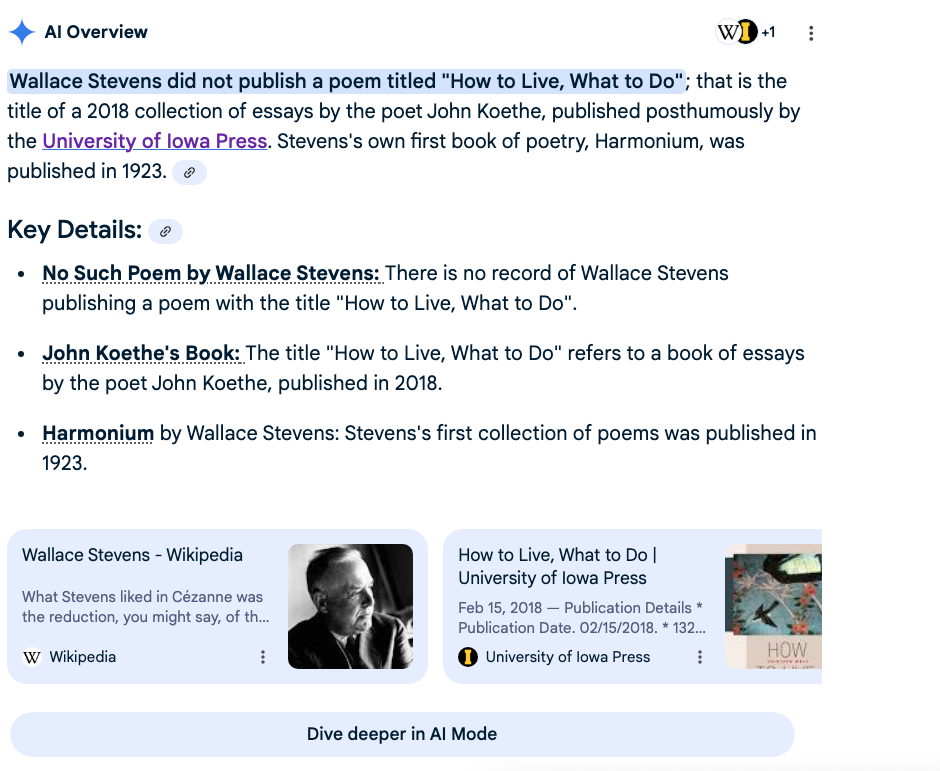
The GenAI Overview is incorrect. And mores the pity, as a large percentage of users would likely accept the results. (Note well the deceptive and seductive certainty of the output, “did not publish a poem” and “no such poem.”) As an avid reader of poems, with a doctorate in American literature and culture and decades of reading and teaching poetry, I was aware that this overview was wrong. (As it happens, I have also read the Koethke book, and know that he took his title from the poem.) But if you don’t have background or expertise, well, again, mores the pity.
There is such a poem. But remember, my question was about when the poem was published, and in which of Stevens’ volumes of poetry. Then curiosity got the best of me. And I clicked on “Dive Deeper in AI Mode.” Below is the prompt and the answer:
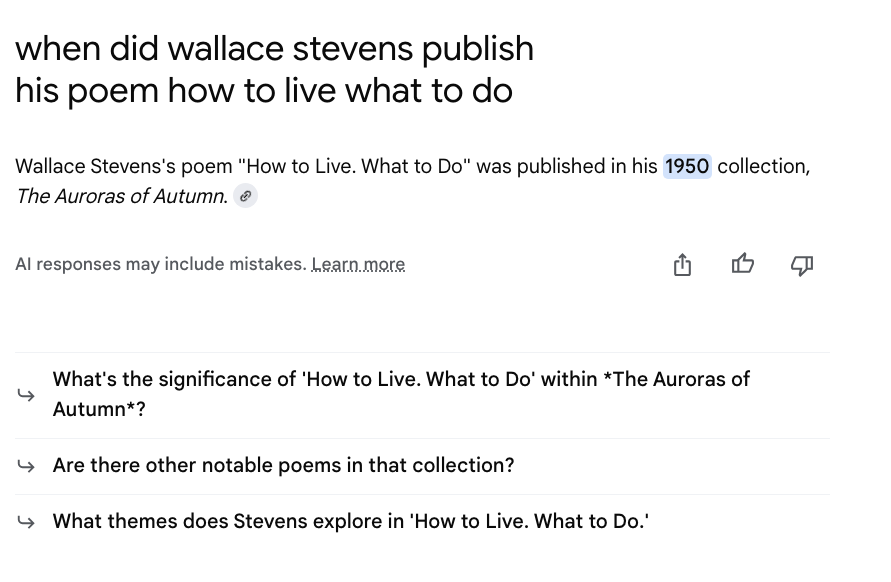
By “going deeper,” the mode of inquiry (GenAI) produced a new finding: Lo! Wallace Stevens did write and publish a poem entitled “How to Live, What to Do.” But. I studied Stevens in graduate school, and have taught his work for decades; and I knew that this was among his earlier poems. So I got up and pulled the Collected Poetry and Prose off the shelf and looked at the Table of Contents to refresh my memory. And there it was, nestled between “Lions in Sweden” and “Some Friends from Pascagoula” in the sequence of poems in Ideas of Order, a book published in 1936.
(As a follow up, I retyped my query into Google search and in this instance the GenAI “Overview” reported that the poem appears in the 1942 collection Parts of the World, though the table of contents of that book does not include the poem. (“AI responses may include mistakes”. . . .)
The Use of AI in Teaching and Learning
One of you wrote to me in an email to recommend that “we avoid the use of AI as much as possible. I believe that everything GenAI does for us makes us lose a skill that we could greatly benefit from.”
I’m not sure I could say this better. The example above illustrates well the problem. I might begin to define the problem as the wide availability of a (seductive) technology that is unreliable. In order to check the accuracy of the information generated a user will in most cases spend far more time vetting the information than if the user simply used a more reliable methods of searching for information––methods, not incidentally, we will be practing next week.
But the more I think about the problem the more I suspect that the use of GenAI will diminish the opportunity for people (in the present case, you, as students) to experience the pleasure and rewards of curiosity––the formalized curiosity that the writer and sociologist Zora Neale Hurston once called “poking and prying with a purpose.” (She makes this widely-cited remark about research in her lovely memoir, Dust Tracks on a Road, first published in 1942.)
So maybe it is not so much “losing” a skill as making it less possible to access the opportunity to experience the creative mind at work. “There is then creative reading as well as creative writing,” the nineteenth-century American thinker Ralph Waldo Emerson writes in his singular 1836 oration The American Scholar. He continues, “When the mind is braced by labor and invention, the page of whatever book we read becomes luminous with manifold allusion. Every sentence is doubly significant, and the sense of our author is as broad as the world.” We might compare Emerson’s expanding circle of the self (“broadness”) to Whitman’s aspiration for the reader in the second epigraph to this class note. “Not the book needs so much to be the complete thing, but the reader of the book does.”
Emerson and Whitman are chasing a simple formulation, really: it is that reading, thinking, and writing are by definition creative activities that we learn and refine as we develop as human beings. In reading we learn to process language and information, to access ideas, and open ourselves to minds and worlds that differ from our own; in thinking we learn to recognize patterns, make inferences, and evaluate evidence, as well as to access concepts and principles, understand cause and effect, temporality, and to consider moral and ethical questions in complex situations we face in our lives; and in writing we discover and formulate and learn to share thoughts and ideas, communicate with different audiences, and learn to use language and discourse effectively in differing rhetorical contexts.
These creative activities––reading, thinking, research, writing––are what this class is all about.
What can you do with this poem? How does this poem help you think? How do you think with a poem? What can you do with what you know? These questions bring to mind another comment that one of you made, that “using AI completely defeats the purpose of any assignment because it does it for you.” What is the purpose of the reading, thinking, and writing assignments in this class? The purpose––and forgive me for reaching for more abstract language to capture the purpose––is to engage you in activities that constitute you, as a writer and as a thinking subject with agency in the world.
Finally, in your comments on AI there surfaced a prescient question about the very definition of writing itself. After all, what is writing? (or as Caelin asks in his literacy narrative, “What is good writing?”) These questions are helpful for us. For GenAI produces text, not thinking and not writing. Texts that are machine-generated output have no intent, provenance, or reliable accuracy. Writing as output is different from writing as constitutive. GenAI makes you dependent on Natural Language Processing (NLP) to generate language and in the process robs you of one of your greatest gifts as a human being: the ability to use language. I can’t help but think of the conclusion of Walker Percy in the essay we read and annotated during the first week of class, “The Loss of Creature.” As you will remember, he writes, that the loss of our autonomy (his term is “sovereignty”) is “a consequence of the seduction of the layman by science. The layman will be seduced. . .as long as he waives his sovereign rights as a person and accepts his role of consumer as the highest estate to which the layman can aspire” (63).
As you navigate the use of GenAI in forms of intellectual work, and develop a functional level of AI Literacy, I encourage you to consider the cautionary words of one of your classmates. “If you get all your help from AI,” they write, “it can damage your ability to ask for help from another human. AI doesn’t judge or think, it doesn’t have a face or a social standing.” This is a brilliant and haunting observation that should give all of us pause.
Acceptable and Unacceptable Uses
While some of your groups were more critical of these emergent technological tools, others were more willing to approach the use of GenAI with less skepticism. Using language from your experiences using GenAI, sent to me for writing specific guidelines for our class, please find below a list of acceptable and unacceptable uses. I also include below guidelines for citing GenAI using the Modern Language Association (MLA) style guide and the relevant excerpt from the Keene State Policy on Academic Honesty.
Acceptable uses
- Exploration of Ideas, including the use of AI to explore topics and generate initial ideas, developing sample statements of purpose (or thesis statements) through AI-assisted questioning, creating outlines or possible organizational sequences of ideas;
- Research Assistance, including clarifying complex concepts or terminology, defining search terms, generating a list of questions to focus a line of inquiry, or compiling a first draft of an annotated bibliography or list of works cited;
- Writing Process Support, including reviewing grammar and style, suggesting sentence revisions for clarity, or receiving feedback on the organization of a draft.
Unacceptable uses
- Generating Primary Content, including having GenAI write substantial portions of assignments, submitting AI-generated text as original work, using GenAI to complete an entire assignment;
- Doing Critical Analysis, including the use of GenAI-generated analysis or interpretations, or using GenAI conclusions rather than thinking and reasoning on one’s own;
- Failing to disclose AI, including misrepresenting GenAI-generated content as your own intellectual work, or using GenAI to complete writing tasks designed to evaluate specific skills (such as explication, analysis, or interpretation.
If you are using an GenAI tool to think or write for you, you are violating the trust of your teacher, who is dedicated to improving your intellectual capacities; you are betraying your classmates, and failing to contribute to the learning community in our classroom; and you are transgressing the ethical values that motivate genuine academic inquiry.
Guidelines for Citing AI
Honesty and transparency are core principles of academic inquiry. You are therefore responsible for your writing and for disclosing the use of any assistance you received in completing your academic work. Any and all use of GenAI must be appropriately documented using standard academic citation guidelines
The Modern Language Association (MLA) Style Center has guidelines for citing generative AI. In this class we will follow the MLA guidelines:
- cite a GenAI tool whenever you paraphrase, quote, or incorporate into your own work any content (whether text, image, data, or other) that was created by it;
- acknowledge all functional uses of the tool (like editing your prose or translating words) in a note, your text, or another suitable location;
- and be judicious in vetting each secondary source a GenAI cites.
Here is an example of how to cite an in text citation or paraphrase: (“Describe the symbolism”): - Works Cited Entry “Describe the symbolism of the green light in the book The Great Gatsby by F. Scott Fitzgerald” prompt. ChatGPT, 13 Feb. version, OpenAI, 8 Mar. 2023, chat.openai.com/chat.
- Works-Cited-List Entry “In 200 words, describe the symbolism of the green light in The Great Gatsby” follow-up prompt to list sources. ChatGPT, 13 Feb. version, OpenAI, 9 Mar. 2023, chat.openai.com/chat.
The Keene State College Academic Honesty Policy statement on generative AI
Generative artificial intelligence (AI) is an emerging tool in teaching, learning, and workplace environments. The College strongly encourages instructors to establish and to clearly articulate course policies governing students’ appropriate use of generative AI, if any. Generative AI tools may not be used in the completion of coursework unless the instructor specifically authorizes their use. If an instructor approves the use of generative AI for coursework, any use must be properly cited, as defined by this Academic Honesty Policy. The College encourages our entire academic community to consider the ethical implications of uploading copyrighted work to generative AI programs.
Walt Whitman and Democratic Literacy
Closer yet I approach you,
What thought you have of me now, I had as much of you—
I laid in my stores in advance,
I consider’d long and seriously of you before you were born.
Who was to know what should come home to me?
Who knows but I am enjoying this?
Who knows, for all the distance, but I am as good as looking
at you now, for all you cannot see me?
––Walt Whitman, Crossing Brooklyn Ferry
Reading and Literacy
This week we are transitioning into the second phase of our work together this semester: reading and thinking and writing with the poems (and prose) of Walt Whitman. You will be immersed in Whitman’s writing as you continue to develop as readers, thinkers, and writers; and you will be learning to make productive use of digital and print archives.
Our inquiry into Whitman’s corpus will be immersive—a method of reading we will be practicing together through the end of October. But the quality and reach of our immersive reading project will begin with you: with your motivation to immerse yourself in a textual corpus and to ride your curiosity from passage to passage, from text to text. This kind of intellectual immersion requires patience and persistence as your reading experience is challenged by singular texts that are, in both a literal and a figurative sense, beyond you.
In the MLA AI Literacy document I cited in my most recent “Teacher Talk” piece the authors write that “developing literacy in reading means being able to reread, tackle increasingly difficult texts, and do research in order to further build your capability as a reader. Literacy also assumes you have enough knowledge to question and evaluate what you are studying.” Following this, I included my own definition of what can happen when we experience the kind of reading I am describing here as part of what I have come to call “democratic literacy.” I write,
reading, thinking, and writing are by definition creative activities that we learn and refine as we develop as human beings. In reading we learn to process language and information, to access ideas, and open ourselves to minds and worlds that differ from our own; in thinking we learn to recognize patterns, make inferences, and evaluate evidence, as well as to access concepts and principles, understand cause and effect, temporality, and to consider moral and ethical questions in complex situations we face in our lives; and in writing we discover and formulate and learn to share thoughts and ideas, communicate with different audiences, and learn to use language and discourse effectively in differing rhetorical contexts.
I call this literacy “democratic” in part because of the inherent responsibilities we have as people living together in what Whitman and others have called a “culture of democracy.”
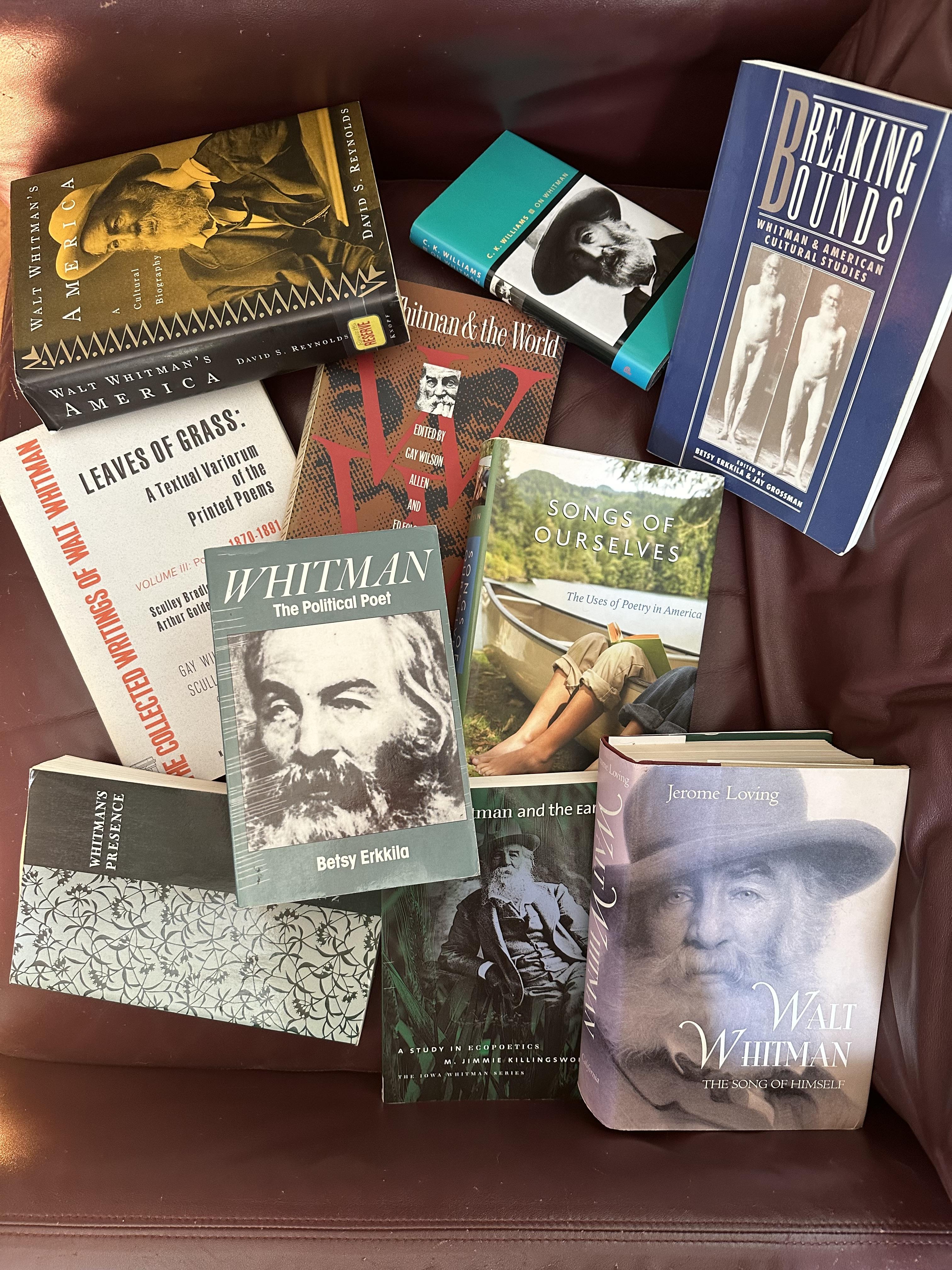
In our class meeting this week I confessed my bias toward books. And I believe that reading Walt Whitman’s Leaves of Grass is an experience that everyone should have with a copy of the book in their hands. But I also want to save you the cost of purchasing another book; and, in using the Walt Whitman Archive, we will be reading in (and learning to navigate) a digital archive––one of the learning experiences that I believe is important for every student in college.
Over the next few weeks ,we will be reading and doing research on primary and secondary materials—all available in The Walt Whitman Archive. As you begin the first week in our study of Leaves of Grass, I recommend starting with the 1855 edition of Leaves of Grass, specifically the page that lists the poems. (This repository will be easier for you to navigate than the Complete Edition text.) However, in the spirit of immersion, I want you to allow your curiosity to lead you to the Background, and also “The Preface” to the 1855 edition available using the Complete Edition link. The background essay includes a fascinating account of the material process of publishing a book in the nineteenth century, and the complete edition of the book will give you access to the actual manuscript pages of the first edition.
The “Background” essay makes useful disclosures about the organization of the text as well. For instance, the author Ivan Marki writes that
it is also possible, as Ed Folsom has proposed, that the arrangement of the poems had less to do with thematics and more to do with the odd circumstances of the printing of the volume. Perhaps the final six poems contain no “Leaves of Grass” title because Whitman was trying to squeeze all of his poems into twelve signatures; thus, starting with the fourth poem, he stopped leaving blank space between poems, and, starting with the seventh poem, he omitted the repeated titles, moving the shorter poems to the end of the volume in case he would have to delete one in order to stay within the allotted number of pages (he was, after all, paying for the paper himself).
Our Week 3 Timeline on the course web site has a link to the page where you can read the two poems we will dig into on Tuesday next week, “I Celebrate Myself” and “Come Close to Me.”
Most of the work we will be doing in the weeks to come will be with the text of the complete (or “Deathbed Edition”) of Leaves of Grass (1891–92). The Individual Poems and Clusters is the page you will likely want to bookmark for the work ahead.
One of the lessons for us is that the poems that appear in published works are written. In other words, as we have already talked about in class, composing is a process. And Whitman’s case is fascinating, as he worked on his poems for most of his adult life—revising, reordering them in sequences, and reflecting on the placement of the poems in the book Leaves of Grass. One of your jobs in the coming weeks will be to become interested in these intellectual and textual processes and to learn how to use research methods to trace them.
Navigating the Archive
In this section on navigating the Archive I’ll start with an example. Let’s say I read and become interested in the poem “This Compost.” And then I want to learn more about the poem. How do I navigate this digital archive? One pathway to follow, click by click on my desktop machine, leads me to what I might be looking for:
Published Writings > U.S. Editions of Leaves of Grass > Leaves of Grass (1891-92) > Autumn Rivulets > This Compost
One question we will be asking is when individual poems first appear in Leaves of Grass. This question will lead us to questions about the provenance of the lines of the poem, which would likely lead to a search in the archive for “This Compost.” As it happens, the search prompt turns up 59 results. One of the items is written by Harold Aspiz, “”This Compost” (1856),”includes a descriptive textual history of the poem:
Originally titled “Poem of Wonder at The Resurrection of The Wheat,” this exquisite lyric meditation on death was number 4 in the “Leaves of Grass” cluster in the 1860 edition, received its present intriguing title in 1867, and (having undergone several textual changes over the years) attained its present form in 1881, when it was placed in the “Autumn Rivulets” cluster of Leaves of Grass together with many other poems about death.
(Note well the descriptive mode of writing here. For you will be writing a textual history for each of the two poems that you will choose from Leaves of Grass for your descriptive commentaries.)
But there is more. The Archive includes letters and textual fragments and notebook entries that document the emergence and writing of the poem. There are other points of entry into the materials as well, pages such as the Integrated Catalog of Walt Whitman’s Literary Manuscripts that combines the catalogs of each repository––describing all of Whitman’s literary manuscripts, organized around the concept of Whitman’s “works.”
The other interest we will have, as a curious collective of critical readers, is how published literary works were read and received. The Archive has a repository, Commentary, a fascinating compilation of early commentary on Whitman’s writing, and Reviews (1855-1892), that includes all of the items found in Walt Whitman: The Contemporary Reviews, ed. Kenneth M. Price (Cambridge University Press, 1996) as well as more than 100 reviews not included in that volume because of space considerations or because they had not been discovered. The repository Selected Criticism includes some of the copyrighted criticism, some out-of-copyright commentary, and a few of the many full-length book studies by several scholars. And there is a Bibliography that includes articles, books, chapters of books, and poems about Whitman, published from 1838 to the present.