Browse Category

Reading and Writing

“Now comes good sailing”

Today is the bicentennial of the birth of Henry David Thoreau. It is good to see Thoreau celebrations and stories of Thoreau in the news, including an exhibit at the Morgan This Ever New Self: Thoreau and his Journals. Happy birthday Henry!

Last week I picked up a copy of Laura Dassow Walls’ just released biography, Henry David Thoreau: A Life. I am now reading the chapter “Transcendental Apprentice,” that covers the years 1937-1841. Working for the past two years on a Emerson project has prepared me well for this delicious summer reading.

As it happens, about two weeks ago, I spent some time with Laura and friends in Detroit at the twenty-fifth anniversary conference of the Association for the Study of Literature and Environment. One evening we dropped in on the storefront of Shinola, where Laura and I shared a moment of pleasure when we ferreted out from an employee the origins of the phrase “shit from Shinola.” We then enjoyed pizza and beer on a deck at the Motor City Brewery, and took in music by the Mongrel Dogs, before huddling under two small bumbershoots with Jim and Julianne as we were thoroughly soaked on the way back to our hotels by a heaving Michigan downpour.

In the “Preface” to her biography, Laura writes that “Thoreau struggled all his life to find a voice that could be heard despite the din of cynicism and the babble of convention.” She then points to the strange but explainable story of Thoreau’s life that has set up shop in our cultural imaginary:

That he was a loving son, a devoted friend, a lively and charismatic presence who fill the room, laughed and danced, sand and teased and wept, should not have to be said. But astonishingly, it does, for some deformation of sensibility has brought Thoreau down to us in ice, chilled into a misanthrope, prickly with spines, isolated a hermit and a nag.

Reading Laura’s story about Thoreau’s life I am recognizing the Thoreau I have come to know as a devoted reader of his work–whether in reading and teaching the more widely circulated publications, or in my own saunters through the journals and manuscripts over the years. “Today, two hundred years after his birth,” Laura writes,

we have invented two Thoreau’s, both of them hermits, yet radically at odds with each other; one speaks for nature; the other for social justice. Yet the historical Thoreau was no hermit, and as Thoreau’s own record shows, his social activism and his defense of nature sprang from the same roots: he found society in nature, and nature he found everywhere, including the town center and the human heart.

As Ralph Waldo Emerson wrote in “Thoreau,” “The country knows not yet, or at least in part, how great a son it has lost.”

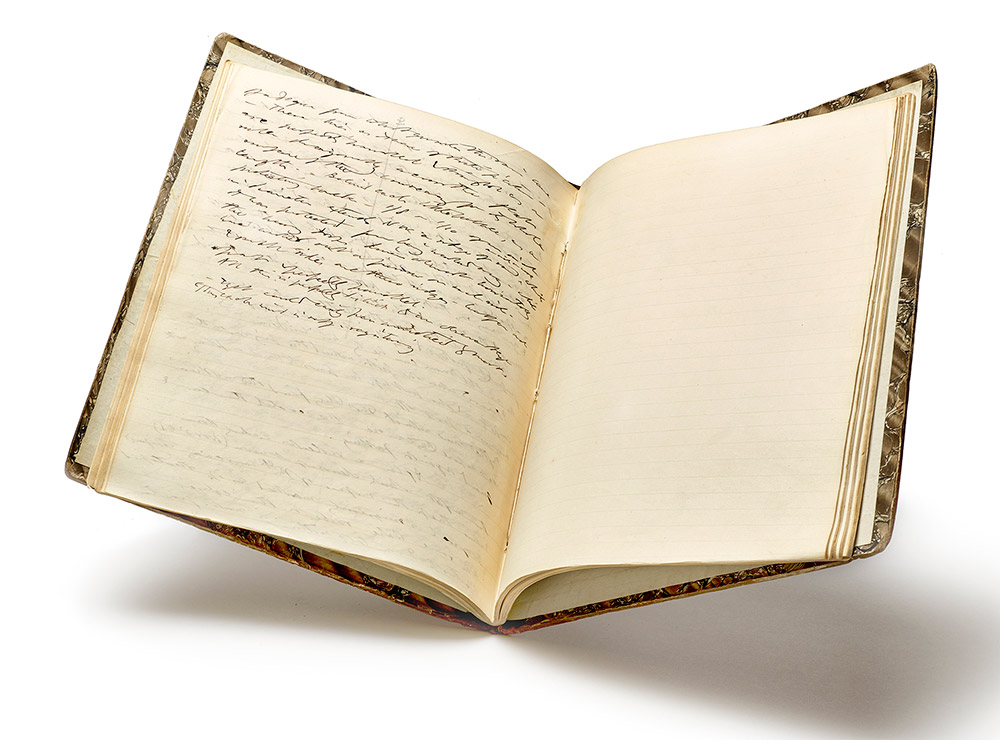
“All this is perfectly distinct to an observant eye, and yet could easily pass unnoticed by most. Thus each wind is self registering.” Henry D. Thoreau’s final journal entry, dated November 3, 1861. The Morgan Library & Museum; purchased by Pierpont Morgan, 1909.

What is remarkable, to me at least, is how the in inventions of Thoreau persist, both in the scholarly and the cultural spaces in which these versions of Thoreau appear. Perhaps Laura’s story–sharply detailed, sensitive, alive–will do its little part in reanimating a more holistic vision of our place in the world. Thoreau saw, Laura notes,

the end of one geological epoch and the beginning of the next, and the unease he felt is rampant today, infecting the headlines and blocking our own imagination of the future he believed he was helping to realize. Thoreau could see the ground was shifting, and, in the sheer audacity of his genius, he decided it was up to him to witness the change and alert the world.

As Thoreau is reported by his sister Sophia to have said on his deathbed, at forty-four years of age, “Now comes good sailing.”

Ralph Waldo Emerson

Every detachment prepares a new detachment. Of course, prophecy becomes habitual and reaches all things. Having seen one thing that was firmament enter into the kingdom of growth, the conclusion is irresistible, there is no fixture in the Universe. Everything was moved, did spin, and will spin again. This changes once and for all his view of things. Hint of dialectic: Things appears as seeds of an immense future. Whilst the dull man seems to himself always to live in a finished world, the thinker always finds himself in the early stages; the world lies up to him in heaps and gathered materials;—materials of a structure that is yet to be built.

from “The Relation of Intellect to Natural Science” (1848)

Few men know how to take a walk. The qualifications of a professor are endurance, plain clothes, old shoes, an eye for nature, good humor, vast curiosity, good speech, good silence, and nothing too much. If a man tells me he has an intense love of nature, I know, of course, that he has none. Good observers have the manner of trees and animals, their patient good sense, and if they add words, ‘tis only when words are better than silence. But a loud singer, or story teller, or vain talker profanes the river and the forest, and is nothing like so good company as a dog.

from “Country Life” (1858)

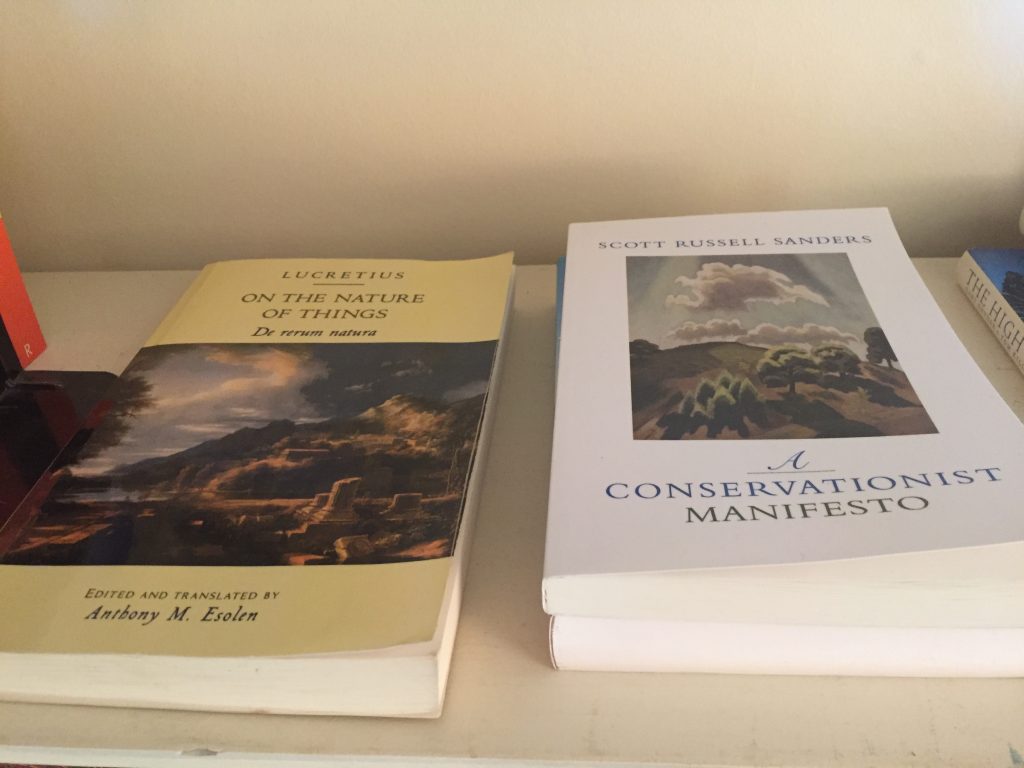
Last week I received in the mail  “The Best Read Naturalist”: Nature Writings of Ralph Waldo Emerson, edited by Michael Branch and Clinton Mohs. When I was asked to review the manuscript of this book for the University of Virginia Press, I was teaching the biologist E. O. Wilson’s The Meaning of Human Existence (2014). Reading Emerson and Wilson I was intrigued by the congruence between the questions both authors are asking. “Does humanity have a special place in the Universe? What is the meaning of our personal lives? Where are we going? Why?” These are Wilson’s questions, presented in the spirit of reasoning about what he calls “the relation between science and humanities.”

It strikes me that this is precisely the line of reasoning that Emerson enacted with his audiences in the lyceum. Branch and Mohs build on this connection between Emerson’s fascination with natural science and his humanistic exploration of our place in the world, arguing that Emerson “illuminates the importance of nineteenth-century natural science to the evolution of American ideas about the environment” (ix). For example, in one of the talks included in this anthology, “Humanity of Science” (1836), Emerson writes, “In a just history, what is the face of science? What lesson does it teach? What wisdom will a philosopher draw from its recent progress?” (140). This series of questions offers teachers and students access to Emerson’s engagement with the social and cultural history of natural science.
As it happens, about the same time I read the manuscript of “The Best Read Naturalist” a student showed up in one of my classes prepared to talk about an essay by Emerson. The student raised his hand. He then asked a question. “How do I begin to talk about the essay when I have highlighted every word in the opening paragraph?”

This is the same student who, in an essay I had asked him to write on his experiences with reading and writing in school, described his belief that the purpose of the academic essay “is to break the illusion of false knowledge.” He then pointed out, “of course essays are assigned so teachers can assess a student’s understanding, but they also allow students to assess their own understanding. For me,” he concluded, “the written word has become a way to audit my thoughts from a neutral point of view so that I may realize the flaws of my thought process.”

Then, a few weeks later, we read Emerson’s essay “Illusions” from The conduct of Life:

There are as many pillows of illusion as flakes in a snow-storm. We wake from one dream into another dream. The toys, to be sure, are various, and are graduated in refinement to the quality of the dupe. The intellectual man requires a fine bait; the sots are easily amused. But everybody is drugged with his own frenzy, and the pageant marches at all hours, with music and banner and badge.

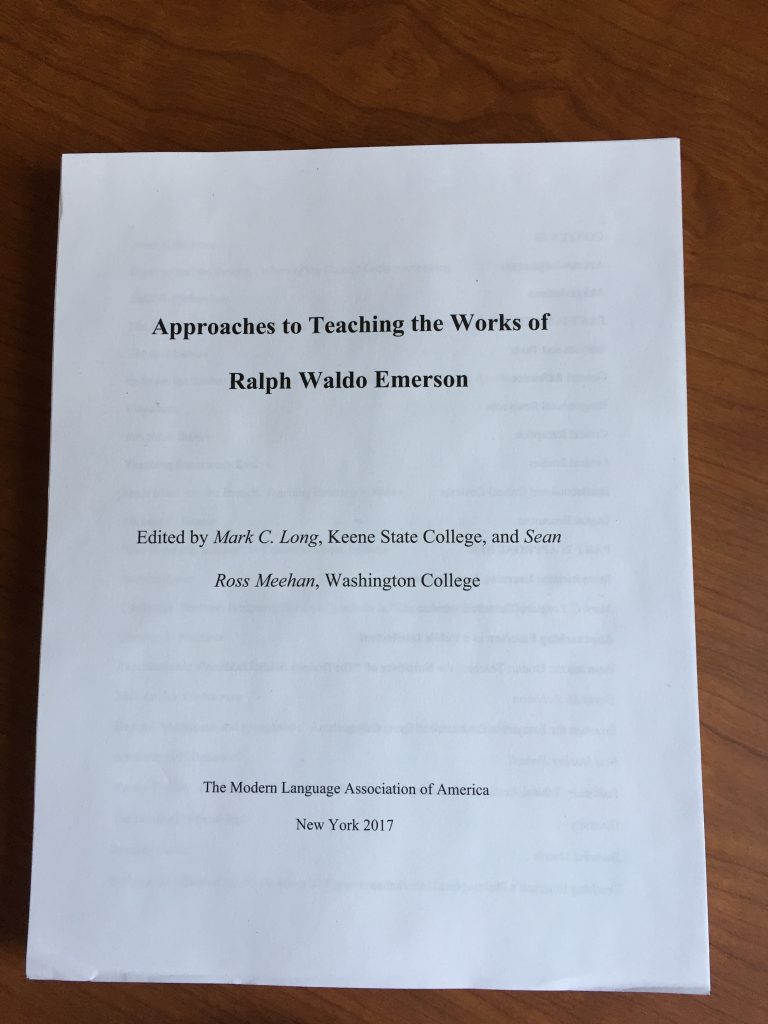
In the introduction to the book I recently co-edited with a colleague who teaches at Maryland’s Washington College, Sean Meehan, Approaches to Teaching the Works of Ralph Waldo Emerson, we remind our readers that ever since F. O. Matthiessen made him a founding figure of the “American Renaissance,” Emerson has remained a staple of undergraduate surveys in American literature and seminars on the “Age of Emerson.” We go on to describe the wide-ranging global, not just national, presence of Emerson’s writing, across the Atlantic and around the world. Our collection of essays demonstrate the multiple ways contemporary students encounter Emerson’s works—in courses on Transcendentalism, Romanticism, environmental literature, literary theory and philosophy, rhetoric and composition, media studies, and genre courses in poetry and the essay, and in upper-level seminars.
Not only was Emerson a leading figure of American Transcendentalism and transatlantic Romanticism, prominent nineteenth-century poet and literary mentor. For he is one of America’s greatest essayist, and students frequently encounter his writing alongside Henry David Thoreau, Walt Whitman, Emily Dickinson, Friedrich Nietzsche, William James, James Baldwin, Wallace Stevens, Robert Frost, Ralph Ellison, Mary Oliver, and Annie Dillard, to name a few. Emerson was also America’s first public intellectual. His addresses, essays, and poems were deeply engaged with the social and political issues of nineteenth-century America.

Teaching a seminar on Emerson, and working on our forthcoming book, I found myself spending more time with Emerson’s writing. Work had just been completed on the ten-volume scholarly edition of all of Emerson’s works published in his lifetime and under his supervision, The Collected Works of Ralph Waldo Emerson. The culmination of a half-century of vigorous textual editing, I now had access to the full range of Emerson’s writing and thinking. The publication of this textual scholarship—beginning with The Early Lectures of Ralph Waldo Emerson, the sixteen volumes of The Journals and Miscellaneous Notebooks, extending to The Complete Sermons, The Poetry Notebooks, The Topical Notebooks, the four-volume supplement to The Letters of Ralph Waldo Emerson and The Selected Letters, Emerson’s Antislavery Writings, The Later Lectures and Selected Lectures—reintroduced me to Emerson and to the ways that Emerson worked and thought through his ideas in the medium of writing.

Approaches to Teaching the Works of Ralph Waldo Emerson recognizes Emerson’s continuing presence in the curriculum and offers instructors a pedagogical resource to guide and inspire the teaching of Emerson. The Table of Contents for the book that will be published later this year offers a preview of the contexts and the range of scholars engaged with Emerson’s work.


PART 1: MATERIALS

Editions and Texts
General Reference
Biographical Resources
Critical Reception
Critical Studies
Intellectual and Critical Contexts
Digital Resources

PART 2: APPROACHES

Introduction: Learning from Emerson
 Mark C. Long and Sean Ross Meehan


Approaching Emerson as a Public Intellectual


Emerson the Orator: Teaching the Narratives of “The Divinity School Address” David M. Robinson


Emerson the Essayist in the American Essay Canon 
Ned Stuckey-French


Politically Ethical Aesthetics: Teaching Emerson’s Poetry in the Context of U.S. Diversity
 Saundra Morris


Teaching Emerson’s Philosophical Inheritance Susan L. Dunston

Emerson and the Reform Culture of the Second Great Awakening Todd H. Richardson

The Turbulent Embrace of Thinking: Teaching Emerson the Educator Martin Bickman


Emerson the Author: Introducing the Collected Works of Ralph Waldo Emerson into the Classroom
 Ronald A. Bosco


Teaching Emerson’s Essays


Once More into the Breach: Teaching Emerson’s Nature
 Michael P. Branch


“The American Scholar” as Commencement Address
 Andrew Kopec


The Divine Sublime: Educating Spiritual Teachers in “The Divinity School Address” Corinne E. Blackmer


Experimenting with “Circles”
 Nels Anchor Christensen


Beyond “mendicant and sycophantic” Reading: Teaching the Seminar “Studies in American Self-Reliance”
 Wesley T. Mott


The Ideals of “Friendship”
 Jennifer Gurley


In Praise of Affirmation: On Emerson’s “Experience” Branka Arsić

Teaching Emerson’s Other Works


Emerson in the Nineteenth-Century Poetry Course
 Christoph Irmscher


Teaching Emerson’s Antislavery Writings 
Len Gougeon


Approaching the Practical Emerson through the Sermons and the Early Lectures Carolyn Maibor


Emerson, Gender, and the Journals 
Jean Ferguson Carr


A Natural History of Intellect? Emerson’s Scientific Methods in the Later Lectures Meredith Farmer


Emerson Across the Curriculum


“These Flames and Generosities of the Heart”: Emerson in the Poetry Workshop Dan Beachy-Quick


Between the Disciplines and Beyond the Institution: Emerson’s Environmental Relevance
 T.S. McMillin


Emerson in Media Studies and Journalism
 David O. Dowling


Emerson and the Digital Humanities
 Amy Earhart


Emerson Around the World

Emerson’s Transatlantic Networks Leslie Elizabeth Eckel

Translating the Latin American Emerson Anne Fountain

Emerson and Nietzsche Herwig Friedl

Emerson in the East: Perennial Philosophy as Humanistic Inquiry John Michael Corrigan
NAPLA Project

The year I began graduate school at the University of Washington the department of English began the Computer-Integrated Courses (CIC) Program. The idea was that students in 100-level writing courses would benefit from new learning technologies. From the inception of the Computer-Integrated Courses (CIC) program in 1990, the program’s philosophy was built around “the idea that the computer has become a ‘natural’ part of the reading, writing, research, and critical thinking processes.”

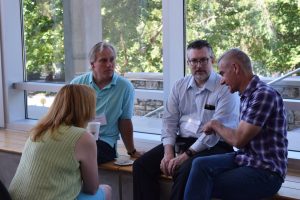
Meeting with co-faculty member Cole Wilcox and Project directors Jeff McClurken and Ellen Homes Pearson at a summer 2016 COPLAC Digital Research Faculty Development Seminar at the University North Carolina Asheville, North Carolina

Sixteen years later this idea continues to shape my teaching and pedagogy. In the fall of 2016 I offered a digital humanities course called “Public Access and the Liberal Arts A Narrative History.” Designed and co-taught with Dr. Cole Wilcox, professor of English at Truman State University, the course enrolled students from the University of North Carolina Asheville, The State University of New York (SUNY) Geneseo, and Keene State College.

The idea for this course was born in a COPLAC Digital Humanities Workshop at the University of Mary Washington that included faculty from Sonoma State, University of Montevallo, USC Aiken, Midwestern State, and Truman State. Our course documented the 1944 G.I. Bill and public access to higher education and, later, increasing public access to the liberal arts. The students documented the experiences of students, alumni, staff and faculty at the campuses at which they were studying and used digital technologies to capture the history and the prospects of the public liberal arts.

Keene State College story of Abby Shepherd’s project on the Women of Keene State

Our class met synchronously on Tuesday and Thursday (EST) from 2-3:20. The students worked in teams to build an online archive of oral histories by alumni, faculty, staff, and current students— layered, web-based narratives that include audio and video stories, images, maps and timelines, and documentary evidence of their home campus.

If you are interested in one version of the idea that digital technologies have become part of the reading, writing, research, and critical thinking processes, have a look at our course site, Public Access and the Liberal Arts: A Narrative History, and the Student Sites:

Foundations of Knowledge at SUNY Geneseo
UNC Asheville: An Educational Narrative
The Women of Keene State

You might also have a look at the full College Profile of Abby Shepherd.


Right and Wrong

This morning I read Michelle Navarre’s “Cleary The Wrong Way to Teach Grammar” in The Atlantic magazine. The essay takes up the question whether grammar lessons must come before writing or the learning of grammar through writing (and reading). Navarre, an associate professor and associate dean at DePaul University’s School for New Learning, notes the decades of study that demonstrate how teaching rules outside of context or use does not work well for most writers.

These kinds of conversations inevitably bring up approaches to teaching writing, and the ways that teaching writing in schools does and does not result in better writing. What we have discovered in more than a decade of work at Keene State College is that developing writers requires a sustained focus on writing—across all four years, and in as many classrooms and fields of study as possible. If we value writing, we need to give students authentic and challenging writing at every turn. This philosophy of teaching writing, it should follow, needs to shape elementary, secondary and post-secondary classrooms. Have a look at another essay in The Atlantic series, Peg Tyre’s 2012 essay “The Writing Revolution” for a case study at New Dorp High School focused on teaching analytic writing, every day, in virtually every class.

Finally, and not incidentally, The Atlantic series includes an essay by a secondary teacher, Andrew Simmons, whose “Facebook Has Transformed My Students’ Writing—for the Better,” offers a first-person anecdotal case for the value of social media in developing skills associated with storytelling and emotional authenticity in personal writing.

Digital Compost

“Something startles me where I thought I was safest”

Walt Whitman, “This Compost”

It is exciting to be a professor of English right now: for the archive of materials we use in our professional lives has undergone (and is undergoing) fundamental and lasting change. The conditions for literary production and reception are being radically transformed and the work of teaching and research are, as a result, changing. While scholars will necessarily travel to libraries for research, scholars and their students now have access to (and, in a number of cases, are building) an expanding archive of materials that were only a decade ago only available to those with the resources and time to travel to research libraries or to more modest holdings in public or private collections.

For a decade my students and I have been using the Walt Whitman Archive, an electronic library of written materials, including the six editions of Whitman’s major work, Leaves of Grass. The archive makes accessible Whitman’s notebooks, manuscript fragments, prose essays, letters, and journalism, as well as the ongoing historical and critical commentary on his work. So, for example, my students can access all the volumes of Horace Traubel’s With Walt Whitman in Camden and we can easily call up page images of Leaves of Grass Imprints in class. Students reading in the historical commentary on Whitman’s writings and current criticism, moreover, now have access to electronic versions of essays and more than twenty full-length books. The co-editors of the site, Kenneth M. Price (University of Nebraska-Lincoln) and Ed Folsom (University of Iowa), have created a beautiful thing.

Also, in my American Studies courses, the Library of Congress web portal that supports the Library’s mission “to support the Congress in fulfilling its constitutional duties and to further the progress of knowledge and creativity for the benefit of the American people” has helped my students do much more interesting work with a greater range of materials and artifacts. Finally, my colleague at the University of New Hampshire, Siobhan Senier, is building a digital archive/anthology of materials, Writing of Indigenous New England, with the help of students, tribal historians, and local historical societies. you can learn more about this work at Siobhan’s Indigenous New England Literature site.

Then, this year, I became aware of two new projects that have, to be honest, startled me. The first, more useful to me in thinking more clearly about the fundamental changes that are taking place in my professional field is the monograph Literary Studies in the Digital Age: an Evolving Anthology ,a part of the MLA Commons project. Here is the description of the anthology by the editors:

We began the process of creating this anthology with the intention of providing a primer to core tools and techniques for computational approaches to literary studies. Yet, since literary studies represents a confluence of fields and subfields, tools and techniques, and since computational approaches come from a great variety of sources, it became clear that any primer would have to be dynamic and capable of incorporating a rich and growing array of methodologies.

What is interesting is that the anthology is evolving using the tools of social computing made possible by web 2.0 technologies. In their Introduction, Introduction, Kenneth M. Price and Ray Siemens make the following claim:

The field of literary studies is being reshaped in the digital age. Texts have acquired a new kind of malleability, and they are often encountered in large aggregations, allowing for a scale of research far different from that in the past. At the same time, new possibilities as well as limitations for publishing are changing how, what, and to whom texts are disseminated. These changes require us to reexamine assumptions and to adopt altered research methodologies.

The introduction is worth reading. It can help to moderate the rhetoric that surrounds what some have called the digital turn. They return to 1963 and the founding of the Centre for Literary and Linguistic Computing at Cambridge University by Roy Wisbey. They also mention the period between 1966–78 when professional organizations were established and publications developed to explore possibilities of using computers in the humanities. They call attention to Computers and the Humanities (1966), the Association for Literary and Linguistic Computing (ALLC, 1973), and the Association for Computers and the Humanities (ACH, 1978).

The other project is more ambitious, and delightfully so: The Digital Public Library of America is working to make available (the beta version launches April 18 2013) an enormous amount of archival materials. The material and conceptual implications of this project are staggering. The blog entry called “What is the DPLA?” is a helpful place to start. There is also a very good overview of the conception of the project in the April 25 2103 edition (vol. LX no.7) of The New York Review of Books by Robert Darnton.

To take just one example of a DPLA “service hub”: The Mountain West Digital Library (MWDL) is a search portal for digital collections about the Mountain West region with free access to over 700,000 resources from universities, colleges, public libraries, museums, historical societies, and government agencies, counties, and municipalities in Utah, Nevada, and other parts of the U.S. West. The MWDL will help to accelerate the preservation of materials in these local sites while reaching out to provide access to those interested in the mountain west. For someone who teaches at a small, centrally isolated liberal arts college, the materials available in the Mountain West Digital Library collections will give me the capacity (and help me imagine) new ways to do my own research as well as help me teach courses using primary documents that would otherwise be unavailable to my students.