Browse Category

Reading and Writing

Swimming with the Current

Among the ways college professors stay alive is by swimming in the current with their intellectual peers. Meaningful exchange with students and colleagues beyond one’s home institution strengthens one’s scholarship and teaching. And it contributes to a more productive institutional culture. In fact, a good deal of my scholarship and teaching has its origins in these intellectual streams of thought; and in this post I trace some of my intellectual activities beyond Keene State College during the 2010-11 academic year.

Wall mural in Cincinnati by Rosalind Tallmadge, et alia

On Sunday I returned from a week in Bloomington, Indiana, at the biennial conference of the Association for the Study of Literature and the Environment (ASLE). The week began along the Ohio River, in Cincinnati, with my friend, colleague and collaborator, John Tallmadge, whose book The Cincinnati Arch had prepared me for this look-and-see tour of the city.

Author and Mentor, Collaborator and Friend, John Tallmadge, on a tour of Cincinnati

When we arrived in Bloomington I made may way to the ASLE Executive Council meeting. No longer a member of the Council, I do try to attend these meetings as a program coordinator. Sitting in reminded me of the ongoing collaborative efforts that have built and sustain  this organization. Our organization has grown in size, to 1400 members, and in breadth, with members from 41 countries and with 24 affiliations with scholarly groups both in and outside of the United States. The close to 800 participants seemed a natural fit with the Brobdingnagian scale of the Bloomington campus. The  buildings are enormous, and the campus spreads far and wide. The grey-white Indiana limestone buildings, some of which date back to the late nineteenth century, loom over the Dunn Woods, the Arboretum, and the rather Lilliputian Jordan River. The wooded areas on campus are littered with downed trunks and limbs from a storm on May 25th that took down over 300 trees across this nearly 2,000 acre campus.

Art Museum at Indiana University

I kicked off the week co-facilitating (with John Tallmadge, Rochelle Johnson, Tom Hillard and Sarah Jaquette Ray) a pre-conference workshop “Staying Alive: A Workshop for Academic Professionals.” ASLE’s tradition of mentoring graduate students and building community has evolved to include the Staying Alive Project, a vision that includes building mentoring relationships with one another across all phases and dimensions of academic life. The workshop that John and I offered at Wofford College in Spartanburg, South Carolina in 2007 and in Victoria, British Columia in 2009 seeks to initiative honest conversations about the challenges and rewards of academic life. During the conference, as the coordinator of the ASLE Mentoring Program, I also organized mentoring meetings between graduate students and faculty members outside their home departments; and talked with other members of the organization about ways to promote international scholarly exchanges in the field of literature and environment.

Academic Building at Indiana University

My conference days revolved around attending concurrent sessions, sharing meals with friends and collaborators, and attending plenary talks. The people who make ASLE their professional home, and with whom I enjoy spending  time when we gather every two years, include John Tallmadge, Mike Branch, Rochelle Johnson, Ian Marshall, Megan Simpson, Randall Roorda, Nicole Merola, Anne Raine, Arlene Plevin,  Annie Ingram, Scott Slovic, John Lane, Jim Warren, Dan Payne and Tom Hillard.  The people who find themselves gathering in this biennial eddy in the intellectual stream share a love for thinking, talking, eating, making music and drinking beer.
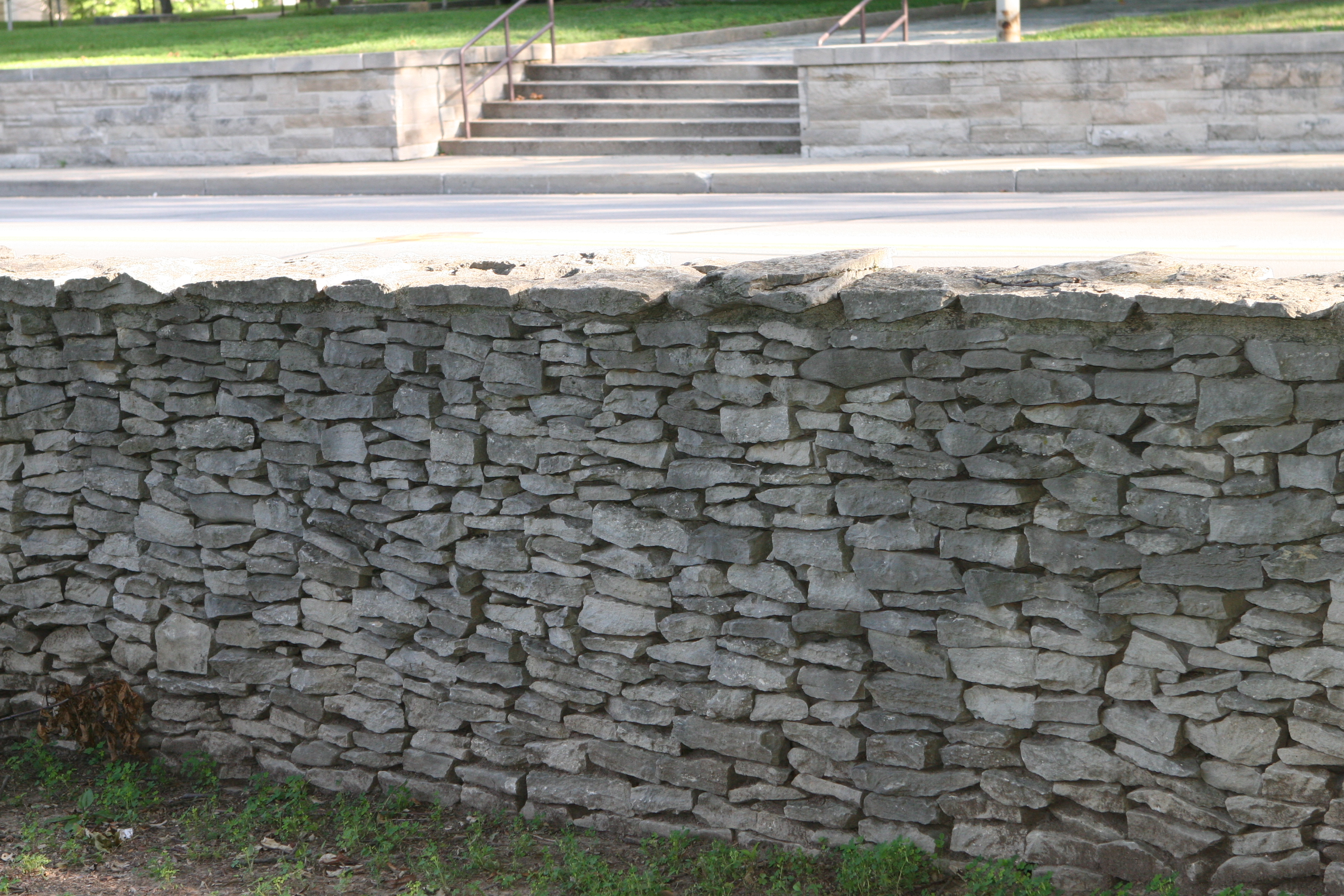
“Something there is that doesn’t love a wall. . . .” near the Wells Library on the campus of Indiana University

During my week in Bloomington I found myself preoccupied with getting right the argument I had been trying to pin down in the presentation I would give on Saturday, “Frames of Rejection: Frames of Acceptance: Environmentalism in the Classroom” on the panel “Green Without Guilt: Pedagogy and Scholarship for Teaching Environmentalism in the Disciplines.” But most of the week had me moving from session to session, absorbing and discussing ideas, as well as attending plenary sessions by Una Chaudhuri (professor of English, Drama and Environmental Studies at New York University), Helen Tiffin (recently retired professor of English at the University of Tasmania), Zakes Mda (poet, novelist and critic from South Africa), Robert L. Fischman (professor of Law at Indiana University), Marc Bekoff (professor emeritus of Ecology and Evolutionary Biology, University of Colorado) and Rubén Martínez (professor of Literature and Writing at Loyola Marymount University in Los Angeles). I also attended an evening reading and performance, Wilderness Plots, that began as a book, by Soctt Russell Sanders, of brief tales of the settlement of the Ohio Valley between the American Revolution and the Civil War. The spirited evening performance by Sanders, and musicians Timm Grimm, Krista Detor, Carrie Newcomer, Tom Roznowski and Michael White, was recorded for Indiana Public Television. There were also two receptions honoring senior colleagues in our field: for Lawrence Buell, who is retiring from the English department at Harvard University, and for John Felstiner, from the department of English at Stanford. I list these names and performances to suggest the tributaries that feed into the mainstream intellectual work of the organization. At the same time, I am suggesting the ways that an intensive week of intellectual exchange with students and colleagues  feeds my teaching, scholarship and service at Keene State College.
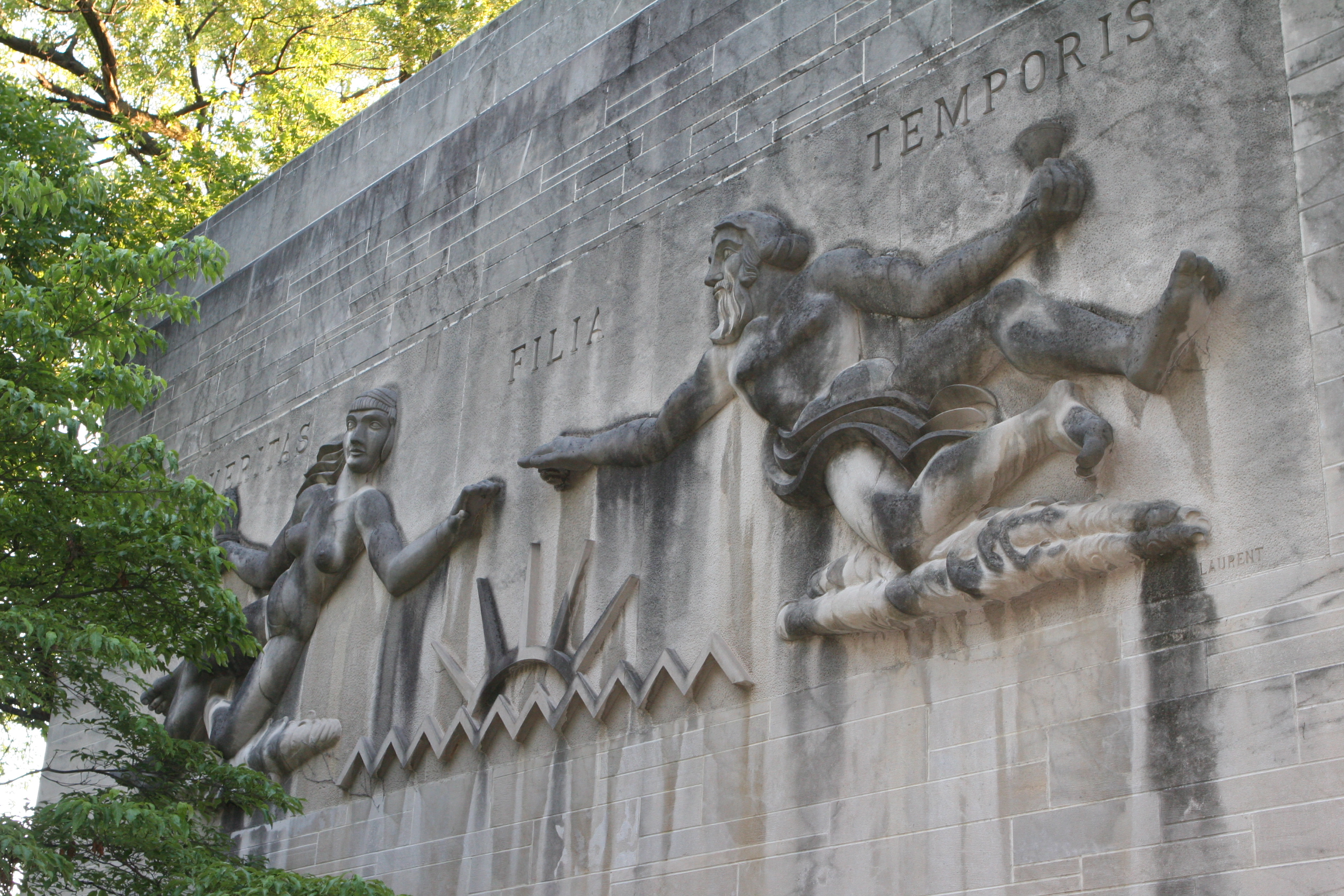
“Truth is the Daughter of Time,” aphorism and and relief, west wall of Ballantine Hall, Indiana University

Our panel on Saturday afternoon was well attended. I talked about my upper-level undergraduate elective designed to help students understand the social movement we call environmentalism, as well as explore the ways environmental concern shapes the development of a genre of writing. Using Kenneth Burke’s writings from the 1930s to reflect on my course, I offered an overview of the kick-ass books we read: Rachel Carson’s Silent Spring, Gary Snyder’s Turtle Island, Masanobu Fukuoka’s The One Straw Revolution: An Introduction to Natural Farming, Edward Abbey’s The Monkey Wrench Gang, Wendell Berry’s The Unsettling of America: Culture and Agriculture, Linda Hogan’s Solar Storms, Snyder’s The Practice of the Wild, Terry Tempest Williams’ Refuge and T. C. Boyle’s The Tortilla Curtain. I argued essentially that environmentalism needs environmental literature. But not to affirm the environmentalist agenda. Nor to pursue its agenda by other means. Rather my conviction is that environmental literature, like most literature worth reading, should remind us that genuine thinking is  less dogmatic and more provisional, less universal and more situated, less earnest and more alive. Environmental literature should encourage us to re-imagine how we think the environment—even as, in some cases, those books are working with the inherently reductive language and discourse of environmentalism.

American Literature Association, Boston, Massachusetts

In late May I spent a day at the annual American Literature Association Conference in Boston. In addition to attending discussions of the work of the nineteenth century American authors Ralph Waldo Emerson and Henry Wadsworth Longfellow, I chaired a session I organized called “American Literature and the Ecological Thought” framed around recent theoretical work by Timothy Morton, professor of English at the University of California Davis, and author of Ecology without Nature (2007) and The Ecological Thought (2010). Cathleen Rowley, from Stony Brook University, presented “An Ecological Reading of Hawthorne’s House of the Seven Gables,”  Amy Campion, University of Minnesota, presented “John Cheever and the Ecological Thought,” and Heather Houser, University of Texas at Austin, presented “Visualize or Describe? The Contemporary Novel, Visualization and Environmentality.”

Emerson was right. . . . books are for a Scholar’s idle times

Modern Language Association Convention, Los Angeles, California

In January I traveled to the Modern Language Association convention in Los Angeles, California, where I presided at the session I have been organizing for a number of years, “Teaching in the Small College Department,” an annual event sponsored by the Association of the Departments of English. I centered the 2011 small college session on the small college department and the curriculum. The central question I asked the panelists to address was how small college departments are (re)configuring the English major, designing courses and doing collaborative work around courses in the major or in the general studies curriculum, especially in light of the mission of smaller institutions—as well as in relation to the profession-wide conversation about the English major, for instance, in the 2008 Report of the Teagle Foundation on the Undergraduate Major in Language and Literature.

In smaller institutions and departments, faculty and students routinely work together in collaborative and cooperative endeavors. And the session suggested that much of this work is devoted to rethinking the English major. It is not surprising that faculty in smaller settings have been generating innovative ways of thinking about English, as the 2003 special issue of the ADE Bulletin on “The English Major” demonstrated. The faculty in small college departments, focused primarily on their mission of undergraduate education, tend to be more broadly involved in teaching at levels of the curriculum, and hence are more able to create opportunities to rethink and refashion the undergraduate major in English. The 2011 session features faculty from institutions that are part of the Council on Public Liberal Arts Colleges, COPLAC, a consortium of colleges seeking to offer high-quality, public liberal arts educations.

Lunch at the Runcible Spoon, Bloomington, Indiana

Washington College, Chestertown, Maryland

In the fall of 2010 I spent two days at Washington College in Chestertown, Maryland, where I was invited to present the annual Sophie Kerr Lecture and to lead a college conversation for faculty on writing and the curriculum. My Kerr Lecture and slide presentation, co-sponsored by the Center for Environment and Society, was entitled “John Muir and the Mountains of California: Prospects for Environmental Thinking and Writing.”

My first talk on writing was a standing-room-only workshop for faculty in the Global Research and Writing Seminar Program called “Thinking, Writing and Research in the Undergraduate Writing Classroom: A Case for Sustained Writing Projects.” I also presented a college-wide workshop for faculty and students, “Thinking about the Values of Writing.”

One of many opportunities for cultural exegesis in the scholarly stream

The Natural History of Reading, University of Washington, Seattle, Washington

The 2010-11 academic year began for me in June of 2010 when I traveled to the University of Washington to speak at an undergraduate honors conference at the University of Washington.  Seattle entitled “The Natural History of Reading.” The conference, organized by Leroy Searle under the auspices of the Simpson Humanities Center, was the culminating event in a course designed to examine the activity of reading as an essential component of learning and inquiry. The course and conference began with the historical tropes pertaining to ‘The Book’—or, as Leroy framed it, “the Book of God, the Book of Nature, and the productions of Man”—in literature, philosophy, and science, art, photography, and architecture. Students read The Bible  (King James version), The Qu’ran  (Abdullah Jusuf Ali translation), Gerald Holton: Thematic Origins of Scientific Thought, James Gleick: Genius: The Life and Science of Richard Feynman, Lee Smollin: The Trouble with Physics, Charles Sanders Peirce: The Essential Peirce, vol 1, William Blake: Complete Poetry and Prose and William Faulkner: Light in August. They also discussed Plato, the Phaedrus, Johannes Kepler, The Six-Sided Snowflake, Samuel Taylor Coleridge, selections from Biographia Literaria and The Friend, Louis Sullivan,  Selections from Autobiography of an Idea and Kindergarten Chats and Nathan Lyons, Selections from Photographers on Photography.

I was one of three invited speakers whose work on the activity of reading would contribute to this course of inquiry. Each of the undergraduate students presented a talk at the conference and there were social events to continue the conversations that emerged in the academic session. My talk, “The Problem of Reading, the Practice of Writing,” began with a theoretical question: what is the relationship between reading and writing? As I reminded the audience of undergraduates, graduate students and professors, the problem with asking this question is that most responses immediately call on a set of commonplaces about the practice of teaching writing in school. For students in primary and secondary grades are to be introduced to the practice of writing mostly through routine tasks that promote mastery of a discrete skill set; college undergraduates are asked to produce essays, for the most part, that demonstrate whether or not they have a working understanding of course content; graduate students produce readings of books that apply ready-made protocols to generate arguments as a quantitative measure for professional advancement; and professors, having internalized the imperative to publish, produce reams of writing that very few people have reason to read. (The situation, as I explained, is a perfect case of what the critic Kenneth Burke once called the beauracratization of the imaginative—a phrase, as he put it, as bungling as the situation it seeks to describe.) I then when on to talk about how at most colleges and universities our first-year students therefore find themselves writing essays with little to no intellectual investment; how their teachers find themselves reading essays that no one should ever be asked to read; and how most tenure-stream faculty have abandoned the first-year course while quietly ignoring the working conditions of the contingent faculty they hire to teach it. Is there a better way? My essay drew on my own study of theories of reading and writing as well as the pedagogical  experiment underway at Keene State College with the first year course. My argument was that when students are actually thinking and writing, the activity of reading becomes, quite naturally, a central intellectual activity in the course. My essay was later published in the fall in the conference proceedings, The Natural History of Reading.

The Real Work

“Knowing that nothing need be done, is where we begin to move from”

-Gary Snyder, “Four Changes,” Turtle Island (1974)

Refuse bin, Mahabalipuram, India, February 2008

How do we address the social needs and demands of an economy, the natural constraints of ecology and the political imperatives of democracy? How do we think about the environment in historical, political, historical, sociological, economic, technological, and moral terms? And how do we reconcile the democratic freedoms at home with the imperialism abroad that feeds the greed for resources to feed our insatiable consumer economy? These complicated questions—at the center of the social movement (and discourse) we have come to call environmentalism—have motivated a range of writers whose cultural work begins with the paradox that the scientific, industrial and technological advances of the modern world have inexorably created an ecological catastrophe of massive proportions.

This semester I’m teaching a course in American and Environmental Studies that takes up these questions. Our focus is

US Forest Service campaign to prevent fire

environmental writing and its relationship to the discourse of environmentalism. I’m interested in the ethical claims of environmentalism as a framework for considering how writers (and writer-activists) seek to foster reflection and transformation of personal assumptions and attitudes, beliefs and behavior. My course, “Writing in an Endangered World,” is an interdisciplinary course and therefore designed to address program outcomes in Environmental Studies (critical thinking and problem solving skills, communication skills, skills associated with moral and character development, an understanding of the ethical implications of environmental issues) as well as in American Studies (understanding historical and contemporary American cultures, responding resourcefully to texts, integrating forms of scholarship from more than one discipline, and the ability to write an effective documented essay that includes a thesis that integrates interdisciplinary approaches). To these ends, the course makes visible the assumptions, frameworks, and methods of the disciplines that study natural and human history, the relationship between ecological and human systems, and the history and values of environmental engagement in North America during the 20th century. In addition to reading Ramachandra Guha, Environmentalism: A Global History, students are reading Rachel Carson, Silent Spring, Gary Snyder, Turtle Island, Edward Abbey, The Monkey Wrench Gang, Wendell Berry, The Unsettling of America: Culture and Agriculture, Linda Hogan, Solar Storms, Gary Snyder, The Practice of the Wild: Essays, Terry Tempest Williams, Refuge and T. C. Boyle The Tortilla Curtain. The course has also have considered the cultural presence of environmental concern in visual images, advertising campaigns, popular music, as well as other forms of cultural discourse.

The politics of environmental concern

I’m primarily interested in students thinking about how environmental writers use language as a primary vehicle for exploring the human prospect in an age of environmental crisis. Wendell Berry’s essays in The Unsettling of America, for example, ask students to consider the commonplaces that make possible our thinking about environmental questions. Berry enumerates the faults and contradictions of a system—call it what you will, capitalist, exploitative, free-market or global economy. Indeed Carson, Snyder, and Abbey all work from these commonplace ways of thinking. What makes this writing worth reading is that it moves beyond the limits of the language we make available to ourselves to address the problems we are being asked to think about. Imaginative writing takes many forms—including the writing we include in the genres of nonfiction, fiction, poetry. The language of this writing—its arguments, demonstrations, anecdotes and stories—serve as a counterpoint to what Wendell Berry calls our failure to reason about moral questions. “Public discourse of all kinds,” he insists in The Unsettling of America, “now tends to pattern itself either upon the arts of advertisement and propaganda (that is, the arts of persuasion without argument, which leads to reasonless and even unconscious acquiescence) or upon the allegedly objective or value-free demonstrations of science” (230). Berry’s claim about moral ignorance in The Unsettling of America is a provocation: a reminder that we are at once inheritors of a culture as well as stewards of that culture, and that the current state of the world is ultimately our responsibility. What do the current practices of agriculture, he asks, say about us? My case in the course is that Berry is not interested in the thinking that reinforces the opposition between saints and sinners (we are all both, he points out) or righteously pointing to the shortcomings or faults of someone else or some system or another. He is interested in the ways that we might move beyond thinking that begins “with a set of predetermining ideas” toward thinking that begins with “particular places, people, needs and desires” (233). He elaborates on this idea in chapter two, where he points to the problems of more ambitious institutional solutions that narrow and simplify as they propose particular actions or objectives.

Our focus on writing about particular places, people, needs and desires was enriched by a class visit by the writer Mark

Mark Kurlansky

Kurlansky. Mark was on campus for one of the spring Keene is Reading program events. (We had selected his book Cod: A Biography of the Fish That Changed the World and he was in town to give a talk at the Colonial Theater on the long and complex history of the cod fishing and the depleted fishing stocks and the people’s lives who are linked to the great fisheries of the North Atlantic.) He talked with the students about the work of a writer; and, given the focus of the course,  he addressed what it might mean to be a writer in an age of environmental concern. At one point he asked the students whether any of them had read Darwin. When he saw that none of the students had, he suggested that anyone interested in understanding contemporary environmental  problems could do no better than to read and consider what Darwin makes visible in his work. The teacher of the course (me!) could not have asked for a more timely and apposite recommendation.

Know Thyself

ripinski.trail

What is English? This question is at the center of a conversation that has been unfolding since I arrived at Keene State College in 1998. Provisional answers to the question, as well as the multiple ways the question can be answered, have motivated changes in how we conceive and deliver our undergraduate program. How do we cultivate careful reading and the use of literary vocabulary? How do they experience the process of writing about literature and culture and learn to use writing for a range of expressive and persuasive purposes? How do wehelp students understand the ways historical, social, and cultural contexts shape literary works?  In what ways are students introduced to those works in literary and expressive traditions produced by cultures whose collective humanity and aesthetic identity have been historically devalued, denied, or dismissed? How do students come to understand literary genre? How literary works relate intertextually? How the history of language has affected the development of literature? In what ways arestudents exposed to the history of criticism and critical theory, its application in literary analysis as well as current scholarly debates in the field of English studies?

For the past ten years our thinking about (and as) a program has been motivated by a desire to improve conditions for ripinski.5student learning and, at the same time, ameliorate the difficult working conditions faculty face. New members of our department have invigorated this discussion in collaboration with those who have been at the College for some time. And College-wide curricular changes (that English, in part, initiated) have transformed the work that we do.  As a result, we now share the responsibility for a program that grows out of the ongoing and ever-present questions about English as a field of study.

I’ve been thinking about all of this over the summer as the primary author of the English department’s Self Study. For those reading who are not aware, college and universities undertake a self study every ten years or so. The University System of New Hampshire policy requires the Academic Overview Committee (AOC), which reports to the Keene State College Senate, to oversee and facilitate program review on our campus. The purpose of the academic overview process is to evaluate the strengths and challenges of the academic programs and its current and projected resource needs. Program review includes self-analysis by members of the program, external peer review, evaluation by the Academic Overview Committee, and response from the administration.

ripinski.8

So, what is English? Well,  The StoryI tell in this attached excerpt from the forty page document gives an overview of who we say we are and the history of the program, and might be of interest to anyone curious about English at Keene State College. The conversations around our central question are intense, ongoing, and deeply engaging. While we may not have a definitive answer to the question (in fact, we might want to question the value of such a thing), we are always working to articulate the reasons why we have the program we have–among ourselves, with our students and to the others who support the work that we do.


Skater Boy

Last month the Times reported that Andy Kessler died at the age of forty-eight. Kessler, as the obituaries page explained, brought skateboarding to New York City in the 1970s, and was a member of a community of skateboarders and graffiti artists named the Soul Artists of Zoo York.

mcl.mammoth
Mark Long at 8000 feet in the Easter Sierra, circa 1979

It is fascinating to watch skateboarding organizing itself into the landscape of twentieth-century cultural history. The mythology in the Times, according to the writer of the obituary, is that New York skateboarding was neither the sport nor the cultural phenomenon as it was in California, “where scrappy, expert skateboarders like Jay Adams and Tony Alva created a style, ultimately a legend, that came to be called Dogtown.” Of course this is the Times, and it is New York, and the day after Kessler’s obituary appeared something else offered itself up: the acclaimed young fiction writer Bret Anthony Johnston—author of the internationally acclaimed Corpus Christi: Stories and the editor of Naming the World: And Other Exercises for the Creative Writer and a veteran urban skateboarder—published a brief essay titled “The End of Falling.”

By now you are probably wondering why a professor of English at Keene State College is writing about skateboarding. Well, it may have something to do with my years as a teenage rider in the 1970s, my sense of a larger cultural story about our generation, or simply species recognition: for here is an English professor (an award winning author, and current Briggs-Copeland Professor of Fiction position at Harvard, at that!) writing about skateboarding.

In “The End of Falling” Johnston admits that while he never knew Kessler, his life story was legendary among skaters in the city, a figure who pioneered a style of riding that Johnson calls a “gritty, dirty, and beautiful, the shadow-version of the breezy West Coast surf-style.” For this English professor, a one-time professional skateboarder, the image of a hip young professor of fiction at Harvard carving “gritty, dirty, and beautiful” turns on a sidewalk once walked by the likes of William James and W.E.B Du Bois sits well.

Kessler had a rough time, it seems. His story reminds me of a contemporary of mine in California, Jay Adams, whose unfortunate life path is featured in Stacy Peralta’s recent film Dog Town. Yes, drugs were a part of the skateboarding culture East and West, and it seems Kessler himself ended up hooked on heroin. He then turned a corner and led an effort to build a park for skateboarders and roller-bladers in Riverside Park—recruiting a group of disadvantaged youths to build it. The story resonates, at least for Johnston and perhaps his editor, as it falls into the broader contours of a story some of my generation appear to want to tell themselves. “Kessler’s great and lasting contribution to skateboarding,” Johnston intones, “was recognizing its transformative and transcendent qualities, the myriad ways in which a highly individualized endeavor invited, not precluded, community.”

mcl.logan1
Mark Long, Carlsbad, California, circa 1978

Well, sure. I guess. Skateboarding is more than not a crime. More to the point, though, is that it is really hard to grow up, especially when the flimsy façade of privilege or youthful freedom breaks down and you find yourself struggling with the brutal facts of a flesh-and-blood life. My hunch is that the narrative Johnston is working with resonates for the over-forty crowd whose life revolves around scenarios predicated in the conceit that things are not what they used to be. And they are not, of course. Johnston deftly holds up the Kessler story as a counterpoint to the commodifaction of skateboarding and the skating culture, “the ubiquitous television presence, the department store displays of designer skater apparel, and the proliferation of free municipal skateparks around the country.” All this is rather dispiriting for a so-called breezy guy from California. But I can’t help but wonder about the cultural nostalgia that animates these kinds of stories. “For most of Kessler’s life,” Johnston goes on to say, “years of which were mired in violence and addiction and the existential angst that torments many a non-conformist, skateboarding wasn’t merely a sport or pastime or even the artistic expression of his soul. It was the path to his soul’s salvation.”

Johnston is a good enough writer to know that this kind of language is a stretch. So he excuses himself on his way to an almost passionate defense of skateboarding against those who still think of it as, well, criminal. “For all of their perceived destructiveness,” he writes, “for all of their purported unthinking and lawless mischief, skateboarders are a creative and compassionate breed. Often, especially when Kessler was nurturing what would become the East Coast scene, the kids who gravitated toward skateboarding were misfits and malcontents, the shy outcasts who’d been intimidated and sullied by the complex pressures of social interaction. Skateboarding gave them an identity and voice, and Kessler, by example, gave them the confidence to declare themselves to society.” Johnston here, appealing to his audience, rhetorician at large.

Mark Long, Logan Earth Ski Catalog, Carlsbad, California, circa 1978

For me all of this is mildly reassuring. In northern San Diego, the California skate scene, as I experienced it in the 60s and 70s, was a natural extension of surfing—a way of biding time when the surf was not up. It was also a business, and a few found themselves with a lot of money. Still, the convening of young boys (and a few girls) seeking refuge from the complications and confusions of a post-60s culture was fueled by a deep sense of purpose—though I’m pretty sure none of us really knew what that purpose was. There was a powerful sense of freedom as we navigated our young lives in a slippery, drug- infested counterculture that in retrospect seems far less glamorous or important than people seem to want it to be. It was important as a relatively non-violent and mostly affirming path through adolescence and we tried to find a way to becoming adults.

When urethane wheels and grease-packed bearings appeared new things became possible. We gathered in the streets and school playgrounds to practice turns on imaginary waves and we discovered wheelies and spins and tricks that led us into garages to cut new shapes of boards that would help us twist and turn in the California sun. When we were a bit older, we gathered on the wide, black asphalt hills of what would become the resort La Costa, barefoot and with no pads or helmets, testing our equipment and ourselves at forty and even fifty miles an hour. When the extended drought set in during the mid-70s, reservoirs, empty pools and huge concrete drainage pipes offered terrain to match our skills and imaginations. Empty pools at abandoned hotels and forty foot concrete drainage pipes in the desert became the scenes of our young lives. We were a portable culture of athletic kids that would set itself up in any backyard pool we could find. The D-Town boys were, in fact, one of many groups who were defining the contours of modern skateboarding. Much to our surprise—to mine, at least—a genuine sport developed, and a few of us found ourselves sponsored—with equipment, clothing and even small salaries provided by our sponsors. We found ourselves riding fresh concrete in new skate parks, competing against one another, and doing demonstrations for catalogs and magazines.

mjlsanclemente
Mitchell Long, San Clemente, California, circa 1978

For whatever reason, I walked away at the peak of it, abandoning the sport just as I had the chance to go on an East Coast exhibition tour. Life moved, and I moved with it, and hence I never found myself in a empty pool or skate park with Kessler. By the time he managed to get the skating park open at Riverside Park at 108th Street in 1995, I was nearing the end of graduate school, completing a doctoral dissertation and teaching writing, poetry and fiction. And while I had spent part of a year living in Manhattan, I missed the opportunity to ride the brick banks under the Brooklyn Bridge, carve a Wall Street handrail or drop into the drained pool in Van Cortlandt Park.

On Writing about Questions

This semester I am once again immersed in Emerson. My students are reading and thinking about his language in my introduction to the major course, English 200. Too, Emerson’s thinking, and his use of language, offered a space to think about being named the 2009 Distinguished Scholar at Keene State College and the keynote address I would be giving to faculty, students and their families at the annual Keene State College Academic Excellence Conference.

While I am skeptical of the discourse of excellence–as anyone who has read Bill Reading’s book or the French sociologist Pierre Bourdieu should be–I am an enthusiastic supporter of the goals of the annual event:  to give undergraduate te students the opportunity to share their intellectual work with a broad audience and to work closely with students beyond the classroom. In any given year over 350  students and family members, faculty, staff, community members, area legislatures and university trustees attend the gathering. As I was trying to figure out what to say to such a diverse audience, and how I might approach the occasion, I found in Emerson’s essay “The Poet” a formulation that proved to be useful in organizing the second part of what turned out to be a three-part essay. Emerson says, “We know that the secret of the world is profound, but who or what shall be our interpreter, we know not. A mountain ramble, a new style of face, a new person, may put the key into our hands.” It was the mountain ramble part that helped.

And so I was thinking: where questions come from, why we take them up, how they move us from where we are to someplace new. My talk began by asserting that whatever the academic field, most research and scholarship can be traced back to a question. However my interest was really how intellectual work is motivated by questions that transcend academic fields, professional identities, the very idea of academic excellence. As a humanist, I explained to my audience, I am preoccupied with these deeper questions. But, as I went on to say, any certainty that I might have had about where questions come from had been unraveling since late February when I was skiing across a frozen lake with my five-year-old friend Ben and he asked, “What is more importanter, living or being loved?”

Another significant moment in mywriting process was discovering something unexpected in a familiar poem by Mary Oliver.  Her poem offered a beautiful way of describing the scholarly process. It also helped me find my way to the three parts to the essay I was trying to write. The gist of it all, she says, is that we keep looking, one question leads to another question, we think again. (That “we,” it turned out, also resonated with me.) If you are interested, here is what I ended up saying to the hundreds of people gathered for lunch in a talk I titled “The Trouble with Scholarship.”