Browse Tag

open education

Open Education and ASLE

The things which are dear to men at this hour are so on account of the ideas which have emerged on their mental horizon, and which cause the present order of things as a tree bears its apples. A new degree of culture would instantly revolutionize the entire system of human pursuits.

-Ralph Waldo Emerson, “Circles”

In 2013 and 2014 the Association for the Study of Literature and Environment (ASLE) dedicated energy and resources to building a new web site as part of a renewed focus on the digital strategy of the association. We worked from the visionary digital work of Dan Phillipon and built a new web site as part of a more comprehensive digital strategy for the association.

The web site of the Association for the Study of Literature and Environment (ASLE) in 1999

Earlier that year, in my role as president of ASLE, I collaborated with the managing director of our association, Amy McIntryre, on a comprehensive review of our strategic plan. The 2014 Strategic Plan mapped out our continued work as an open and engaged community of scholars in a new mission statement for our association: “The mission of the Association for the Study of Literature and Environment (ASLE) is to inspire and promote the work of scholars, educators, students, and writers in the environmental humanities and arts.” Among the revised goals we included outreach through member collaboration and public dialogue; the promotion of equity, diversity, inclusion, and accessibility; and facilitating the public dissemination of member projects and expertise.

After two years of work I announced in my President’s column the launching of our site and outlined some of the opportunities the new web site would present the members of our association:

President’s Update

In addition to launching the new web site we established a digital strategies committee to guide ASLE’s efforts to facilitate the public dissemination of member projects and expertise. More recently, as a continuing member of the ASLE digital strategies committee, I proposed a working group to explore the possibilities of open education and pedagogy in our ASLE community.

The home page of the ASLE web site in 2018

The transformative possibilities of open pedagogy, learning, and resources offer a productive provocation to the members of ASLE as the landscape of higher education continues to change. As public support for higher education continues to ebb we should be reexamining all that we do in our various roles on college and university campuses, in our secondary school classrooms, and our communities of practice. We need to take our advocacy talk for a walk.

One way to do this is to explore open education and pedagogy in our ASLE community. For those less familiar with the emergence of open there are useful definitions in circulation. Open Educational Resources (OERs) are materials shared in the public domain under an intellectual property license that allows their free use and re-purposing by others. These educational resources might include individual and collaborative research, course materials and/or modules, textbooks, videos and media projects, to name a few.

Open pedagogy may align especially well with the mission and values of ASLE. At the same time the values and practices of of open pedagogy-with roots in feminist and critical pedagogies-offer a productive provocation for members of our association whose intellectual work is channeled through narrower disciplinary conversations and artifacts such as monographs that create a buzz but most often in more isolated intellectual hives.

So what might be the connections between academic institutions, open pedagogy and learning, and environmental advocacy? Here are the guiding questions I drafted for the workgroup:

How might members of the Association use open education to move our teaching and research activities into communities outside the academy?

How might ASLE offer undergraduate and graduate students opportunities to create and access OERs as well as promote student agency in intellectual communities within and beyond their home institutions?

How might OERs create new partnerships with nonacademic stakeholders as we continue to work on common challenges and projects in the environmental arts and humanities?

In their recent Message from the Co-Presidents, ASLE members Stacy Alaimo and Jeffrey J. Cohen frame environmental humanism as environmental activism. “We study, write, compose and create because we care about issues like biodiversity, environmental justice, survival in a time of endemic precarity and global catastrophe, and the effects of climate change on humans and nonhumans alike,” they write. Wicked problems such as these do not have easy solutions, of course, though they “have faith that widened community is our best way forward.” This is useful language, I believe, to guide us in where the extraordinary labor of the environmental humanities. But how do we widen the community? How do we work to unsettle the personal and disciplinary and institutional disincentives to intellectual work that widen the community?

For the past two days I have been at the University of New Hampshire at the annual Academic Technology Institute. During the gathering my friend, biology colleague, and collaborator Karen Cangialosi presented a keynote talk on open education and advocacy.
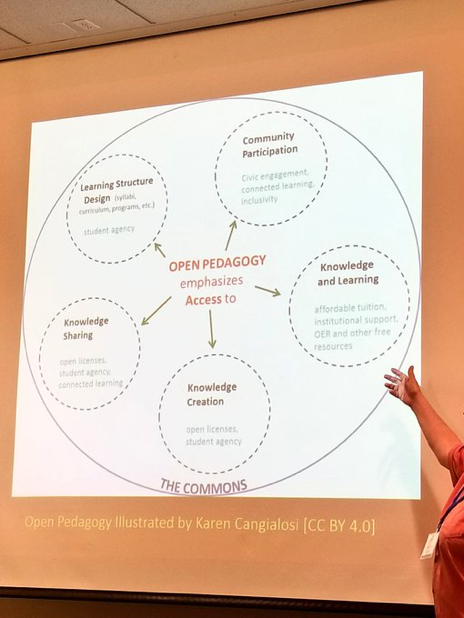
One of Karen’s central claims was that access and agency should be at the core of our work with our students and that the open education movement should refocus academic work on the commons. In the illustration above, Karen emphasizes student agency through course design, knowledge creation, and connected learning, as well as connected learning, community participation, and inclusivity.

The use of Open Educational Resources (OER)—and the practices of Open Pedagogy—connects academic labor to the wider public and in turn improves access to education. Teaching and learning in the open is about connecting students to a larger world and to making the process of education more transparent and accessible. With roots in critical pedagogy, open pedagogy values students constructing their own learning process; and, as another colleague writes, practitioners of open pedagogy seek to empower students “while actively critiquing and confronting the industrial and corporate approach of co-opting and packaging ‘teaching technology’ to turn students into consumers.” Instead, teachers and students build ways to leverage the Open web for discovery, creativity and analysis, as well as dialogue with the wider public.

Karen’s advocacy work is part of an ecology of open pedagogy that is to my mind one of the ways ASLE can expand its circle. What are the opportunities for members of ASLE to further its commitments to sharing and contributing knowledge, the public humanities, service learning projects, creating and displaying public art, and engaging our students with local environmental problems? The first answer to that question is gathering the ongoing work that exemplifies the activities already unfolding in what I might call here the ASLE ecology of open.

Open education takes many forms. Below are a few examples of work already happening in ASLE that I hope will expand the scope of our charts: creating OERs; building project sites for education, research, and public engagement; creating course sites on the open web to promote digital identity, fluency, and citizenship.

Creating OERs This can be on OER Commons  or OpenStax, by using an open-source publishing platform like Press Books, or engaging with the Rebus Community whose members believe that educational materials for every subject should be a free and open public resource. One example of this kind of work is a resource that my colleague at Plymouth State University created (with her students) The Open Anthology of Early American Literature

 Building Project Sites

Ecoarttech is a faculty project site by ASLE members Leila Nadir and Cary Peppermint

Play the LA River is a project and collaboration that includes ASLE Member Alison Caruth

The Laboratory for Environmental Narrative Strategies is a project at UCLA

Dawnland Voices features indigenous writing from New England and the Northeast and is edited and curated by ASLE Member Siobhan Senier

Digital Thoreau English professor Paul Schatz’s project at SUNY Geneseo

The Disability History Museum My colleague in the department of history at Keene State College is responsible for developing education curricula and has developed materials with undergraduate students

NICHE: Network in Canadian History & Environment / Nouvelle initiative canadienne en histoire de l’environnement is a Canadian-based confederation of researchers and educators who work at the intersection of nature and history. We explore the historical context of environmental matters and communicate our findings to researchers, policymakers, and the public.

Sustainable Play Brad Rassler’s project for long-form storytelling at the confluence of people, planet, and play.

Petrofictionary is a mode of archiving words and concepts that assist in the study of petrofiction: literary figurations of petroleum, the most important energy source of the twentieth and (so far) twenty-first centuries. The Petrofictionary was created as a collaborative project by the students in English 7087: Petrofictions, at Memorial University of Newfoundland, and edited by Amy Donovan under the guidance of Dr. Fiona Polack. It is intended as an archive, a tool, and a source of both information and inspiration as we consider the wide-reaching implications of petroleum culture and speculate about new modes of human existence after oil.

Domain of One’s Own projects have taken hold at many colleges and universities. The KSCopen.org project, to take one example, emphasizes digital identity, digital fluency and digital citizenship. Some examples of course and project sites at KSCopen.org, including advocacy sites such as NH Science for Citizens, student project sites such as my Far Field Learning Lab

Course Sites

The Open Space of Democracy is an open learning site (as opposed to a course built in a learning management system like Canvas).

Writing in an Endangered World  is a course in which student blogs are syndicated to the main site. All of the student writing appears on the course site as well as the individual student sites. The student blogs and the course Project blogs/web sites are listed in the post It’s a Wrap.  For example, one student created the Nature In A Quarter Hour Podcast offers a series of reflections (and an interview) based in the field of environmentalism and it’s literary contributions

COPLAC Digital team-taught Distance Learning Seminars with students from more than one institution. For example, I team-taught a course Public Access and the Liberal Arts with a faculty member at Truman State University with students from multiple campuses

Selected Definitions and Resources Karen Cangialosi, has compiled an excellent Open Pedagogy Learning Community Resource List. And most colleges and universities (most often library-based resources) have FAQs about Open Educational Resources (OER). At Keene State College, for example, we have an Open Educational Resources page. The Open Educational Resources page on the Keene State College web site has a useful list of links More About OER.

Open Education Consortium A worldwide community of hundreds of higher education institutions and associated organizations committed to advancing open education.

SPARC: Open Education SPARC believes that Open Educational Resources (OER) maximize the power of the Internet to improve teaching and learning, and increase access to education.

Creative Commons: Education The Education program at Creative Commons works to maximize the benefits of open educational resources (OER) and the return on investment in publicly funded education and research programs.

The Academic Commons Provides serves as a platform/tool that institutions and organizations can use to share their own and learn from each other’s work in an open, collaborative way.”

OER Mythbusting Myths about OER can stop people from using them and causing real educational change. The goal of this publication is to dispel those myths.

Once again, the question of the opportunities: where do we go from here? I will report back with any news as the work of the digital strategies committee takes shape in what I hope will be student and faculty collaborations within, across, and outside our courses, colleges and universities, and communities.
Days in the Open

I am becoming increasingly aware of a conversation that I did not know I was a part of. Or perhaps it is that I am finding my way through what I am doing to a conversation. And I am thinking of the “unending conversation” Kenneth Burke describes in his 1941 book The Philosophy of Literary Form:

Imagine that you enter a parlor. You come late. When you arrive, others have long preceded you, and they are engaged in a heated discussion, a discussion too heated for them to pause and tell you exactly what it is about. In fact, the discussion had already begun long before any of them got there, so that no one present is qualified to retrace for you all the steps that had gone before. You listen for a while, until you decide that you have caught the tenor of the argument; then you put in your oar. Someone answers; you answer him; another comes to your defense; another aligns himself against you, to either the embarrassment or gratification of your opponent, depending upon the quality of your ally’s assistance. However, the discussion is interminable. The hour grows late, you must depart. And you do depart, with the discussion still vigorously in progress.

The conversation is about teaching and learning. Although the quaint parlor I am asked to imagine is now a stream of thought made possible by digital networks.

51fpky2zjsl-_sx336_bo1204203200_After a conversation about openness and education the other day with my friends and colleagues Jenny and Karen, for some reason a book on my shelf caught my eye—a collection of essays by Doug Robinson, A Night on the Ground, A Day in the Open. As it happens, Doug’s writings from the 1970s include “Running the Talus,” an essay that was profoundly inspiring for a young man exploring the valleys and high peaks of California’s Sierra Nevada.

(Cover art: Lake Basin the High Sierra, Color Woodblock Print, Chiura Obata, 1930)


But Doug’s words bring back more than just adrenaline-fueled days in the mountains before this twenty-something mountaineer headed off to try school—those hundreds of peaks climbed, twenty-pitch days on a granite wall, day-long trans-Sierra runs, high mountain traverses, deep powder days, and backcountry ski descents.

2

In the mid 1990s I became interested in more visible (open?) teaching and learning. Reading a Report published by the Modern Language Association published the year I completed graduate school, making-faculty-work-visible , led to a series of attempts to come to terms with the surprising ways that academic disciplines diminish the value of teaching and pedagogy. I presented three talks on making teaching and learning more visible: in 2001 in New Orleans, “Pedagogy in the Public Domain,” in Chicago, “Open Pedagogy and the Public,” and in New York, “Narratives from the First Year: a Plea for Visibility.”

img_0960

Looking back, I see myself groping toward an understanding of (and a mild impatience with) teaching as a mostly privatized practice. When I returned from a sabbatical in India, these interests emerged in my scholarship, specifically in an essay I wrote as a guest editor to a special issue of the  journal Pedagogy, Centers and Peripheries, and in my teaching, as I began experimenting with opening up my classroom. Inspired by my friend and collaborator Sean Meehan, notably his dynamic teaching blog Comp|Post, I put my course syllabi and materials on the open-source platform Word Press.

As a result, all of the writing in my courses was visible. Everyone—the writer, the teacher, the classmates, and anyone else who might be interested—had access to the intellectual work of a college professor and students in the classroom. Sean also helped me to see a course not only as open, but also as an ongoing project. Each course would frame the core questions and problems that arise in the study of what I was teaching. The course process—the materials, my teaching, student learning, and the writing they produce—would be visible for anyone who might be interested. Students could see what their peers were doing. And the materials the students were producing would persist.

I began teaching differently in the open as well. I found myself writing on the course blog before class sessions, preparing myself for my time with students, thinking aloud and modeling for students forms of thinking and writing I want them to do. Following class sessions, I was writing as well—reflecting on the intellectual work of the students, making new connections, and openly processing my way to the next class session.

This pedagogical emphasis on process—and on sustaining thought so that students have the time to struggle through the process of formulating and developing their thinking—led me to us more sustained intellectual projects that allow students to experiment with writing conventions while developing (and claiming) their emerging voice. Students were reading books in my classes, as always—the real books that need to be read and that I was trained to teach. But students were also reading on web-based portals, repositories, and archives. My students were making use of web-based resources, from writing guides and handbooks to digital archives, such as Calisphere, the Walt Whitman Archive, the Digital Public Library of America (DPLA), NICHE: Network in Canadian History & Environment / Nouvelle initiative canadienne en histoire de l’environnement.


3

I drove down the Freeway
And turned off at an exit
And went along a highway
Til it came to a sideroad
Drove up the sideroad
Til it turned to a dirt road
Full of bumps, and stopped.
Walked up a trail
But the trail got rough
And it faded away—
Out in the open,
Everywhere to go.

—Gary Snyder, from Left Out in the Rain

In 2010 I wrote Professors, Students, Blogs that described my use of blogs for teaching. In addition to Sean, I was inspired by a former colleague who keeps one of the most consistently interesting blogs on planet earth, Hoarded Ordinaries. Lorianne inspired me to use a blog in the way I am right now: making visible my intellectual work professing at a public liberal arts college.

img_1007And I was learning from my students. One day a graduate student stopped by my office to ask whether she might not write an essay in my American poetry class. She wanted to create a hypertext reading of a poem called “Piute Creek.” This was fifteen years ago and I did not really know what she was proposing. But without hesitation I said yes. What she made was powerful. Her work has stayed with me, though the site was built on a server that is no longer there. Another of my students, working on an individualized major in Writing in Biology, made a blog called Creative Biology. And a student doing an independent study called “The Ecology of the New England Garden” captured some of what she was doing on the blog Regional Roots.

In the spring of 2013 I wrote a blog post called Digital Compost to make visible some of the emergent technologies and their uses in literary and cultural studies. More and more, I was directing students to digital archives and repositories to access primary documents. I was sharing what was rapidly becoming available with my students who are studying at a public college that had not been able to provide access to these kinds of materials.

img_0834More and more I am spending my days in the open. My writing course Searching for Wildness was the first course that I designed to persist as an ongoing intellectual project. The course is organized around texts, questions, ideas, and histories, as all good humanities courses are. But the course is open and active. Each group of students who signs up for the class is contributing to an ongoing cultural project of understanding and making meaning.

Out in the open. Everywhere to go.

4

This past spring I designed and taught an interdisciplinary American Studies course on the natural and cultural history of California. California Dreaming focused on the natural and cultural history of California. I asked students to explore a simple question that becomes more and more interesting as you think with it: What explains California?

I borrowed the question from the journalist Phillip L. Fradkin’s book The Seven States of California: A Natural and Human History. Each student was asked to design and implement a project on the natural and cultural history of California. They were asked, first, to connect their own interests to materials in archives and on the web. Second, they organized their primary materials into that would help to explain California. They wrote essays, created Word Press, Tumblr, Wix, or other web-based sites to describe the primary materials they had gathered as a body of work–describing the objects and artifacts, making connections, and telling a story that expands and deepens our understanding of the natural and /or cultural history of California.

mcl-mammothThe students explored California through places and bioregions, individual histories and collective narratives of identity and culture, ideals, and representations. Students explored the historical myth and material reality of the Golden State through indigenous cultures and narratives of exploration; waves of immigration and demographic change; the presence of racism and multicultural history and identity; water, orange groves, and agribusiness; cities and suburbia; political corruption and capital crimes; money and Hollywood moguls; technological booms and busts; film, fiction, and fashion; popular music and poetry; sex, drugs, rock and roll; narratives of self-actualization and alienation; the emergence of surfing and skateboarding; skiing, mountaineering, and rock climbing; television, sports, and celebrity culture.

Their research projects—their answers to the question, “What is California?”—offers evidence of the generative intellectual work that is possible in the open, even in a first-year college course.

5

This summer I spent a week in Asheville, North Carolina at a course development workshop in preparation for co-teaching a multi-campus, team-taught, distance seminar in digital scholarship with professor of English Cole Woodcox from Truman State University.

img_0824

Public Access and the Liberal Arts: A Narrative History, or NAPLA, is funded by the Council of Public Liberal Arts (COPLAC), with support from the Executive Director of COPLAC, William Spellman. The course idea emerged a year earlier in a COPLAC Digital Humanities Workshop at the University of Mary Washington that brought together faculty from Keene State College, Sonoma State, University of Montevallo, USC Aiken, Midwestern State, and Truman State to design distance-learning, digital humanities courses.

img_0836Our digital humanities project is documenting the emergence of the public liberal arts. Similar to the Story Corps project started in 2003, the course is about digital storytelling and the narratives of selected COPLAC institutions. Students are capturing the stories and life experiences of students, alumni, staff and faculty, and constructing a digital resource that captures the history and the prospects of the public liberal arts. As designers and editors of the digital archives, students are deepening their own sense of place in higher education and making visible the history of the liberal arts at the institution in which they are studying.

img_0837Our primary course objective is for teams enrolled at COPLAC campuses to research and represent the histories of their local campus. The context for this research will be the 1944 G.I. Bill and public access to higher education and, later, increased public access to liberal arts education. The objectives of the course are to 1) build an online archive of oral histories by alumni, faculty, staff and current students; 2) use digital tools to produce a layered, web-based narrative that includes audio and video stories, images, maps and documentary evidence of their home campus and 3) collaborate with faculty mentors to integrate their web site projects with a main COPLAC site to make visible the story of the public liberal arts. Our vision for this public storytelling project is to offer a digital resource for current students, alumni, educators, administrators, development and admission offices, historians, archivists, and the public in general.

img_0833

Interested in knowing more? Visit the NAPLA Course Site to check in on the action. I’ll also be sharing more here as we get further along in the course.