It began with a conversation. Jason wanted to talk over a new environmental literature course at Phillips Exeter Academy, and Mark, at the time the president of ASLE, was hoping to create new opportunities for secondary educators in our association. Two years later, twenty-five elementary and secondary school faculty gathered for the inaugural Environmental Literature Institute (ELI) at Phillips Exeter Academy in Exeter, New Hampshire. Participants from Hawaii, California, New Mexico, Georgia, New York, Vermont, New Hampshire, and Toronto, Canada, spent a week in New Hampshire developing new courses and revising curriculum for a range of secondary school settings.
We welcomed as keynote speaker and workshop leader Scott Russell Sanders, who spent a year at Phillips Exeter in 1974-75 as a Bennett Fellow. And throughout the week we were guided by the generous spirit of the late Exeter Instructor Peter Greer—whose course Literature and the Land was among the earliest environmental literature courses to be taught at the secondary school level.
Scott Russell Sanders meets with ELI participants
Each day began with morning physical and reflective activities, including walking and running, yoga, and mountain biking. Participants then circled at the Harkness table to discuss writing by Robin Wall Kimmerer, Gary Paul Nabhan, Richard Wright, Robert Frost, and Marc Bekoff; participated in daily field sessions with the workshop leaders; and took advantage of time set aside for course and curriculum building.
The week included a series of special events as well. Scott Russell Sanders’ presented “Taking Care of Home: Sustainability on a Small Planet.” We discussed Climate change pedagogy via Skype with Stephen Siperstein, who will be joining the faculty of Choate Rosemary Hall next year. We enjoyed an evening with John Elder reading, playing music, and discussing his newest book, Picking up the Flute, at the Water Street Bookstore. And Jennifer Pharr Davis, author and 2012 National Geographic Adventurer of the Year, shared some of her experiences walking over 12,000 miles on six different continents.
ELI gathered at the big Harkness table on the top floor of Phillips Hall
Participants considered a range of interdisciplinary and field-based pedagogies. Master teachers Scott and John shared their experiences and provided mentoring—both in the classroom and in a writing and poetry discussion at a local biodynamic farm. Clare Walker Leslie guided participants in the art of seeing nature through drawing—in the classroom, out of doors on the campus, and in the open fields of the Colby Farm. And Patrick Thomas from Milkweed Editions offered an insider’s view of the interplay between writing and publishing. ELI concluded with the participants sharing their work in progress: revised units for existing courses, new course ideas, and aspirations for interdisciplinary collaborations.
Sketching in the field at Colby Farm with the inimitable Claire Walker Leslie
ELI is committed to developing a teacher collaborative committed to developing environmental humanities at the secondary level. Our vision is to share the resources of ASLE with secondary school colleagues as well as to share the wisdom, resources, and pedagogical methods of our secondary school teachers with the members of ASLE who teach in post-secondary schools.
Jason Bremiller (Phillips Exeter), John Elder (Middlebury College), and Soctt Russell Sanders (Indiana University)
Among the goals of the 2014 ASLE strategic plan is to improve public discourse about the environment through community-based, K-12, and undergraduate programs. To this end, members of ELI received two-year memberships to ASLE, a collection of resources from Milkweed Editions, and a subscription to Orion magazine. We have also set up in the ASLE Member Community a Chatter forum designed to share resources and materials among secondary educators working in the environmental humanities. We are considering a workshop at ASLE 2017 featuring ELI alumni. And we are talking about a mentoring network for secondary school teachers as we plan for ELI 2017.
Because the literary fiction and nonfiction that I study and teach is concerned with environmental systems, the primary questions about literary production and reception that have kept professors of English busy for nearly one hundred years have become, for me at least, inextricable from complicated economic, social, and cultural activities. Though as Gregory Bateson once pointed out, our failure to relate to natural systems and processes is a product of the way we think and talk. We need alternative patterns of thinking and talking about natural and human systems, and we need new ways to teach these alternative patterns.
At the recent conference on ecocultural ethics in Goa, India, I found myself on a featured panel dedicated to the question of ecological learning. One way to define ecological learning would be to draw on Timothy Morton’s elaboration of what he calls the “ecological thought”: “The ecological crisis we face is so obvious that it become easy. . .to join the dots and see that everything is interconnected. This is the ecological thought. And the more we consider it, the more the world opens up.” As he goes on to argue, though, the ecological thought
“brings to light aspects of our existence that have remained unconscious for a long time; we don’t like to recall them”
“is about considering others, in their interests, in how we should act toward them, and in their very being”
“forces us to invent ways of being together that don’t depend on self interest”
This language reminds me of John Muir, in 1911, saying in My First Summer in the Sierra, that“when we try to pick out anything by itself, we find it hitched to everything else in the Universe.” Ecological learning, then, to stumble toward a more abstract formulation, is learning about what Muir call “things” and then finding that things are only really things when connected to other things.
Fisheries biologist Aaron Salvio Lobo speaking at the session on “Ecological Learning” at the Birla Institute of Technology and Science, Goa, India
It is difficult to study and teach Rachel Carson’s Silent Spring, for instance, without addressing basic science as well as questions about science and society; there is little doubt that reading in the literature of food or animal studies without addressing the application of rapidly evolving technology would be next to impossible; and there is no question that narratives of environmental justice raise pressing moral and ethical questions by tracing the life-world consequences of rapid developments in science and technology.
These were some of the thoughts I was having as I prepared for the panel discussion in Goa. The discussion was moderated by Dr. Samhida Shikha, from Dronacharya Government College Gurgaon, and included a fisheries biologist, Aaron Salvio Lobo, an expert on waste management, Dr. Srikanth Mutnuri, a professor of ethics who teaches at a school of mining, Dr. Ajit K. Behura and an architect, environmental educator, activist, and blogger from the capital city of Panjim, Tallulah D’Silva, whose work has been recognized in the World Economic Forum’s Global Shapers Community. The audience for our session on ecological learning included members of the humanities and social sciences, from literary and cultural studies, anthropology, philosophy, religious studies, linguistics and political science.
Another lovely cove and stretch of sand on the Arabian Sea
My contribution to the panel began with an anecdote about arriving in Mumbai at the beginning of this month to meet Rebecca, who had been teaching law in Pune. Gandhi Jayanti, the national holiday, was in full swing, and Prime Minister Modi happened to be using the occasion to kick off his Swachh Bharat Campaign. What followed were days of editorial and public commentary in the Times and in Goa periodicals and online about the clean India campaign. In Goa, one headline read “Desi tourists leave behind uncivil footprints,” and the it-is-the-other-guy’s-problem excuse was once again registered. “Calangute and Baga beaches witness trail of broken bottles and garbage: visibility upset, Calangute MLA Michael Lobo has accused the tourism department of not being serious enough to tackle the problem.” Remarkably, I noted, one person from out of state when interviewed complained of the lack of warning or display boards regarding the disposal of trash and bottles on the beach. “I don’t see a single warning signboard so it is no use blaming us tourists.” Enough said.
I then offered a case study of Keep America Beautiful (founded 1953), the largest community improvement organization in the United States, that was formed in response to the problem of highway litter that followed the construction of the Interstate Highway System and an increasingly mobile and convenience-oriented American consumer in the middle decades of the twentieth century. I traced the Keep America Beautiful organization joining with the Ad Council in 1961; the subsequent 1971Earth Day theme, “People Start Pollution. People can stop it,” featuring the well-known (and problematic) “Crying Indian” campaign launched on Earth Day, narrated by actor William Conrad, and featuring “Iron Eyes Cody,” the Native American man (who was actually an Italian) devastated to see the destruction of the earth’s natural beauty caused by the thoughtless pollution and litter of a modern society). In 1975 the “Clean Community System” led to the “Keep My Town Beautiful” organization and the more recent “Great American Cleanup” campaigns that have organized 3.9 million volunteers who have removed seventy-six million pounds of litter and recycled hundreds of millions of pounds of metals, newsprint, tires and electronics.
While noting the fundamental historical and cultural differences with the Modi campaign, I admitted that the anecdote offered some hope for those who are rightly cynical of centralized campaigns for “cleanliness” linked to patriotism and political parties. Still, the narrative from the 1950s to the present in the US offers a complex of motivations and investments that contributed to changing the behavior of people as part of a social movement. The question I posed is how academic disciplines and institutions of higher education prepare students to participate throughout their lives in the practice of what the panel was calling ecological learning.
Our lovely friends, thoughtful colleagues and generous hosts in Goa, Rayson Alex and Susan Deborah
Listening to my colleagues, and participating in the lively audience give and take that followed in the hour we had reserved for discussion, I realized how challenging it is to free ourselves from the terminological moraines. These jumbled piles of words and phrases make it difficult to enact the necessary changes in teaching and learning that would be commensurate with the environmental predicament. What was refreshing for me was that the discussion with my Indian colleagues unfolded without the use of any of the terms so common in the discourse of American academics, terms such as “interdisciplinary,” “multidisciplinary,” “transdisciplinary.” Rather, my Indian friends and colleagues were focused on practice. They were talking about thereal work.
Rhetorical and social engineering in the park, Panjim, Goa
Since arriving back in the United States this panel discussion has stayed with me. And I have been thinking more about the terms we use to define what we do and that we deploy to stake out our place in the enterprise of higher education. It is my good fortune to be a member of a faculty that offers courses, minors and degree programs in what we call “interdisciplinary fields of study.” These include American Studies, Criminal Justice Studies, Environmental Studies, Holocaust and Genocide Studies, Women’s and Gender Studies. Over the years, I have taught courses in three of these “fields” (American Studies, Environmental Studies, Women’s and Gender Studies) and have given much thought to the approaches taken to the various subjects, materials, and topics within these fields.
The self-evident fact that knowledge about our selves and the world, to use the commonplace jargon often used academic circles, is “constructed” often devolves into abstract and decontextualized conversations about the knowledge and methods of academic disciplines or “interdisciplinary” fields of study or “multidisciplinary” modes of teaching and learning. The consequence is that the questions that structure the intellectual work in our colleges and universities (for professors and for students) become less salient or, arguably, less relevant—particularly in public discourse where facts are bound to be uncertain, values are disputed, and the stakes are high.
I am most grateful to my colleagues in India for helping me to think though my own evolving approach to the study, teaching, and learning as a literary and cultural historian. The term that appears most aligned with my practice as a thinker and teacher is “transdisciplinarity.” A sabbatical leave offers the necessary time and space to reflect on one’s ongoing work as a reader, writer and teacher. And among the most fruitful set of ideas for my reflections this year has been the thinking of Basarab Nicolescu—in particular, his Manifesto of Transdisciplinarity, trans K. Claire Voss (Albany: State University of New York Press, 2002). A useful précis of the manifesto is available in the “Charter of Transdisciplinarity” that has its origins in the First World Congress of Transdisciplinarity convened in 1994 in Convento da Arrábida, Portugal. The document, produced by the editorial committee comprised of Lima de Freitas, Edgar Morin, and Basarab Nicolescu, has 15 articles, as well as a Preamble, that reads as follows:
· Whereas, the present proliferation of academic and nonacademic disciplines is leading to an exponential increase of knowledge which makes a global view of the human being impossible;
· Whereas, only a form of intelligence capable of grasping the cosmic dimension of the present conflicts is able to confront the complexity of our world and the present challenge of the spiritual and material self-destruction of the human species;
· Whereas, life on earth is seriously threatened by the triumph of a techno-science that obeys only the terrible logic of efficacy of efficacy’s sake;
· Whereas, the present rupture between increasingly quantitative knowledge and increasingly impoverished inner identity is leading to the rise of a new brand of obscurantism with incalculable social and personal consequences;
· Whereas, an historically unprecedented growth of knowledge is increasing the inequality between those who have and those who do not, thus engendering increasing inequality within and between the different nations of our planet;
· Whereas, at the same time, hope is the counterpart of all the afore-mentioned challenges, a hope that this extraordinary development of knowledge could eventually lead to an evolution not unlike the development of primates into human beings;
One cannot help but admire the ambitious and hopeful language of this manifesto. My admiration, however, is precisely how the language links the abstractions of knowledge production to the material (and ideological) planetary concerns of the present. What is really remarkable, though, is that this heady rhetoric allows for both a generative acceptance and skepticism about knowledge and power, a finely aware register of social and environmental equity and justice, and an inclusive acceptance of the human in the words “cosmic” and “spiritual.” Just how these ideas might shape one’s day-to-day work is a challenge to be sure. But the challenge might help to put the words we use to describe teaching and learning in our colleges and universities to more consequential work—words such as “integrative,” “interdisciplinary,” and “multidisciplinarity—by envisioning a transformation of both our knowledge-seeking methods and the institutions that sponsor our ongoing search.
This was my ambition in India, after all: to imagine with my colleagues practical projects for individual and collaborative inquiry that would in turn expand the scope of conventional pedagogical theory and practice. Perhaps a moratorium on any word that builds off the term “discipline” would offer a glimpse of something more.
Let’s just say your professional title is Professor of English and American Studies, and you happen to have been elected President of the Association for the Study of Literature and Environment (ASLE-US), and you are invited to deliver the Keynote Address at the International Conference on Ecocultural Ethics: Recent Trends and Future Directions, sponsored by the Department of Humanities and Social Sciences, at the Birla Institute of Technology and Science in Goa, India. Perhaps, in addition to your address, “The Ecological Arts: Humanities, Technology, Science,” you would be invited to be part of a featured conference session on ecological learning with a fisheries biologist, a philosopher of science, a community activist, and an expert on wastewater treatment. And let’s say you also chair a session called “Representations of Land and Animals,” and spend your days on campus meeting with research scholars from universities across India to discuss their work in the environmental humanities. How would you approach your visit?
On the dais with professor K. E. Raman, Director of BITS Pilani Goa at the inaugural ceremony, with professor Meenakshi Raman, Dr. Reena Cheruvaleth, and Dr. Rayson K. AlexIf your goal in India was to share with your Indian colleagues recent trends and future directions in ecocriticism and the environmental humanities, you might feature your own project, or talk about methodological or theoretical trends. However if your focus was not on intellectual or theoretical discourse then you might zero in on institutions—and the pressing need for us to work together to change them. In fact you might float the title, “The Ecological Arts,” and use the term ecology to bring together the humanities, sciences, and technology. Then you would lay out your key terms and then connect those key terms to a way of thinking about education before sharing your own efforts, and those of ASLE-US colleagues, who are transforming their intellectual work, disciplines and institutions. Hey, you might even conclude that our current intellectual work, our academic disciplines and institutions, struggle to honor this basic point and that we need to work together to transform our work, and the work of our students, as we meet the new challenges of a rapidly changing world.
Professor Mark with young research scholars from Central University in Pondicherry
So that is what I did. I explained to my audience that one of my projects as the current president of ASLE-US has been designing and building a web site to strengthen how our members share resources, collaborate, as well as engage audiences beyond the academy—from community groups and national organizations to journalists. As part of this work, we have reached out to dozens of our members, and have compiled an archive of video, audio and text commentaries that chronicle the histories and activities of ecocriticism and the environmental humanities. The web site includes an archive of member perspectives on ecocriticism and the environmental humanities delivered for academic audiences. Currently the archive includes University of California Los Angeles professor Ursula Heise’s assessment of the environmental humanities in her 2014 “American Comparative Literature Association’s State of the Field Report”; University of Wisconsin professor Rob Nixon’s keynote address at the Utrecht Edward Said Memorial Conference in 2013 that explores convergences between colonial oppression and ecological degradation, the unequal distribution of environmental resources and risks and conditions of environmental injustice; the University of Texas’s Stacy Alaimo’s primer on science studies and the environmental humanities. The archive has an essay by Julianne Lutz Warren, Senior Scholar at the Center for Humans and Nature, on “Generativity,” and a conversation with Iain MacCalman, professor at the Sydney Environment Institute, in Australia, about the necessary transformation of our intellectual work in the humanities and social sciences in the “anthropocene.” These member perspectives, I concluded, are all pointing to the historical and ethical imperative to transform our intellectual work to address the complicated and complex environmental questions we are facing today.
“The true artist, like the true scientist, is a researcher using materials and techniques to dig into the truth and meaning of the world in which he himself lives. . . .”
-Paul Strand, Letter to the editor of the Photographic Journal 103.7 (1963): 216.
Sixty years ago, in June of 1955, an international symposium on the relationship between the human and the earth was organized by the Wenner Gren Foundation for Historical Research in Anthropology. Convened in Princeton, New Jersey, “Man’s Role in the Changing Face of the Earth” honored George Perkins Marsh’s 1864 book Man and Nature. The symposium brought together seventy participants to further, in the words of the Wenner-Green Foundation President Paul Frejos, an understanding of the human and the earth “by synthesis, transcending the limits of present disciplines or branches of science” (vii). The conference participants, in fact, were chosen not to represent academic disciplines; and, as the symposium unfolded, in the words of one of the organizers, Marston Bates, “less and less was said in defense or in support of a particular disciplinary association” (1132).
Post-monsoon rains in the afternoon near the central coast of Goa, India
One of the conveners of the symposium, Carl O. Sauer, professor of Geography at the University of California, Berkeley, raised the present and future condition of the earth as a principal ethical concern. In the words of Marston Bates, a professor of Zoology at the University of Michigan, and also a co-convener of the symposium, “What sort of world is it that we want, and can we get it?” (1134). In his summary remarks on the proceedings, Bates insisted, “the sciences and the humanities form a false dichotomy, because science is one of the humanities” (1139). The third principal organizers of the symposium, Lewis Mumford, reminded the participants that “within the limits of earth’s resources and man’s biological nature, there are as many different possible futures as there are ideals, systems of values, goals and plans, and social, political, educational, and religious organizations for bringing about their realization” (1150).
Forests and rice fields between the coast and the interior, central Goa, India
In linking ideals and systems of values to collective organizations and institutions, Mumford suggests a direction for one of my primary fields of work, ecocriticism and the environmental humanities. In preparing a keynote address that I delivered in Goa, India, this month I found myself reading in the two-volume proceedings of the International Symposium edited by William L. Thomas, Jr. in collaboration with the principal organizers of the symposium, Carl O. Sauer, Marston Bates, and Lewis Mumford, a historian, philosopher and literary critic. The Princeton Symposium reminded me of the challenges we face when ideals and systems of values run up against less agile organizations and institutions.
With colleagues and friends on an afternoon outing in Goa
Since at least the publication of David Orr’s important 1990 book Ecological Literacy: Education and the Transition to a Postmodern World, those of us who work in the environmental humanities have been aware of how individual research agendas and narrow professional incentives do not directly address ecological literacy or sustainability. Orr makes a case that our individual work as research scholars will and should continue. But he is convinced that this work holds less promise in addressing the global predicament of environmental crisis. In essays with titles such as “The Problem of Education,” “What is Education For?” and “Place and Pedagogy,” Orr argues that our current ecological crisis is associated with a failure of education. We face a moral and the ethical obligation, he concludes, to rethink our professional activities as well as to transform the institutions where we work.
View from the guest house, BITS Pilani Goa
Why is this rethinking so difficult to do? In my recent keynote address at the Birla Institute of Technology Pilani Goa, I suggested to the international gathering that we need more activism within our places of work, as new kinds of interdependence are increasingly a feature of our educational institutions. In the United States, for example, professors and students are designing and implementing curricular models that emphasize collaboration across disciplines and fields of study—from applied and problem-based learning to service learning initiatives and projects involving students, teachers, and local citizens or community groups. In Goa, I encouraged my audience to imagine new ways to integrate ecological, ethical and social contexts in the work of the humanities. I called on the words of a colleague, and former president of ASLE, Ursula Heise, who argues that the environmental humanities by definition “seeks to respond to the call for new institutional formations to correspond to innovative kinds of knowledge. . . [and] also to translate humanistic research more effectively into the public sphere” (“Comparative”). And yet I cautioned that transformations of academic programs and institutions requires valuing this work—among our peers, in our disciplinary associations, as well as in faculty promotion and retention standards. For it is easy to say that our activities are constituted in socially constructed systems, and that our activities can reconstitute those very systems. It is much more difficult to do.
In preparing my remarks for BITS Pilani Goa, I learned that the Birla Institute was founded by the industrialist Ghanshyam Das Birla who voiced a broad and progressive approach to education. “What do we propose to do here?” he asked. “We want to teach real science, whether it is engineering, chemistry, humanities, physics or any other branch.” The next generation of the Birlas speak in similar language. Here is Basant Kumar Birla echoing the same educational ethos. “For a rich and full life, interest and involvement in Fine Arts, Music, Literature, Social, Cultural and Spiritual activities are essential.” And Dr. Sarala Birla, the wife of Basant Kumar—and daughter of activist and writer Brijlal Biyani—Education is a meaningless ritual, unless it moulds the character of students and imparts in them a strong sense of values.”
In my keynote that opened the conference I asked the hundreds of participants to consider recent trends and future directions in “ecocultural ethics” as intellectual work in our shared study of environmental issues and problems. I shared a few examples of innovative collaborations with students, academic colleagues and community-based groups: faculty and students conducting research together, often by taking the campus or local community as a site for the inquiry (a pedagogical model, by the way, that responds well to the call for surveys of employers and business leaders—in the US and in The Times of India that I read in Mumbai—for the human skills of thinking well, communicating effectively, collaborating, and persuasion; programs, centers, and institutes in which faculty are working on projects not limited by disciplinary, methodological or epistemological differences; and technology initiatives designed to build resources for academics, journalists, and the members of the public.
Dinner following the conference on the edge of the Arabian Sea
We then talked, in the discussion period and throughout the conference, about comparable projects and initiatives in India. One of the research scholars was inspired by my talk and invited tribal people to the BITS campus for his presentation. And later, during an evening out with colleagues, I learned more about the generative work of one of the conference organizers (who is collaborating with my English colleague Rayson Alex on the natural and cultural history of a bird sanctuary near Panjim) Solano Jose Savio Da Silva, who works in Development Studies and Political Science.
Among the ways college professors stay alive is by swimming in the current with their intellectual peers. Meaningful exchange with students and colleagues beyond one’s home institution strengthens one’s scholarship and teaching. And it contributes to a more productive institutional culture. In fact, a good deal of my scholarship and teaching has its origins in these intellectual streams of thought; and in this post I trace some of my intellectual activities beyond Keene State College during the 2010-11 academic year.
Wall mural in Cincinnati by Rosalind Tallmadge, et alia
On Sunday I returned from a week in Bloomington, Indiana, at the biennial conference of the Association for the Study of Literature and the Environment (ASLE). The week began along the Ohio River, in Cincinnati, with my friend, colleague and collaborator, John Tallmadge, whose book The Cincinnati Arch had prepared me for this look-and-see tour of the city.
Author and Mentor, Collaborator and Friend, John Tallmadge, on a tour of Cincinnati
When we arrived in Bloomington I made may way to the ASLE Executive Council meeting. No longer a member of the Council, I do try to attend these meetings as a program coordinator. Sitting in reminded me of the ongoing collaborative efforts that have built and sustain this organization. Our organization has grown in size, to 1400 members, and in breadth, with members from 41 countries and with 24 affiliations with scholarly groups both in and outside of the United States. The close to 800 participants seemed a natural fit with the Brobdingnagian scale of the Bloomington campus. The buildings are enormous, and the campus spreads far and wide. The grey-white Indiana limestone buildings, some of which date back to the late nineteenth century, loom over the Dunn Woods, the Arboretum, and the rather Lilliputian Jordan River. The wooded areas on campus are littered with downed trunks and limbs from a storm on May 25th that took down over 300 trees across this nearly 2,000 acre campus.
Art Museum at Indiana University
I kicked off the week co-facilitating (with John Tallmadge, Rochelle Johnson, Tom Hillard and Sarah Jaquette Ray) a pre-conference workshop “Staying Alive: A Workshop for Academic Professionals.” ASLE’s tradition of mentoring graduate students and building community has evolved to include the Staying Alive Project, a vision that includes building mentoring relationships with one another across all phases and dimensions of academic life. The workshop that John and I offered at Wofford College in Spartanburg, South Carolina in 2007 and in Victoria, British Columia in 2009 seeks to initiative honest conversations about the challenges and rewards of academic life. During the conference, as the coordinator of the ASLE Mentoring Program, I also organized mentoring meetings between graduate students and faculty members outside their home departments; and talked with other members of the organization about ways to promote international scholarly exchanges in the field of literature and environment.
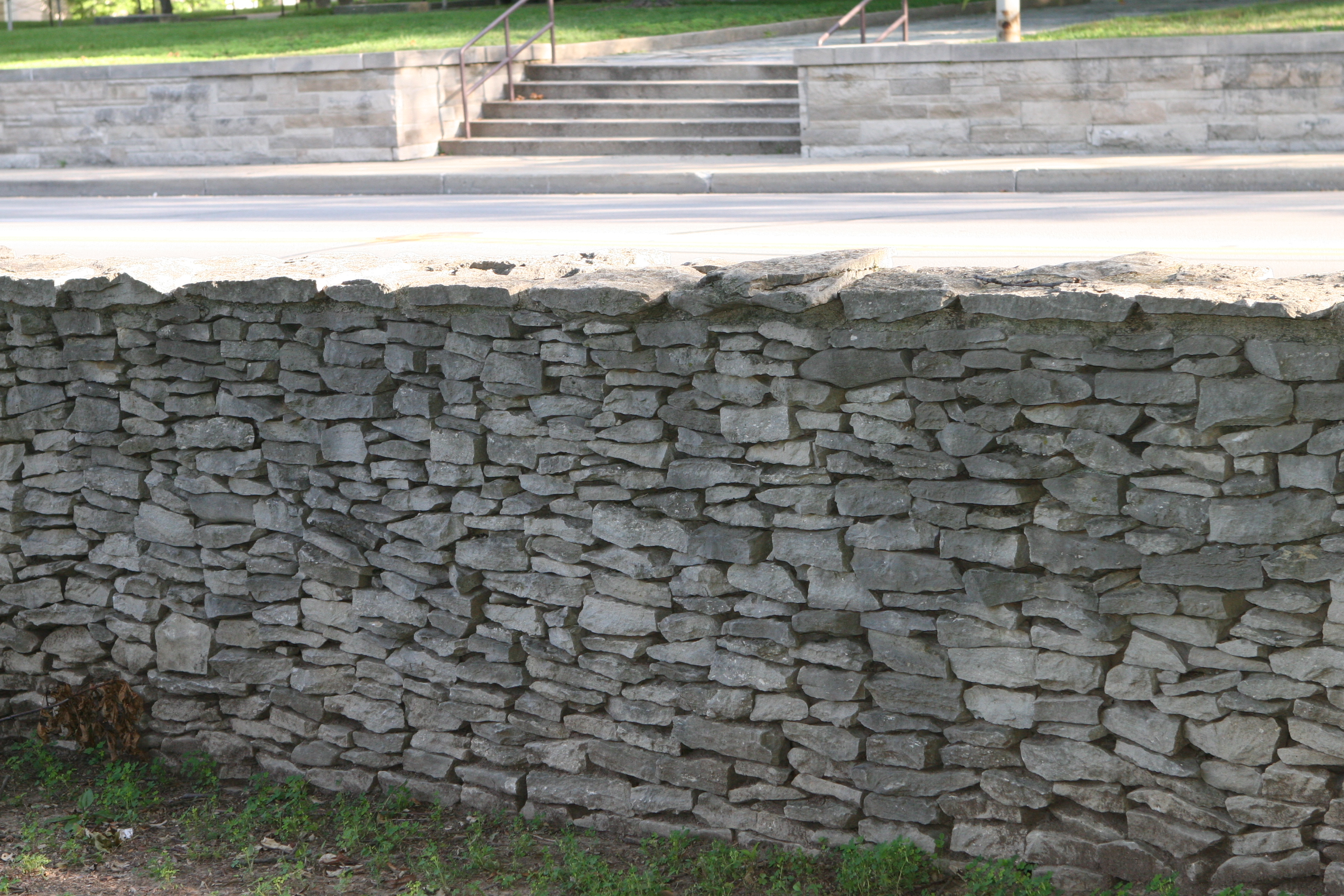
“Something there is that doesn’t love a wall. . . .” near the Wells Library on the campus of Indiana University
During my week in Bloomington I found myself preoccupied with getting right the argument I had been trying to pin down in the presentation I would give on Saturday, “Frames of Rejection: Frames of Acceptance: Environmentalism in the Classroom” on the panel “Green Without Guilt: Pedagogy and Scholarship for Teaching Environmentalism in the Disciplines.” But most of the week had me moving from session to session, absorbing and discussing ideas, as well as attending plenary sessions by Una Chaudhuri (professor of English, Drama and Environmental Studies at New York University), Helen Tiffin (recently retired professor of English at the University of Tasmania), Zakes Mda (poet, novelist and critic from South Africa), Robert L. Fischman (professor of Law at Indiana University), Marc Bekoff (professor emeritus of Ecology and Evolutionary Biology, University of Colorado) and Rubén Martínez (professor of Literature and Writing at Loyola Marymount University in Los Angeles). I also attended an evening reading and performance, Wilderness Plots, that began as a book, by Soctt Russell Sanders, of brief tales of the settlement of the Ohio Valley between the American Revolution and the Civil War. The spirited evening performance by Sanders, and musicians Timm Grimm, Krista Detor, Carrie Newcomer, Tom Roznowski and Michael White, was recorded for Indiana Public Television. There were also two receptions honoring senior colleagues in our field: for Lawrence Buell, who is retiring from the English department at Harvard University, and for John Felstiner, from the department of English at Stanford. I list these names and performances to suggest the tributaries that feed into the mainstream intellectual work of the organization. At the same time, I am suggesting the ways that an intensive week of intellectual exchange with students and colleagues feeds my teaching, scholarship and service at Keene State College.
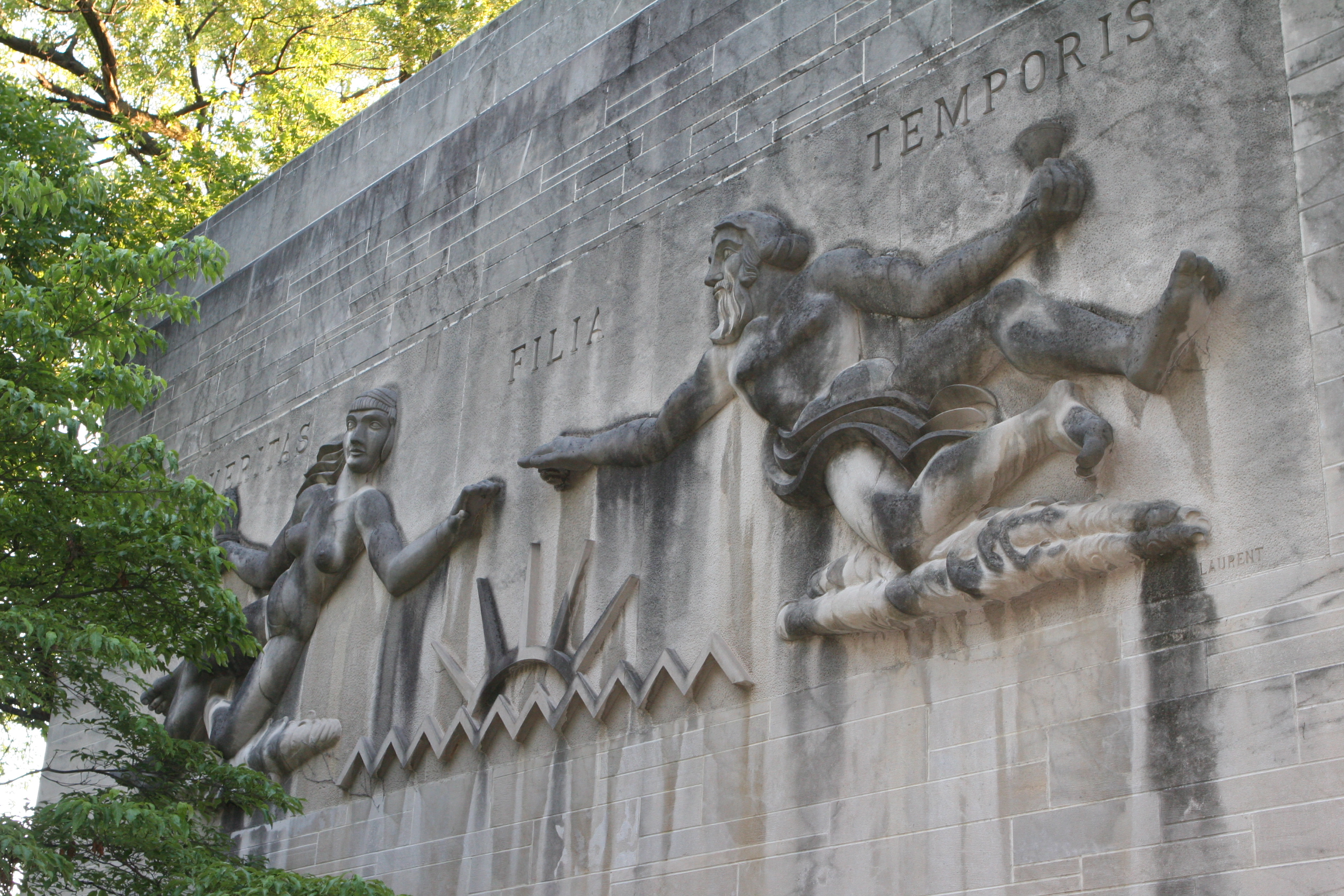
“Truth is the Daughter of Time,” aphorism and and relief, west wall of Ballantine Hall, Indiana University
Our panel on Saturday afternoon was well attended. I talked about my upper-level undergraduate elective designed to help students understand the social movement we call environmentalism, as well as explore the ways environmental concern shapes the development of a genre of writing. Using Kenneth Burke’s writings from the 1930s to reflect on my course, I offered an overview of the kick-ass books we read: Rachel Carson’s Silent Spring, Gary Snyder’s Turtle Island, Masanobu Fukuoka’s The One Straw Revolution: An Introduction to Natural Farming, Edward Abbey’s The Monkey Wrench Gang, Wendell Berry’s The Unsettling of America: Culture and Agriculture, Linda Hogan’s Solar Storms, Snyder’s The Practice of the Wild, Terry Tempest Williams’ Refuge and T. C. Boyle’s The Tortilla Curtain. I argued essentially that environmentalism needs environmental literature. But not to affirm the environmentalist agenda. Nor to pursue its agenda by other means. Rather my conviction is that environmental literature, like most literature worth reading, should remind us that genuine thinking is less dogmatic and more provisional, less universal and more situated, less earnest and more alive. Environmental literature should encourage us to re-imagine how we think the environment—even as, in some cases, those books are working with the inherently reductive language and discourse of environmentalism.
American Literature Association, Boston, Massachusetts
In late May I spent a day at the annual American Literature Association Conference in Boston. In addition to attending discussions of the work of the nineteenth century American authors Ralph Waldo Emerson and Henry Wadsworth Longfellow, I chaired a session I organized called “American Literature and the Ecological Thought” framed around recent theoretical work by Timothy Morton, professor of English at the University of California Davis, and author of Ecology without Nature (2007) and The Ecological Thought (2010). Cathleen Rowley, from Stony Brook University, presented “An Ecological Reading of Hawthorne’s House of the Seven Gables,” Amy Campion, University of Minnesota, presented “John Cheever and the Ecological Thought,” and Heather Houser, University of Texas at Austin, presented “Visualize or Describe? The Contemporary Novel, Visualization and Environmentality.”
Emerson was right. . . . books are for a Scholar’s idle times
Modern Language Association Convention, Los Angeles, California
In January I traveled to the Modern Language Association convention in Los Angeles, California, where I presided at the session I have been organizing for a number of years, “Teaching in the Small College Department,” an annual event sponsored by the Association of the Departments of English. I centered the 2011 small college session on the small college department and the curriculum. The central question I asked the panelists to address was how small college departments are (re)configuring the English major, designing courses and doing collaborative work around courses in the major or in the general studies curriculum, especially in light of the mission of smaller institutions—as well as in relation to the profession-wide conversation about the English major, for instance, in the 2008 Report of the Teagle Foundation on the Undergraduate Major in Language and Literature.
In smaller institutions and departments, faculty and students routinely work together in collaborative and cooperative endeavors. And the session suggested that much of this work is devoted to rethinking the English major. It is not surprising that faculty in smaller settings have been generating innovative ways of thinking about English, as the 2003 special issue of the ADE Bulletin on “The English Major” demonstrated. The faculty in small college departments, focused primarily on their mission of undergraduate education, tend to be more broadly involved in teaching at levels of the curriculum, and hence are more able to create opportunities to rethink and refashion the undergraduate major in English. The 2011 session features faculty from institutions that are part of the Council on Public Liberal Arts Colleges, COPLAC, a consortium of colleges seeking to offer high-quality, public liberal arts educations.
Lunch at the Runcible Spoon, Bloomington, Indiana
Washington College, Chestertown, Maryland
In the fall of 2010 I spent two days at Washington College in Chestertown, Maryland, where I was invited to present the annual Sophie Kerr Lecture and to lead a college conversation for faculty on writing and the curriculum. My Kerr Lecture and slide presentation, co-sponsored by the Center for Environment and Society, was entitled “John Muir and the Mountains of California: Prospects for Environmental Thinking and Writing.”
My first talk on writing was a standing-room-only workshop for faculty in the Global Research and Writing Seminar Program called “Thinking, Writing and Research in the Undergraduate Writing Classroom: A Case for Sustained Writing Projects.” I also presented a college-wide workshop for faculty and students, “Thinking about the Values of Writing.”
One of many opportunities for cultural exegesis in the scholarly stream
The Natural History of Reading, University of Washington, Seattle, Washington
The 2010-11 academic year began for me in June of 2010 when I traveled to the University of Washington to speak at an undergraduate honors conference at the University of Washington. Seattle entitled “The Natural History of Reading.” The conference, organized by Leroy Searle under the auspices of the Simpson Humanities Center, was the culminating event in a course designed to examine the activity of reading as an essential component of learning and inquiry. The course and conference began with the historical tropes pertaining to ‘The Book’—or, as Leroy framed it, “the Book of God, the Book of Nature, and the productions of Man”—in literature, philosophy, and science, art, photography, and architecture. Students read The Bible (King James version), The Qu’ran (Abdullah Jusuf Ali translation), Gerald Holton: Thematic Origins of Scientific Thought, James Gleick: Genius: The Life and Science of Richard Feynman, Lee Smollin: The Trouble with Physics, Charles Sanders Peirce: The Essential Peirce, vol 1, William Blake: Complete Poetry and Prose and William Faulkner: Light in August. They also discussed Plato, the Phaedrus, Johannes Kepler, The Six-Sided Snowflake, Samuel Taylor Coleridge, selections from Biographia Literaria and The Friend, Louis Sullivan, Selections from Autobiography of an Idea and Kindergarten Chats and Nathan Lyons, Selections from Photographers on Photography.
I was one of three invited speakers whose work on the activity of reading would contribute to this course of inquiry. Each of the undergraduate students presented a talk at the conference and there were social events to continue the conversations that emerged in the academic session. My talk, “The Problem of Reading, the Practice of Writing,” began with a theoretical question: what is the relationship between reading and writing? As I reminded the audience of undergraduates, graduate students and professors, the problem with asking this question is that most responses immediately call on a set of commonplaces about the practice of teaching writing in school. For students in primary and secondary grades are to be introduced to the practice of writing mostly through routine tasks that promote mastery of a discrete skill set; college undergraduates are asked to produce essays, for the most part, that demonstrate whether or not they have a working understanding of course content; graduate students produce readings of books that apply ready-made protocols to generate arguments as a quantitative measure for professional advancement; and professors, having internalized the imperative to publish, produce reams of writing that very few people have reason to read. (The situation, as I explained, is a perfect case of what the critic Kenneth Burke once called the beauracratization of the imaginative—a phrase, as he put it, as bungling as the situation it seeks to describe.) I then when on to talk about how at most colleges and universities our first-year students therefore find themselves writing essays with little to no intellectual investment; how their teachers find themselves reading essays that no one should ever be asked to read; and how most tenure-stream faculty have abandoned the first-year course while quietly ignoring the working conditions of the contingent faculty they hire to teach it. Is there a better way? My essay drew on my own study of theories of reading and writing as well as the pedagogical experiment underway at Keene State College with the first year course. My argument was that when students are actually thinking and writing, the activity of reading becomes, quite naturally, a central intellectual activity in the course. My essay was later published in the fall in the conference proceedings, The Natural History of Reading.