Browse Category

Teaching and Learning

The Small College Department

For ten years the journal Pedagogy: Critical Approaches to Teaching Literature, Language, Composition, and Culture has distinguished itself as the only profession-wide journal devoted exclusively to teaching in English studies. The journal, founded by Marcy Taylor and Jennifer Holberg, has sustained a professional conversation around teaching and the scholarship produced around it. A winner of the 2001 Best New Journal Award from the Council of Editors of Learned Journals, Pedagogy is celebrating its tenth anniversary.

My work on the journal includes writing book reviews, an essay and since 2005 serving an associate editor of the journal. As associate editor, I am responsible for the book review section in our three issues published each year. I serve as a liaison with book publishers, recruit reviewers, edit individual and roundtable reviews, and work with the authors of longer “Forum” essays by senior teachers.

The Spring 2010 special issue of Pedagogy

My most recent contribution to Pedagogy, and to the profession-wide conversation about teaching, is a special issue dedicated to the small college department. As guest editor for the spring 2010 issue I asked ten contributors to foreground the ways the small college departments generate conditions for innovative pedagogy, curriculum development, and the integration of the professional activities of reading, writing and teaching. In my Guest Editor’s Introduction, “Centers and Peripheries,” I introduce the two goals of the special issue: to investigate what might be possible in the small college department as well as to suggest how these possibilities might inspire comparable intellectual work in other professional and institutional contexts. Because the current traditional conception of the discipline has rendered a great deal of the intellectual work of the profession invisible, I contend, we need to talk more about what our colleagues are actually doing outside the doctorate-granting institution. My claim is that representing more fully what we do will help us to move beyond general claims for teaching as a form of scholarship and away from de-contextualized arguments about the value of teaching.

Since graduate school I have been surprised by the parochial discourse of the profession that situates the so-called research institution at the center of intellectual production, value and prestige. Over the years, I have tried to bring people together to talk about the ways we devalue significant intellectual work and to make visible the a more complex system of postsecondary education made up of four-year liberal arts colleges, comprehensive universities, two-year colleges, community colleges, and public and private colleges and universities.  As an assistant professor I was fortunate  to find at the annual Modern Language Association (MLA) convention colleagues interested in making visible forms of intellectual work in small college departments. After presenting on issues in small college departments for a couple of years, I began organizing and chairing the annual session sponsored by the Association of Departments of English (ADE). At the 2005 convention in Washington, D.C., the session “Graduate Education and the Small College Department” I invited graduate directors from research institutions (U of Wisconsin, Rutgers U, U of Pittsburgh) and small-college faculty (Marywood U, U of the Pacific, and Cornell College). And in 2006, in Philadelphia, I focused the session on the procedures and criteria for tenure and promotion in the small college department. And in 2009 we considered criteria and requirements for earning tenure—specifically how these criteria may have changed or be changing, whether changes (and what changes) would seem more productive and more counter-productive, and how institutional conditions and complexities determine the work of promotion and tenure committees. Have the requirements for publication for tenure and promotion changed in institutions over the past ten years? How do small-college departments define productivity and growth in scholarship and related professional activity? How do small-college departments value scholarship beyond the standard peer-reviewed journals or monograph? How does the apparently necessary specialization in graduate school prepare graduate students for positions where the publication of a monograph is not the requirement for tenure?

My inquiry into the conditions for teaching and learning in small college departments led to an invitation  to write a featured “Commentary,” “Where Do You Teach?”, for the fall 2005 issue of Pedagogy and an essay, “Reading, Writing and Teaching in Context” in the book Academic Cultures: Professional Preparation and the Teaching Life (MLA 2008). In both of these essays I consider the debilitating representation of faculty work in terms of research and teaching as separate activities. My argument is that this pervasive subplot in the narrative of the profession is rooted in a representation of faculty work that transcends the local institution and the ways that departments and institutions define intellectual work.

The special issue of Pedagogy dedicated to the small college department is a culmination of many years of work. My hope is that the professional conversation about our intellectual work will continue and that our special issue will inspire others to explore what  it means to be primarily a teacher in a community of writing and scholarly exchange.

A Grant from the NEH

The course I described in my last posting, “Writing in an Endangered World,” engaged students with the social movement of environmentalism and new forms of environmental writing. This course was the culmination of many years of scholarly work—both outside and within the classroom—a process I outlined in the inaugural issue of Keene State College’s Arts & Humanities News (Spring 2010). “Writing in an Endangered World,” however, is more than a culmination: it is a starting point for a new project supported by a generous two-year grant I received from the National Endowment for the Humanities (NEH).

Charles Darwin, from Notebook B (1837)

The grant proposal, approved last month, will support development of an upper-level humanities course in the Integrative Studies Program (ISP). My course will survey changing concepts of nature from the ancient world to the age of Darwin. Students will read a sequence of major texts from the Western tradition alongside religious and scientific documents to understand the broad contours of thinking about the natural world in the Western cultures of Europe, as well as in the Eastern cultures of China and India, and the Arab-World and Africa. Thinking across intellectual traditions will empower students to think comparatively and to understand the dynamics of intertextual and intercultural exchange.

As it is currently envisioned,“What is Nature” will be organized around a sequence of primary texts with supplemental excerpts from treatises, letters, and books of poetry. Students will consider multiple genres of writing, including myth, scientific treatises, and narrative, poetry, in which the question of nature arises, as well as discuss illustrations and diagrams that represent human understandings of the natural world. Readings will include creation stories, including the Maidu Myths, a cycle of tribal creation stories in Western North America; the Hebrew Bible, with emphasis on Genesis and the Psalms; selected  hymns from the Indian Brahmanical or Vedic scripture, the Rig Veda, and selections from the Sanskrit verses of Kālidāsa and Dharmakīrti; relevant selections from the Chinese Huai-nan Tzu; Hesiod’s Theogony, and the dialogues of Plato. Students will be introduced to Aristotle’s thinking about the world of nature and read his writing in conjunction with selected dialogues of Plato,specifically the Timaeus and Laws; students will then trace the reception and development of ideas about nature in two narrative poems that influenced thinking about nature through the Middle Ages and the Renaissance. The first, Lucretius’ De rerum natura (On the Nature of Things), an epic poem written in the middle of the first century BC, contrasts the Epicurian view of nature (and man) with the three major Aritstotelian classifications of the physical world; the second, Ovid’s Metamorphosis, describes the creation and history of the world, and its elaborate mythologies express ideas about nature that inspired imaginative writing by such authors as Dante, Chaucer, Shakespeare, and Milton.

Carl Von Linne, Titelseite von Linnés Manuskript Praeludia Sponsaliorum Plantarum (1729)

The Roman astronomer Claudius Ptolemy’s argument in the Almagest—that the earth was the center of the universe, and that the sun, planets, and stars revolved around it—will offer students an intellectual context in which to situate the key treatises—and illustrations—that make visible the Copernican system that would replace the Ptolemaic world view. Students will consider sixteenth and seventeenth century views of nature in the writings of Newton, Bacon’s Novum Organum (The New Organon; or, True Directions Concerning the Interpretation of Nature) and Descartes, whose Discourse on Method will help students understand the mechanistic view of nature and method of scientific inquiry. The Enlightenment’s vision of science and the mid-eighteenth century will be represented by the Swedish botanist Carl Linnaeus, whose Systema Naturae introduced a classification system that divided living things into two kingdoms (plants and animals), classes, orders, genera, and species, and that led to subsequent ambitions to create a comprehensive taxonomy that would include everything known about the natural world; and the debate about natural degeneracy in the New World in the writings of the French naturalist Georges-Louis Leclerc, Comte de Buffon and Thomas Jefferson.

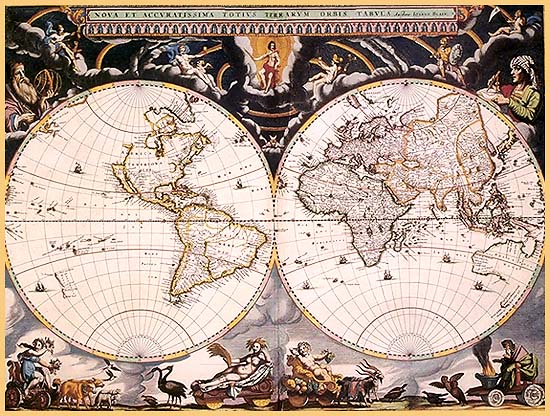
Americae sive qvartae orbis partis nova et exactissima description, by Diego Gvtiero Philippi (1554-1569), from the Rosenwald Collection, Library of Congress

The final unit in the course will be organized around Darwin’s seminal nineteenth century writings. Students will read passages from the narratives in The Voyage of the Beagle (1839), study the argument of his most well-known book On the Origin of Species (1859), and examine his illustrations and journal notes. This segment of the course will introduce students to scientific ideas about nature (and the human) in a broad humanistic framework that will include selections from the German and Romantic poets Frederich Schiller, Frederich Hölderlin, William Blake, William Wordsworth; the natural history writers Gilbert White, William Bartram, Ralph Waldo Emerson and Henry David Thoreau; and the naturalists Alexander von Humboldt and George Perkins Marsh.

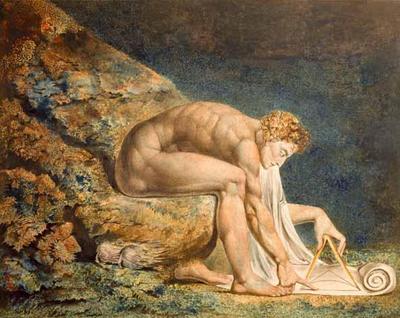
William Blake, “Newton” (1795)

The opportunity to develop and teach a pre-disciplinary course with a broad historical scope will extend my ongoing inquiry into experiences and concepts of nature from the perspective of the humanities. It will allow me to return to my doctoral dissertation on theories of inquiry, focused on American intellectual history, that was informed by readings in European literary traditions, philosophy, and the history of science, especially the nineteenth-century writings of the logician and scientist Charles Sanders Peirce, who offers insights into how normal science is practiced, how scientific discoveries come about, and the process that produces paradigm shifts in communities of inquiry that will inform my ways of teaching students how concepts of nature have evolved and changed.

I’m deeply grateful to the National Endowment for supporting this work—work that will begin this summer and continue through the 2011-12 academic year when I will be teaching the course.

The Real Work

“Knowing that nothing need be done, is where we begin to move from”

-Gary Snyder, “Four Changes,” Turtle Island (1974)

Refuse bin, Mahabalipuram, India, February 2008

How do we address the social needs and demands of an economy, the natural constraints of ecology and the political imperatives of democracy? How do we think about the environment in historical, political, historical, sociological, economic, technological, and moral terms? And how do we reconcile the democratic freedoms at home with the imperialism abroad that feeds the greed for resources to feed our insatiable consumer economy? These complicated questions—at the center of the social movement (and discourse) we have come to call environmentalism—have motivated a range of writers whose cultural work begins with the paradox that the scientific, industrial and technological advances of the modern world have inexorably created an ecological catastrophe of massive proportions.

This semester I’m teaching a course in American and Environmental Studies that takes up these questions. Our focus is

US Forest Service campaign to prevent fire

environmental writing and its relationship to the discourse of environmentalism. I’m interested in the ethical claims of environmentalism as a framework for considering how writers (and writer-activists) seek to foster reflection and transformation of personal assumptions and attitudes, beliefs and behavior. My course, “Writing in an Endangered World,” is an interdisciplinary course and therefore designed to address program outcomes in Environmental Studies (critical thinking and problem solving skills, communication skills, skills associated with moral and character development, an understanding of the ethical implications of environmental issues) as well as in American Studies (understanding historical and contemporary American cultures, responding resourcefully to texts, integrating forms of scholarship from more than one discipline, and the ability to write an effective documented essay that includes a thesis that integrates interdisciplinary approaches). To these ends, the course makes visible the assumptions, frameworks, and methods of the disciplines that study natural and human history, the relationship between ecological and human systems, and the history and values of environmental engagement in North America during the 20th century. In addition to reading Ramachandra Guha, Environmentalism: A Global History, students are reading Rachel Carson, Silent Spring, Gary Snyder, Turtle Island, Edward Abbey, The Monkey Wrench Gang, Wendell Berry, The Unsettling of America: Culture and Agriculture, Linda Hogan, Solar Storms, Gary Snyder, The Practice of the Wild: Essays, Terry Tempest Williams, Refuge and T. C. Boyle The Tortilla Curtain. The course has also have considered the cultural presence of environmental concern in visual images, advertising campaigns, popular music, as well as other forms of cultural discourse.

The politics of environmental concern

I’m primarily interested in students thinking about how environmental writers use language as a primary vehicle for exploring the human prospect in an age of environmental crisis. Wendell Berry’s essays in The Unsettling of America, for example, ask students to consider the commonplaces that make possible our thinking about environmental questions. Berry enumerates the faults and contradictions of a system—call it what you will, capitalist, exploitative, free-market or global economy. Indeed Carson, Snyder, and Abbey all work from these commonplace ways of thinking. What makes this writing worth reading is that it moves beyond the limits of the language we make available to ourselves to address the problems we are being asked to think about. Imaginative writing takes many forms—including the writing we include in the genres of nonfiction, fiction, poetry. The language of this writing—its arguments, demonstrations, anecdotes and stories—serve as a counterpoint to what Wendell Berry calls our failure to reason about moral questions. “Public discourse of all kinds,” he insists in The Unsettling of America, “now tends to pattern itself either upon the arts of advertisement and propaganda (that is, the arts of persuasion without argument, which leads to reasonless and even unconscious acquiescence) or upon the allegedly objective or value-free demonstrations of science” (230). Berry’s claim about moral ignorance in The Unsettling of America is a provocation: a reminder that we are at once inheritors of a culture as well as stewards of that culture, and that the current state of the world is ultimately our responsibility. What do the current practices of agriculture, he asks, say about us? My case in the course is that Berry is not interested in the thinking that reinforces the opposition between saints and sinners (we are all both, he points out) or righteously pointing to the shortcomings or faults of someone else or some system or another. He is interested in the ways that we might move beyond thinking that begins “with a set of predetermining ideas” toward thinking that begins with “particular places, people, needs and desires” (233). He elaborates on this idea in chapter two, where he points to the problems of more ambitious institutional solutions that narrow and simplify as they propose particular actions or objectives.

Our focus on writing about particular places, people, needs and desires was enriched by a class visit by the writer Mark

Mark Kurlansky

Kurlansky. Mark was on campus for one of the spring Keene is Reading program events. (We had selected his book Cod: A Biography of the Fish That Changed the World and he was in town to give a talk at the Colonial Theater on the long and complex history of the cod fishing and the depleted fishing stocks and the people’s lives who are linked to the great fisheries of the North Atlantic.) He talked with the students about the work of a writer; and, given the focus of the course,  he addressed what it might mean to be a writer in an age of environmental concern. At one point he asked the students whether any of them had read Darwin. When he saw that none of the students had, he suggested that anyone interested in understanding contemporary environmental  problems could do no better than to read and consider what Darwin makes visible in his work. The teacher of the course (me!) could not have asked for a more timely and apposite recommendation.

Philadelphia and the MLA

Most every year I join thousands of professors and graduate students, independent scholars and writers, booksellers and editors for the annual pilgrimage to the Modern Language Association’s (MLA) Annual Convention. This year I arrived by train from New Haven, Connecticut, in Philadelphia, Pennsylvania, the site of the 2009 convention. My trip to the MLA this year was brief.  We have new horses at home, and my daughter E is competing in the Polar Bear ice hockey tournament in Shelton, Connecticut, and so I could only get away for a couple of days.

Soon after the train pulled into the 30th Street Station I hopped a cab to the hotel, printed out introductory remarks that I had revised on the train, and walked to the Marriot Hotel where I chaired a special session sponsored by the Association of the Departments of English on the small college department. I focused this year’s session on the criteria and requirements currently active in departments and institutions for earning tenure—specifically how these criteria may have changed or be changing, whether changes (and what changes) would seem more productive and more counter-productive, and how institutional conditions and complexities determine the work of promotion and tenure committees. A number of questions were addressed by the three panelists. Have the requirements for publication for tenure and promotion changed in institutions over the past ten years? How do small-college departments define productivity and growth in scholarship and related professional activity? How do small-college departments value scholarship beyond the standard peer-reviewed journals or monograph? How does the apparently necessary specialization in graduate school prepare graduate students for positions where the publication of a monograph is not the requirement for tenure?

My brief introductory remarks suggested that small departments have something important to add to the profession-wide conversation about scholarly activities and modes of publication (including digital). For many of our institutions have aligned standards for faculty evaluation with the mission, values and practices of our institution; abandoned the reductive conflation of scholarship with publication; revised our standards for promotion and tenure to reflect the intellectual work our faculty do; published standards for promotion and tenure are published and visible to junior faculty;  conduct faculty evaluation without depending upon the judgment of presses or outside evaluators; value teaching and service in both promotion and tenure reviews; and value collaborative intellectual work as a contribution to the profession as well as the to the public that supports our work. I argued that representing more fully what we do will require us to move beyond general claims for teaching as a form of scholarship and decontextualized arguments about the value of teaching. Instead, I suggested, we need to shift our focus to the local histories of institutions where we can learn what the profession is doing beyond our inevitably parochial point of view. My goal for the special session was to investigate what might be possible in the small college department as well as to suggest how these possibilities might inspire comparable intellectual work in other professional and institutional contexts. The speakers were Jeffry C. Davis, associate professor of English at Wheaton College, James M. Lang, associate professor in the English Department at Assumption College, and Ann Green, associate professor at Saint Joseph’s University. We were fortunate to have close to fifty people in the audience and a good question and answer period.

An evening watching ice hockey on the TV, a green curry Thai dinner, a good night’s sleep and a morning run though the cold and windy canyons of the city and along the icy shore of the Schuylkill river—then back to the convention hotel to help out as a job counselor for the MLA. In the afternoon, I joined David Lawrence, Steve Olson, Sheridan Blau, and John Ottenberg in a special session arranged by the MLA Office of Research called “Reading as a Teacher: a Workshop for Teachers of Literature.” We designed this session to explore a pragmatic question: Does reading to teach a work of literature call for forms of attention that are distinctive—ways of thinking and observing that differ from those we use as scholars or as readers generally? Elizabeth Bishop’s poem “The Moose” was to be the focus of the discussion. Before the workshop, participants were asked to read the poem as if they are preparing to teach it in either a lower-division undergraduate literature course taken chiefly by nonmajors or an upper-division course in twentieth-century American poetry taken mainly by English majors. (The poem is available online at the Web site of The Poetry Foundation.) We each offered brief introductory remarks and then we divided the room into small discussion groups of eight people. The organizing questions for the group included the following: What problems and possibilities for teaching and learning does Bishop’s “The Moose” offer? What challenges or difficulties follow from this poem’s way of doing what it does, whether for a student attempting to read it or for a teacher attempting to guide or enable students’ reading? Ostensibly, we were to conclude the workshop with thirty minutes of full-group discussion. But we really only had a few minutes to report on its discussion. My group, in fact, talked more generally about the idea of reading as a teacher and the assumptions of the workshop itself. We all agreed that the session was a good start; but we needed more time to address the interesting questions we had raised.

My friends and graduate student colleagues J and M were at the session and we went out for a nice Italian dinner. The three of us work together on the journal and it is always good to catch up in person. I was also fortunate to have a nice breakfast the following morning with my friend and graduate school advisor before catching the train back to New Haven where R picked me up and whisked me back to Shelton to watch the girls win another hockey game and qualify for the final day of games.

Teaching the Local

On November 4-6 Keene State College hosted the biennial World Affairs Symposium, “From Local to Global: A Centennial Symposium.” The 2009 Symposium examined issues raised by artists, educators, scholars, planners, and community leaders whose work deepens our understanding of the complex phenomena recognized as “globalization.” Programming and events explored the impact of “the global” on cultures, environments, economies, and identities defined as “local.” The Symposium was organized around a set of questions that included: How do perceptions of the global shape discourses of the local? When do localized discourses and cultural practices determine limits and definitions of global? Where do these concerns direct communication between people, especially within the praxis of teaching and learning? When does local knowledge become globalized? How can global information be localized?

My contribution to our sixth biennial symposium was “Teaching the Local in an Age of Globalization.” My goal was to bring together a panel of speakers whose teaching and writing has deepened our awareness of the natural and cultural systems of which we are a part.  I wanted to feature professors whose students have experiences outside the classroom (in the towns and cities and farmlands and forests near their colleges); whose courses emphasize interdisciplinary learning (integrating the study of literature and story with the study of history, nature, and science); and collaboration (with local residents, towns, and organizations).

The speakers I invited were Pavel Cenkl, of Sterling College, John Elder, of Middlebury College, John Harris, of Franklin Pierce University, and Kent Ryden, from the University of Southern Maine—all of whom have made notable contributions to the study of the nature and culture of New England. Pavel Cenkl is Dean of Academics at Sterling College in Craftsbury Common, Vermont where he also teaches courses in humanities and regional studies. He has recently organized two summer institutes focusing on the rural heritage of the Northeast. Pavel has published This Vast Book of Nature: Writing the Landscape of New Hampshire’s White Mountains, 1784-1911 and, more recently, edited the collection of essays, Nature and Culture in the Northern Forest: Region, Heritage, and Environment in the Rural Northeast. He lives on a steadily expanding homestead in Craftsbury with his wife and son. John Elder has taught English and Environmental Studies at Middlebury College since 1973, where he has taught courses in American nature writing, Romantic English poetry and contemporary American poetry of nature, Japan’s haiku tradition, and community-based courses that focus on the future of Vermont’s towns and farms.  John’s three most recent books have all combined discussion of literature, descriptions of the Vermont landscape, and personal memoir.  He and his wife Rita live in the Green Mountain village of Bristol and operate a sugarbush in the adjacent town of Starksboro with their grown children. Kent Ryden teaches in the American and New England Studies program at the University of Southern Maine, of which he was director for the past four years. Kent is the author of Mapping the Invisible Landscape:  Folklore, Writing, and the Sense of Place and Landscape with Figures: Nature and Culture in New England, as well as many articles and chapters on topics in ecocriticism, cultural geography, and regional literature. He has a Ph.D. in American Civilization from Brown University, and is a recipient of the American Studies Association’s Ralph Henry Gabriel Prize. And John R. Harris is Director of the Monadnock Institute of Nature, Place and Culture at Franklin Pierce University, and a faculty member in the Environmental Science and American Studies Departments.  His work on the study of place in the Monadnock Region has appeared in Where the Mountain Stands Alone (University Press of New England, 2007) and Teaching North American Environmental Literature (Modern Language Association, 2008). John and his wife Susie have lived with their three daughters in Westmoreland since 1985.


Pavel’s presentation focused on the Work-Learning-Service program at Sterling College and its emphasis on place and identity, The program’s emphasis on cultivating a sense of place provides opportunities to explore the global frameworks of local places. John elaborated on his interest in the global context of the local-food movement in New England. John described teaching a community-based course called “Farm Stories,” in which students read the literature of farming, interview, and work on stories about families who operate eleven farms near the Middlebury campus. He used both Virgil’s Georgics and recent farmers’ protests in Brussels relate the challenges of Vermont farmers to a global context. John also reported on organizing two conferences that speak to this topic: one in Middlebury on local food and culture in Vermont, Quebec, and France and one in Siena on local food and culture in New England and Tuscany.  Kent’s presentation focused on the cultural politics of place in Falmouth, Maine, asking which place-defining narratives get privileged, and why, and what the implications of that are. He also touched on how northern New England places have historically existed in a kind of economic and cultural “colonial” relation to southern New England. Finally, John Harris reflected on distinctive features of the New England identity over time and the strong sense of community he finds in our region through his discussions with local town residents around issues of town government, community size and the importance of celebrating communal history.