Mark C. Long. Upstream: Selected Essays. By Mary Oliver. New York: Penguin, 2016. Cloth. $26.00 and Felicity. By Mary Oliver. New York: Penguin, 2016. 81 pp. Cloth. $24.95. Published in ISLE: Interdisciplinary Studies in Literature and Environment (2017)
A child went forth in Mary Oliver’s new book of essays, Upstream. The child was alone in the woods. She was wandering upstream, away from difficulties, the “sorrow and mischance and rage” (14) around her that she felt deeply but was powerless to change. One day the little girl walked the wrong way, and was lost, but was “slopping along happily in the stream’s coolness. So maybe it was the right way after all,” Oliver surmises. “If this was lost, let us all be lost always. The beech leaves were just slipping their copper coats; pale green and quivering they arrived into the year. My heart opened, and opened again” (5). And, as this child went forth, her heart opened, and opened again, in the world of books. She read by day and into the night. She built bookshelves. She thought “about perfectibility, and deism, and adjectives, and clouds, and the foxes” (15). And she took solace in friendship among writers. “I never met any of my friends, of course, in a usual way—they were strangers, and lived only in their writings,” she admits. “But if they were only shadow-companions, still they were constant, and powerful, and amazing” (9), Oliver writes, in the essay, “My Friend Walt Whitman.” These writers, she admits, “changed the world” (9).
From these childhood experiences is fashioned a lesson to share, “that the world’s otherness is antidote to confusion, that standing within this otherness—the beauty and the mystery of the world, out in the fields or deep inside books—can re-dignify the worst-stung heart” (14-15). Drawing on the earlier collections Blue Pastures, Winter Hours, and Long Life, Oliver gathers essays on some of the writers who made a difference. She recalls the moral purpose of Emerson, who refused to turn away from the world; Wordsworth’s praise of both the beauty and the strangeness of the world; Poe’s rushing forward with the “wild courage of despair”; and Whitman’s unshakeable, egalitarian belief in an “existence in which man’s inner light is neither rare nor elite, but godly and common, and acknowledged” (100). For Oliver, the books of these authors are alive with extravagance and possibility, “the opinions, the rhapsodic persuasions, the engrafted logics, the clues that are to the mind of the reader the possible keys to his own self–quarrels, his own predicament” (68-69).
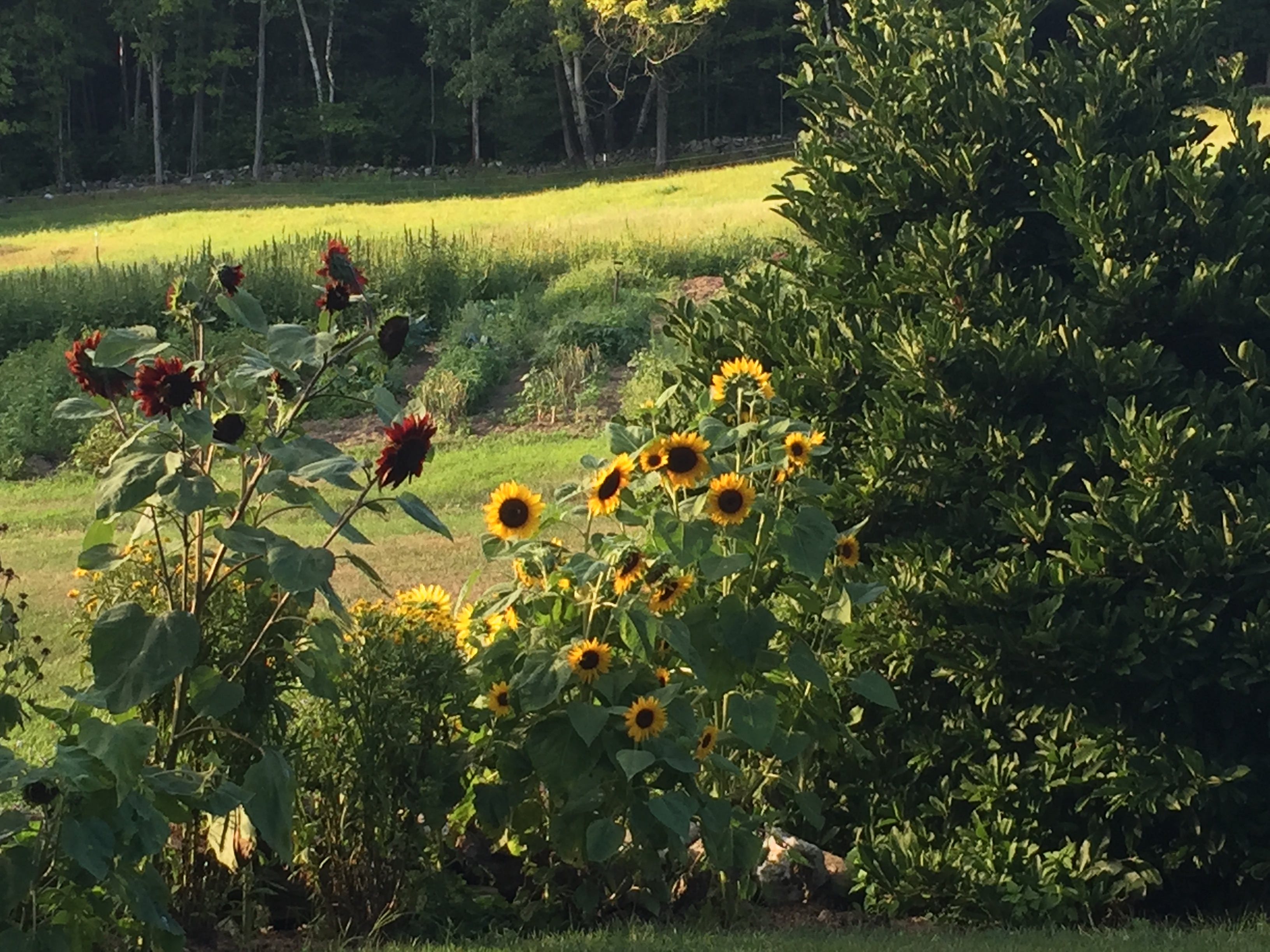
The poems collected in Felicity are songs of extravagance and possibility— and their opinions and persuasions have designs on the reader. The title of the first section, “The Journey,” and the epigraph from Rumi, “You broke the cage and flew,” suggest what will follow. In “The World I Live In,” Oliver writes, “I have refused to live / locked in the orderly house of / reasons and proofs. / The world I live in and believe in / is wider than that” (11). In “Leaves and Blossoms along the Way,” Oliver challenges her readers to live and believe in this wider world. “To understand many things you must reach out / of your own condition,” she insists (18). And in the final line of “Whistling Swans” Oliver explains to her readers her hope that in reaching out a person can become open to a world of possibilities beyond the self: “So listen to them and watch them, singing as they fly. / Take from it what you can” (29). These poems, like so many Oliver has shared with her readers over the years, offer invitations, or opportunities, to reach beyond the self, wherever one might happen to be.
The sequence of lyric poems in the second section of Felicity traces the “invisible / and powerful and uncontrollable /and beautiful and possibly even /unsuitable” experiences we call love. This section, entitled “Love,” opens with an epigraph from Rumi. “Someone who does not run / toward the allure of love / walks a road where nothing lives” (41). In the poem “The First Day,” Oliver recalls the “warm sting of possibility,” the opening of the heart, “the spreading warmth of joy” (45). In “No, I’d Never Been to This Country,” she acknowledges the risk and embraces the commitment we undertake in loving another person: “I didn’t know where the roads / would lead me. No, I didn’t intend to turn back” (49). A group of short poems celebrates a life moving along its journey and the discovery, in its unfolding, of abiding happiness. “Everything that was broken has / forgotten its brokenness,” she explains (61). And “Pond,” a sunny-summer-August-day poem, concludes with the lines, “All my life I have been able to feel this happiness, / except whatever was not happiness, / which I also remember. / Each of us wears a shadow” (67). The poems at once acknowledge the weight of our inescapable shadows, our “self-quarrels and predicaments,” and the beautiful and mysterious ways love enters into, and shapes, our lives.
Like much of Oliver’s work, Upstream and Felicity explore the challenges and opportunities we face amidst transformation and change. In the essay of gratitude that concludes Upstream, “Provincetown,” Oliver celebrates the “perfect sufficiency,” the sweetness and simplicity of the place she would call home for fifty years. At the same time, she describes “the terrible change,” the “slow but harsh” transformation of her beloved home. “The tourist business was in,” she adds, and the town “became a place to live for a while, and to spend money. Not so much in which to live a life” (174). What Oliver makes of these changes is neither bitter nor sentimental. “This town had to find another way to live,” she decides. “It was just, well, different” (175).
And so it goes—I guess. The world changes. You change. You make your way the best you can. You use the resources you have. What I can say, with more confidence, is that one of those resources, as these books once again remind us, is the writing of Mary Oliver.
Advance Access publication March 31, 2017doi:10.1093/isle/isx017 VC The Author(s) 2017. Published by Oxford University Press on behalf of the Association for the Study of Literature and Environment. All rights reserved. For Permissions, please email: journals.permissions@oup.com.
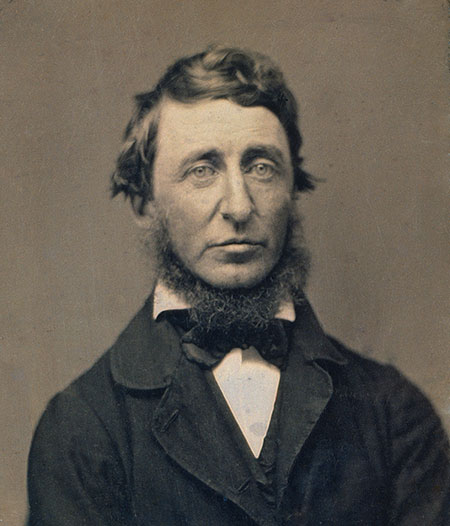
Today is the bicentennial of the birth of Henry David Thoreau. It is good to see Thoreau celebrations and stories of Thoreau in the news, including an exhibit at the Morgan This Ever New Self: Thoreau and his Journals. Happy birthday Henry!
Last week I picked up a copy of Laura Dassow Walls’ just released biography, Henry David Thoreau: A Life. I am now reading the chapter “Transcendental Apprentice,” that covers the years 1937-1841. Working for the past two years on a Emerson project has prepared me well for this delicious summer reading.
As it happens, about two weeks ago, I spent some time with Laura and friends in Detroit at the twenty-fifth anniversary conference of the Association for the Study of Literature and Environment. One evening we dropped in on the storefront of Shinola, where Laura and I shared a moment of pleasure when we ferreted out from an employee the origins of the phrase “shit from Shinola.” We then enjoyed pizza and beer on a deck at the Motor City Brewery, and took in music by the Mongrel Dogs, before huddling under two small bumbershoots with Jim and Julianne as we were thoroughly soaked on the way back to our hotels by a heaving Michigan downpour.
In the “Preface” to her biography, Laura writes that “Thoreau struggled all his life to find a voice that could be heard despite the din of cynicism and the babble of convention.” She then points to the strange but explainable story of Thoreau’s life that has set up shop in our cultural imaginary:
That he was a loving son, a devoted friend, a lively and charismatic presence who fill the room, laughed and danced, sand and teased and wept, should not have to be said. But astonishingly, it does, for some deformation of sensibility has brought Thoreau down to us in ice, chilled into a misanthrope, prickly with spines, isolated a hermit and a nag.
Reading Laura’s story about Thoreau’s life I am recognizing the Thoreau I have come to know as a devoted reader of his work–whether in reading and teaching the more widely circulated publications, or in my own saunters through the journals and manuscripts over the years. “Today, two hundred years after his birth,” Laura writes,
we have invented two Thoreau’s, both of them hermits, yet radically at odds with each other; one speaks for nature; the other for social justice. Yet the historical Thoreau was no hermit, and as Thoreau’s own record shows, his social activism and his defense of nature sprang from the same roots: he found society in nature, and nature he found everywhere, including the town center and the human heart.
As Ralph Waldo Emerson wrote in “Thoreau,” “The country knows not yet, or at least in part, how great a son it has lost.”
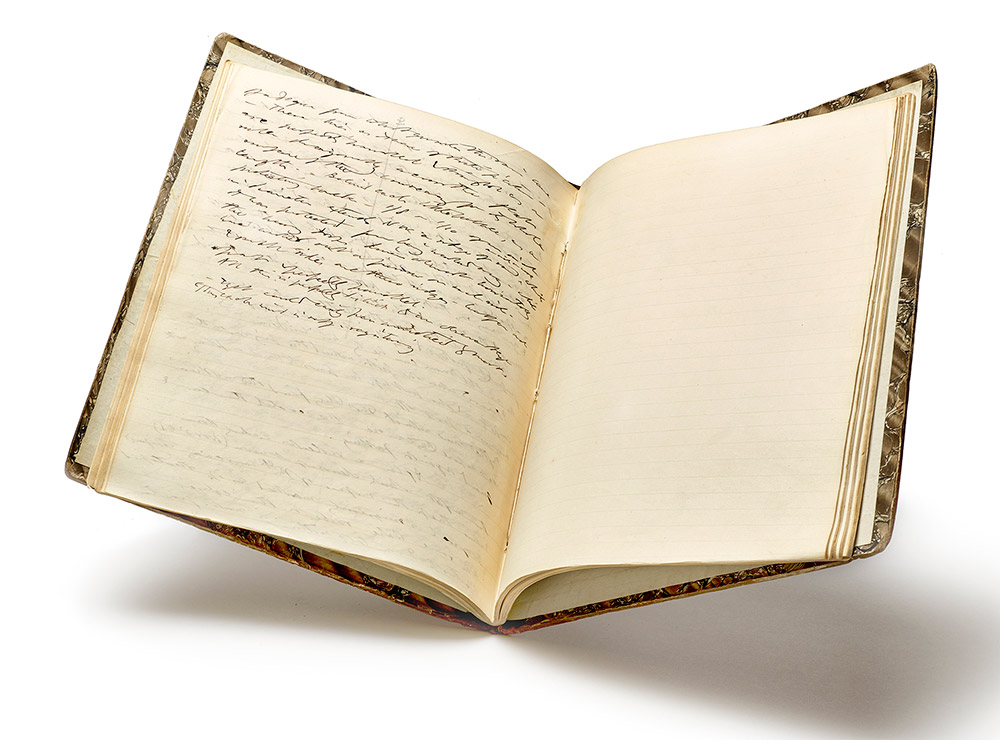
“All this is perfectly distinct to an observant eye, and yet could easily pass unnoticed by most. Thus each wind is self registering.” Henry D. Thoreau’s final journal entry, dated November 3, 1861. The Morgan Library & Museum; purchased by Pierpont Morgan, 1909.
What is remarkable, to me at least, is how the in inventions of Thoreau persist, both in the scholarly and the cultural spaces in which these versions of Thoreau appear. Perhaps Laura’s story–sharply detailed, sensitive, alive–will do its little part in reanimating a more holistic vision of our place in the world. Thoreau saw, Laura notes,
the end of one geological epoch and the beginning of the next, and the unease he felt is rampant today, infecting the headlines and blocking our own imagination of the future he believed he was helping to realize. Thoreau could see the ground was shifting, and, in the sheer audacity of his genius, he decided it was up to him to witness the change and alert the world.
As Thoreau is reported by his sister Sophia to have said on his deathbed, at forty-four years of age, “Now comes good sailing.”
Among the enduring privileges of professing college English is designing opportunities for students to discover through their studies possibilities in their lives that might not otherwise have presented themselves were they not in school.
Recently three of my former students, and a KSC graduate and collaborator, have been appeared in College publications. While I am not able to to credit for the trajectories of these amazing people it feels good to know where they are, what they are doing, and knowing that what they are doing they are doing well.
Lilly Goldberg is Gala and Membership Associate, at the National Portrait Gallery in the Smithsonian Institution, Washington, DC. An alumni note Following the Path with Passion appeared on the Keene State College Academics web page.
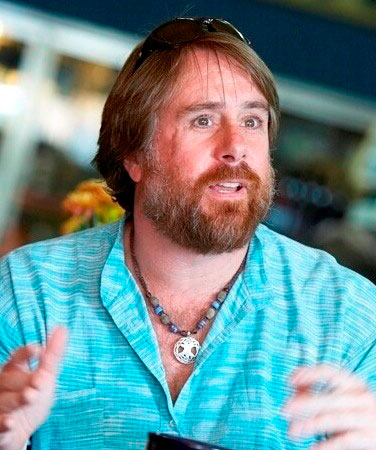
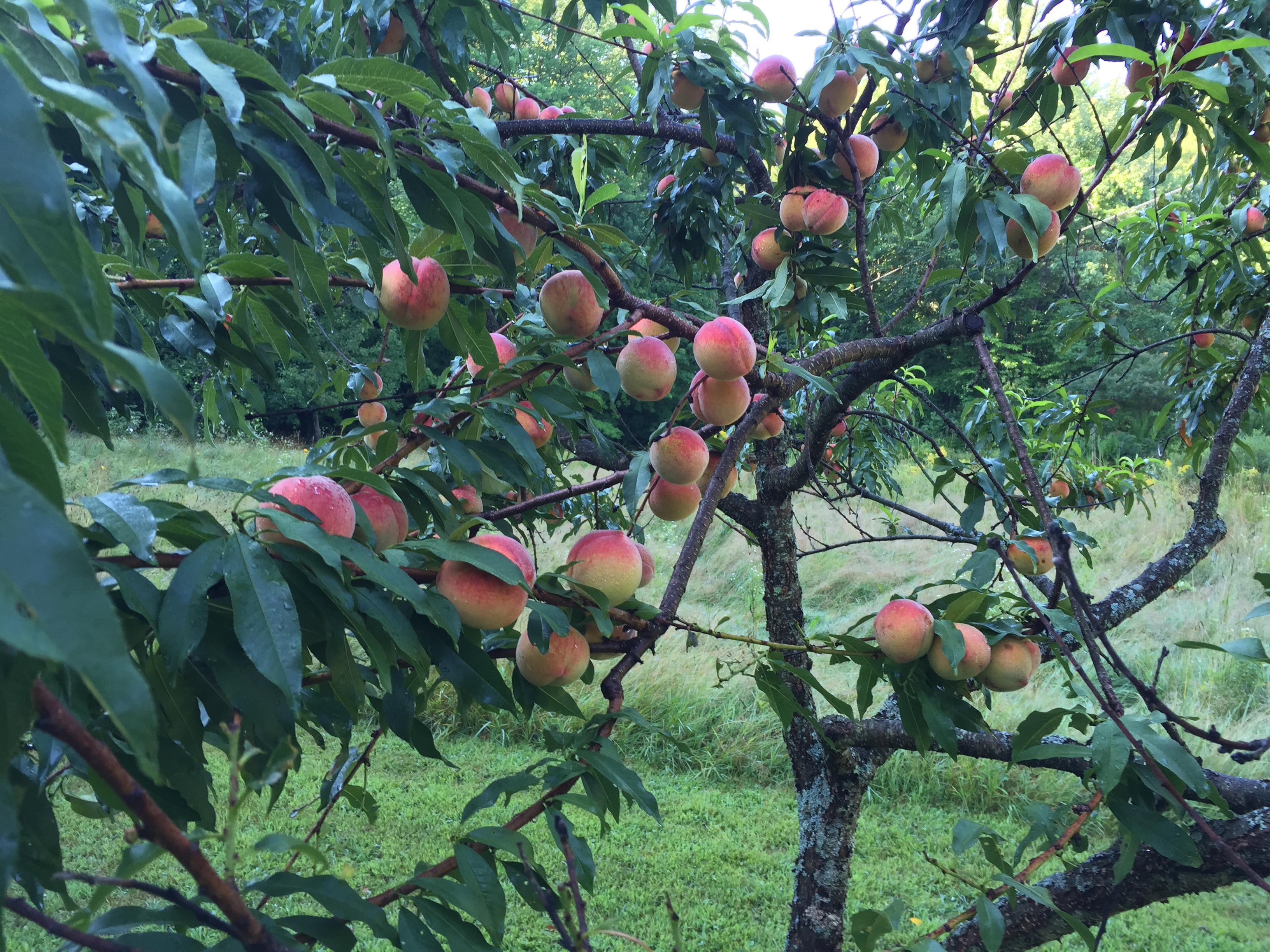
Clai Lasher Sommers is the owner of New Dawn Farm in Westmoreland, New Hampshire. The story Poetry and Farming appeared this past spring.
One of my current preoccupations as the Director of the Integrative Studies program is thinking about the common elements of a baccalaureate degree. And it is a good thing, too, for when I began my three-year term as Director this past fall my charge included overseeing the largest academic program at the College, working with colleagues to improve the Program, and envisioning what the Program might be.
Many institutions of higher education, including Keene State, require students to take courses that are, by design, not a part of their professional aspirations or vocational goals. The idea behind these course general requirements goes back to the historical Socrates in Athens, as well as Seneca and the Stoics in ancient Rome. In the words of Martha Nussbaum, the idea of a liberal education involves literacy, including cultural literacy, to “make the mind more subtle, more rigorous, more active,” and the idea of access, so that “in this messy, puzzling, and complicated world,” all citizens are empowered “to question everyone, recognizing everyone’s humanity.”
The classical ideas that underpin a liberal education in the United States include access. For in a modern democracy, a college education, in principle, should be available to all and not limited to instrumental goals: a college education, in the words of Nussbaum, should offer students “something that can impart meaning and discipline to their intellectual lives in a general way, making them both richer as individuals and better informed as citizens” (43). This is the idea behind general education.
Of course general education as we know it today is a twentieth century phenomenon. It is in part a response to the rise of the research university between 1820 and 1920 and the focus of specialized research. As Louis Menand explains in his reliable little history, The Marketplace of Ideas: Reform and Resistance in the America University (2010), one notable agent of change was Charles William Eliot who proposed that the bachelor’s degree be a prerequisite for admission to professional school. In an 1869 article in the Atlantic Monthly, Eliot write that the ideal collegiate experience would be “the enthusiastic study of subjects for the love of them without any ulterior objects.”
In the twentieth century, critics responded to what they considered pre-professional training and overspecialization, on the one hand, and the neglect of the socializing function of higher education, on the other. One response, at Columbia University, as well as at Dartmouth, Stanford, Williams, and other elite colleges, was to design courses on citizenship, a development that arose out of anxiety about the larger number of immigrants, or the children of immigrants, seeking the opportunity promised by higher education. The focus of the general education curriculum would be some version of what professors considered a common culture, again a response to the declining moral authority of traditional institutions, in the post-war period.
What has become clearer over the years is that the problem of general education is that a college’s general education curriculum, in the words of Menand, “what the faculty chooses to require of everyone, is a reflection of its overall educational philosophy.” The other part of the problem is that the curriculum is always changing in response to changes in the culture and to values that a faculty determine constitute a liberally educated person. It is no wonder that revising a general education program–as I learned as a member of the committee that designed the Integrative Studies Program in 2006–“is a labor-intensive enterprise, because general education goes to the heart of what a faculty thinks college is all about.”
It follows that the conversations I am having as Director of Integrative Studies are about education–what faculty and staff and students believe education should be. What knowledge and skills are relevant to students? What ways of thinking and knowing matter, and will matter, in the lives of our students beyond school? Many of the arguments are surprisingly simple, breaking along the lines of liberalism and professionalism, of cultivating our humanity or acquiring so-called practical professional skills.
A sensible path to thinking about general education is reading about the history of this idea about what education is–and what it ought to be. For me this reading has included Nussbaum’s 1997 classical defense of reform in liberal education, Cultivating Humanity, as well as Menand. This thinking has guided me to a number of interesting documents, including the 1945 Harvard Report on General Education. The Report describes the general abilities a student will cultivate in college–“effective thinking, communication, the making of relevant judgments, and the discrimination of values.” The committee that drafted the report then adds that these abilities will be of little use unless the student can relate this learning “to the realities of experience and practice.” This holistic view (in a charmingly antiquated title for the section) is elaborated in “The Good Man and the Citizen.”
What is remarkable is the full description of what is called in the Report “Personal Integration,” or what is called the “proper fruition” of a liberal education. Education should focus on more than “bookishness and skill in the manipulation of concepts,” the goal of what is called in the Report “specialism.” It should focus, rather, on the whole person and the cultivation of reason through what the Report calls integration. The authors note that reason is “not an activity apart, but rational guidance of all human activity. Thus the fruit of education is intelligence in action. The aim is mastery of life; since living is an art, wisdom is the indispensable means to this end.”
This is remarkable to me because about ten years ago the faculty at Keene State College voted to approve a general education curriculum that we called “Integrative Studies.” Just what we meant by integration was not especially clear–or, more precisely, it was clear but clarity was in the eye of the beholder. I recall objecting to the term at the time, in fact, arguing that the term was too abstract.
Over the past decade teaching in the Program, and helping to administer the first-year writing course that is one of the foundational courses, I have come to think that the term integration may be worth keeping around. In the revision of the ISP learning outcomes last year, we define the term as “the capacity to integrate learning within the curriculum, between the curriculum and the co-curriculum, and with communities beyond the classroom.” We go on to say that “integrative learning is both a framework for teaching and learning in all ISP courses and also a summative learning outcome for the program.”
Representation of the ISP Program, Randall Hoyt, fall of the 2016-17 academic year
Others clearly agree. As a recent National Academies of Sciences, Engineering and Medicine Report by the Board on Higher Education and Workforce suggests, it is integrating higher education in the arts, humanities, sciences, engineering, and medicine that “will enable all citizens to have enriching and meaningful life. As such, we believe that more effective integration of educational experiences in all disciplines—particularly in the arts, humanities, sciences, engineering, and medicine—will benefit all of our nation’s citizens.”
No doubt integration of disciplines and interdisciplinary fields of study is something faculty and program administrators can promote. But integration, in the end, is something our students do. Students should be able to experience the ways one course informs and deepens their learning in one or more other courses, and the ways that their learning in one or more courses is connected to their out-of-class experiences. But how exactly do we help them integrate what they are learning?
One strategy we pursued this past year was to have the students tell us. During the semester I joined with my friend and colleague Randall Hoyt, professor of Graphic Design, and his student Dylan, to interview four students about their experiences in the ISP. Our goal is to better explain the program—to faculty and staff, prospective students and families, and current students—and to empower students to make thoughtful decisions about their ISP course selections.
I had the good fortune to have a committee of faculty from across the College who are committed to the Program. The Members of the Integrative Studies Program Committee (ISPC) this past year were Mike Cullinane, QL Coordinator; Katherine Tirabassi, ITW Coordinator; Steven Harfenist, II Coordinator; Carol Leger (fall) and Bob Schauman (spring), KSCAA; Kathleen Forrister, Professional and Graduate Studies; William McCulloch, Sciences and Social Sciences; Randall Hoyt, Arts and Humanities; Elizabeth Dolinger, Library; George Smeaton, Office of Institutional Research and Assessment.
If one is interested, I include a summary that I included in my year-end report on the Integrative Studies Program. This is the work we will build on next year as we begin an institutional reorganization. One part of this reorganization is a Center for Integrative Learning in which the ISP will be housed. I am cautiously optimistic that this change will result in more faculty engagement in the ISP and more understanding among our students of the value of the ISP in their experiences as students at Keene State College.
Summary of Work
The ISPC enjoyed a productive year. Our work focused on 1) curriculum and program development; 2) aligning policies and practices; 3) communication, outreach, and promotion; 4) visibility and representation of the ISP, 5) enrollment and staffing; 6) faculty development; and 7) program assessment. The fall 2016 ISP curriculum proposal included a simplified list of ISP learning outcomes approved last year and revised (and simplified) description of the purpose and philosophy of the Program. The ISPC completed a review of ISP policies and the ISPC and the KSC Senate Executive Committee unanimously approved a revised policy document. And, in collaboration with the Office of Institutional Research and Assessment, we designed a cycle for ISP assessment that offers faculty time and space to consider what we discover in our assessments, and to consider possible changes to the ISP based on our findings. As we look ahead to 2017-18, we are hopeful that the proposed two-school administrative structure for the College will strengthen the Integrative Studies Program, and the place of integrative learning, in the undergraduate curriculum at Keene State College.
Work Accomplished
ISPC Charge Approved by the College Senate Developed in consultation with the Office of the Provost and in conversation with members of the College community. The ISPC presented the agenda items to the SEC so that the working agenda would be shared with the campus via the Senate
Submitted Program Redesign Proposal to curriculum committees and Senate Executive Committee/Academic Standards. Unanimously passed by Senate. Policy changes approved as retroactive to earlier catalog years
Drafted Statements of Roles and Responsibilities for ISP Coordinators We outline the QL, ITW and II coordinator responsibilities, subcommittee charge and responsibilities, as well as course review policies/processes. These reports will be useful for the coordinators, the associate provost and provost, as well as faculty considering serving in these roles. The reports will be reviewed and, when necessary, updated, annually. (See documents in Appendices to this Report)
Completed Comprehensive Policy Review and Update that was approved by the College Senate and made available on the Senate ISP and the ISP web sites
Revised ISP Amendment Policy The Integrative Studies Program Committee (ISPC), any faculty member(s), or academic department(s) may propose a change to the structure, principles, or policies of the Integrative Studies Program by submitting the proposed change in writing to the ISPC. The ISPC will consult with the proposal originator(s) and with the chairs of the Senate Curriculum Committee (SCC), the Standards Committee (ASC), and the Academic Policy Committee (APC) to determine an appropriate timeline for considering the proposal. The ISPC will then send the proposal to all Department Chairs for advisory opinions. After the time for departmental advisory opinions has past, the ISPC will submit the proposal with their vote and advisory opinion plus any departmental advisory opinions to the School Curriculum Committees. The School Curriculum Committees will review the proposal and forward their votes to the SCC, the ASC, the APC, and the Senate, as appropriate, for a vote
Articulated and Clarified Transfer Credits Policy The Keene State College Credit Transfer Policy allows credits to be allocated to Integrative Studies Program requirements or electives. Advanced Placement (AP) and College-Level Examination Policy (CLEP) equivalencies are available at Academic and Career Advising (ACA) web site on the “Credit by Examination” page. Other transfer credits for ISP courses are listed on the “Articulation Agreements” page. Transfer credits from institutions in the United States and at international institutions are listed on the “Transfer Credits” page. Study-Away credits may be used to fulfill one upper-level ISP course with the approval of the Director or Associate Director of the Global Education Office (GEO)
Completed a Successful Search for a Coordinator of Integrated Thinking and Writing The committee (Mark C. Long, English (chair), Michael Cullinane, Mathematics, and Susan Whittemore, Biology, read the application materials, interviewed, and recommended hiring Irene McGarrity for a three-year term as Coordinator of ITW
Updated and Revised the ISP Document Archive on the Senate Web Site (See Appendices to this Report)
Hosted Team from Castleton University to discuss AACU Foundations, Connections, and Directions Grant with Ingrid Johnston-Robedlo, Dean of Special Academic Programs; Chris Boettcher, Associate Professor of English; Sue Generazzo, Associate Professor and chair of Math Department; Dennis Proulx, Dean of Students
Developed an ISP Advising Guide and distributed to faculty and staff. Will be distributed in subsequent semesters prior to registration period in the fall and the spring
Published Course Profiles in the Academic Affairs Newsletter: Steve Harfenist’s Physics and Music and Marcia Murdock’s Dance as a Way of Knowing
Convened Monthly Meetings with the Chair of the Senate and Attended Senate Meetings (when necessary) to clarify and strengthen alignment of ISP with existing curriculum process at the College
Conducted Video Interviews with Students and produced an ISP Promotional Video Featuring Student Sarah Dugas. During the semester Randall Hoyt, his student Dylan, and Mark Long interviewed four students about their experiences in the ISP to better explain the program—to faculty and staff, prospective students and families, and current students—and to empower students to make thoughtful decisions about their ISP course selections.
Meetings with Working Groups on Campus to develop collaborative models with academic and co-curricular groups, college-wide learning outcomes, the Center for Creative Inquiry (CCI), Living Learning Communities (LLCs), Open Pedagogy Learning Community
Engaged in an Open and Integrative Project to explore ISP involvement in Open Educational Resources, Open Pedagogy, and Technology Fellow Program. Mark met monthly with Jenny Darrow, Director of Academic Technology, and the Academic Technology Steering Committee (ATSC) chair Karen Cangliosi to design a Domain of One’s Own pilot project for 2017-18. In June Mark attended the Domains 2017 Conference with Jenny and Karen in Oklahoma City.
Collaborated with Student Affairs on a Title III Grant Project that, if successful, will expand the College’s capacity to serve first-year, low-income, Pell recipients and transform the campus’s engagement with first-year students. The structured First Year Experience for entering students is designed 1) to improve academic success, 2) increase retention & graduation, and 3) enhance campus-wide community and culture
Developed a staffing plan for ITW and worked with the Director of the Honors Program, and the Academic Affairs Council to discuss feasibility and implementation in a more deliberate and effective staffing model for academic year 2017-18
Promoted Writing in the ISP and Across the Curriculum through a learning community using John Bean’s Engaging Ideas: The Professor’s Guide to Integrating Writing, Critical Thinking, and Active Learning. Kate Tirabassi and Mark Long facilitated two meetings each semester
Conducted two Workshops on Supporting Student Writers at KSC as part of the May Faculty Enrichment Day to share the work of teaching writing across the four year and sustain a collective of faculty teaching writing across the disciplines and in the disciplines. At these workshops, Kate Tirabassi and Mark Long distributed copies of Engaging Ideas, now in its second edition, a book that was developed for faculty teaching in a new core curriculum at Seattle University. We have distributed a copy of Engaging Ideas to all who attended ISP-sponsored workshops in the spring of 2016, fall of 2016, and spring of 2017
Conducted an ISP Workshop on Tuesday May 16 to review changes to the ISP and to offer faculty and staff a forum for sharing ideas about how to strengthen the Program. Part I, “Make it New: ISP Outcomes, Curriculum, Policies, Advising,” reviewed changes to the ISP in 2016-17 and offered an opportunity for faculty and staff to ask questions about the Program and to share thoughts with the ISPC as we look ahead to the 2017-18 academic year. Part II, “Looking for the ‘We’ in the ISP,” an integrative learning collaboratory, invited the fifteen faculty and staff who attended to share ideas about integrating lower- and upper-level courses, building parallel courses or course sequences that bring faculty and students together, or addressing ISP and/or college-wide learning outcomes through concurrent or sequenced courses, academic and co-curricular collaboration, team-teaching
College-Wide Learning Outcomes and the ISP Mark met monthly with Patrick Dolenc and Kim Schmidl-Gagne, and at the end of the semester with the CWLO steering committee. Mark worked with Pat and Kim to plan and present an ISP/CWLO presentation as part of the end-of-the-year Academic Affairs meeting
Developed a Three-Year Assessment Cycle for ISP Program Outcomes (See Appendices to this Report.)
Worked with George Smeaton on an Assessment of Writing Kate Tirabassi and Elizabeth Dolinger who developed a new rubric for assessing writing. Elizabeth Dolinger, Mark Long, Kate Tirabassi, and Michael Wakefield conducted a direct assessment of writing using essays from Thinking and writing.
Met with Paul Baures, Chemistry, and Renate Gebauer, Environmental Studies, and George Smeaton to discuss the National Academies of Sciences, Engineering, and Medicine report “Integrating Higher Education in the Arts, Humanities, Sciences, Engineering, and Medicine”
Developed an ISP Question for the Alumni Survey for the Keene State College class of 2015 that asks: “What experience did you have at KSC—inside or outside the classroom—that has proved most valuable for whatever you are doing now in your life?” One respondent wrote the following: “My integrated studies courses proved helpful as they gave me the generalist educational background that I need out here to teach every class”
Meeting with Faculty Participants in the Undergraduate Research and Creative Endeavors (URCE) Mark met with faculty in the summer 2017 Institute to explore possible connections between URCE and the ISP
What challenges had an impact on your work this year?
The Integrative Studies Program has become central to our identity at Keene State. And yet there remains considerable concern that it isn’t “integrative” in any meaningful sense. Integrative learning is a framework for teaching and learning in all ISP courses and a summative learning outcome for the Program. The challenge for us can be stated in the form of a question: how do we create opportunities for our students to integrate learning—within the curriculum, between the curriculum and the co-curriculum, and with communities beyond the classroom?
What goals would you suggest for the next year of work in this area?
Continue ISP Visibility Project to more clearly articulate the ISP in the academic profile of the College and in the experience of our students. Continue revising and updating the ISP web pages to more directly and simply communicate values of the ISP and goals of a liberal integrative education. And develop additional short video features to capture and document how our students make the most of their ISP
Work with Dean of the Mason Library to develop a transitional plan for the ISP in the new College structure in general and the Center for Integrative Learning in particular Discussions may include writing across the ISP, the relationship between ITW and 200-, 300-, and 400-level courses, upper-level ISP courses, and “pathways minors” in the ISP
Complete a Foundational Requirements Review to address curricular and program structure of ITW and QL by engaging the ISPC in a deliberate review of the two foundational courses; write a report for the associate provost; meet with associate provost to discuss findings and possible recommendations for campus discussion, if necessary
Meet with Faculty and Staff, Program Chairs and Coordinators to gather information and perspectives on the ISP and to cultivate relationships for program-related initiatives as we transition to the new College structure
Meet with Registrar and Staff to clarify program requirements (most notably the NEASC requirement for a 40-credit program minimum) and to discuss consistency and fairness in waivers/exceptions/substitutions we approve
Meet with the Deans and the Academic Affairs Council to discuss ISP-related issues and invite deans to an ISPC meeting to discuss the program as we transition to the new College structure
Provide Guidance for Faculty in Revising Course Outcomes and facilitate the process in which each course will include the integrative learning outcome, the academic perspectives outcome, and two of the five skills outcomes
Plan Faculty Development Initiatives and set goals related to ISP faculty development across the next three years. Collaborate with Faculty Enrichment, Center for Writing, and other relevant offices/programs/groups, as needed
What challenges do you anticipate in your efforts next year?
We anticipate challenges in moving ahead with strengthening the ISP when the focus of departments and academic programs will be articulating their work within the new administrative structure. However, we remain hopeful that the proposed two-school administrative structure will strengthen the place of the Integrative Studies Program in the Center for Integrative Learning.
Do you have any other comments that might be relevant here?
We appreciate the support we have received from the Office of the Provost and the deans this year. In addition, Mark would like to express his gratitude to the members of the ISPC. Each member of the committee provided valuable input and participated in various projects and initiatives.
Respectfully submitted,
Mark
Mark C. Long
Professor of English
Director, Integrative Studies Program
From the excitement of the NAPLA project in the fall of 2016 to the challenges of the Open Space of Democracy in the spring of 2017—a year of teaching and learning on which to continue building.
In the spring of 2017 my classroom work centered on a new course for American Studies students, The Open Space of Democracy. The idea for the course emerged from a line in the amazing prose essay by the nineteenth-century writer Walt Whitman, “Democratic Vistas,” in which he writes, “democracy is a great word, whose history, I suppose, remains unwritten, because that history has yet to be enacted.”
Everything unfolded from there—and it was a good thing, too, as the very idea of democracy was once again (and remains) at stake. So my students and I got to work in January tracing Whitman’s supposition from the formative ideas about democratic culture that emerged in the United States in the nineteenth century to the debates in the twentieth century about art and public engagement that arose in response to John Dewey’s ideas about what he called “creative democracy,” in writing by Horace Kallen, Muriel Rukeyser, James Baldwin, Adrienne Rich, Terry Tempest Williams, and in recent theories and practices of socially engaged art.
The reading, class activities, and writing were guided by Terry Tempest Williams, who makes a case in The Open Space of Democracy that democracy “depends on engagement, a firsthand accounting of what one sees, what one feels, and what one thinks, followed by the artful practice of expressing the truth of our times through our own talents, gifts and vocations.” Practicing the scholarly methods humanists use to work with cultural materials, students contributed to the Aspect Magazine Project in the Keene State College archives. The students designed an individual research project using primary materials, and library-based and digital archives. This process is documented on the course site, particularly in a post from the course site, Roads to Take.
Students further developed their research experience and methods by defining, organizing, and elaborating the significance of their literary and cultural materials in the public domain by contributing to the project site Democracy + Culture.
We designed this project to make visible students thinking through the problem of defining, building, and sustaining a democratic culture, and one of the students produced a video trailer” for the course that will offer one point of inquiry into the intellectual work that I believe should be central to the public liberal arts.
Caution: students at work in the Mason Library archive at Keene State College
 The poems collected in Felicity are songs of extravagance and possibility— and their opinions and persuasions have designs on the reader. The title of the first section, “The Journey,” and the epigraph from Rumi, “You broke the cage and flew,” suggest what will follow. In “The World I Live In,” Oliver writes, “I have refused to live / locked in the orderly house of / reasons and proofs. / The world I live in and believe in / is wider than that” (11). In “Leaves and Blossoms along the Way,” Oliver challenges her readers to live and believe in this wider world. “To understand many things you must reach out / of your own condition,” she insists (18). And in the final line of “Whistling Swans” Oliver explains to her readers her hope that in reaching out a person can become open to a world of possibilities beyond the self: “So listen to them and watch them, singing as they fly. / Take from it what you can” (29). These poems, like so many Oliver has shared with her readers over the years, offer invitations, or opportunities, to reach beyond the self, wherever one might happen to be.