Ralph Waldo Emerson

Every detachment prepares a new detachment. Of course, prophecy becomes habitual and reaches all things. Having seen one thing that was firmament enter into the kingdom of growth, the conclusion is irresistible, there is no fixture in the Universe. Everything was moved, did spin, and will spin again. This changes once and for all his view of things. Hint of dialectic: Things appears as seeds of an immense future. Whilst the dull man seems to himself always to live in a finished world, the thinker always finds himself in the early stages; the world lies up to him in heaps and gathered materials;—materials of a structure that is yet to be built.

from “The Relation of Intellect to Natural Science” (1848)

Few men know how to take a walk. The qualifications of a professor are endurance, plain clothes, old shoes, an eye for nature, good humor, vast curiosity, good speech, good silence, and nothing too much. If a man tells me he has an intense love of nature, I know, of course, that he has none. Good observers have the manner of trees and animals, their patient good sense, and if they add words, ‘tis only when words are better than silence. But a loud singer, or story teller, or vain talker profanes the river and the forest, and is nothing like so good company as a dog.

from “Country Life” (1858)

Last week I received in the mail  “The Best Read Naturalist”: Nature Writings of Ralph Waldo Emerson, edited by Michael Branch and Clinton Mohs. When I was asked to review the manuscript of this book for the University of Virginia Press, I was teaching the biologist E. O. Wilson’s The Meaning of Human Existence (2014). Reading Emerson and Wilson I was intrigued by the congruence between the questions both authors are asking. “Does humanity have a special place in the Universe? What is the meaning of our personal lives? Where are we going? Why?” These are Wilson’s questions, presented in the spirit of reasoning about what he calls “the relation between science and humanities.”

It strikes me that this is precisely the line of reasoning that Emerson enacted with his audiences in the lyceum. Branch and Mohs build on this connection between Emerson’s fascination with natural science and his humanistic exploration of our place in the world, arguing that Emerson “illuminates the importance of nineteenth-century natural science to the evolution of American ideas about the environment” (ix). For example, in one of the talks included in this anthology, “Humanity of Science” (1836), Emerson writes, “In a just history, what is the face of science? What lesson does it teach? What wisdom will a philosopher draw from its recent progress?” (140). This series of questions offers teachers and students access to Emerson’s engagement with the social and cultural history of natural science.

As it happens, about the same time I read the manuscript of “The Best Read Naturalist” a student showed up in one of my classes prepared to talk about an essay by Emerson. The student raised his hand. He then asked a question. “How do I begin to talk about the essay when I have highlighted every word in the opening paragraph?”

This is the same student who, in an essay I had asked him to write on his experiences with reading and writing in school, described his belief that the purpose of the academic essay “is to break the illusion of false knowledge.” He then pointed out, “of course essays are assigned so teachers can assess a student’s understanding, but they also allow students to assess their own understanding. For me,” he concluded, “the written word has become a way to audit my thoughts from a neutral point of view so that I may realize the flaws of my thought process.”

Then, a few weeks later, we read Emerson’s essay “Illusions” from The conduct of Life:

There are as many pillows of illusion as flakes in a snow-storm. We wake from one dream into another dream. The toys, to be sure, are various, and are graduated in refinement to the quality of the dupe. The intellectual man requires a fine bait; the sots are easily amused. But everybody is drugged with his own frenzy, and the pageant marches at all hours, with music and banner and badge.

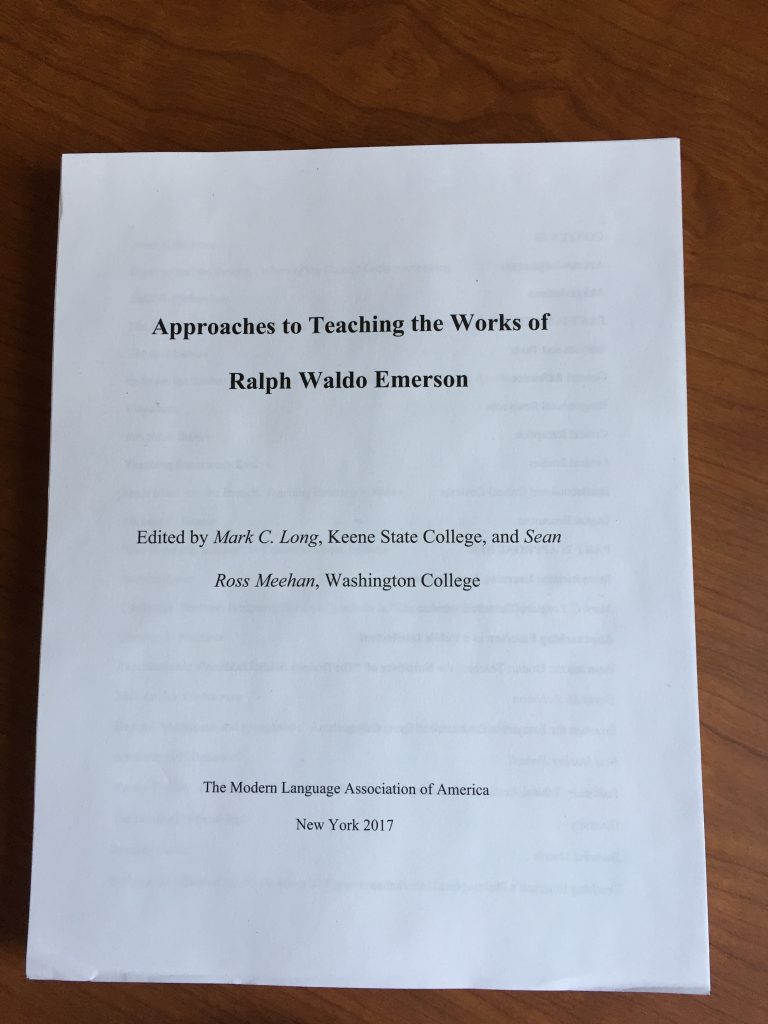
In the introduction to the book I recently co-edited with a colleague who teaches at Maryland’s Washington College, Sean Meehan, Approaches to Teaching the Works of Ralph Waldo Emerson, we remind our readers that ever since F. O. Matthiessen made him a founding figure of the “American Renaissance,” Emerson has remained a staple of undergraduate surveys in American literature and seminars on the “Age of Emerson.” We go on to describe the wide-ranging global, not just national, presence of Emerson’s writing, across the Atlantic and around the world. Our collection of essays demonstrate the multiple ways contemporary students encounter Emerson’s works—in courses on Transcendentalism, Romanticism, environmental literature, literary theory and philosophy, rhetoric and composition, media studies, and genre courses in poetry and the essay, and in upper-level seminars.
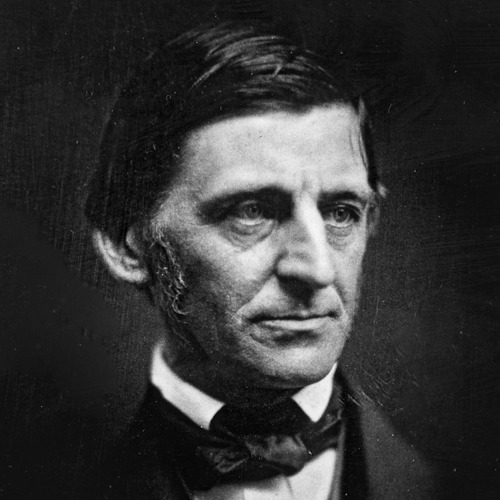
Not only was Emerson a leading figure of American Transcendentalism and transatlantic Romanticism, prominent nineteenth-century poet and literary mentor. For he is one of America’s greatest essayist, and students frequently encounter his writing alongside Henry David Thoreau, Walt Whitman, Emily Dickinson, Friedrich Nietzsche, William James, James Baldwin, Wallace Stevens, Robert Frost, Ralph Ellison, Mary Oliver, and Annie Dillard, to name a few. Emerson was also America’s first public intellectual. His addresses, essays, and poems were deeply engaged with the social and political issues of nineteenth-century America.

Teaching a seminar on Emerson, and working on our forthcoming book, I found myself spending more time with Emerson’s writing. Work had just been completed on the ten-volume scholarly edition of all of Emerson’s works published in his lifetime and under his supervision, The Collected Works of Ralph Waldo Emerson. The culmination of a half-century of vigorous textual editing, I now had access to the full range of Emerson’s writing and thinking. The publication of this textual scholarship—beginning with The Early Lectures of Ralph Waldo Emerson, the sixteen volumes of The Journals and Miscellaneous Notebooks, extending to The Complete Sermons, The Poetry Notebooks, The Topical Notebooks, the four-volume supplement to The Letters of Ralph Waldo Emerson and The Selected Letters, Emerson’s Antislavery Writings, The Later Lectures and Selected Lectures—reintroduced me to Emerson and to the ways that Emerson worked and thought through his ideas in the medium of writing.

Approaches to Teaching the Works of Ralph Waldo Emerson recognizes Emerson’s continuing presence in the curriculum and offers instructors a pedagogical resource to guide and inspire the teaching of Emerson. The Table of Contents for the book that will be published later this year offers a preview of the contexts and the range of scholars engaged with Emerson’s work.


PART 1: MATERIALS

Editions and Texts
General Reference
Biographical Resources
Critical Reception
Critical Studies
Intellectual and Critical Contexts
Digital Resources

PART 2: APPROACHES

Introduction: Learning from Emerson
 Mark C. Long and Sean Ross Meehan


Approaching Emerson as a Public Intellectual


Emerson the Orator: Teaching the Narratives of “The Divinity School Address” David M. Robinson


Emerson the Essayist in the American Essay Canon 
Ned Stuckey-French


Politically Ethical Aesthetics: Teaching Emerson’s Poetry in the Context of U.S. Diversity
 Saundra Morris


Teaching Emerson’s Philosophical Inheritance Susan L. Dunston

Emerson and the Reform Culture of the Second Great Awakening Todd H. Richardson

The Turbulent Embrace of Thinking: Teaching Emerson the Educator Martin Bickman


Emerson the Author: Introducing the Collected Works of Ralph Waldo Emerson into the Classroom
 Ronald A. Bosco


Teaching Emerson’s Essays


Once More into the Breach: Teaching Emerson’s Nature
 Michael P. Branch


“The American Scholar” as Commencement Address
 Andrew Kopec


The Divine Sublime: Educating Spiritual Teachers in “The Divinity School Address” Corinne E. Blackmer


Experimenting with “Circles”
 Nels Anchor Christensen


Beyond “mendicant and sycophantic” Reading: Teaching the Seminar “Studies in American Self-Reliance”
 Wesley T. Mott


The Ideals of “Friendship”
 Jennifer Gurley


In Praise of Affirmation: On Emerson’s “Experience” Branka Arsić

Teaching Emerson’s Other Works


Emerson in the Nineteenth-Century Poetry Course
 Christoph Irmscher


Teaching Emerson’s Antislavery Writings 
Len Gougeon


Approaching the Practical Emerson through the Sermons and the Early Lectures Carolyn Maibor


Emerson, Gender, and the Journals 
Jean Ferguson Carr


A Natural History of Intellect? Emerson’s Scientific Methods in the Later Lectures Meredith Farmer


Emerson Across the Curriculum


“These Flames and Generosities of the Heart”: Emerson in the Poetry Workshop Dan Beachy-Quick


Between the Disciplines and Beyond the Institution: Emerson’s Environmental Relevance
 T.S. McMillin


Emerson in Media Studies and Journalism
 David O. Dowling


Emerson and the Digital Humanities
 Amy Earhart


Emerson Around the World

Emerson’s Transatlantic Networks Leslie Elizabeth Eckel

Translating the Latin American Emerson Anne Fountain

Emerson and Nietzsche Herwig Friedl

Emerson in the East: Perennial Philosophy as Humanistic Inquiry John Michael Corrigan
Days in the Open

I am becoming increasingly aware of a conversation that I did not know I was a part of. Or perhaps it is that I am finding my way through what I am doing to a conversation. And I am thinking of the “unending conversation” Kenneth Burke describes in his 1941 book The Philosophy of Literary Form:

Imagine that you enter a parlor. You come late. When you arrive, others have long preceded you, and they are engaged in a heated discussion, a discussion too heated for them to pause and tell you exactly what it is about. In fact, the discussion had already begun long before any of them got there, so that no one present is qualified to retrace for you all the steps that had gone before. You listen for a while, until you decide that you have caught the tenor of the argument; then you put in your oar. Someone answers; you answer him; another comes to your defense; another aligns himself against you, to either the embarrassment or gratification of your opponent, depending upon the quality of your ally’s assistance. However, the discussion is interminable. The hour grows late, you must depart. And you do depart, with the discussion still vigorously in progress.

The conversation is about teaching and learning. Although the quaint parlor I am asked to imagine is now a stream of thought made possible by digital networks.

51fpky2zjsl-_sx336_bo1204203200_After a conversation about openness and education the other day with my friends and colleagues Jenny and Karen, for some reason a book on my shelf caught my eye—a collection of essays by Doug Robinson, A Night on the Ground, A Day in the Open. As it happens, Doug’s writings from the 1970s include “Running the Talus,” an essay that was profoundly inspiring for a young man exploring the valleys and high peaks of California’s Sierra Nevada.

(Cover art: Lake Basin the High Sierra, Color Woodblock Print, Chiura Obata, 1930)


But Doug’s words bring back more than just adrenaline-fueled days in the mountains before this twenty-something mountaineer headed off to try school—those hundreds of peaks climbed, twenty-pitch days on a granite wall, day-long trans-Sierra runs, high mountain traverses, deep powder days, and backcountry ski descents.

2

In the mid 1990s I became interested in more visible (open?) teaching and learning. Reading a Report published by the Modern Language Association published the year I completed graduate school, making-faculty-work-visible , led to a series of attempts to come to terms with the surprising ways that academic disciplines diminish the value of teaching and pedagogy. I presented three talks on making teaching and learning more visible: in 2001 in New Orleans, “Pedagogy in the Public Domain,” in Chicago, “Open Pedagogy and the Public,” and in New York, “Narratives from the First Year: a Plea for Visibility.”

img_0960

Looking back, I see myself groping toward an understanding of (and a mild impatience with) teaching as a mostly privatized practice. When I returned from a sabbatical in India, these interests emerged in my scholarship, specifically in an essay I wrote as a guest editor to a special issue of the  journal Pedagogy, Centers and Peripheries, and in my teaching, as I began experimenting with opening up my classroom. Inspired by my friend and collaborator Sean Meehan, notably his dynamic teaching blog Comp|Post, I put my course syllabi and materials on the open-source platform Word Press.

As a result, all of the writing in my courses was visible. Everyone—the writer, the teacher, the classmates, and anyone else who might be interested—had access to the intellectual work of a college professor and students in the classroom. Sean also helped me to see a course not only as open, but also as an ongoing project. Each course would frame the core questions and problems that arise in the study of what I was teaching. The course process—the materials, my teaching, student learning, and the writing they produce—would be visible for anyone who might be interested. Students could see what their peers were doing. And the materials the students were producing would persist.

I began teaching differently in the open as well. I found myself writing on the course blog before class sessions, preparing myself for my time with students, thinking aloud and modeling for students forms of thinking and writing I want them to do. Following class sessions, I was writing as well—reflecting on the intellectual work of the students, making new connections, and openly processing my way to the next class session.

This pedagogical emphasis on process—and on sustaining thought so that students have the time to struggle through the process of formulating and developing their thinking—led me to us more sustained intellectual projects that allow students to experiment with writing conventions while developing (and claiming) their emerging voice. Students were reading books in my classes, as always—the real books that need to be read and that I was trained to teach. But students were also reading on web-based portals, repositories, and archives. My students were making use of web-based resources, from writing guides and handbooks to digital archives, such as Calisphere, the Walt Whitman Archive, the Digital Public Library of America (DPLA), NICHE: Network in Canadian History & Environment / Nouvelle initiative canadienne en histoire de l’environnement.


3

I drove down the Freeway
And turned off at an exit
And went along a highway
Til it came to a sideroad
Drove up the sideroad
Til it turned to a dirt road
Full of bumps, and stopped.
Walked up a trail
But the trail got rough
And it faded away—
Out in the open,
Everywhere to go.

—Gary Snyder, from Left Out in the Rain

In 2010 I wrote Professors, Students, Blogs that described my use of blogs for teaching. In addition to Sean, I was inspired by a former colleague who keeps one of the most consistently interesting blogs on planet earth, Hoarded Ordinaries. Lorianne inspired me to use a blog in the way I am right now: making visible my intellectual work professing at a public liberal arts college.

img_1007And I was learning from my students. One day a graduate student stopped by my office to ask whether she might not write an essay in my American poetry class. She wanted to create a hypertext reading of a poem called “Piute Creek.” This was fifteen years ago and I did not really know what she was proposing. But without hesitation I said yes. What she made was powerful. Her work has stayed with me, though the site was built on a server that is no longer there. Another of my students, working on an individualized major in Writing in Biology, made a blog called Creative Biology. And a student doing an independent study called “The Ecology of the New England Garden” captured some of what she was doing on the blog Regional Roots.

In the spring of 2013 I wrote a blog post called Digital Compost to make visible some of the emergent technologies and their uses in literary and cultural studies. More and more, I was directing students to digital archives and repositories to access primary documents. I was sharing what was rapidly becoming available with my students who are studying at a public college that had not been able to provide access to these kinds of materials.

img_0834More and more I am spending my days in the open. My writing course Searching for Wildness was the first course that I designed to persist as an ongoing intellectual project. The course is organized around texts, questions, ideas, and histories, as all good humanities courses are. But the course is open and active. Each group of students who signs up for the class is contributing to an ongoing cultural project of understanding and making meaning.

Out in the open. Everywhere to go.

4

This past spring I designed and taught an interdisciplinary American Studies course on the natural and cultural history of California. California Dreaming focused on the natural and cultural history of California. I asked students to explore a simple question that becomes more and more interesting as you think with it: What explains California?

I borrowed the question from the journalist Phillip L. Fradkin’s book The Seven States of California: A Natural and Human History. Each student was asked to design and implement a project on the natural and cultural history of California. They were asked, first, to connect their own interests to materials in archives and on the web. Second, they organized their primary materials into that would help to explain California. They wrote essays, created Word Press, Tumblr, Wix, or other web-based sites to describe the primary materials they had gathered as a body of work–describing the objects and artifacts, making connections, and telling a story that expands and deepens our understanding of the natural and /or cultural history of California.

mcl-mammothThe students explored California through places and bioregions, individual histories and collective narratives of identity and culture, ideals, and representations. Students explored the historical myth and material reality of the Golden State through indigenous cultures and narratives of exploration; waves of immigration and demographic change; the presence of racism and multicultural history and identity; water, orange groves, and agribusiness; cities and suburbia; political corruption and capital crimes; money and Hollywood moguls; technological booms and busts; film, fiction, and fashion; popular music and poetry; sex, drugs, rock and roll; narratives of self-actualization and alienation; the emergence of surfing and skateboarding; skiing, mountaineering, and rock climbing; television, sports, and celebrity culture.

Their research projects—their answers to the question, “What is California?”—offers evidence of the generative intellectual work that is possible in the open, even in a first-year college course.

5

This summer I spent a week in Asheville, North Carolina at a course development workshop in preparation for co-teaching a multi-campus, team-taught, distance seminar in digital scholarship with professor of English Cole Woodcox from Truman State University.

img_0824

Public Access and the Liberal Arts: A Narrative History, or NAPLA, is funded by the Council of Public Liberal Arts (COPLAC), with support from the Executive Director of COPLAC, William Spellman. The course idea emerged a year earlier in a COPLAC Digital Humanities Workshop at the University of Mary Washington that brought together faculty from Keene State College, Sonoma State, University of Montevallo, USC Aiken, Midwestern State, and Truman State to design distance-learning, digital humanities courses.

img_0836Our digital humanities project is documenting the emergence of the public liberal arts. Similar to the Story Corps project started in 2003, the course is about digital storytelling and the narratives of selected COPLAC institutions. Students are capturing the stories and life experiences of students, alumni, staff and faculty, and constructing a digital resource that captures the history and the prospects of the public liberal arts. As designers and editors of the digital archives, students are deepening their own sense of place in higher education and making visible the history of the liberal arts at the institution in which they are studying.

img_0837Our primary course objective is for teams enrolled at COPLAC campuses to research and represent the histories of their local campus. The context for this research will be the 1944 G.I. Bill and public access to higher education and, later, increased public access to liberal arts education. The objectives of the course are to 1) build an online archive of oral histories by alumni, faculty, staff and current students; 2) use digital tools to produce a layered, web-based narrative that includes audio and video stories, images, maps and documentary evidence of their home campus and 3) collaborate with faculty mentors to integrate their web site projects with a main COPLAC site to make visible the story of the public liberal arts. Our vision for this public storytelling project is to offer a digital resource for current students, alumni, educators, administrators, development and admission offices, historians, archivists, and the public in general.

img_0833

Interested in knowing more? Visit the NAPLA Course Site to check in on the action. I’ll also be sharing more here as we get further along in the course. 

Environmental Humanities at Exeter

img_0916
A primary need of students and teachers alike

It began with a conversation. Jason wanted to talk over a new environmental literature course at Phillips Exeter Academy, and Mark, at the time the president of ASLE, was hoping to create new opportunities for secondary educators in our association. Two years later, twenty-five elementary and secondary school faculty gathered for the inaugural Environmental Literature Institute (ELI) at Phillips Exeter Academy in Exeter, New Hampshire. Participants from Hawaii, California, New Mexico, Georgia, New York, Vermont, New Hampshire, and Toronto, Canada, spent a week in New Hampshire developing new courses and revising curriculum for a range of secondary school settings.

We welcomed as keynote speaker and workshop leader Scott Russell Sanders, who spent a year at Phillips Exeter in 1974-75 as a Bennett Fellow. And throughout the week we were guided by the generous spirit of the late Exeter Instructor Peter Greer—whose course Literature and the Land was among the earliest environmental literature courses to be taught at the secondary school level.

img_0855
Scott Russell Sanders meets with ELI participants

Each day began with morning physical and reflective activities, including walking and running, yoga, and mountain biking. Participants then circled at the Harkness table to discuss writing by Robin Wall Kimmerer, Gary Paul Nabhan, Richard Wright, Robert Frost, and Marc Bekoff; participated in daily field sessions with the workshop leaders; and took advantage of time set aside for course and curriculum building.

The week included a series of special events as well. Scott Russell Sanders’ presented “Taking Care of Home: Sustainability on a Small Planet.” We discussed Climate change pedagogy via Skype with Stephen Siperstein, who will be joining the faculty of Choate Rosemary Hall next year. We enjoyed an evening with John Elder reading, playing music, and discussing his newest book, Picking up the Flute, at the Water Street Bookstore. And Jennifer Pharr Davis, author and 2012 National Geographic Adventurer of the Year, shared some of her experiences walking over 12,000 miles on six different continents.

img_0854
ELI gathered at the big Harkness table on the top floor of Phillips Hall

Participants considered a range of interdisciplinary and field-based pedagogies. Master teachers Scott and John shared their experiences and provided mentoring—both in the classroom and in a writing and poetry discussion at a local biodynamic farm. Clare Walker Leslie guided participants in the art of seeing nature through drawing—in the classroom, out of doors on the campus, and in the open fields of the Colby Farm. And Patrick Thomas from Milkweed Editions offered an insider’s view of the interplay between writing and publishing. ELI concluded with the participants sharing their work in progress: revised units for existing courses, new course ideas, and aspirations for interdisciplinary collaborations.

Sketching in the field at Colby Farm with the inimitable Claire Walker Leslie

ELI is committed to developing a teacher collaborative committed to developing environmental humanities at the secondary level. Our vision is to share the resources of ASLE with secondary school colleagues as well as to share the wisdom, resources, and pedagogical methods of our secondary school teachers with the members of ASLE who teach in post-secondary schools.

Jason Bremiller (Phillips Exeter), John Elder (Middlebury College), and Soctt Russell Sanders (Indiana University)

Among the goals of the 2014 ASLE strategic plan is to improve public discourse about the environment through community-based, K-12, and undergraduate programs. To this end, members of ELI received two-year memberships to ASLE, a collection of resources from Milkweed Editions, and a subscription to Orion magazine. We have also set up in the ASLE Member Community a Chatter forum designed to share resources and materials among secondary educators working in the environmental humanities. We are considering a workshop at ASLE 2017 featuring ELI alumni. And we are talking about a mentoring network for secondary school teachers as we plan for ELI 2017.

NAPLA Project

The year I began graduate school at the University of Washington the department of English began the Computer-Integrated Courses (CIC) Program. The idea was that students in 100-level writing courses would benefit from new learning technologies. From the inception of the Computer-Integrated Courses (CIC) program in 1990, the program’s philosophy was built around “the idea that the computer has become a ‘natural’ part of the reading, writing, research, and critical thinking processes.”

Meeting with co-faculty member Cole Wilcox and Project directors Jeff McClurken and Ellen Homes Pearson at a summer 2016 COPLAC Digital Research Faculty Development Seminar at the University North Carolina Asheville, North Carolina

Sixteen years later this idea continues to shape my teaching and pedagogy. In the fall of 2016 I offered a digital humanities course called “Public Access and the Liberal Arts A Narrative History.” Designed and co-taught with Dr. Cole Wilcox, professor of English at Truman State University, the course enrolled students from the University of North Carolina Asheville, The State University of New York (SUNY) Geneseo, and Keene State College.

The idea for this course was born in a COPLAC Digital Humanities Workshop at the University of Mary Washington that included faculty from Sonoma State, University of Montevallo, USC Aiken, Midwestern State, and Truman State. Our course documented the 1944 G.I. Bill and public access to higher education and, later, increasing public access to the liberal arts. The students documented the experiences of students, alumni, staff and faculty at the campuses at which they were studying and used digital technologies to capture the history and the prospects of the public liberal arts.

Keene State College story of Abby Shepherd’s project on the Women of Keene State

Our class met synchronously on Tuesday and Thursday (EST) from 2-3:20. The students worked in teams to build an online archive of oral histories by alumni, faculty, staff, and current students— layered, web-based narratives that include audio and video stories, images, maps and timelines, and documentary evidence of their home campus.

If you are interested in one version of the idea that digital technologies have become part of the reading, writing, research, and critical thinking processes, have a look at our course site, Public Access and the Liberal Arts: A Narrative History, and the Student Sites:

Foundations of Knowledge at SUNY Geneseo
UNC Asheville: An Educational Narrative
The Women of Keene State

You might also have a look at the full College Profile of Abby Shepherd.


How Not to Say Interdisciplinary

Because the literary fiction and nonfiction that I study and teach is concerned with environmental systems, the primary questions about literary production and reception that have kept professors of English busy for nearly one hundred years have become, for me at least, inextricable from complicated economic, social, and cultural activities. Though as Gregory Bateson once pointed out, our failure to relate to natural systems and processes is a product of the way we think and talk. We need alternative patterns of thinking and talking about natural and human systems, and we need new ways to teach these alternative patterns.

At the recent conference on ecocultural ethics in Goa, India, I found myself on a featured panel dedicated to the question of ecological learning. One way to define ecological learning would be to draw on Timothy Morton’s elaboration of what he calls the “ecological thought”: “The ecological crisis we face is so obvious that it become easy. . .to join the dots and see that everything is interconnected. This is the ecological thought. And the more we consider it, the more the world opens up.” As he goes on to argue, though, the ecological thought

  • “brings to light aspects of our existence that have remained unconscious for a long time; we don’t like to recall them”
  • “is about considering others, in their interests, in how we should act toward them, and in their very being”
  • “forces us to invent ways of being together that don’t depend on self interest”

This language reminds me of John Muir, in 1911, saying in My First Summer in the Sierra, that“when we try to pick out anything by itself, we find it hitched to everything else in the Universe.” Ecological learning, then, to stumble toward a more abstract formulation, is learning about what Muir call “things” and then finding that things are only really things when connected to other things.

Panel Discussion[DoPy] (9)

Fisheries biologist Aaron Salvio Lobo speaking at the session on “Ecological Learning” at the Birla Institute of Technology and Science, Goa, India

It is difficult to study and teach Rachel Carson’s Silent Spring, for instance, without addressing basic science as well as questions about science and society; there is little doubt that reading in the literature of food or animal studies without addressing the application of rapidly evolving technology would be next to impossible; and there is no question that narratives of environmental justice raise pressing moral and ethical questions by tracing the life-world consequences of rapid developments in science and technology.

These were some of the thoughts I was having as I prepared for the panel discussion in Goa. The discussion was moderated by Dr. Samhida Shikha, from Dronacharya Government College Gurgaon, and included a fisheries biologist, Aaron Salvio Lobo, an expert on waste management, Dr. Srikanth Mutnuri, a professor of ethics who teaches at a school of mining, Dr. Ajit K. Behura and an architect, environmental educator, activist, and blogger from the capital city of Panjim, Tallulah D’Silva, whose work has been recognized in the World Economic Forum’s Global Shapers Community. The audience for our session on ecological learning included members of the humanities and social sciences, from literary and cultural studies, anthropology, philosophy, religious studies, linguistics and political science.

IMG_1464

Another lovely cove and stretch of sand on the Arabian Sea

My contribution to the panel began with an anecdote about arriving in Mumbai at the beginning of this month to meet Rebecca, who had been teaching law in Pune. Gandhi Jayanti, the national holiday, was in full swing, and Prime Minister Modi happened to be using the occasion to kick off his Swachh Bharat Campaign. What followed were days of editorial and public commentary in the Times and in Goa periodicals and online about the clean India campaign. In Goa, one headline read “Desi tourists leave behind uncivil footprints,” and the it-is-the-other-guy’s-problem excuse was once again registered. “Calangute and Baga beaches witness trail of broken bottles and garbage: visibility upset, Calangute MLA Michael Lobo has accused the tourism department of not being serious enough to tackle the problem.” Remarkably, I noted, one person from out of state when interviewed complained of the lack of warning or display boards regarding the disposal of trash and bottles on the beach. “I don’t see a single warning signboard so it is no use blaming us tourists.” Enough said.

I then offered a case study of Keep America Beautiful (founded 1953), the largest community improvement organization in the United States, that was formed in response to the problem of highway litter that followed the construction of the Interstate Highway System and an increasingly mobile and convenience-oriented American consumer in the middle decades of the twentieth century. I traced the Keep America Beautiful organization joining with the Ad Council in 1961; the subsequent 1971Earth Day theme, “People Start Pollution. People can stop it,” featuring the well-known (and problematic) “Crying Indian” campaign launched on Earth Day, narrated by actor William Conrad, and featuring “Iron Eyes Cody,” the Native American man (who was actually an Italian) devastated to see the destruction of the earth’s natural beauty caused by the thoughtless pollution and litter of a modern society). In 1975 the “Clean Community System”  led to the “Keep My Town Beautiful” organization and the more recent “Great American Cleanup” campaigns that have organized 3.9 million volunteers who have removed seventy-six million pounds of litter and recycled hundreds of millions of pounds of metals, newsprint, tires and electronics.

While noting the fundamental historical and cultural differences with the Modi campaign, I admitted that the anecdote offered some hope for those who are rightly cynical of centralized campaigns for “cleanliness” linked to patriotism and political parties. Still, the narrative from the 1950s to the present in the US offers a complex of motivations and investments that contributed to changing the behavior of people as part of a social movement. The question I posed is how academic disciplines and institutions of higher education prepare students to participate throughout their lives in the practice of what the panel was calling ecological learning.

IMG_1493

Our lovely friends, thoughtful colleagues and generous hosts in Goa, Rayson Alex and Susan Deborah

Listening to my colleagues, and participating in the lively audience give and take that followed in the hour we had reserved for discussion, I realized how challenging it is to free ourselves from the terminological moraines. These jumbled piles of words and phrases make it difficult to enact the necessary changes in teaching and learning that would be commensurate with the environmental predicament. What was refreshing for me was that the discussion with my Indian colleagues unfolded without the use of any of the terms so common in the discourse of American academics, terms such as “interdisciplinary,” “multidisciplinary,” “transdisciplinary.” Rather, my Indian friends and colleagues were focused on practice. They were talking about thereal work.

IMG_1379

Rhetorical and social engineering in the park, Panjim, Goa

Since arriving back in the United States this panel discussion has stayed with me. And I have been thinking more about the terms we use to define what we do and that we deploy to stake out our place in the enterprise of higher education. It is my good fortune to be a member of a faculty that offers courses, minors and degree programs in what we call “interdisciplinary fields of study.” These include American Studies, Criminal Justice Studies, Environmental Studies, Holocaust and Genocide Studies, Women’s and Gender Studies. Over the years, I have taught courses in three of these “fields” (American Studies, Environmental Studies, Women’s and Gender Studies) and have given much thought to the approaches taken to the various subjects, materials, and topics within these fields.

The self-evident fact that knowledge about our selves and the world, to use the commonplace jargon often used academic circles, is “constructed”  often devolves into abstract and decontextualized conversations about the knowledge and methods of academic disciplines or “interdisciplinary” fields of study or “multidisciplinary” modes of teaching and learning. The consequence is that the questions that structure the intellectual work in our colleges and universities (for professors and for students) become less salient or, arguably, less relevant—particularly in public discourse where facts are bound to be uncertain, values are disputed, and the stakes are high.

I am most grateful to my colleagues in India for helping me to think though my own evolving approach to the study, teaching, and learning as a literary and cultural historian. The term that appears most aligned with my practice as a thinker and teacher is “transdisciplinarity.” A sabbatical leave offers the necessary time and space to reflect on one’s ongoing work as a reader, writer and teacher. And among the most fruitful set of ideas for my reflections this year has been the thinking of Basarab Nicolescu—in particular, his Manifesto of Transdisciplinarity, trans K. Claire Voss (Albany: State University of New York Press, 2002). A useful précis of the manifesto is available in the “Charter of Transdisciplinarity” that has its origins in the First World Congress of Transdisciplinarity convened in 1994 in Convento da Arrábida, Portugal. The document, produced by the editorial committee comprised of Lima de Freitas, Edgar Morin, and Basarab Nicolescu, has 15 articles, as well as a Preamble, that reads as follows:

·      Whereas, the present proliferation of academic and nonacademic disciplines is leading to an exponential increase of knowledge which makes a global view of the human being impossible;

·      Whereas, only a form of intelligence capable of grasping the cosmic dimension of the present conflicts is able to confront the complexity of our world and the present challenge of the spiritual and material self-destruction of the human species;

·      Whereas, life on earth is seriously threatened by the triumph of a techno-science that obeys only the terrible logic of efficacy of efficacy’s sake;

·      Whereas, the present rupture between increasingly quantitative knowledge and increasingly impoverished inner identity is leading to the rise of a new brand of obscurantism with incalculable social and personal consequences;

·      Whereas, an historically unprecedented growth of knowledge is increasing the inequality between those who have and those who do not, thus engendering increasing inequality within and between the different nations of our planet;

·      Whereas, at the same time, hope is the counterpart of all the afore-mentioned challenges, a hope that this extraordinary development of knowledge could eventually lead to an evolution not unlike the development of primates into human beings;

One cannot help but admire the ambitious and hopeful language of this manifesto. My admiration, however, is precisely how the language links the abstractions of knowledge production to the material (and ideological) planetary concerns of the present. What is really remarkable, though, is that this heady rhetoric allows for both a generative acceptance and skepticism about knowledge and power, a finely aware register of social and environmental equity and justice, and an inclusive acceptance of the human in the words “cosmic” and “spiritual.” Just how these ideas might shape one’s day-to-day work is a challenge to be sure. But the challenge might help to put the words we use to describe teaching and learning in our colleges and universities to more consequential work—words such as “integrative,” “interdisciplinary,” and “multidisciplinarity—by envisioning a transformation of both our knowledge-seeking methods and the institutions that sponsor our ongoing search.

This was my ambition in India, after all: to imagine with my colleagues practical projects for individual and collaborative inquiry that would in turn expand the scope of conventional pedagogical theory and practice. Perhaps a moratorium on any word that builds off the term “discipline” would offer a glimpse of something more.